
Return to Elementary Literature 7
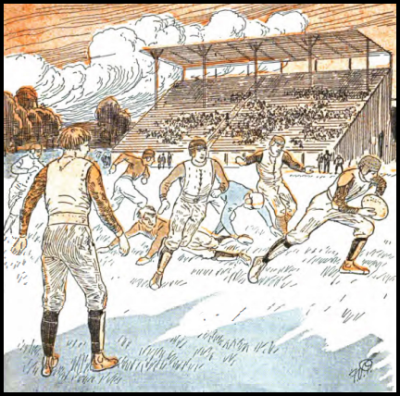
The house championships had gone on until the Woodhull and the Kennedy emerged for the final conflict. The experience gained in these contests, for on such occasions Stover played with his House team, had sharpened his powers of analysis and given him a needed acquaintance with the sudden, shifting crises of actual play.
Now, the one darling desire of Stover, next to winning the fair opinion of his captain, was the rout of the Woodhull, of which Tough McCarty was the captain and his old acquaintances of the miserable days at the Green were members—Cheyenne Baxter, the Coffee-colored Angel, and Butsey White. This aggregation, counting as it did two members of the ‘Varsity, was strong, but the Kennedy, with P. Lentz and the Waladoo Bird and Pebble Stone, the Gutter Pup, Lovely Mead, and Stover, all of the scrub, had a slight advantage.
Stover used to dream of mornings, in the lagging hours of recitation, of the contest and the sweet humiliation of his ancient foes. He would play like a demon, he would show them, Tough McCarty and the rest, what it was to be up against the despised Dink Stover—and dreaming thus he used to say to himself, with suddenly tense arms:
“Gee, I only wish McCarty would play back of the line so I could get a chance at him!”
But on Tuesday, during the ‘Varsity practice, suddenly as a scrimmage ended and sifted open, a cry went up. Ned Banks, left end on the ‘Varsity, was seen lying on the ground after an attempt to rise. They gathered about him with grave faces, while Mr. Ware bent over him in anxious examination.
“What is it?” said the captain, with a serious face.
“Something wrong with his ankle; can’t tell yet just what.”
“I’ll play Saturday, Garry,” said Banks, gritting his teeth. “I’ll be ready by then. It’s nothing much.”
The subs carried him off the field with darkened faces—the last hopes of victory seemed to vanish. The gloom spread thickly through the school; even Dink, for a time, forgot the approaching hour of his revenge in the great catastrophe. The next morning a little comfort was given them in the report of Doctor Charlie that there was no sprain but only a slight wrenching, which, if all went well, would allow him to start the game. But the consolation was scant. What chance had Banks in an Andover game? There would have to be a shift; but what?
The captain, looking indeed very serious, arrived, surveyed the group and called Stover out. Dink, surprised, jumped up, saying:
“You want me, sir?”
“Yes.”
Cockrell put his arm under Stover’s and quietly drew him away.
“Stover,” he said, “I’ve got bad news for you.”
“For me?”
“Yes. I’m not going to let you go into the Woodhull game this afternoon.”
Stover received the news as though it had been the death of his entire family, immediate and distant. His throat choked, he tried to say something and did not dare trust himself.
“I’m sorry, my boy—but we’re up against it, and I can’t take any risks now of your getting hurt.”
“It means the game,” said Dink at last.
“I’m afraid so.”
“We’ve no one to put in my place—no one but Beekstein Hall,” said Stover desperately. “Oh, please, sir, let me play; I’ll be awfully careful. It’s only a House game.”
“Humph—yes, I know these House games. I’m sorry, but there’s no help for it.”
“But I’m only a scrub, sir,” said Stover, pleading hard.
“We’re going to play you at end,” said Cockrell suddenly, seeing he did not understand, “just as soon as we have to take Banks out; and Heaven only knows when that’ll be.”
Dink was aghast.
“You’re not going—you’re not going—” he tried to speak and stopped.
“Yes, we’ve talked it over and that seems best. . . .”
“Oh, but I’m so light.”
The captain watched the terror-stricken look in his face and was puzzled.
“What’s the matter! You’re not getting shaky?”
“Oh, no, sir,” said Dink, “it’s not that. It—it seems so awful that you’ve got to put me in.”
“You’re better, my boy, than you think,” said Cockrell, smiling a little, “and you’re going to be better than you know how. Now you understand why you’ve got to keep on the sidelines this afternoon. You’re too fragile to take risks on.”
“Yes, I understand.”
“It comes hard, doesn’t it?”
“Yes, sir, it does, very hard.”
When the Kennedy and the Woodhull lined up for play an hour later, little Pebble Stone was at end in place of Stover, who watched from his post as linesman the contest that was to have been his opportunity. He heard nothing of the buzzing comments behind, of the cheers or the shouted entreaties. Gaze fixed and heart in throat, he followed the swaying tide of battle, imprisoned, powerless to rush in and stem the disheartening advance.
The teams, now more evenly matched, both showed the traces of tense nerves in the frequent fumbling that kept the ball changing sides and prevented a score during the first half.
In the opening of the second half, by a lucky recovery of a blocked kick, the Kennedy scored a touchdown but failed to kick the goal, making the score four to nothing. The Woodhull then began a determined assault upon the Kennedy’s weak end. Stover, powerless, beheld little Pebble Stone, fighting like grim death, carried back and back five, ten yards at a time as the Woodhull swept up the field.
“It’s the only place they can gain,” he cried in his soul in bitter iteration.
He looked around and caught the eye of Captain Cockrell and sent him a mute, agonizing, fruitless appeal.
“Kennedy’s ball,” came the sharp cry of Slugger Jones, the umpire.
Dink looked up and felt the blood come back to his body again—on the twenty-five-yard line there had been a fumble and the advance was checked. Twice again the battered end of the Kennedy was forced back for what seemed certain touchdowns, only to be saved by loose work on the Woodhull’s part. It was getting dark and the half was ebbing fast—three minutes more to play. A fourth time the Woodhull furiously attacked the breach, gaining at every rush over the light opposition, past the forty-yard line, past the twenty-yard mark and triumphantly, in the last minute of play, over the goal for a touchdown. The ball had been downed well to the right of the goal posts and the trial for goal was an unusually difficult one. The score was a tie, everything depended on the goal that, through the dusk, Tough McCarty was carefully sighting. Dink, heartbroken, despairing, leaning on his linesman’s staff, directly behind the ball, waited for the long, endless moments to be over. Then there was a sudden movement of McCarty’s body, a wild rush from the Kennedy and the ball shot high in the air and, to Stover’s horror, passed barely inside the farther goalpost.
“No goal,” said Slugger Jones. “Time’s up.”
Dink raised his head in surprise, scarcely crediting what he had heard. The Woodhull team were furiously disputing the decision, encouraged by audible comments from the spectators. Slugger Jones, surrounded by a contesting, vociferous mass, suddenly swept them aside and began to take the vote of the officials.
“Kiefer, what do you say?”
Cap Kiefer, referee, shook his head.
“I’m sorry, Slugger, it was close, very close, but it did seem a goal to me.”
“Tug, what do you say!”
“Goal, sure,” said Tug Wilson, linesman for the Woodhull. At this, jeers and hoots broke out from the Kennedy.
“Of course he’ll say that!”
“He’s from the Woodhull.”
“What do you think!”
“Justice!”
“Hold up, hold up, now,” said Slugger Jones, more excited than anyone else. “Don’t get excited; it’s up to your own man. Dink, was it a goal or no goal?”
Stover suddenly found himself in a whirling, angry mass—the decision of the game in his own hands. He saw the faces of Tough McCarty and the Coffee-Colored Angel in the blank crowd about him and he saw the sneer on their faces as they waited for his answer. Then he saw the faces of his own teammates and knew what they, in their frenzy, expected from him.
He hesitated.
“Goal or no goal?” cried the umpire, for the second time.
Then suddenly, face to face with the hostile mass, the fighting blood came to Dink. Something cold went up his back. He looked once more above the riot, to the shadowy posts, trying to forget Tough McCarty, and then, with a snap to his jaws, he answered:
“Goal.”
—From The Varmint
Questions for Study
- What do you especially like about Stover? What do you think of his reasons for wanting to beat the Woodhull? Why was his temptation so unusually hard? What do you think the Kennedy boys said and did afterward?
- Judging merely from this sketch, what do you expect Stover to do in the Andover game? After expressing your own guess, you will enjoy reading the next chapters of The Varmint.
Return to Elementary Literature 7
The lessons published on this site are freely available to read. If you wish to move from reading to formal study — with graded assessments, academic records, and the support of the Academy — you may enroll at any time. Enrollment is open year round, to students of all ages.
← Previous: Lesson 07. Sella, Part II, by William Cullen Bryant | Contents | Next: Lesson 09. The Quality of Mercy, by William Shakespeare →