
Return to Elementary Literature 7
Continued from Part 1…
Autumn came and went;
The winter passed; another summer warmed
The quiet pools; another autumn tinged
The grape with red, yet while it hung unplucked,
The mother, ere her time, was carried forth
To sleep among the solitary hills.
A long still sadness settled on that home
Among the mountains. The stern father there
Wept with his children, and grew soft of heart,
And Sella, and the brothers twain, and one
Younger than they, a sister fair and shy,
Strewed the new grave with flowers, and round it set
Shrubs that all winter held their lively green.
Time passed; the grief with which their hearts were wrung
Waned to a gentle sorrow. Sella, now,
Was often absent from the patriarch’s board;
The slippers hung no longer in the porch;
And sometimes after summer nights her couch
Was found unpressed at dawn, and well they knew
That she was wandering with the race who make
Their dwelling in the waters. Oft her looks
Fixed on blank space, and oft the ill-suited word
Told that her thoughts were far away. In vain
Her brothers reasoned with her tenderly.
“Oh leave not thus thy kindred;” so they prayed:
“Dear Sella, now that she who gave us birth
Is in her grave, oh go not hence, to seek
Companions in that strange cold realm below,
For which God made not us nor thee, but stay
To be the grace and glory of our home.”
She looked at them with those mild eyes and wept,
But said no word in answer, nor refrained
From those mysterious wanderings that filled
Their loving hearts with a perpetual pain.
And now the younger sister, fair and shy,
Had grown to early womanhood, and one
Who loved her well had wooed her for his bride,
And she had named the wedding day. The herd
Had given its fatlings for the marriage feast;
The roadside garden and the secret glen
Were rifled of their sweetest flowers to twine
The door posts, and to lie among the locks
Of maids, the wedding guests; and from the boughs
Of mountain orchards had the fairest fruit
Been plucked to glisten in the canisters.
Then, trooping over hill and valley, came
Matron and maid, grave men and smiling youths,
Like swallows gathering for their autumn flight.
In costumes of that simpler age they came,
That gave the limbs large play, and wrapt the form
In easy folds, yet bright with glowing hues
As suited holidays. All hastened on
To that glad bridal. There already stood
The priest prepared to say the spousal rite,
And there the harpers in due order sat,
And there the singers. Sella, midst them all,
Moved strangely and serenely beautiful,
With clear blue eyes, fair locks, and brow and cheek
Colorless as the lily of the lakes,
Yet moulded to such shape as artists give
To beings of immortal youth. Her hands
Had decked her sister for the bridal hour
With chosen flowers, and lawn whose delicate threads
Vied with the spider’s spinning. There she stood
With such a gentle pleasure in her looks
As might beseem a river-nymph’s soft eyes
Gracing a bridal of the race whose flocks
Were pastured on the borders of her stream.
She smiled, but from that calm sweet face the smile
Was soon to pass away. That very morn
The elder of the brothers, as he stood
Upon the hillside, had beheld the maid,
Emerging from the channel of the brook,
With three fresh water lilies in her hand,
Wring dry her dripping locks, and in a cleft
Of hanging rock, beside a screen of boughs,
Bestow the spangled slippers. None before
Had known where Sella hid them. Then she laid
The light brown tresses smooth, and in them twined
The lily buds, and hastily drew forth
And threw across her shoulders a light robe
Wrought for the bridal, and with bounding steps
Ran toward the lodge. The youth beheld and marked
The spot and slowly followed from afar.
Now had the marriage rite been said; the bride
Stood in the blush that from her burning cheek
Glowed down the alabaster neck, as morn
Crimsons the pearly heaven halfway to the west.
At once the harpers struck their chords; a gush
Of music broke upon the air; the youths
All started to the dance. Among them moved
The queenly Sella with a grace that seemed
Caught from the swaying of the summer sea.
The young drew forth the elders to the dance,
Who joined it half abashed, but when they felt
The joyous music tingling in their veins,
They called for quaint old measures, which they trod
As gayly as in youth, and far abroad
Came through the open windows cheerful shouts
And bursts of laughter. They who heard the sound
Upon the mountain footpaths paused and said,
“A merry wedding.” Lovers stole away
That sunny afternoon to bowers that edged
The garden walks, and what was whispered there
The lovers of these later times can guess.
Meanwhile the brothers, when the merry din
Was loudest, stole to where the slippers lay,
And took them thence, and followed down the brook
To where a little rapid rushed between
Its borders of smooth rock, and dropped them in.
The rivulet, as they touched its face, flung up
Its small bright waves like hands, and seemed to take
The prize with eagerness and draw it down.
They, gleaming through the waters as they went,
And striking with light sound the shining stones,
Slid down the stream. The brothers looked and watched
And listened with full beating hearts, till now
The sight and sound had passed, and silently
And half repentant hastened to the lodge.
The sun was near his set; the music rang
Within the dwelling still, but the mirth waned;
For groups of guests were sauntering toward their homes
Across the fields, and far, on hillside paths,
Gleamed the white robes of maidens. Sella grew
Weary of the long merriment; she thought
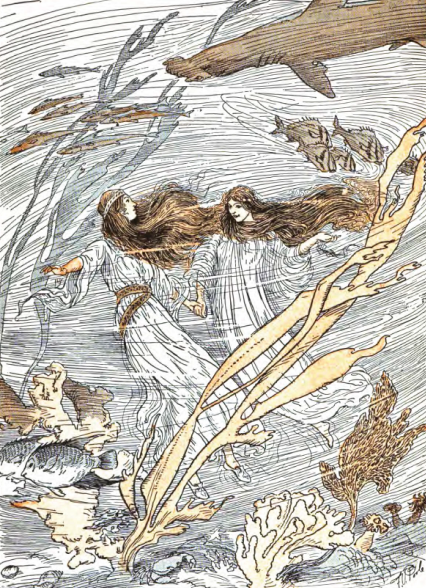
Of her still haunts beneath the soundless sea,
And all unseen withdrew and sought the cleft
Where she had laid the slippers. They were gone.
She searched the secret cleft, and next she stooped
And with spread palms felt carefully beneath
The tufted herbs and bushes, and again,
And yet again she searched the rocky cleft.
“Who could have taken them?” That question cleared
The mystery. She remembered suddenly
That when the dance was in its gayest whirl,
Her brothers were not seen, and when, at length,
They reappeared, the elder joined the sports
With shouts of boisterous mirth, and from her eye
The younger shrank in silence. “Now, I know
The guilty ones,” she said, and left the spot,
And stood before the youths with such a look
Of anguish and reproach that well they knew
Her thought, and almost wished the deed undone.
Frankly they owned the charge: “And pardon us;
We did it all in love; we could not bear
That the cold world of waters and the strange
Beings that dwell within it should beguile
Our sister from us.” Then they told her all;
How they had seen her stealthily bestow
The slippers in the cleft, and how by stealth
They took them thence and bore them down the brook,
And dropped them in, and how the eager waves
Gathered and drew them down: but at that word
The maiden shrieked—a broken-hearted shriek—
And all who heard it shuddered and turned pale
At the despairing cry, and “They are gone,”
She said, “gone—gone forever. Cruel ones!
‘Tis you who shut me out eternally
From that serener world which I had learned
To love so well. Why took ye not my life?
Ye cannot know what ye have done.” She spake,
And hurried to her chamber, and the guests
Who yet had lingered silently withdrew.
The brothers followed to the maiden’s bower,
But with a calm demeanor, as they came,
She met them at the door. “The wrong is great,”
She said, “that ye have done me, but no power
Have ye to make it less, nor yet to soothe
My sorrow; I shall bear it as I may,
The better for the hours that I have passed
In the calm region of the middle sea.
Go, then. I need you not.” They, overawed,
Withdrew from that grave presence. Then her tears
Broke forth a flood, as when the August cloud,
Darkening, beside the mountain, suddenly
Melts into streams of rain. That weary night
She paced her chamber, murmuring as she walked,
“O peaceful region of the middle sea!
O azure bowers and grots, in which I loved
To roam and rest! Am I to long for you,
And think how strangely beautiful ye are,
Yet never see you more? And dearer yet,
Ye gentle ones in whose sweet company
I trod the shelly pavements of the deep,
And swam its currents, creatures with calm eyes
Looking the tenderest love, and voices soft
As ripple of light waves along the shore,
Uttering the tenderest words! Oh! ne’er again
Shall I, in your mild aspects, read the peace
That dwells within, and vainly shall I pine
To hear your sweet low voices. Haply now
Ye miss me in your deep-sea home, and think
Of me with pity, as of one condemned
To haunt this upper world, with its harsh sounds
And glaring lights, its withering heats, its frosts,
Cruel and killing, its delirious strifes,
And all its feverish passions, till I die.”
So mourned she the long night, and when the morn
Brightened the mountains, from her lattice looked
The maiden on a world that was to her
A desolate and dreary waste. That day
She passed in wandering by the brook that oft
Had been her pathway to the sea, and still
Seemed, with its cheerful murmur, to invite
Her footsteps thither. “Well may’st thou rejoice,
Fortunate stream!” she said, “and dance along
Thy bed, and make thy course one ceaseless strain
Of music, for thou journeyest toward the deep,
To which I shall return no more.” The night
Brought her to her lone chamber, and she knelt
And prayed, with many tears, to Him whose hand
Touches the wounded heart and it is healed.
With prayer there came new thoughts and new desires.
She asked for patience and a deeper love
For those with whom her lot was henceforth cast,
And that in acts of mercy she might lose
The sense of her own sorrow. When she rose
A weight was lifted from her heart. She sought
Her couch, and slept a long and peaceful sleep.
At morn she woke to a new life. Her days
Henceforth were given to quiet tasks of good
In the great world. Men hearkened to her words,
And wondered at their wisdom and obeyed,
And saw how beautiful the law of love
Can make the cares and toils of daily life.
Still did she love to haunt the springs and brooks,
As in her cheerful childhood, and she taught
The skill to pierce the soil and meet the veins
Of clear cold water winding underneath,
And call them forth to daylight. From afar
She bade men bring the rivers on long rows
Of pillared arches to the sultry town,
And on the hot air of the summer fling
The spray of dashing fountains. To relieve
Their weary hands, she showed them how to tame
The rushing stream, and make him drive the wheel
That whirls the humming millstone and that wields
The ponderous sledge. The waters of the cloud,
That drench the hillside in the time of rains,
Were gathered at her bidding into pools,
And in the months of drought led forth again,
In glimmering rivulets, to refresh the vales,
Till the sky darkened with returning showers.
So passed her life, a long and blameless life,
And far and near her name was named with love
And reverence. Still she kept, as age came on,
Her stately presence; still her eyes looked forth
From under their calm brows as brightly clear
As the transparent wells by which she sat
So oft in childhood. Still she kept her fair
Unwrinkled features, though her locks were white.
A hundred times had summer, since her birth,
Opened the water lily on the lakes,
So old traditions tell, before she died.
A hundred cities mourned her, and her death
Saddened the pastoral valleys. By the brook,
That bickering ran beside the cottage door
Where she was born, they reared her monument.
Ere long the current parted and flowed round
The marble base, forming a little isle,
And there the flowers that love the running stream,
Iris and orchis, and the cardinal flower,
Crowded and hung caressingly around
The stone engraved with Sella’s honored name.
Questions for Study
- Can you justify what the brother did?
- Tell what you think of the way Sella finally accepted the loss of her slippers. When have you, or when should you have, accepted some loss in the same way instead of ‘crying over spilt milk’?
- What beauties did Sella find to replace those she had lost? Which was the more unselfish, the younger or the older Sella?
Return to Elementary Literature 7
The lessons published on this site are freely available to read. If you wish to move from reading to formal study — with graded assessments, academic records, and the support of the Academy — you may enroll at any time. Enrollment is open year round, to students of all ages.
← Previous: Lesson 07. Sella, Part I, by William Cullen Bryant | Contents | Next: Lesson 08. The Sportsman, by Owen Johnson →