
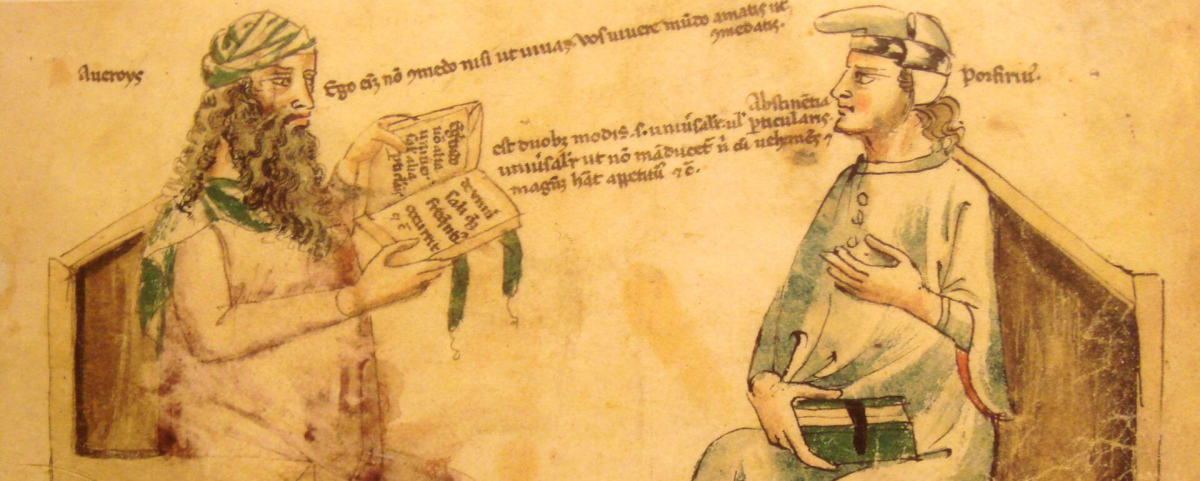
In the opening sentence of Porphyry’s Introduction, we read:
Since it is necessary, both to the doctrine of the Categories of Aristotle, and to the formation of definitions, and in short, to those things which pertain to division and demonstration, to know what Genus and Difference, Species, Peculiarity, and Accident are; and since also the theory of these is useful: In a summary way, I will briefly endeavour to discuss for you, in the form, as it were, of an Introduction, what has been delivered on this subject by the ancients.
In this opening sentence, Porphyry identifies for us the challenges that make his Introduction necessary.
First, in Aristotle’s Categories, which is the first book of Aristotle’s series on the art of reasoning, he shows that all of the things we say (predicate) about subjects can be divided into “ten Categories”: Substances, Quantities, Qualities, Relatives, Places, Times, Situations, Possession, Action, and Passion. Many students struggle to understand what Aristotle is actually teaching in the Categories, which leads to confusion and false ideas in reasoning and philosophy. The first problem is that modern students think of the word “categories” as if it means “classes” or “groups”, but the Greek word “katēgoriai” actually means “predicates”. The ten Categories are the ten highest genera of predicates, under which are many different species of predicates, as well as differences, peculiarities and accidents. They are not simply “classes” of predicates, but they are predicates themselves.
As you read that, you may be thinking, “I don’t really know what he’s talking about here. Genera? Species? Differences? Peculiarities? Accidents? I don’t know what these things are. How am I supposed to understand what Aristotle is talking about?”
Now, look at what Porphyry says: “Since it is necessary…to the doctrine of the Categories of Aristotle to know what Genus and Difference, Species, Peculiarity, and Accident are…”. You can see that this is exactly what Porphyry intends to explain for us in the Introduction. The problem we have run into is that the ten Categories explain what we predicate about subjects, but they don’t explain the different modes (ways) of predicating. If we don’t understand the modes of predication, or ways in which we speak about subjects, we can’t understand what Aristotle is teaching in the Categories. To clear this up, Porphyry explained that there are five modes of predication, which are called the “five Predicables”: Genus, Difference, Species, Peculiarity and Accident. The purpose of his Introduction is to teach us exactly what these are so that we can go on to study Aristotle’s Categories with understanding.
Second, Porphyry says that studying the Categories isn’t the only reason to learn about the five Predicables. Another important skill in the study of reasoning and philosophy is understanding definition. When most people attempt to give definitions of terms, they simply describe them. Descriptions are not definitions. If you were asked, “What is a human?”, you could answer, “A human is someone who lives in houses, wears clothes, talks with other people, and uses tools.” That would be a good description, but it wouldn’t explain exactly what a human is. Is a newborn baby a human? Is a homeless person a human? Is a person who can’t talk a human? The definition of a human has to explain exactly what a human is, and it has to be true of all humans at all times. If we try to define human, we’ll find it’s very difficult. Fortunately, there is a rule for making definitions. To define something, we must give two important pieces of information about it. We must name the genus to which it belongs and we must name the difference that sets it apart from all other things in that genus. So, in order to make definitions, we have to understand what Genus and Difference are — and they are two of the five Predicables. Porphyry is going to teach this in his Introduction.
Third, Porphyry says that another important skill in reasoning and philosophy is division. St. Thomas Aquinas explained that it is the business of a wise man to know the order in things. A wise man needs to know the order of his own soul, of his own will and of the world around him. It is not enough to simply collect information about all of these things. We must study to know the order that God created in all things and we are responsible to help keep things in that order. The knowledge of this order is called “Wisdom” and the pursuit of wisdom is called “Philosophy”. For us to know the order in things, we must know how different things relate to one another. When we think about different things, we can see that many are similar in some ways and different in others. If we look at a man and a woman, they are both humans. In their bodies, they are similar in many ways: they have two legs, two arms, five senses, a mind, and so on. Yet, there are also differences in their bodies. If we look at two men, we see that there are similarities and differences between them as well. If we look at a man and a dog, we see that there are similarities and differences between them. If we look at a man and a plant, we can see similarities and differences. Even if we look at a man and a rock, we can find similarities and differences. We can observe all of these similarities and differences, but how can we make any sense of the order of them? Porphyry is going to explain that knowledge of the five Predicables helps us to know this order that exists in things. When we’re finished with Porphyry’s Introduction, you won’t be able to know this order yet — we have to study Aristotle’s works for that — but you will understand what you need to know.
Lastly, Porphyry says that to study Aristotle’s philosophy well, we will need to understand demonstration. By demonstration, he means the ability to prove that something is true or false. Above, we saw that it is difficult to make definitions, even though many people think they can do so. The same thing is true when we’re asked to prove that something is true or false. It’s not enough to show that something may be true or false. In philosophy, we must prove with absolute certainty that a thing is true or false. Imagine if you met a man who told you that he is not going to die. How would you prove to him that he’s wrong? You could argue that everyone who has ever lived has died, but he would not be convinced by that. The fact that all other men have died does not prove that he is going to die. He could be the first man to not die. Your argument may show that he will probably die, but it did not show that he will certainly die. As with making definitions, it turns out that demonstration is difficult as well. Fortunately, Aristotle will teach us how to make demonstrations that prove things are true or false with certainty, but you will need to understand how to form propositions in which you predicate something about a subject that truly identifies what it is. In order to do this, you need to understand the different modes of predication, that is, the five Predicables. In his Introduction, Porphyry is going to help you get started.
So, in this opening sentence, Porphyry explained that there are at least four reasons why we need to understand the five Predicables if we wish to become wise. They are easy to remember because they all begin with the letter “D”. We need to understand the five Predicables so that we can prepare to study: (1) the doctrine of Aristotle’s Categories, (2) definition, (3) division and (4) demonstration.
Mr. William C. Michael, O.P.
Headmaster
Classical Liberal Arts Academy