
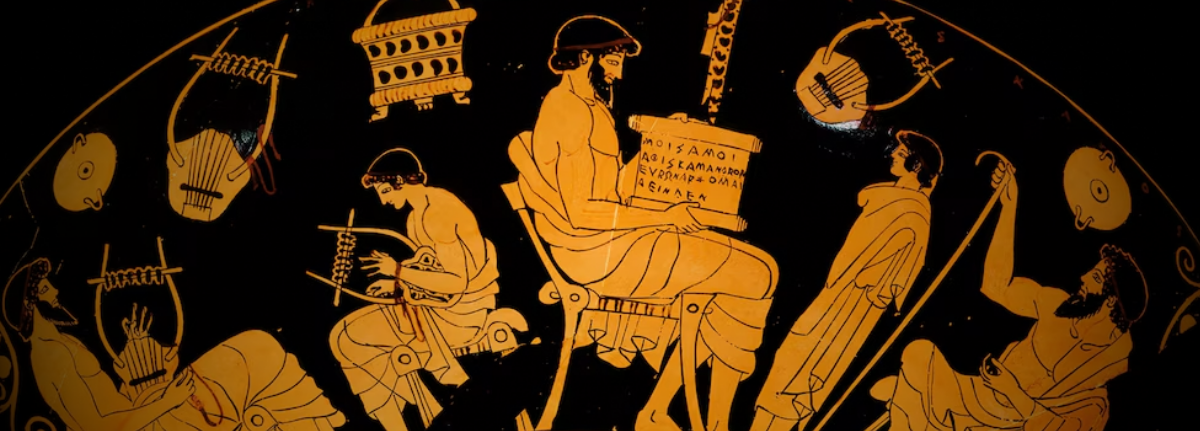
This article provides a helpful explanation of the development of the seven liberal arts, based on the chapter on that subject in Thomas Davidson’s Aristotle and Ancient Educational Ideals. The tradition of the seven liberal arts did not arise in ancient Greece as a fixed or formal system, but developed gradually from a more unified understanding of education. This history is explained in my book Understanding Classical Catholic Education. In its earliest form, Greek culture recognized two principal branches of training: gymnastics for the body and music for the soul. Yet the Greek conception of “music” was far broader than its modern sense. It embraced not only singing and instrumental performance, but poetry, language, memory, and the whole cultivation of the inner life. Within this single discipline were contained the seeds of what would later become distinct arts, for poetry formed the moral imagination, and even philosophy itself was regarded as a refinement of this wider musical education.
The Differentiation of the Arts
As Greek thought matured, distinctions began to emerge within this original unity. The introduction of letters and the increasing use of writing gradually separated literary study from the broader discipline of music. Education, which had once been an organic whole, began to differentiate into more specialized pursuits. At the same time, the Pythagoreans drew attention to the importance of number and proportion, recognizing in them principles that governed not only mathematics but the structure of reality itself. Thus arithmetic, geometry, and astronomy came to be understood as essential to the pursuit of wisdom.
Aristotle further clarified this development by distinguishing various intellectual disciplines, though he did not establish a definitive list of the liberal arts. He recognized studies such as logic, arithmetic, geometry, astronomy, and music as belonging to the intellectual formation of man, and he distinguished between higher and lower studies. In doing so, he anticipated the later division between preparatory arts and philosophical science. Yet the system remained fluid, and no fixed number of arts had yet been agreed upon.
The Movement Toward a Fixed Curriculum
After the time of Aristotle, Greek education gradually lost its original unity, and later thinkers sought to preserve its substance by organizing it into structured curricula. Among the Romans, authors such as Varro attempted to enumerate the principal branches of learning, including grammar, rhetoric, arithmetic, geometry, astronomy, and music, along with other practical disciplines. These efforts, however, did not yet produce a universally accepted scheme. Different writers proposed different groupings, reflecting the absence of a settled tradition and the continued effort to recover what had once been an organic whole.
The Formalization of the Seven Liberal Arts
The number and arrangement of the liberal arts were finally fixed in late antiquity. Martianus Capella presented a system of seven arts which was later received and transmitted throughout the medieval world. These were divided into the Trivium—grammar, dialectic, and rhetoric—and the Quadrivium—arithmetic, geometry, music, and astronomy. This division reflects a natural order in human learning. The arts of the Trivium discipline the mind in language and reasoning, preparing it for the more abstract studies of the Quadrivium, which elevate the intellect to the contemplation of number, proportion, and the order of the cosmos.
Christian thinkers adopted and deepened this structure, integrating it into a higher synthesis. St. Augustine, Cassiodorus, and St. Isidore of Seville treated the liberal arts as preparatory disciplines, ordered to philosophy and ultimately to theology. In this way, the arts were not regarded as ends in themselves, but as steps in the ascent of the soul to wisdom. The traditional division into seven was retained, not merely for convenience, but because it expressed a fitting order and harmony within the sciences themselves.
The Philosophical Meaning of the Liberal Arts
At its foundation, the tradition of the liberal arts rests upon the conviction that education is ordered to the perfection of the intellect. These arts are called “liberal” because they are proper to a free man, one who seeks truth for its own sake rather than for utility alone. The Trivium forms the mind in the right use of language and reason, while the Quadrivium raises it to the contemplation of the intelligible structure of reality. Beyond these lies philosophy, which seeks the causes of things, and theology, which directs the soul to its highest end in God.
The Restoration in the Classical Liberal Arts Academy
The Classical Liberal Arts Academy restores this ancient vision by recovering its unity and purpose. It recognizes that the earliest Greek education was not divided into isolated subjects, but ordered toward the formation of the whole man. (See “The Goal of Classical Catholic Education“) Accordingly, it presents the liberal arts not as disconnected disciplines, but as parts of a single intellectual journey. Grammar, logic, and rhetoric are taught as stages in the mastery of language and thought, while the mathematical arts are studied as disciplines that train the mind to perceive order and proportion.
At the same time, the Academy restores the proper end of education. Modern systems often reduce learning to practical utility, but the classical tradition directs it toward wisdom. The liberal arts are therefore understood as preparatory to philosophy, and ultimately to theology, in which the highest truths are contemplated. By returning to the sources of Greek and Christian learning, and by reestablishing the natural order of studies, the Academy seeks not merely to revive an ancient curriculum, but to renew the formation of the human intellect in truth.
In this restoration, the original spirit of Greek education is recovered, though now brought to its full perfection within the Christian tradition. What began as the cultivation of the soul through music and discipline is restored as a complete path of intellectual and moral formation, leading the student from the first elements of language to the contemplation of the highest realities.
Mr. William C. Michael, O.P.
Headmaster
Classical Liberal Arts Academy
The sources, goals, method, outline, and direction of this lesson are the work of Mr. William C. Michael, O.P., Headmaster of the Classical Liberal Arts Academy. The written copy has been composed from his materials and instructions with the assistance of artificial intelligence tools, and reviewed and approved by him before publication.