
In recent years, the language of education has become increasingly confused. Many schools now describe themselves as “classical schools,” yet the meaning of the term varies widely. Some institutions apply the label because they teach Latin. Others emphasize great books or Western history. Some introduce courses in logic or rhetoric while otherwise retaining a modern college-preparatory curriculum. At the same time, many schools emphasize STEM education—science, technology, engineering, and mathematics—without offering students sustained engagement with the intellectual traditions that shaped Western civilization.
As a result, parents, educators, and policymakers often find it difficult to understand what schools actually teach. A school may claim to offer classical education while including only a few humanities courses. Another may advertise strong science programs even though those courses rely primarily on textbook explanations rather than mathematical modeling or experimental investigation.
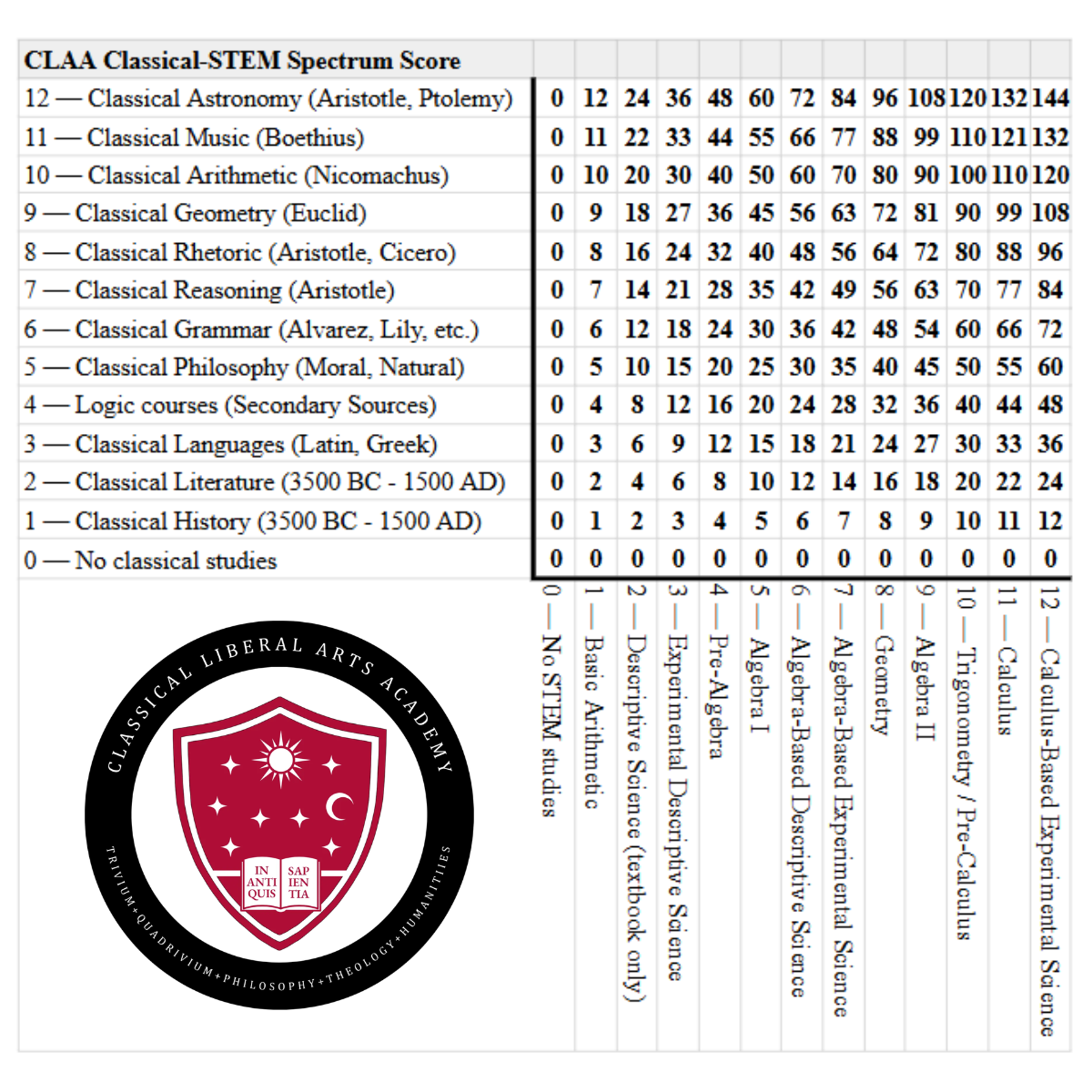
The Classical–STEM Spectrum is designed to bring clarity to this situation. It provides a framework for evaluating school curricula by measuring two essential dimensions of education: the depth of a school’s classical studies and the strength of its STEM instruction. By examining these two dimensions together, the spectrum makes it possible to understand the intellectual structure of a school’s curriculum in a clear and objective way.
The framework is based on a two-axis model. One axis measures the presence and development of classical studies within a school’s program. The second axis measures the level of modern scientific and mathematical education. When these two axes are combined, they form a grid that allows each school to be located at a specific point on the spectrum.
The Classical Studies Axis measures the degree to which a curriculum engages the classical intellectual tradition. It begins at level zero, where no classical studies are present, and progresses through increasingly advanced stages of classical learning.
At the first level, students study classical history, examining the development of civilizations from roughly 3500 BC through the late medieval period. These courses provide the historical framework within which classical thought developed.
The next stage includes classical literature, where students read the major works of antiquity and the medieval world. These texts introduce students to the cultural and intellectual foundations of Western civilization.
Beyond literature, students may study classical languages, particularly Latin and Greek. Language study allows students to encounter classical texts in their original form and cultivates precision in reading and interpretation.
At the next level appear courses in logic, typically taught through secondary sources. These courses introduce students to the structure of reasoning and train them to analyze arguments.
From logic students advance to classical philosophy, including the study of moral and natural philosophy. Here students examine the causes of human action and the principles governing the natural world, often drawing upon the philosophical tradition associated with Aristotle.
The next stage includes the formal disciplines that formed the foundation of classical education itself. Students study classical grammar, drawing upon traditions such as those found in the Latin grammars of Alvarez and later authors. From grammar they progress to classical reasoning, reflecting the methods of inquiry found in Aristotle’s works on reasoning and investigation. Students then study classical rhetoric, drawing upon the traditions of Aristotle and Cicero to learn the disciplined art of persuasive communication.
At the highest levels of the classical axis appear the mathematical sciences of the quadrivium, which formed the culmination of classical liberal education. These include classical geometry, based on Euclid’s Elements; classical arithmetic, following the tradition of Nicomachus; classical music, as described in Boethius’s theory of harmonic proportion; and classical astronomy, represented by the cosmological studies associated with Aristotle and Ptolemy. In the classical tradition these subjects were understood as intellectual sciences that revealed the mathematical order underlying the universe.
While the classical axis measures engagement with the intellectual heritage of antiquity and the medieval world, the second axis measures preparation for the scientific and technological realities of the modern world. This axis is known as the STEM Axis, and it evaluates the depth of instruction in mathematics and science.
The STEM axis begins with basic arithmetic, the fundamental operations of number. From this foundation, students may study introductory science courses that require little mathematical preparation. These courses often involve descriptive science, such as biology or earth science, presented primarily through textbooks.
A higher level is reached when students engage in experimental descriptive science, where observation and laboratory investigation become central parts of the course. Students conduct experiments, collect data, and learn the methods of empirical inquiry.
As mathematical study advances, students encounter pre-algebra, where ratios, proportions, and quantitative reasoning are introduced. This preparation leads to Algebra I, where students learn symbolic equations and mathematical relationships that form the foundation of modern scientific explanation.
Once algebraic competence is established, students can study algebra-based science, including subjects such as chemistry or introductory physics. At this stage the spectrum distinguishes between algebra-based science presented primarily through textbooks and algebra-based science taught through regular laboratory investigation.
Beyond this level students study geometry, followed by Algebra II, which introduces more advanced functions and equations. The next stage includes trigonometry or pre-calculus, which prepares students for advanced mathematical modeling.
At the highest level of the STEM axis is calculus, the mathematical language used to describe motion, change, and dynamic systems. With calculus as a foundation, students may study calculus-based experimental science, such as advanced physics or engineering science. These subjects represent the highest level of STEM instruction typically available within secondary education.
An important principle underlies the structure of the STEM axis. In modern science, mathematics plays the role that the liberal arts played in classical learning. Just as the liberal arts provided the intellectual instruments necessary for philosophical knowledge, mathematics provides the instruments through which modern science explains natural phenomena. The level of mathematics mastered by students therefore determines the depth of scientific understanding they can achieve.
When the Classical Studies Axis and the STEM Axis are combined, they form a grid that allows schools to be evaluated across both dimensions simultaneously. Each position on the grid corresponds to a Classical–STEM Spectrum score.
Unlike earlier models that simply added the two dimensions together, the Classical–STEM Spectrum calculates its score by multiplying the two axes. This method reflects the central principle of the system: meaningful education requires the development of both classical learning and scientific understanding.
If a school has no classical studies, its position on the classical axis is zero. When multiplied by any STEM score, the result remains zero. Likewise, a school that neglects mathematics and science cannot achieve a significant score even if its classical studies are strong.
This method ensures that the spectrum measures integrated education, not partial education. Only schools that cultivate both traditions can achieve high scores.
For example, a school that offers strong STEM instruction but no classical studies would receive a spectrum score of zero, even if its mathematics and science programs are advanced. Conversely, a school devoted entirely to classical humanities but lacking scientific preparation would also receive a score of zero. Only schools that combine classical intellectual training with substantial mathematical and scientific education can rise toward the highest levels of the spectrum.
The multiplication method also creates clearer distinctions between schools. Because the spectrum score reflects the interaction between the two axes, differences between programs become easier to see. Schools that develop both traditions in a balanced way achieve significantly higher scores than those that emphasize only one dimension.
In practical use, the evaluation of a school includes three pieces of information: its classical level, its STEM level, and its resulting spectrum score. A school might be evaluated, for example, as Classical Level 8, STEM Level 7, producing a spectrum score of 56. Another school might have Classical Level 2 and STEM Level 10, producing a score of 20. These results reveal both the character of the school’s curriculum and its degree of integration between classical and scientific learning.
The Classical–STEM Spectrum therefore provides a clear and objective method for evaluating school curricula in the twenty-first century. Instead of relying on labels such as “classical school” or “STEM academy,” the spectrum measures the actual intellectual structure of a school’s program.
For parents, the spectrum offers a straightforward way to understand the educational environment their children will encounter. For educators and school leaders, it provides a roadmap for curricular development. Schools that wish to strengthen their programs can examine their position on the spectrum and identify the areas in which further development is needed.
Mr. William C. Michael, O.P.
Headmaster
Classical Liberal Arts Academy