
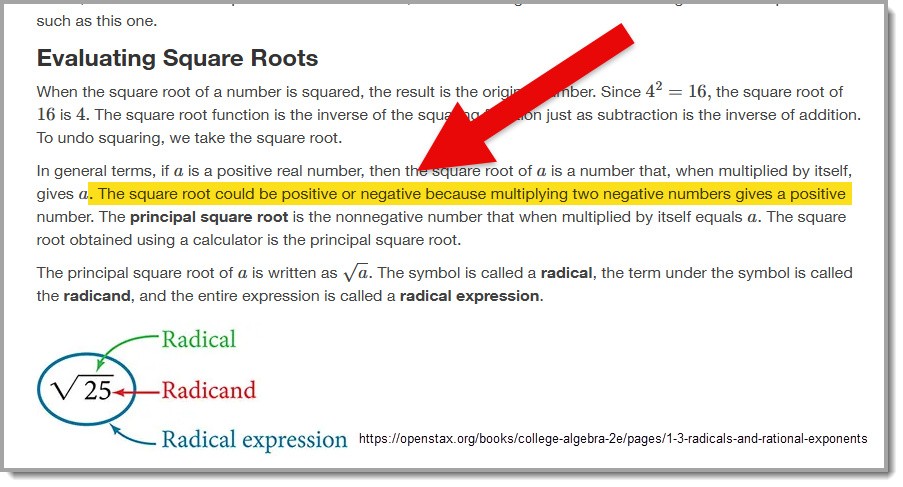
Mathematicians argue that negative numbers exist because they can serve as square roots for positive quantities. A screenshot of the OpenStax Algebra textbook above (the most widely used textboook in the world) provides an example of this teaching. This is fed to kids in schools and they drink it in as normal. This idea, however, was opposed for many years by philosophers who denied that it was possible for negative quantities to exist.
This provides us with an opportunity to ask, “What, exactly, are we learning in modern Mathematics courses?” Is this truth? Or, is Mathematics some sort of “Trojan Horse” being used to lead us to intellectual and spiritual ruin? When we consider that modern schools that focus on modern Mathematics and Science require that we remove traditional courses like Grammar, Reasoning, Rhetoric, Ethics, Metaphysics and theology from the curriculum, the concern should grow. What’s going on here?
It is absurd to teach that negative quantities exist. Unfortunately, we are trained to deny our on sense and experience in the name of “Math” and “Science”. Students are taught (as above) not only that negative quantities exist but that they can be used in calculations. To show that negative quantities exist, teachers draw a “number line” and mark “0” at the center. They mark units on the line in both directions from 0 and say that numbers to the right are “positive” and numbers to the left of 0 are “negative”. Students listen and nod.
Students are trained in modern schools to accept teachings in modern Math and Science classes without questioning anything. If they do doubt something and ask for proof, they are scoffed at as if all of this is self-evidence. It is not at all, however, self-evident. In fact, it makes no sense at all.
The Effect of Modern Mathematics
In Mathematics, we work with four basic operations: addition, subtraction, multiplication and division. When we begin school, we are shown how these operations work with counters and other physical objects. Everyone understands that when we talk about adding we are talking about increasing a sum by adding more objects. When we speak about subtraction, we understand that we are diminishim a number of objects by taking some away. When we speak about multiplication, we are speaking about adding a number (called the multiplicand) to itself a certain number of times (called the multiplier) to make a product that is greater than the original quantity. When we divide, we understand that we are asking how many times a certain quantity (the dividend) contains another (the divisor). All of these operations have clear meanings and sensible solutions.
To this simple world of Mathematics, however, we reach a point where negative numbers are introduced. There is no way, other than on a number line, to explain what a negative number is. There is no way to show a student a negative quantity. At this point, Mathematics changes and students are told to accept statements as facts that have no real-world meaning. They are told that:
- When we add to a quantity a “negative number”, the sum is less than the original quantity.
- When we subtract a “negative number” from a quantity, the difference is greater than the original quantity.
- When we multiply a quantity a “negative number” of times, the product is a “negative number”.
- When we divide a quantity by a “negative number”, the quotient is a “negative number”.
Now, for addition and subtraction, there appears to be some sense here because these rules are translated in our heads to the following”
- Adding a “negative number” is really just subtracting a positive number.
- Subtracting a “negative number” is really just adding a positive number.
We translate the talk about “negative numbers” into statements about natural numbers. Why? Because “negative numbers” don’t exist and really make no sense. This becomes more obvious when we move on to multiplication and division.
We’re told that when we multiply a quantity a “negative number” of times, the product is a “negative number”. So, let’s begin with the number 4 as our multiplicand. We’re told to multiply 4 “negative two” times. What does that mean? It is absolute meaningless nonsense. The language itself makes no sense and our minds simply stop. There is no meaning to these words.
The same happens with division. We’re told to divide a quantity by a “negative number”. So, let’s begin with the number 36 and how many times it contains “negative 3”. The student tries to think about the question, but it is meaningless. The language makes no sense. There is no idea in the student’s mind that can make sense of what is being asked. Again, there is no meaning to these words.
Then, the textbooks make the next move. They tell the students what to do:
- For multiplication, add the 4 to itself (i.e., multiply) two times. That makes 8. Now, make that negative. So, the answer is “negative 8”. This is how you multiply by a negative number.
- For division, divide the number 36 by 3. The quotient is 12. Now, make that negative. So, the answer is “negative 12”. This is how you divide by a negative number.
There is no reason in this teaching. The student is taught to accept statements and procedures that have no natural existence or meaning — and they do so. The student begins speaking of “negative numbers” and drilling exercises in which he follows the procedures he is told to perform without any understanding or explanation. It is mindless obedience. The student no longer believes that Mathematics is a study one “understands”. It is a subject with rules that cannot be understood that one simply obeys and does. The relationship between the student and the teacher and subject has changed. The student has learned to listen and do what he is told. That is how Mathematics works.
As students, we can remember when school changed in this way. We can remember the point when “being a good student” meant following the instructions with no explanation.
Studying What Does Not Exist
As we go along with this, we eventually run into a problem. Positive numbers have squares, as 144 is the square of 12. Oddly, what we are told about the multplication also leads us to say that 144 is also the square of -12. So 144 is the square of both 12 and -12. OK, whatever — we’re just mindlessly following instructions at this point, so it doesn’t matter. We learn, however, that there are no negative squares. So, if we ask, “What is the square root of -144?”, there is no answer.
Well, unless we just imagine one. And, believe it or not, that’s what modern Math teaches us to do. Here’s the instruction from the OpenStax ALgebra II textbook:
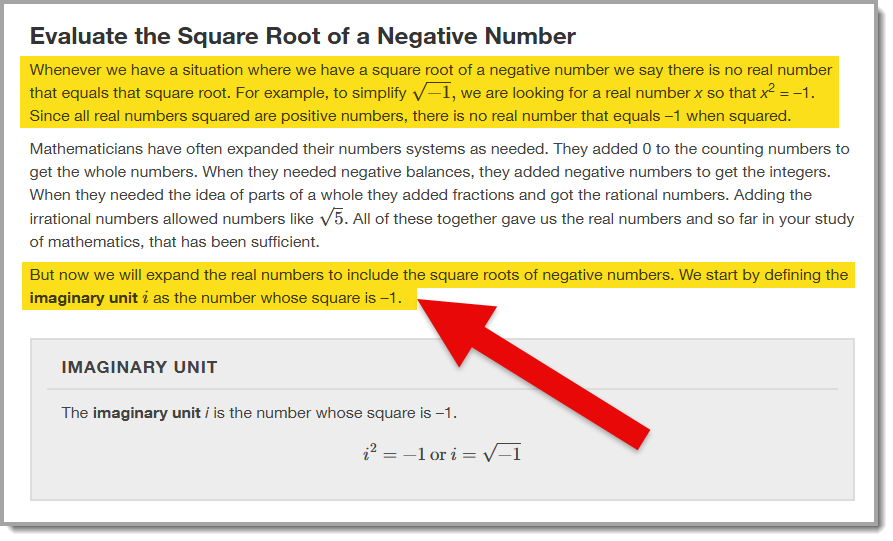
Students are told that the solution to this problem is that we create a new number, which is not actually a number. We will call this number an “imaginary number”. This “imaginary number” is √−1. Yes, the “imaginary number” is the square root of “negative one”, even though the textbook just told us, “there is no real number that equals –1 when squared.”. The student is then shown what to do when asked to give the square root of a negative number (which does not exist):
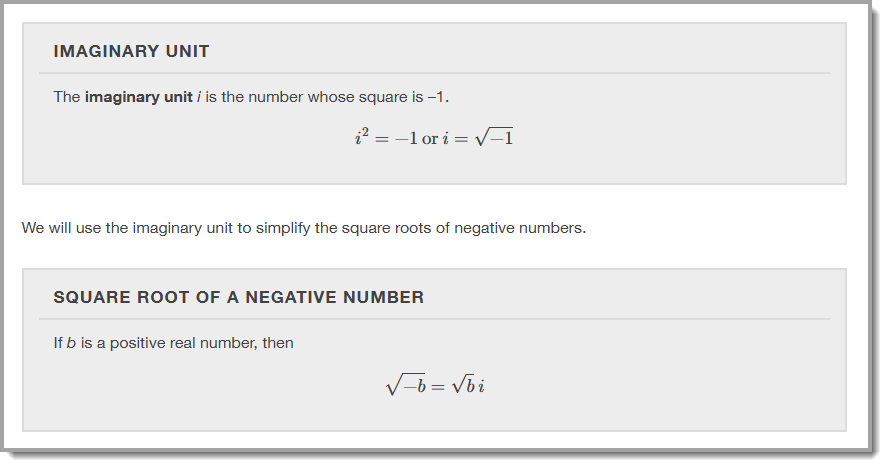
Note what actually happens: just as with the other operations, the student is taught to ignore the negative number, work with a real (positive) number, and then simply attach the “imaginary” stuff. Don’t think about it. Don’t ask for an explanation. Just do what you’re told. This is how Math works.
You use the “imaginary number”.
Attempts to Defend Modern Mathematics
Now, we can laugh at how crazy this seems, but we have to ask, “Why are we doing this?” Why are we teaching our children to imagine numbers that don’t exist? After all, isn’t the whole purpose of this modern scientific education supposed to be to learn the truth about the material world by means of observation (i.e., experimentation)?
The audacious answer from the mathematicians can be found in the writings of Leonhard Euler ((Source: https://classicalliberalarts.com/resources/EULER_ELEMENTS_OF_ALGEBRA.pdf)), who explained:
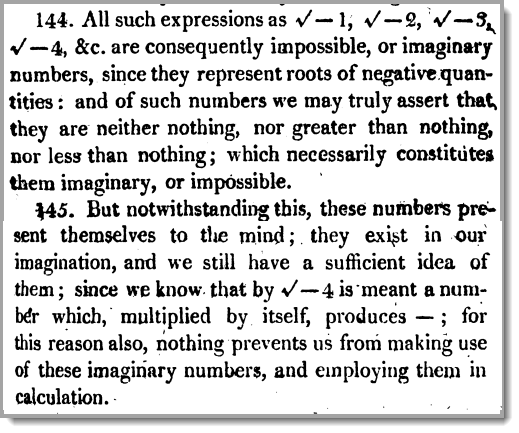
So, Euler simply tells us that these impossible numbers, “exist in our imagination”! That’s quite a bold thing to say without any evidence, but we’ll ignore that as good students do. More importantly, he tells us that we can “make use of these imaginary numbers and employ them in calculation”. In short, we teach students to admit imaginary numbers because they are useful–and Euler provides examples. For example, since we know that the square root of a quantity mulitiplied by itself produces its square. Therefore, √−3 x √−3 = -3. So, you could do that.
But Euler doesn’t leave us here. He provides this amazing passage, which is worth reading carefully:
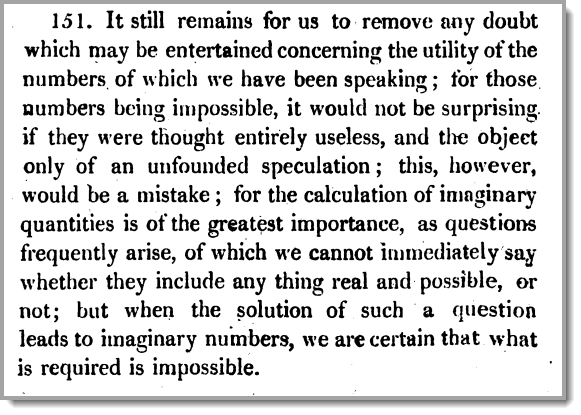
So, if you think this talk of imaginary numbers is “entirely useless”, you’re not alone. However, the reason why imaginary numbers are useful is — get this — that if a solution to a problem ever contains imaginary numbers, then we know that it is impossible.
Why?
Because no such numbers exist.
We Need to Study Reality
Now, I can joke about mathematicians working with numbers that don’t exist, but there’s a real moral problem in all of this. While students are spending 20% or more of their time in school learning these things, they are doing so at the expense of more important studies, which are bumped out of the curriculum by this nonsense. Students wasting their time pretending to learn modern Mathematics are not learning the arts or Grammar, Reasoning, Rhetoric, real Arithmetic and Geometry, Moral Philosophy, Metaphysics, Sacred Scripture, Scholastic Theology — and more.
In his work Summa Contra Gentiles, St. Thomas Aquinas wrote the following:
“The ultimate end of the universe must, therefore, be the good of an intellect. This good is truth. Truth must consequently be the ultimate end of the whole universe, and the consideration of the wise man aims principally at truth.”((Source. St. Thomas Aquinas, Summa Contra Gentiles. https://isidore.co/aquinas/ContraGentiles1.htm#1))
The study of what is imaginary, impossible and false is not the work of the wise man. Real classical Catholic education is concerned with what is true, that is, what agrees with reality. Being ignorant of this, we have no time for nonsense. Yet, this is what modern education has become.
In 1910, Pope St. Pius X warned of this danger:
“In these days when the natural sciences absorb so much study, the more severe and lofty studies have been proportionately neglected – some of them have almost passed into oblivion, some of them are pursued in a half-hearted or superficial way, and, sad to say, now that they are fallen from their old estate.”((Pope St. Pius X, Pascendi Dominici Gregis, par. 47. https://www.vatican.va/content/pius-x/en/encyclicals/documents/hf_p-x_enc_19070908_pascendi-dominici-gregis.html))
In the Classical Liberal Arts Academy, there is no excuse for why this should happen.
Mr. William C. Michael, O.P.
Headmaster
Classical Liberal Arts Academy