
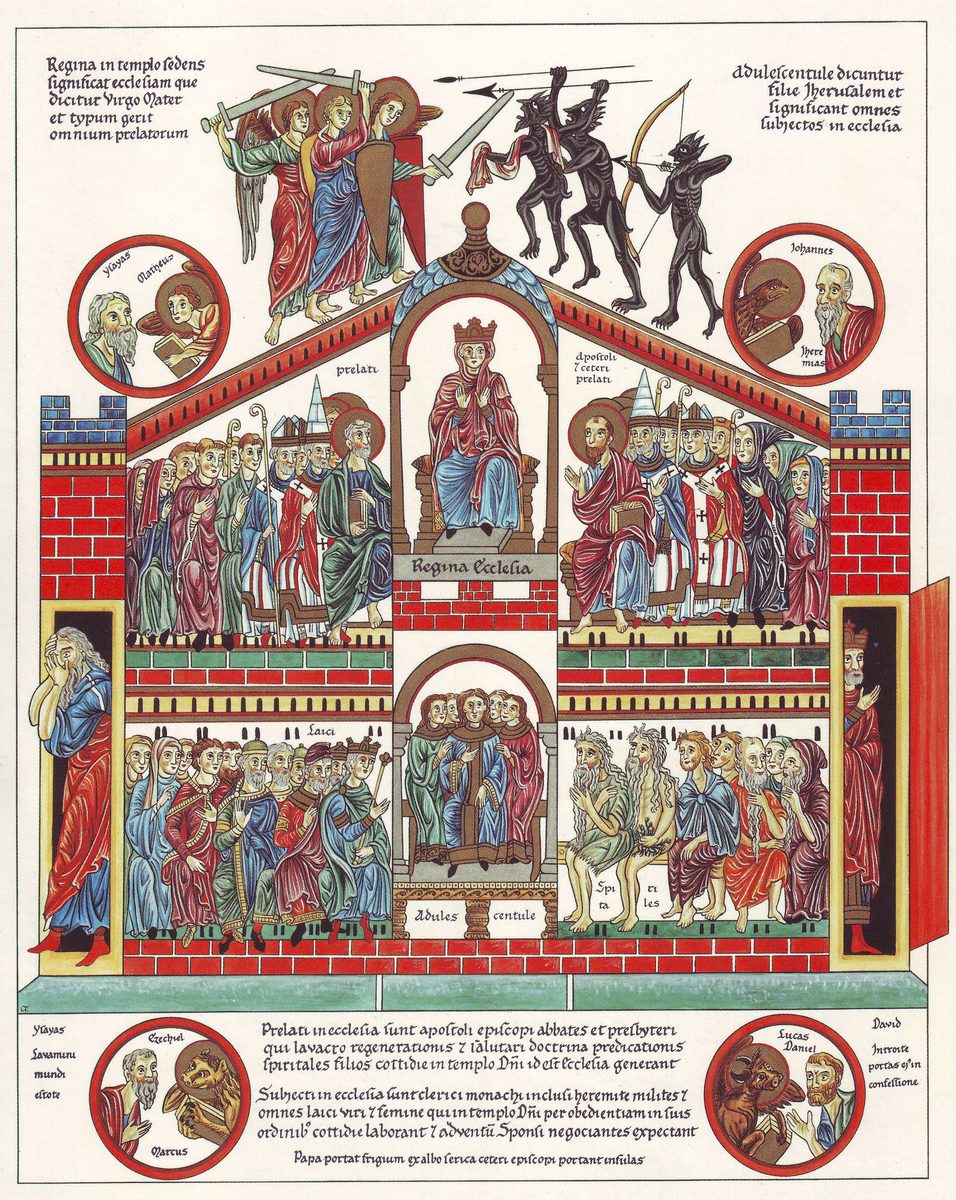
An Illustration from the Hortus Deliciarum of Herrad of Hohenburg
The Manuscript and Its Author
The image before us comes from the Hortus Deliciarum, the “Garden of Delights,” an illustrated encyclopedia compiled between about 1167 and 1185 by Herrad of Landsberg, abbess of the canonesses of Hohenburg Abbey in Alsace, on the mountain now known as Mont Sainte-Odile. Herrad assembled the work for the instruction of the women under her care. It was, in her own description, a gathering of the nectar drawn from many flowers of Holy Scripture and of philosophical writing, and it ran to some three hundred and twenty-four parchment leaves carrying more than three hundred illustrations, together with poems, hymns, and some of the earliest surviving polyphonic music to come from a religious house of women.
The original manuscript no longer exists. It was destroyed in 1870, when the library at Strasbourg burned during the Prussian bombardment of the city in the Franco-Prussian War. What survives is a body of copies, tracings, and descriptions made in the decades before the fire, principally through the labors of Christian Moritz Engelhardt, who published a study of the manuscript in 1818, and of the scholars who traced individual plates for their own use. The bright and even coloring of the plate reproduced here is therefore a nineteenth-century reconstruction rather than the twelfth-century paint. The drawing, the arrangement, and above all the Latin inscriptions are faithful to what Herrad’s artists produced, and it is the inscriptions that make this plate so valuable, for they tell us exactly what the image was intended to teach.
Herrad’s favorite author was Honorius of Autun, and it is from his Speculum Ecclesiae that the title of her whole work is drawn. Honorius describes Paradise as the hortus deliciarum, the garden of spiritual delights, and sees that Paradise, reopened by Christ, as represented in the Church, the house of God containing all the treasures of divine wisdom, which Christ will lead as His bride to her eternal consummation. That sentence is, in effect, the program of the plate we are about to read. The image is not a decoration attached to a text. It is itself a treatise, and a remarkably complete one, on the constitution of the Church.
The Plate as a Whole
The Church is drawn as a building. It is a temple of red brick with a gabled roof, its front wall removed so that we may look inside, in the manner of a cutaway architectural drawing. The interior is divided into four compartments, two above and two below, with a central niche in each register. Doorways stand at either side, each occupied by a figure. Four medallions occupy the four corners of the page, outside the building itself. Above the roofline a battle is in progress. Beneath the foundation runs a block of explanatory text in three sentences. Every one of these elements carries a label or a caption, and the whole composition is legible from top to bottom as a single argument.
The Two Captions at the Head of the Page
At the upper left, in the space beside the roof, Herrad places the key to the entire image:
Regina in templo sedens significat ecclesiam que dicitur Virgo Mater et typum gerit omnium prelatorum.
“The Queen seated in the temple signifies the Church, who is called Virgin Mother, and she bears the type of all prelates.”
At the upper right stands its companion:
Adulescentule dicuntur filie Jherusalem et significant omnes subiectos in ecclesia.
“The maidens are called the daughters of Jerusalem, and they signify all those who are subject within the Church.”
Two things should be noted at once. First, the caption does not say that the crowned woman on the throne is the Blessed Virgin. It says that she signifies the Church, “who is called Virgin Mother.” The Queen is Ecclesia bearing Mary’s titles, and we shall return to why that is so. Second, the term adulescentulae is not a casual word for young women. It is taken from the Canticle of Canticles, where at 1:2 we read adolescentulae dilexerunt te, the maidens have loved thee. Herrad identifies these maidens with the daughters of Jerusalem addressed throughout the Canticle, and reads them as figures of all the faithful who stand under authority in the Church. The twelfth century read the Canticle as the great scriptural account of the union of Christ with His Church, and this plate is, among other things, an illustration of that reading.
The Queen Enthroned
At the center of the upper register, beneath a gabled arch surmounted by an orb, sits the crowned figure labeled in the panel beneath her: Regina Ecclesia, the Queen Church. She is enthroned within the temple which is herself, a deliberate paradox of the kind medieval art employs without embarrassment. She raises her hands in the gesture of address and blessing. Her crown, her throne, and her central position declare that the Church is not merely an assembly of the faithful but a sovereign reality, the Bride of a King and therefore a Queen.
The second half of her caption, typum gerit omnium prelatorum, that she bears the type of all prelates, is easy to pass over and should not be. It means that the Church’s motherhood is not an abstraction. Wherever she generates children, she does so through those whom she has set over her household. The Queen and the prelates are not two competing subjects. The prelates are the instruments through whom the Queen acts, and the plate will make this explicit in the text at the foot of the page.
The Four Compartments: The States of Life
The interior of the building is divided into four groups, each labeled.
In the upper left compartment stands the word prelati. Here are bishops in mitres carrying croziers, abbots, and priests, some in the striped and patterned vestments the artist uses to indicate liturgical dress, one at the front holding a book. In the upper right compartment the label reads apostoli et ceteri prelati, the apostles and the rest of the prelates. The two large haloed and bearded figures at the front of that group are the apostles, and behind and among them press the mitred bishops. One figure in that crowd wears not a mitre but a white conical cap, and he is identified for us by the last line of text at the foot of the plate. He is the pope.
The two upper compartments together, therefore, present the whole teaching and governing order of the Church, apostolic in its origin and episcopal, abbatial, and presbyteral in its continuation.
Below them, in the lower left compartment, we read laici. This is a crowd of men and women, and near the front of it stands a crowned king holding a sceptre. The inclusion of the king among the laity, and not among the powers set over the Church, is itself a piece of twelfth-century argument, made in the century of the Investiture Controversy. Temporal sovereignty does not confer ecclesiastical rank. The king is a layman.
In the lower right compartment the label runs vertically down the panel in syllables, Spi-ri-ta-les: the spiritales, the spiritual men. These are drawn quite differently from every other group. They are barefoot, long-haired and long-bearded, thinly and roughly clad, seated rather than standing. They are the hermits, the recluses, and the ascetics, those who have withdrawn from ordinary life to a life of penance. Herrad’s placement of them within the walls of the building, in their own compartment, makes a quiet but firm point: the solitary is not outside the Church. His solitude is a room in her house.
Between the two lower compartments, in a central niche directly beneath the Queen, stands a close-pressed group of young women beneath the label adulescentule. These are the daughters of Jerusalem of the caption above, the whole body of the subject faithful gathered at the doorway of the temple.
The Figures in the Doorways
At either side of the building a doorway is drawn, and in each stands a single large figure identified by an inscription at the bottom corner of the page.
On the left stands an aged, bearded man in blue and red, his head resting on his hand in the conventional medieval posture of grief and mourning. The inscription beneath reads:
Ysayas: Lavamini, mundi estote.
“Isaias: Wash yourselves, be clean.”
The words are from Isaias 1:16, from the prophet’s opening arraignment of a people whose worship has become an offense because their hands are full of blood.
On the right stands a crowned figure, his hand raised in address, and beside him the door of the temple stands open, painted red and swung outward. The inscription beneath reads:
David: Introite portas eius in confessione.
“David: Enter into his gates with thanksgiving.”
The words are from Psalm 99:4, the psalm that summons all the earth to serve the Lord with gladness.
Taken together the two doorposts frame the act of entering the Church. On one side the prophet demands cleansing; on the other the psalmist king bids the cleansed come in with praise. Isaias mourns; David rejoices. The one door is the requirement, the other is the welcome, and the Christian passes between them. It is worth observing that the door on David’s side is the one drawn open.
The Four Corner Medallions
At each corner of the page, outside the walls of the building, a red-rimmed medallion contains two heads. Each pairs a prophet of the Old Testament with an evangelist of the New, and with the evangelist appears his living creature.
At the upper left are Isaias and Matthew, and with Matthew the winged man, here shown holding a book. At the upper right are John, accompanied by the eagle, and Jeremias. At the lower left are Ezechiel and Mark, and with Mark the lion. At the lower right are Luke, with the ox, and Daniel.
The four living creatures are drawn from the vision of Ezechiel 1 and from Apocalypse 4:7, and their assignment to the four evangelists is the standard one settled by St. Jerome. Their placement at the four corners of the composition, supporting the building at its angles, states in visual terms what the Church has always held about her own foundation: she is built upon the prophets and the apostles, Jesus Christ Himself being the chief corner stone, as St. Paul says at Ephesians 2:20. Four prophets and four Gospels stand at the four corners of the house, and the house rests upon them.
The Battle Above the Roof
Along the ridge of the gable, above the walls entirely, a combat is under way. On the left, three haloed figures advance, the foremost of them winged. They carry drawn swords, and one bears a long shield of the kite form used in the twelfth century. Against them come three black demons, misshapen and horned, one drawing a bow, one wielding a spear, one holding a cloth or a scroll.
This is the Church Militant, and its position in the composition is exact. The assault does not come from within the walls. It comes from above and outside, and it is met at the roofline by those set to guard the house. Beneath that defense, undisturbed, the four orders of the faithful stand in their compartments and the Queen sits on her throne. The plate is arguing that the Church is at once besieged and secure.
The Three Sentences at the Foot of the Page
Beneath the foundation of the building, in three sentences, Herrad supplies the doctrinal commentary on everything above.
The first defines the prelates:
Prelati in ecclesia sunt apostoli, episcopi, abbates et presbyteri, qui lavacro regenerationis et salutari doctrina predicationis spiritales filios cottidie in templo Domini, id est ecclesia, generant.
“The prelates in the Church are the apostles, bishops, abbots, and priests, who by the laver of regeneration and by the saving doctrine of preaching daily beget spiritual sons in the temple of the Lord, that is, in the Church.”
The second defines those who are subject:
Subiecti in ecclesia sunt clerici, monachi, inclusi, heremite, milites et omnes laici viri et femine, qui in templo Domini per obedientiam in suis ordinibus cottidie laborant et adventum Sponsi negociantes expectant.
“Those subject in the Church are clerics, monks, recluses, hermits, soldiers, and all the laity, men and women, who in the temple of the Lord labor daily by obedience in their several orders, and, trading with what they have received, await the coming of the Bridegroom.”
The third is a note on dress:
Papa portat frigium ex albo serica; ceteri episcopi portant infulas.
“The pope wears the phrygium of white silk; the other bishops wear mitres.”
The first two sentences deserve close attention, and the third is a small documentary treasure.
In the first, the two instruments of the Church’s maternity are named precisely: the laver of regeneration, which is Baptism, and the saving doctrine of preaching. By these two, and daily, the prelates generate spiritual sons. The verb is deliberate. What happens in the font is a birth, and the men who administer it are exercising a maternity that is not their own but the Church’s.
In the second, the word negociantes, trading or doing business, is an allusion to the parable of the talents at Matthew 25:14-30, where the servants are given goods to trade with until their lord returns. And the one for whom they wait is named Sponsus, the Bridegroom, which carries us back to the Canticle and to the parable of the ten virgins in the same chapter of Matthew. The faithful labor in their several orders and wait, as the maidens waited, for the coming of the Spouse. The adulescentulae in the niche beneath the Queen are those virgins.
The third sentence tells us why one head in the upper right compartment is covered differently from the rest. The phrygium was a tall white cap, of eastern derivation in name, worn by the popes of this period and distinguishing them from all other bishops, who wore the mitre. It is the ancestor of the papal tiara, which acquired its crowns in the following centuries. That a canoness in Alsace in the 1170s thought it necessary to gloss the detail for her readers tells us something about how recently the distinction had become fixed.
Why the Church Is Called Virgin Mother
We may now return to the caption at the head of the page, which called the Queen not the Blessed Virgin but the Church, “who is called Virgin Mother.” Behind that phrase lies one of the oldest lines of Christian exegesis, and the plate cannot be understood without it.
St. Ambrose supplies the classic formula. Commenting on the Annunciation in his exposition of St. Luke, he observes that Mary is betrothed and yet a virgin because she is typus Ecclesiae, a type of the Church, which is likewise wedded and yet undefiled. The Church, he says elsewhere, conceives us as a virgin, bears us without pain, and brings us forth by the Spirit. St. Augustine takes the same doctrine and guards it against exaggeration. In De sancta virginitate he argues that the Church imitates the Mother of her Lord, being mother in charity and virgin in the integrity of her faith; but in his twenty-fifth sermon he insists with equal firmness that Mary is a member of the Church, an eminent and preeminent member, but a member of the Body and not the Body itself. She is the figure of the Church and its first realization. She is not the Church.
Behind both Fathers stands the still older typology of the New Eve, worked out by St. Justin Martyr and St. Irenaeus. Eve was mother of all the living according to the flesh; Mary is the beginning of the living according to grace; and the Church continues that maternity through time.
The likeness rests on a genuine proportion and not on a poetic association. Both Mary and the Church conceive by the Holy Ghost and not by man. Both remain virgin in conceiving and in bearing. Both bring forth Christ, Mary the Head in the flesh, the Church the members in the font. Both stand beneath the Cross and receive what flows from the opened side. Isaac of Stella, a Cistercian writing within a generation of Herrad, states the principle as compactly as it can be stated in his sermon for the Assumption: what is said of the one may in a manner be said of the other, since each is mother of Christ and each is virgin, and the faithful soul is a third term in the same series. That triple reading, of Mary, the Church, and the soul, governs the whole commentary tradition on the Canticle in the century that produced this plate.
The doctrine was gathered up and restated at the Second Vatican Council in Lumen Gentium 63 to 65, where Mary is called the type of the Church in the order of faith, of charity, and of perfect union with Christ, and where the Church is said to become a mother by preaching and by baptism, bringing forth to a new and immortal life the sons who are conceived of the Holy Ghost. The language there is borrowed almost entirely from Ambrose and Augustine.
The Virginal Womb and the Font
The sentence at the foot of the plate, that the prelates beget spiritual sons by the laver of regeneration, invites a further step, and the Fathers took it. If the Church is Virgin Mother, where is her womb?
St. Leo the Great answers directly in one of his Christmas sermons: for every man being reborn, the water of Baptism is the likeness of the virginal womb, since the same Holy Ghost who filled the Virgin fills the font. The origin which Christ took in the womb of Mary, he says, He has placed in the font of Baptism. The Roman liturgy says the same thing in the blessing of the baptismal water at the Easter Vigil, where the font is addressed as immaculatus divini fontis uterus, the immaculate womb of the divine font.
The direction of that comparison must be kept straight. The virginal birth of Christ is not a symbol of Baptism. It is a historical fact, and precisely because it is a fact it can serve as the type of which Baptism is the enacted likeness. In typology the type is always the prior reality which illuminates what follows. Reverse the order, and one arrives at the modernist reading in which the account of the Nativity is an allegory generated out of the Church’s later experience of the font, which is exactly the error condemned in Pascendi. The font is an image of the Virgin’s womb, and not the womb an image of the font.
The scriptural anchor for the whole comparison is St. John’s, and it is stronger than is often noticed. At John 1:13, of those who receive the Word and are given the power to be made sons of God, the evangelist writes: qui non ex sanguinibus, neque ex voluntate carnis, neque ex voluntate viri, sed ex Deo nati sunt, who are born not of blood, nor of the will of the flesh, nor of the will of man, but of God. Three natural modes of generation are denied and a fourth affirmed. At John 3:5 the means is supplied: unless a man be born again of water and the Holy Ghost, he cannot enter into the kingdom of God.
There is a detail here worth knowing. Several of the Latin Fathers, including Irenaeus and Tertullian, read John 1:13 in the singular, qui natus est, and referred it to Christ’s own virginal birth. The plural is the better attested reading and the one the Vulgate carries, but the existence of the ancient singular reading shows how early the two births were understood as a single doctrine. On either reading, the three things denied of Christian regeneration are precisely the three things denied of Christ’s conception.
The proportion is exact at every term. The womb is to the font as the natural Body of Christ is to His mystical Body. In both, the efficient cause is the same Holy Ghost. In both, virginity is preserved, for the Church conceives without loss of her integrity. In both, what is brought forth is the same Christ, the Head in the one case and the members in the other. And in both, what excludes original sin is the exclusion of carnal generation, for as St. Thomas observes, original sin is transmitted by seminal generation, and it is the virginal conception that breaks the transmission.
Two precisions keep this from being said too loosely. The first concerns causality. Baptism is not efficacious because Christ was born of a Virgin. It is efficacious because of His Passion, from which all the sacraments draw their power, as St. Thomas teaches in the third part of the Summa. The Nativity supplies the figure and the fittingness; the Cross supplies the cause. Baptism itself is a burial and a rising with Christ, as St. Paul says at Romans 6, and that is its primary sacramental sense. The virginal birth stands alongside as the account of the manner of the new generation rather than the source of its power.
The second concerns the nature of the sacramental sign. The sacraments of the New Law effect what they signify. Baptism does not merely picture a spiritual event occurring elsewhere; it is a true spiritual regeneration, a real generation to the life of grace. That is what keeps the two terms of the comparison parallel. Mary’s conception of Christ was real, and the Church’s begetting of sons in the font is real. Were Baptism only a sign of something else, the likeness would fail at exactly the point that makes it worth drawing.
Where the type and the thing typified diverge, they diverge instructively. Christ was born sinless of a sinless Mother; every man born of the font is born out of sin, and his birth is a cleansing. Christ’s birth is the entry of the sinless into a fallen race; ours is the incorporation of the fallen into a sinless Head. In the type, the one born is the agent of the cleansing; in the antitype, the one born is its recipient. This is not a defect in the likeness. It is what shows the likeness to be a type and not a duplication, for the figure contains the cause and the thing figured receives the effect.
Spouse and Mother
The Queen in Herrad’s temple is crowned, and a crown implies a King. Two titles belong to her together, and neither can be understood apart from the other.
She is the Spouse of Christ. The nuptial figure is older than the Gospel, for in Osee, in Ezechiel 16, and in Isaias 54, Israel is the spouse of the Lord and her unfaithfulness is adultery. But the New Testament names the Bridegroom. St. Paul at 2 Corinthians 11:2 has espoused the Corinthians to one husband, to present them as a chaste virgin to Christ. At Ephesians 5:25-32 the entire comparison rests upon Christ loving the Church and delivering Himself up for her, and Paul calls it sacramentum hoc magnum, this great sacrament, adding that he speaks in Christ and in the Church. The Apocalypse at 21:9 shows the bride, the spouse of the Lamb. The espousal is contracted in the Incarnation, where the Word weds human nature, and consummated upon the Cross, which is why St. Augustine can read Psalm 18:6 of the Bridegroom coming forth from His chamber and ascending the Cross as a marriage bed.
She is also our Mother. St. Cyprian gives the sentence that has never been improved upon: he cannot have God for his Father who has not the Church for his mother. St. Paul at Galatians 4:26 calls the Jerusalem which is above our mother, and the Latin liturgy addresses her as sancta mater Ecclesia.
The two titles are one doctrine. Cyprian sets them side by side in a single clause, calling the spouse of Christ a virgin, incorrupt and chaste, and immediately naming her our mother. Virgin, Bride, and Mother are the same triad we have traced through Mary and through the font. The Church is mother because she is spouse. The sons she bears in the font are begotten of her union with Christ by the Holy Ghost.
A tension in the scriptural language should be acknowledged rather than smoothed away. Scripture calls the Church both the Body of Christ and the Bride of Christ, and a body is not ordinarily a bride. St. Augustine resolves it by way of Genesis 2:24 as St. Paul cites it: they shall be two in one flesh. The bridal union is so complete that Bride and Body name one reality regarded from two sides.
“Why Persecutest Thou Me?”
The whole doctrine receives its most compressed scriptural statement on the road to Damascus. Saul, going to arrest the disciples at Damascus after dragging men and women to prison at Jerusalem, is thrown to the ground and hears: Saule, Saule, quid me persequeris? Saul, Saul, why persecutest thou me?
St. Augustine returns to this verse constantly, and his gloss is the one the Church has kept. The Head cried out on behalf of the members, though no hand was laid upon Him in heaven. In his exposition of Psalm 30 he presses the wording: He did not say, why dost thou persecute my members, but, why dost thou persecute me. The formula Augustine draws from it, caput pro membris, membra pro capite, the Head speaking for the members and the members for the Head, is the classical statement of the unity of the whole Christ.
Two observations sharpen the point. First, Saul was not persecuting an institution in the abstract. He was arresting particular men and women. The identification our Lord asserts is with those individuals, and that is what makes the sentence a statement about a Body rather than a figure of speech about an organization. Second, it is St. Paul alone among the New Testament writers who develops the doctrine of the Body at length, in 1 Corinthians 12, in Romans 12, and in Ephesians and Colossians. It is not unreasonable to think the seed of that whole ecclesiology was planted in the question he heard on that morning. He had believed he was suppressing a sect and was told that he was striking God.
Here a caution is in order, for the identity asserted at Acts 9:4 rests upon something proper to Christ and not transferable. Christ is Head of His Body in a sense in which no husband is head of his wife. He is the principle of its supernatural life and not merely its governor, possessing, as St. Thomas says, the power of pouring out grace into all the members. The Holy Ghost is numerically one in Head and members, which is why Augustine can speak of una persona and why our Lord can say “me” rather than “my members.” Marriage is the sign; the union of Christ and the Church is the reality signified, as St. Paul says explicitly. A sign may be read upward toward the thing it signifies. It may not simply assume its properties. Even Genesis 2:24 preserves the duality in the sentence that asserts the unity: erunt duo in carne una, they shall be two in one flesh.
Regina Ecclesia and Regina Caeli
A single letter separates Herrad’s title from the one the Church gives to the Blessed Virgin, and the whole distinction turns on it. The label painted beneath the throne in this plate reads Regina Ecclesia, in the nominative, two words standing in apposition: the Queen who is the Church. The Marian titles are genitive: Regina Ecclesiae, Queen of the Church, and Regina Caeli, Queen of Heaven. In the one case the Church is the Queen. In the other Mary reigns over her. Herrad’s picture is not a picture of the Blessed Virgin, and yet no reader of it in the twelfth century could have looked at that crowned woman without thinking of her, because the caption at the head of the page has already said that the Church is called Virgin Mother, and there is only one Virgin Mother from whom that title is borrowed.
The two queenships are of different kinds, and the difference is instructive. The Church is queen as Bride. Her royalty is spousal, derived from the King who has wedded her, and this is the royalty the plate depicts, with the whole household of the faithful disposed around her throne. Mary is queen as Mother. Her royalty is maternal, and it rests upon a specific institution of the Davidic kingdom. In Israel the queen was not the king’s wife, since kings had many, but his mother, the gebirah, the great lady. When Bathsheba comes to her son Solomon at 3 Kings 2:19, the king rises from his throne, bows to her, and orders a throne set at his right hand, and he tells her to ask, for he will not turn away her face. Jeremias 13:18 addresses the king and the queen mother together as the two who wear the crown. The mother of the king reigns because her son reigns, and she is heard because she is his mother. That is precisely the shape of Mary’s queenship and of the intercession that follows from it. Neither queen holds her crown in her own right. The Church reigns because her Spouse reigns; Mary reigns because her Son reigns.
There is one scriptural image in which both readings meet, and it is not an accident that the tradition has never chosen between them. At Apocalypse 12 a woman appears in heaven, clothed with the sun, the moon under her feet, and on her head a crown of twelve stars. She brings forth a son who is to rule the nations, and the dragon makes war upon the rest of her seed. The Fathers and the medieval commentators read her as Mary and as the Church together, and they were right to, for the chapter contains both: a mother who bears the Messias and a mother whose remaining children are still under assault. Herrad’s plate is a picture of that second half of the chapter. The demons on her roofline are the dragon making war upon the rest of the woman’s seed.
Where, then, does Catholic devotion to the Blessed Virgin come from? It comes, first, from the Gospel itself, and from a verse that is often overlooked as its charter. At Luke 1:48 Mary says of herself, in the Magnificat, that from henceforth all generations shall call her blessed. The devotion is not an accretion upon the text; it is a prediction within the text, and the Church has understood herself as fulfilling it. To that are joined the angel’s salutation at Luke 1:28, gratia plena, full of grace, which the Church has always read as denoting a fullness rather than a courtesy; Elizabeth’s cry at Luke 1:42, blessed art thou among women; and our Lord’s own word from the Cross at John 19:26-27, giving His mother to the disciple and the disciple to His mother, which the Fathers read as a bequest made to the Church in the person of John.
It comes, second, from the ancient typology of the New Eve, worked out by St. Justin Martyr and St. Irenaeus in the second century, in which the obedience of the Virgin unties the knot that Eve’s disobedience bound, and which stands behind every later development.
It comes, third and decisively, from Christology. The great Marian dogma is not a Marian dogma at all in its motive. When the Council of Ephesus in 431 confirmed the title Theotokos, Mother of God, against Nestorius, the question at issue was not the dignity of Mary but the unity of Person in Christ. If the one born of Mary is a divine Person, then His mother is the mother of God; deny her the title and you have divided Christ into two subjects. Every subsequent definition follows the same logic. The perpetual virginity, affirmed at the Lateran Synod of 649 and in the conciliar tradition, guards the manner of the Incarnation. The Immaculate Conception, defined by Pius IX in Ineffabilis Deus in 1854, is defined explicitly in view of the merits of Christ, so that the exemption is itself an act of redemption, applied by anticipation. The Assumption, defined by Pius XII in Munificentissimus Deus in 1950, declares in her the first completion of what is promised to all the redeemed. Not one of the four stands alone. Each is a statement about Christ, or about what Christ does, made through His Mother.
It comes, fourth, from the liturgy and from prayer, which in this matter ran ahead of the definitions. The oldest known prayer addressed to the Blessed Virgin is the Sub tuum praesidium, preserved on a Greek papyrus of the third or fourth century, in which the faithful already flee to her protection and ask her not to despise their petitions in necessity. By Herrad’s own century the great Marian antiphons were in circulation, among them the Salve Regina, which hails her as Queen and Mother of mercy, and the Regina caeli, laetare, sung in Eastertide. The traditional ascriptions of both are uncertain, but the twelfth-century evidence is not: the generation that painted this plate was singing Regina to the Mother of God. The formal feast of her Queenship is late, established by Pius XII in the encyclical Ad Caeli Reginam of 1954 and now kept on the twenty-second of August, the octave day of the Assumption, but the encyclical was ratifying a devotion many centuries older than itself, and it grounded the title where the tradition had always grounded it, in her divine maternity and in her association with the work of redemption.
What, then, is the end of this devotion? It has one end, and the Church has stated it without ambiguity. The end is Christ.
The distinction of terms is the safeguard. St. Thomas treats it in the Summa: latria, the worship of adoration, is due to God alone and to give it to any creature is idolatry; dulia is the honor rendered to the excellence of a creature; and to the Mother of God is due hyperdulia, a veneration surpassing that given to any other creature but differing from adoration not in degree only but in kind. The Second Vatican Council restated it in Lumen Gentium 66, teaching that the cult given to Mary, while singular, differs essentially from the adoration offered to the Incarnate Word and to the Father and the Holy Ghost, and greatly fosters it. And in Lumen Gentium 60 the Council set the whole matter within its proper causality: whatever salutary influence the Blessed Virgin exercises flows from the superabundance of the merits of Christ, rests upon His mediation, depends entirely upon it, and draws all its power from it. She adds nothing to the one Mediator and takes nothing from Him. She is the first and greatest instance of what He does.
For this reason the Church has warned in both directions at once. Lumen Gentium 67 cautions preachers and theologians against every exaggeration and against any merely sentimental or transient piety, and in the same breath against a narrowness of mind that would starve the faithful of what is due to the Mother of God. Paul VI, in Marialis Cultus of 1974, gave the practical criteria: Marian devotion should be biblical in its content, liturgical in its orientation, sensitive to those separated from us, and attentive to the real condition of the men and women who practice it. The saints who taught the most ardent devotion taught the same subordination. The formula of St. Louis de Montfort, ad Jesum per Mariam, to Jesus through Mary, is a statement of direction, and the direction is toward the Son.
We may now return to the plate and see what it was arguing all along. If Mary is the type of the Church, then honoring her and loving the Church are not two devotions but one, seen at two moments. What we venerate in her is what the Church is and what every soul in the Church is summoned to become: virginal in the integrity of faith, maternal in charity, wholly given to the Word. Lumen Gentium 68 says it in a sentence: she shines forth as a sign of sure hope and consolation to the pilgrim People of God, the image and the beginning of the Church as it is to be perfected in the world to come. That is exactly the relation between the two crowned women, the one in this picture and the one in heaven. Herrad’s Regina Ecclesia sits in a besieged house, surrounded by laborers who are still trading with their talents and still waiting. The Regina Caeli has already been received. She is what the woman on this throne will be.
And the end of the whole devotion is contained in the last words Scripture records from her mouth, spoken at Cana to the servants, and spoken about her Son: Quodcumque dixerit vobis, facite. Whatsoever He shall say to you, do ye. Every honor the Church pays her terminates there, in obedience to Him, and any devotion that stops short of that has misunderstood the woman it claims to honor.
The Argument of the Plate
Read as a whole, Herrad’s image makes a single sustained argument, and it makes it in an order.
At the summit, above the walls, the Church is under assault and is defended. At the corners, four prophets and four Gospels hold the angles of the building. At the sides, Isaias demands cleansing and David bids the cleansed to enter, and the door on David’s side stands open. Within, the Queen sits crowned, Virgin and Mother, spouse of the King. Around her the whole household is disposed in its orders: apostles and prelates who teach and govern above, laity and solitaries who obey and labor below, and at the center the daughters of Jerusalem waiting at the threshold. Beneath the foundation, in three plain sentences, the theology is stated without ornament: the prelates beget by water and preaching, the subjects labor in obedience and trade with what they have been given, and all of them wait together for the coming of the Bridegroom.
That last word is where the plate ends, and it is the right place to end. Every element in the picture, the mitres and the croziers, the king’s sceptre, the hermits’ bare feet, the drawn swords on the roof, is ordered toward an arrival. Honorius of Autun, whose phrase gave Herrad her title, described the Church as the garden of delights reopened by Christ, whom He will lead as His bride to her eternal consummation. The building in this image is that garden, walled and defended and full of laborers, and the Queen within it is waiting.
The sources, goals, method, outline, and direction of this lesson are the work of Mr. William C. Michael, O.P., Headmaster of the Classical Liberal Arts Academy. The written copy has been composed from his materials and instructions with the assistance of artificial intelligence tools, and reviewed and approved by him before publication.