
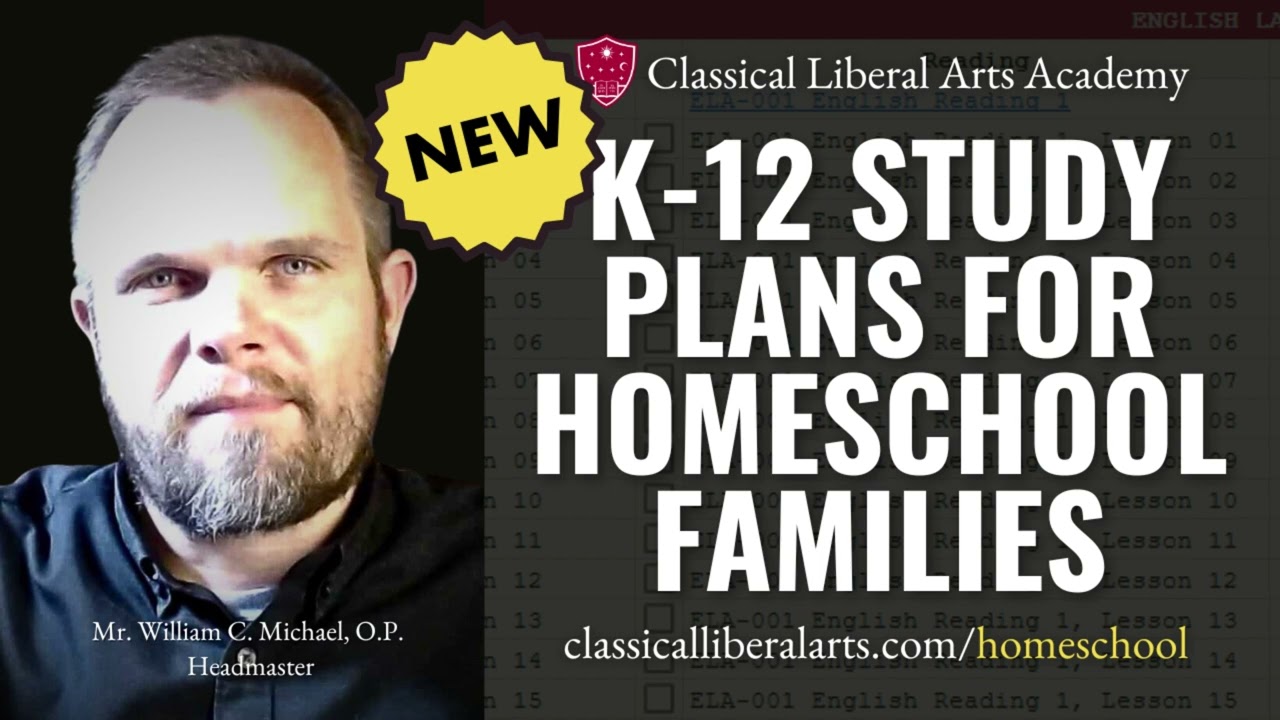
Though the Classical Liberal Arts Academy has served homeschooling families since 2008, our program has never been specifically designed for homeschooling families.
Modern homeschool programs have many flaws, and to avoid them, a program must be developed that has the following virtues:
- A homeschool program must be trustworthy.
- A homeschool program must be simple
- A homeschool program must be secure
- A homeschool program must be flexible
- A homeschool program must be affordable
- A homeschool program must be positive
- A homeschool program must be personal.
Doing what other homeschool programs do doesn’t address these needs. A different approach is necessary and I believe I can provide an effective solution in 2024.
In the talk above, I go into detail about K-12 Study Plans we’re making available for homeschool families. I recommend you listen to it. The transcript is provided below.
Mr. William C. Michael, O.P.
Headmaster
Classical Liberal Arts Academy
Enjoy this article? Take a moment and share it with friends.
Today is Sunday, July 7 2024. And this is William Michael, the headmaster of the classical liberal arts academy. I’d like to talk a bit today to homeschooling parents because I’m about to share some resources and tools in the classical liberal arts academy that are going to be very helpful.
What I’m going to do is break all of the grade levels down for homeschool families into very easy to manage spreadsheets that are really task lists that can be marked and used to track student work throughout the year and in this video in this talk, I’d like to explain what my goals are to help homeschool families. And you know, what the problems are in homeschooling, why homeschooling really hasn’t been able to fulfill its potential or even approach its potential, because of some fundamental problems in the way homeschooling is managed. And then talk about the tools and resources that I’m making available to help homeschooling really take off.
So the first thing I’d like to do is say that there’s a new page on the Academy website. If you go to classical liberal arts.com backslash homeschool, class classical liberal arts.com backslash homeschool, you’ll find a page which is going to be a center for all of the resources that I’m going to talk about. And I spent some time yesterday just writing out some more philosophical type content to sort of prepare for these homeschool resources.
We haven’t really been geared to serve homeschool families. Now we’ve been open to homeschool students, and we’ve welcomed students to come in and use our online courses and things like that. But it has never really been a homeschool program. It’s never been a program designed for homeschool students. And my wife often complains to me and says, it seems like the main group of people interested in our program are adult men, because we get so many adult men enrolling in our courses and and I’ve known that that the work that we’ve done in the academy is not really homeschool friendly for a homeschool mother showing up on our website, and having experience with other homeschool programs and then coming to our site. I know because I talked to homeschool mothers once in a while. And what we’re doing in the classical liberal arts academy just doesn’t fit into the normal stuff in the homeschool world. And that’s because, you know, our primary goal has not been to compete with homeschool programs because I think they’re all faulty. But to really restore the focus on real classical Catholic education, knowing that once we do that all of these practical issues can be taken care of easily private schooling, homeschooling, college studies, and so on. And now with accreditation behind us, we’ve really come to a place where we’re ready to start focusing on the practical application and use of the classical liberal arts academy curriculum in all of our courses.
So what I’d like to do is walk through our program, really a new homeschool program that’s going to be made available that’s going to make this really make homeschooling incredibly easy for homeschooling parents and and I’m going to not only say easy, but I think enjoyable. As I said there are a number of of serious, practical and I could say philosophical, I could say pedagogical problems with homeschool programs they’ve really been able to prosper because of a great vacuum in modern education and they’ve just filled that vacuum but they haven’t filled it well. And homeschooling is largely unsuccessful. You know, we can we can tell our success stories and we can always find students I can I can point to my own kids and how they’ve gone on to success in college and career. But homeschooling has so much more potential and we haven’t even really tapped into that potential yet. And I’m hoping that with these tools and resources and the continued development of our program, we’re really going to be able to start doing some radical stuff in homeschooling and help homeschool parents to succeed in real life circumstances real life. homeschooling, fantasy nonsense, no homeschool conference cheerleading real life challenges, real life dilemmas in homeschooling, because most of us are choosing to homeschool our kids because we don’t want them influenced by secular society. Some people are homeschooling because they can’t afford Catholic education, the tuition at the local schools 9000 bucks, and they’ve got six kids. So there’s just no other option for them. Some some kids like us, or some families like us, we’re out in the country. There’s not a Catholic school in our entire county. So homeschooling for us is just a no brainer. So there’s different reasons. But once we decide to homeschool, we now face this dilemma of managing the education of our children, helping to prepare them for their future vocations. Both generally speaking, as, as Christian adults, and also, specifically as they actually begin to target the fields and the types of work that they’re interested in. We’ve got to help prepare them for both of those things, while also doing all of the work of regular family life, dads need to work moms need to manage the household take care of other kids handle pregnancies. Sometimes mothers also are involved in a family business, or they’ve got their own work to do. We all have different circumstances in homeschooling. And so a plan for high achievement homeschooling has it has a very complex challenge before it, it’s got to have an absolute set of goals. But they’ve got to be affordable, because parents have to bear all the costs of education. And they’ve got to be flexible at the same time. Because no one has the same schedule. No one’s on the same calendar, we we’ve got different things in our family, different events, different times of the year, and so on. So the homeschool program has to be excellent in terms of its quality, it’s got to be affordable in terms of its costs. And it’s got to be flexible, in terms of its organization, and management. And when you put those three qualities together, you’ve got a real problem. This is a very complicated problem to solve. And so what most homeschool programs have done is they’ve just sacrificed quality. they’ve sacrificed real, historic, Christian academic goals. And they’ve just dumbed down the curriculum. So you’re working at the level of of simple workbooks. And they’ve just created these artificial programs to cover the bare minimum requirements for modern grade levels. So they really haven’t addressed the problem, they’ve just chosen an easy way out of the problem that they can turn into cash. And that’s what they’ve done. They make millions and millions of dollars, selling these box curriculum programs that really don’t serve the ends of Christian education. In the classical liberal arts academy, where we’re not, we’re not dumbing things down, we’re not we’re not trying to just slip out from the challenge we face in dealing with this problem. We’ve got to work to fulfill the real goals of Christian education. It’s got to be affordable. And it’s got to be flexible. And when we look at those things, we have to to ask ourselves, How in the world are we going to get this done? And by God’s grace, I think that that I have an explanation and plan for how we can get it done. So what I’d like to do is is invite you to visit that page I mentioned before, classical liberal arts.com backslash homeschool. And as I said, there’s a there’s some philosophical talk there to sort of reorient the minds of homeschooling parents and help them to think about the real goals that we need to pursue and what and needs to be done, we have to get out of this lazy, modern homeschool mind that just dumbs everything down and sets the secular minimum standards as the goals for Christian education. We’ve got to reprogram ourselves. And think rightly, again, about our kids education, because our kids need much more than that. That’s not a Christian education. Our kids need much more, it’s very challenging. And we’ve got to, we’ve got to have a realistic way to get this done to get all this work done. On that page, I talked about the five key characteristics of of our program.
We’re organizing and offering an accredited, classical, Catholic, homeschool, curriculum. And all five terms are important, accredited, classical, Catholic, homeschool curriculum. The challenge is maintaining all five of those pillars, we could say, the challenge is to maintain all five of them, what other homeschool programs do is they neglect one or more of them. The challenge is to fulfill all five of them to observe and maintain all five of them. accredited, classical, Catholic homeschool program curriculum.
So first of all, as far as accreditation goes, you probably know by now that we’ve been accredited by Cognia, which is, which is really an incredible gift. It’s really incredible that the classical liberal arts academy being an authentic classical Catholic study program has been given modern accreditation, because we’re not designed for accreditation, we’ve been designed from the beginning to serve the true goals of real classical Catholic education. And yet, by by working with the evaluators, I was able to show them how classical Catholic studies fulfill all of the modern school requirements. And I was successful in doing that, and, and we received great scores from them. They give a score, it’s called the institutional educational quality, I think it’s called IEQ. And the average for schools that are evaluated by cognita is like 250 to 270 300 is required for accreditation. And in our first attempt, our first evaluation, we received a score of 320, which is 20 points over the required score for accreditation. And there are many schools who don’t, who don’t receive that 300 level score, they receive lower scores, and they may be accredited with conditions or they may have to work to raise their scores. But we nailed accreditation on our first try. And again, that’s presenting a real classical Catholic educational program to the evaluators, which they’ve never seen before. And they were nothing but supportive the whole time. And I want to make sure Catholic families understand that the accreditation evaluators were nothing but enthusiastic and supportive. The whole time. In fact, I was really skeptical. I wasn’t sure I even wanted to pursue accreditation. And so when I first started talking to the regional director for cochlea and to some of the evaluators, I did so expressing my my doubts and and unwillingness to compromise in any way for the sake of accreditation. And what happened was it every step of the way, they reached out to me and told me that everything looks great to keep going, keep going, keep going, you’re going to be accredited, this looks great. And so on. There were a number of times where I was told that this presentation I made or this interview we had or this response I gave was, was one of the best that they had seen. In fact, our evaluator said that in writing up our initial evaluation report, there’s one part where they have to list strengths of an institution. And she said normally, she she lists one or two, she can find one or two that’s worth mentioning. And for us, she mentioned three or four and she she she went out of her way to tell me that that’s not normal. So our experience with the accreditation agency was extremely positive. And I think we all need to be encouraged by that because the world is not against us as many times I to convince us, many who are selling Christian products do so by exploiting this sort of conspiracy theory fear that everyone is out to get us. And it’s a lie. It’s not true. There are very low quality Christian programs that these accrediting institutions and other schools and colleges reject because they’re low quality programs. The people running them are not professional educators, they’re not experts in in education. And when they interview and discuss these things, and evaluate these things, they raise real problems and criticisms with Christian programs. And then those programs just say, this is just persecution. We’re just being attacked by the secular institutions. And it’s not true. And we’ve proven that to be not true. In fact, when I when I started the accreditation process, they they linked me up with Catholics that work with incognita that would be able to provide help and insights into what we could do. So there’s no opposition at all. But the good news for Catholic families and I’ve already started to see some families benefit from this is that the classical liberal arts academy is now an accredited school program. So that’s the first pillar of our homeschool program.
The second is that it’s classical and not classical in the fake classical movement sense, not like mother of divine grace or any of these other programs that claim to be classical but really are not classical liberal arts study programs. The classical liberal arts academy is truly a classical study program. We studied the classical liberal arts we study classical philosophy, we study scholastic theology, we studied classical arithmetic and geometry, we studied classical reasoning and rhetoric. It’s a truly classical study program. So the timeless human education that can never change because human nature never changes that timeless, classical study curriculum, symbolized and represented in the seven liberal arts. We actually truly maintain and make that available to students today, which is like building a house on a rock academically. So our program is accredited and truly classical.
It’s also Catholic. It’s Catholic in the sense that it’s it’s owned and managed and directed by Catholics it is and always will be submissive to the magisterium of the church. You’re never going to hear any of this modern foolishness of speaking against contradicting the Pope and bishops on any matters of faith or morals. My wife and I who run the program are laid Dominicans, we are faithful and obedient to the magisterium of the Catholic Church and we will work to make sure that everything we do in every part of our program is in agreement with Catholic principles of faith and morals and education in in general. So it is a an accredited classical Catholic study program.
Now, when we say it’s a homeschool program, it is not simply a private school program brought home. This is one of the faults of modern homeschool programs. They’ve just taken the modern K to 12 program that’s available at the local school. And they’ve packed it up in boxes and they just ship it to families teaching their children at home. That’s not a homeschool program. That’s a private school program just sold to homeschooling families and this is one of the real faults of homeschooling and why it’s been so unproductive. Our program is going to be a true homeschool program. It’s intended and organized and presented in a way that actually serves homeschool families in real homeschooling circumstances. So it is an accredited classical, Catholic, homeschool.
And lastly, curriculum. If you look at other programs, you’ll see that they’ve got they’ll list a grade level and they’ll list a bunch of books. And those books have no relation to one another. There’s no actual curriculum. It’s just a first grade set of books, second grade set of books, third grade set of books, just whatever happens to be in print all thrown together into a box maybe with some so called lesson plans, which is just a study guide for how to work through those books. But it’s just it’s just a book selling gimmick. It’s like Book of the Month Club. They get you to sign up for a book of the month clubs so that they can sell you a book every month. They’re not interested in, in any clubs. They’re not interested in actually developing your intellect. They’re trying to find creative ways to sell books and homeschooling is jackpot for book sales. And so you get a box of books that weren’t they were not created to work together they were not necessarily created by Catholics. For Catholics, they were not necessarily created for use in a homeschool by parents and children. They may be books that were intended for schools where all of the children are the same age and work together, rather than a homeschool where there are children working in different grade levels at different ages with different abilities. The box programs are are usually not actually homeschool programs, programs designed for use by homeschool families, they’re just collections of books. Our program is actually a curriculum. That means that we begin philosophically with with grammar and arithmetic and basic catechesis and Bible study, and build on that and develop the student’s understanding over the entire course of his or her studies moving from the most elementary studies all the way up to classical philosophy and Scholastic theology. It’s a real curriculum. And again, that may seem simple, but that’s a major difference between the classical liberal arts academy, and other homeschool programs. If you look at what other homeschool programs are doing in high school, it’s very immature. In our program, because of how the program is structured, because it’s a real curriculum, we have students getting into mature studies. By the time they’re 15 years old, studying Aristotle’s philosophical works, getting into the Summa Theologica, reading Sacred Scripture, studying classical mathematics and so on. Other homeschool programs couldn’t even imagine how that could be possible. And they and they sometimes will go as far as telling parents, that kids actually shouldn’t study those subjects. But the problem is when our kids are 17 1819 years old, they’re going to be making the most important decisions of their lives. And we can’t ask them to hold off on those decisions, until they’ve actually been introduced to these mature Christian studies. We’ve got to introduce them earlier. So they’re already familiar with these concepts and lessons before they start making vocational decisions. That’s another important flaw in modern education. The kids learn too little too late, and make the biggest decisions of their lives without the information that they need to make those decisions. We have to bring these higher studies back down into the high school level, like St. Dominic, if you study church history, he was able to go to the university when he was 14 years old. So at 14 years old, they were ready to begin teaching students philosophy and theology. You can you can learn about that more on the Academy website if you’d like to. But there was none of this nonsense that well, you can study that in college when you’re 21 years old. No, it’s too late. And so the curriculum has to be it has to have a trajectory, that that’s high enough to get the kids to the learning that they need when they need it. Not sometime afterwards. That’s just irresponsible. Our program is designed to lead the kids on a curriculum or course of study from their beginning studies up into those higher level studies before they finish high school before. They’re 1819 years old. That’s very important. And it often is neglected. So we’re offering an accredited, classical, Catholic homeschool curriculum, and it’s important that you understand the significance of those five terms accredited, classical, Catholic, homeschool, curriculum around all of this is explained on that page. Again, classical liberal arts.com backslash homeschool.
Now when you go down further, I talk a little bit on that page about what help homeschool parents actually need a homeschooling, often, like I said, is quick to sell books and supplies. But then actually helping parents to effectively educate their children is optional, or it’s, it’s it requires additional fees and things like that, and it quickly becomes unaffordable. There are specific things that homeschooling families need. And I know because I’m the father of a homeschool family. I’ve watched my wife homeschool our kids, I’ve seen the pros and the cons. I’ve seen the strengths and the weaknesses. I know what the needs are for homeschool parents. And I’ve got seven of them listed on this homeschool page.
The first one is that it needs to be trustworthy. As I said before, the main reason we homeschool is because we don’t want our kids instructed by this crazy, modern secular society. We don’t want that nonsense in our kids heads, especially when they’re developing. And so when we bring the kids home, and we take upon ourselves this heroic task of homeschooling in 21st century America, when we look to a study program, we need something that’s trustworthy. It can have junk mixed in, we can have scandals, and so on, we need something that’s trustworthy. And in the classical liberal arts academy, by presenting a real classical Catholic study program, we can assure parents that all of the subjects, all of the courses, all of the texts in our program are trustworthy, you can relax, if you’re a Catholic, you can relax because our content will always be trustworthy. I guarantee that. That’s really the most important thing in homeschooling. Because if it’s not trustworthy, why even bother, you know, if I’m just going to start compromising and settling for inferior things now that I’m, why even bring the kids home at all. It’s got to be trustworthy, it’s got to be different, it’s got to be better. We can’t have something that’s similar or worse than what’s available in schools. And think that homeschooling will just make up for it. That’s not true. It’s got to be better, it’s got to be trustworthy, and our program is trustworthy.
Second, however, because we’re talking about homeschooling parents, who are lay men and lame women who’s got who’s got other things to do. They’re not full time grade teachers in schools with nothing else to do except to teach third grade math. The work of homeschool parents is is very complicated and challenging. And so this homeschool program if it’s going to be realistic, and if parents are going to be able to use it successfully, it has to be simple. It has to be simple. Now, the curriculum itself is not simple. It’s developed over 1000s of years by Many of history’s wisest, most brilliant individuals. So the curriculum itself is not simple, but how it’s presented to homeschool families, how homeschool families manage it. That has to be simple. And this is where I think our homeschool program is going to be very, very helpful, because it is extremely simple. We’ve already done all the work, I look at other homeschool programs, and they asked parents to make lesson plans to lay out the schedule for their studies. They asked parents to grade their children’s assignments, on and on it that’s not simple. It’s not realistic, especially when you’ve got three, four or five children as many of us do some even more. Again, I have 10 children. The plan that’s designed for the homeschool, yeah, it works great with one kid, two kids. But once we get 2345 kids with differing abilities, and it just becomes impossible to actually manage. And so when when things become too complicated, what happens is the standards begin getting lower and lower and lower to the point where parents are just trying to get through the bare minimum requirements and we cannot allow that to happen. We have to have the highest standards but the presentation of the content In the management of the studies has to be simple. And this is where I think my ability comes in to help homeschool parents. And this is what I think impressed the accreditation agents as well.
If you go to the homeschool page that I’m that I’m introducing here, classical liberal arts.com backslash homeschool scroll down to the bottom, you’ll find a section titled study plans. And now I’m just putting these together. I’m introducing them today with this talk. And I have one that’s available for you to look at for first grade. But what I’m doing is I’m actually taking the course recommendations for each grade level, and breaking them down into their specific lessons and tasks. And presenting all of that in a spreadsheet with checkboxes. And so if you go down to the study plans, these are available for free. Right on the main website, you’ll see that the grade the link to the grade one study plan is active, and you can click on that and you can take a look at the study plan for first grade. Now the study plan you’ll see in the spreadsheet is designed to cover all of the content that’s listed in the recommended courses for a grade one student. So everything is presented and broken down on this spreadsheet. And you can see that in the columns, you’ll see the different subjects. And then in the rows, you’ll see all of the different lesson tasks listed down in the spreadsheet. The simplicity of this for homeschool parents, is that we’re not going to constrain ourselves to some complicated schedule. We’re not going to commit to any, any number of hours per day, any number of lessons per this time, or any any number of things on day one, day two, we’re not going to make any irresponsible or unrealistic commitments to time.
We all know that homeschooling, life is unpredictable, it has to be flexible. It has to be flexible. So we could say one of the disadvantages we have is that stuff just comes up. We’ve got all different kinds of stuff going on at home. It’s not a place that’s dedicated exclusively to education, like a school. And so we’ve got to deal with visiting relatives, sicknesses, pregnancies, business requirements, all kinds of different things at home. So there’s some confusion, some chaos that we’ve got to always be able to manage. So that’s a disadvantage that a homeschool has relative to a school. However, we have an advantage in that we’re together 24 hours a day, seven days a week for 365 days a year, not just five or six hours a day for 180 days a year like a school. So while the school may have more order and less distraction. We have more time with our kids all the time. So we may miss a week miss a day, miss a couple days, Miss A night miss a morning, we’ve got plenty of time to get a year’s worth of schoolwork done. And the plan for study can’t lock us into a schedule because what I’ve seen is that if you create a homeschool schedule, everyone starts off at the beginning and everything’s fine. You go 3456 days in, everything’s fine, then all of a sudden, that chaos of family life starts to interrupt with things in a kid’s sick or someone visits or they’re going away for two days or this happened or dad’s home from work because he’s doing this and that and they’re taking a day off, and all of a sudden the schedule starts to fall apart. That’s why a one schedule for every one homeschool program isn’t realistic. With our study plan, there’s no schedule, there’s no schedule, there’s no time restraint. We’re just focused on required tasks. And we’ve got a whole year to get these tasks done as many as we can. Working with as much time as we’ve got with as much energy as we’ve got whenever we’ve got time. We’re working on the next task and the next task and the next task.
What I want to emphasize in this is for homeschooling to be successful. Parents have to learn to maintain a positive attitude all the time. homeschooling parents have to always be positive. And now I’ll say homeschooling programs often don’t allow parents to be positive because they’re always struggling to keep up or falling behind or leaving things undone, and so on our study plan, what I think is going to be one of the most important benefits of it allows parents to just always stay positive, it doesn’t matter what happened yesterday, it doesn’t matter that you missed last year, or screwed up the year before, because you did this or you mess this up. And the past is irrelevant. All that matters is today. And the next task on the list, just keep moving forward. Always stay positive, always focus on what’s next focus on today, what you can do right now, not what you didn’t do what you failed to do. What can you do today? How much can you get done today. And keep that positive, little by little bit by bit attitude. And just keep working one task at a time through the whole school year, or through the whole calendar year, not even the school year, the whole calendar year. And just be patient and positive and keep moving one task at a time. Now when when you’ve got little kids, they really need to be helped through these tasks. But as the kids get older, they’re going to be able to look at these study plans and just get to work. And just keep moving one task at a time through the plan. And that’s what I think is the benefit of this. It’s it’s realistic, it’s flexible. It doesn’t water down standards, it doesn’t compromise. It doesn’t ask parents to follow a schedule that everyone knows they’re not going to follow. It’s realistic, and practical. It’s positive. And that’s what’s important about it. So if you open up that spreadsheet, you’ll just see the tasks listed under each subject. And the goal is just to get started. When you when you begin your homeschooling get started, and just start knocking off tasks. As a homeschooling parent, you can choose to work through the subjects each day, you can work on one subject one day one subject the next day, it may be possible to get three tasks done in one day on one subject. Your family is going to have its own preferences, in terms of how you handle that, you know, even my wife and I disagree on these things I like I like to work on things in chunks. So if I have a project, I’d like to just dive into that project and not turn my attention away from it until it’s done. My wife would rather keep a daily schedule and put in an hour doing this 40 minutes doing this 30 minutes doing this and work through the schedule. Some time my kids say no, we would rather just work on one subject. My teenagers, for example, they’ll say, I just want to work on algebra, as the only subject I work on until it’s done. I just want to get it done. And then I’ll work on history and work on it until it’s done. And then I’ll work on science and so on. So there’s different ways to approach these things. And our plan allows you to choose to work on these things as you feel most comfortable. And I emphasize the word comfortable. Because what’s comfortable is realistic. And I’ll give myself as an example. It’s very difficult for me to get much done when my family’s home and everybody’s up and busy in the house, it’s hard for me to concentrate on work. I’d rather wait until the kids go to bed. And most of the time, most days, I’ll stay up until three four o’clock in the morning sometimes until eight o’clock in the morning working overnight. Because it’s a time when I know I can work without distraction. And it allows me to be with my family have my daughter coming into my office during the day. And I can just chill out and relax because I always know that I’ve got the night time to get my work done. I don’t have to be stressed out during the day. I don’t have to have some strict schedule where no one can bother me during the day. I’ve got the night time always available for me to get my work done. It’s comfortable for me to work like that. Is it ideal? No I can I can give lots of reasons why doing this would be better. Getting up at 5am would be better I could give all those reasons but the reality is my professional work. My the My way of handling it is comfortable for me. And that’s allowed it to be sustainable and productive. So that comfort level in the way we do things is important and we can’t go around constantly telling ourselves we’re going to keep these rigorous schedules and these rigorous task plans and we’re not going to and if we play In that we’re just planning failure. This study plan doesn’t put any artificial, uncomfortable, unnecessary restrictions on our life as a family, it just says, Get the next task done. Keep moving forward, you’ve got one year to get these tasks done, get as many done as you can just keep going little by little bit by bit, one piece at a time, try to get something done every day, try to get as much done as you can, whenever you have time to do it, just keep moving forward day by day. Now, if you look on that spreadsheet again, and you go down about halfway, you’ll see that there’s a yellow row. And it’s labeled minimum goal. minimum goal. And this is this is arbitrary. And I’m warning you in advance that this may need to move, because we’ve got to start using this and working with it before I can really fine tune milestones and things like that. But I’m setting a mark around the 18th row. Where I think if if you can get all of the tasks done for all of the subjects, up to that yellow role, you’ve had a good year of school, you’ve had a good year of homeschooling, that’ll be a good first grade year for your child, there’s still more to learn. But if you can’t get everything done, you should make it your goal to get everything done up to that minimum goal level where that yellow bar is. And then if you scroll down further towards the end, you’ll see that there’s a green bar that says maximum goal. And maximum goal you’ll see it’s it’s around the lesson 36 in some of the courses and 36 is a magic number in education, because in a normal school year, from September to June, there are 36 weeks of school, think about it 36 weeks times five gives you one ad that’s where the number of days of school comes from. So 36 is always an important number, because that’s the number of weeks in the school year. So if you look at English reading, for example, you’ll see that I set the bar at 36 lessons. So 36 lessons of English reading would be a good maximum goal for a school year. And again, if you think about the calendar, that means you know, an average of one lesson per week through the school. So if you can get one reading lesson done per week, and just continue that for 36 weeks. And remember, they don’t have to be the 36 weeks of the school year, because you have the whole calendar year to work at home. So you’re not cramming in June trying to finish and then saying, you know, oh, man, we didn’t finish this, and we didn’t finish. No one said you’re done in June, you still have three, July and August in the summer before the new school year, the new school calendar starts keep working. So when we set these, you know, 36 weeks is the number of weeks in the school year. So it’s a good a good way to set goals. But we’ve got the whole year, we’ve got 365 days to get 180 days of work done, we’ve got 52 weeks to get 36 weeks of work done. And I think that’s how we have to think about it. It doesn’t matter when the tasks get done. It only matters that the tasks get done. So I’ve set a minimum goal for everyone to work for. Take a rest, catch your breath, and then dig in for the second half and try to get to the maximum or as close as you can to the maximum goal. But remember, we’re never going to talk about what we didn’t get done. We’re only going to talk about what’s next what we did get done. We’re going to always stay positive in homeschooling and keep moving forward. That’s the key to success. In homeschooling and we’ve got a plan. We’re going to have a plan that allows us to do this that allows students to see what they need to work on parents to see what they need to work on. Mothers don’t need to make lesson plans. The kids aren’t made dependent on mom. None of that. Everything is prepared. The courses are available. The lessons are prepared, the assessments are prepared, the grading is provided the records are provided, everything is available. All that homeschool parents need to do is help their children get the next tasks on their study plans done and continue doing that as much as they can until the task lists are finished. And it’s just That simple. So the second key principle of a homeschool plan is that it’s got to be simple. And this is capital s simple.
Thirdly, it’s got to be secure. You’ll notice that recently I closed all free enrollments on the academy Study Center. The number one reason I did that was because of security issues. Our site is constantly being targeted by by bots and spam accounts. And if things are free, those bots and spam accounts can get in and do stuff. By closing all three access, we completely block all of that stuff. The only people who will be in the academy Study Center are students who are paid to enroll. So there’s not going to be any any guests browsing around any weirdos in the study center, any curious people just clicking around, it’s only going to be enrolled people. And so the study center will be secure. It’s Secondly, all of our study materials are in one place on one site. So if you want to watch your child’s internet usage, because many parents are nervous about the internet, we’re not giving kids links all over the internet to go find materials and study materials and links to this website. And that website. Everything is on our website. And so our program is secure, the people who are accessing it are known to us and all of the resources that children need to access to study are on our site. So we’re not sending them on wild goose chases all over the internet, there’s no need to go to other sites or go search Google for some, there’s nothing like that everything is on the classical liberal arts academy Study Center site or the main website. And that’s it. And I’ll make sure that that’s the case. So it’s secure.
Fourth, as I said, it’s got to be flexible. And I’ve already explained how the study plan as we’ve got it laid out here can be used in a million different ways. On any schedule in any time zone. No matter how a family’s day is organized. These study plans are flexible, everyone can use them. There’s not one schedule, there’s not one meeting time, there’s not one way to do it, you just have to focus on getting tasks done. However you get them done, it doesn’t matter. It matters that you get the tasks done, not how you get the tasks done. So it’s very flexible.
It’s affordable. You can use this study program, you know, these study plans, these spreadsheets are going to be free, you can use these plans. And all you need to do this is is the CLA student plan, which costs $25 a month. So for only $25 a month, you can run this whole homeschool plan for each of your kids at home, the family plan limits it to $100 a month for the whole family. So if you’ve got a bunch of kids 100 bucks a month, one simple monthly payment is your homeschool budget, and you just follow these plans. So affordability is obviously not an issue. If you want to pay for a student plan for the whole year at you you save even more you get a discount on the cost, you can pay for it with Pay Pal and pay over six months with no interest. There’s lots of options, but you can you can get it even even more affordably than the monthly payment which is affordable enough as it is. So it’s affordable. And if you want premium services, if you want us to work with you directly and help with planning and things like that, you can bump up to the premium subscription plan. And it’s $100 per student for that. But you don’t have to do that for every kid. It’s not all or nothing. You could choose to enroll one child in the premium plan and have all the other kids on the regular student plan. So there’s lots of flexibility even with the enrollment method, trying to keep it as affordable as possible. Because as again, as homeschool parents, you’re bearing all the cost of education, you provide the facility, you provide the personnel, you’re the one doing the work on and on. Why in the world would any homeschool program cost anything remotely close to private school tuition just doesn’t make any sense. Our program is the most affordable, I guarantee it. And if you can’t afford it, and you need financial help, you need to just get in touch with us and let us know what you need and we’ll work something out. So finances are not an issue our program is and will be the most affordable
Next number six that needs to be positive. And I’ve explained how this is positive. We’re not We’re not constraining ourselves or tying ourselves to a schedule that we’re not going to keep. We’re not going to walk around constantly complaining that we failed to keep the schedule. We screwed up this morning. We didn’t keep it. Yes. It never matters what happened yesterday, all we’re ever focused on is the next task and what we can do today, it’s a positive Study Plan, which is what homeschool families need.
And then lastly, it’s personal. My wife, Dania is going to be dedicated to serving this homeschool program. I’m the one working out the solutions and laying it all out. But once once I have things worked out and ready for use, my wife is going to be managing these homeschool programs and working directly with Homeschool parents. So every homeschool parent that enrolls in the academy and uses our homeschool program is going to have direct access to my wife who’s going to be available to work with you and help you through all the nitty gritty practical details of homeschool life. My wife, again is a mother of 10 children. She’s homeschooled all of them. She’s a classicist herself. She’s studying at Catholic University, she’s earning a master of Cata cases to gray, she’s a lay Dominican, she’s a great resource for homeschooling mothers. You know, I don’t I don’t spend too much time dealing with the homeschool world because most of my time is on actual curriculum and philosophy and administrative stuff. But my wife will be available to work with homeschooling parents usually mother’s in all the nitty gritty homeschool stuff day by day, so she’ll be a great point of contact and resource. And she’ll make this program personal for the parents and students that are involved, that’s really going to be her job. But she’ll be available her contact information is available on that homeschool page. So if you’d like to introduce yourself and get in touch, I recommend you do that. I think you’ll find her very helpful and encouraging. And like I said, She’s homeschooled 10 Kids, she knows all the challenges of homeschooling. She knows practically how to handle things, what’s realistic, what’s not realistic, she’s not going to blow smoke in your eyes. And, you know, just recite all kinds of happy sayings that are not realistic, she’s going to be able to help you realistically succeed in homeschooling. So if you’re a homeschooling mother, I recommend you send an email or a text and introduce yourself and begin communicating because this, this can be a personal program that you can enjoy and have access to expert help anytime you need it.
So those seven key characteristics, make our make this homeschool study plan really special, I think and solves many of the problems of modern homeschooling. And we’re going to see that work out. It’s just a matter of putting it together now. So the first of these plans is already published and available, and I invite you to check it out. Again, if you go to classical liberal arts.com backslash homeschool, you can read about our approach and recommendations for homeschooling, realistic, responsible homeschooling. And then down on the bottom of the page, you’ll see links to homeschool study plans, the grade one plan is already available, you can check that out, start thinking about it, the other plans are going to look just like it, they’re just going to be you know, they’re just going to have the content appropriate for other grade levels. But once you see how this is laid out and how it works, you can anticipate the other plans because they’re going to look just like this. So it’s worth checking out even if you don’t have a first grade student, it’s worth checking it out, because you can see how it’s going to work, how it’s laid out, and so on. And I recommend you do that. And then at the bottom of the page, there’s a list of questions, five or six questions and I’ll continue to add to them as we go. But just common questions that I’m sure you’ll have yourselves and I’ve already written out answers for them so you can just read those answers and and get rolling.
So as I said to wrap this all up. The classical liberal arts academy has served homeschool families for 16 years now. It has never been organized to serve homeschooling families well, but this year that’s going to change as we reveal the study plans and get this rolling. My wife again is the contact person for homeschooling parents. Her name is Dania Michael. She’s accessible on live chat. You You can call the Academy, a phone number 866464, CL A, you can also text that number, and it’ll forward those texts to us. You can also email her her emails on the website, but she’s going to be the contact person for homeschooling. And her and I will be communicating. So anything you share with her that she thinks is significant will get passed up to me. And then I’ll make sure that I’m constantly reviewing and rethinking and improving these study plans to make them as effective and helpful as possible. So, again, I invite you to check all of this out at classical liberal arts.com backslash homeschool, this is the first attempt that we’ve really ever made in the classical liberal arts academy to to serve homeschooling families with detailed study plans for them to follow. And I think you’re going to find this to be extremely helpful if you’ve been in the classical liberal arts academy. For some time, you’re going to say, Man, this is what we always needed. And I think you’re going to really find that not only helpful, but it’s going to it’s going to make homeschooling enjoyable, because it’s going to show everyone what needs to get done. Take away all the confusion, the uncertainty, stress and so on and allow you to have a positive attitude towards daily homeschool work. So check it out. If you have any questions about the plan itself, you know, the philosophical type pedagogical stuff, you can get in touch with me with those questions. But if you want to start talking about the practical details of things, get in touch with my wife. We’re here to help all the time. Every day all year it’s it’s the only thing we do. So I hope you find this helpful. I look forward to your feedback and wish you good luck this upcoming school year in a safe and refreshing summer. God bless