
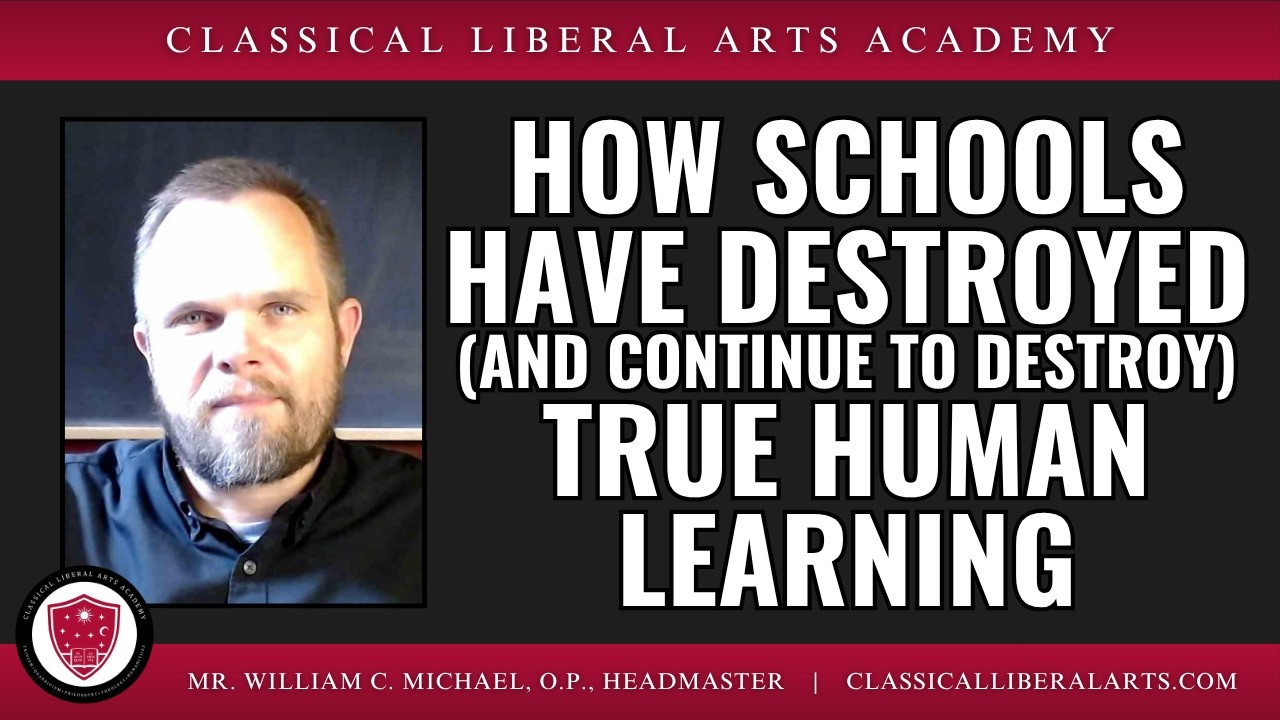
Speaker: William C. Michael, Headmaster, Classical Liberal Arts Academy
Recorded: Thursday, September 3, 2026
Source: RODECaster recording 118, Stereo Mix.wav (1:15:11)
The question: why does study stop when school stops?
Today is Thursday, September 3rd, 2026, and I’m William Michael. I’m the headmaster of the Classical Liberal Arts Academy. I’d like to talk today about how schools throughout history, and continuing today, have destroyed human learning.
We all know that we should be learning. We know that we should be studying. We’re taught when we’re children that we should study and research and be learning throughout life. We know that there are resources available to us. We see the libraries. We know about the online databases and resources that are available. And yet we find that there’s so little study and research being done among adults.
Why do we learn how to write a research paper, for example? Why do we learn how to use libraries? Why do we devote hundreds of millions of dollars in tax funding to libraries and information resources and tools that we never use?
I’ll argue that schools actually are the reason why there’s no independent study or research outside of the school years. That is, when we’re not formally enrolled in schools, either K–12 schools or colleges and universities, we tend not to study, because we think it’s a waste of time.
Schools teach us to be employees
Schools have contributed to this in a number of ways, and they continue to do so. First of all, schools teach us that without their credentials — without a high school diploma, without a college degree, a bachelor’s degree, a master’s degree, a doctoral degree — we can’t get jobs. We will not be able to find quality employment. We will not be able to make a good living. And therefore, if we’re going to study, we need to be careful to make sure that it’s directed toward some credential, some certificate or diploma or degree. Otherwise it’s just a waste of time.
Built into this message is the teaching that we all need to be employees. And remember that almost every teacher that we have in schooling, from kindergarten through twelfth grade and throughout college, is an employee. They work for someone else. They applied for a job. They went through an interview. They work for someone else. They are not independent businessmen.
So we have this educational system where children are being taught, raised, and influenced by men and women who are employees, and they’re teaching the mindset of employees to children — which is completely artificial and unnecessary in a free-market society where we’re free to start our own businesses, start a multitude of businesses, and live a life that satisfies our own unique goals.
By presenting this worldview that we all need to find a place as employees in the future, and that the only way to do that is by collecting credentials from schools, study and research and learning becomes associated with career preparation. It’s seen as something that takes place in school. And if you’re not in school, it makes no sense to study or research, because you’re not going to get any credit for it. You’re not going to get a certificate. You’re not going to get a diploma or a degree. Therefore it’s not going to help you get a job, or if you already have a job, it’s not going to help you get a promotion. So it’s a waste of time.
This is how most people today think about education, and the schools are responsible for this mentality. The schools are responsible for putting students into this mindset that they’re all measured by their employment, and that their employment is going to be dependent on their school credentials. As I said, all of this is false in America, because we’re all free in a free-market society to start our own businesses, sell our own products, deal with paying customers directly. Ultimately the market — the customers — determine what works and what doesn’t work, what they want and what they don’t want, what makes money and what doesn’t make money.
Learning for the sake of wisdom
There’s a lot that needs to be thought through and figured out for us to learn to think rightly. But most importantly, if we’re to think rightly about learning, we need to separate it from this money-making process. We need to separate it from this employment process and realize that learning is important for its own sake.
I don’t just say that to sound cute. Learning is important because there are many questions that we need to answer, many problems that we need to solve, for the sake of our own happiness, that have nothing to do with employment or money-making or academic credentials. They’re simply knowledge that we need to have. There are questions that we need to answer. There are problems that we need to solve. And these things have nothing to do with business, with employment, with money-making, and so on.
Real human learning is concerned with all of these things. Real human learning is concerned primarily with the pursuit of wisdom. And the reason why we pursue wisdom is so that we know what the true end of our life is, what the end of all things is. When we know the true end, we can then look at our lives and order our lives to that end. So even though we have very different circumstances — we’re very different in personality, in resources, in opportunities — we can all, as human beings, still look to our true end and direct everything we do to that end. That’s the life of wisdom. And prudence is knowing what to do in specific situations so that our life is rightly ordered to wisdom, that is, to the fulfillment of our true end as human beings.
All of this has to do with study and contemplation, even prayer, that extends beyond any school curriculum, any school program, any diploma or degree program, any employment or money-making plan. The goal of human learning is human happiness. And so we’ve got to learn to separate, to untangle, learning and study from schooling — because schooling has destroyed human learning.
The scholastic achievement: Albert and Aquinas
I’d like to explain how it’s done that, because it’s even more complicated than what I’ve mentioned so far. I’d like to go back in history and provide an example. As we see this example, we’re going to realize that this has continued through history into the present generation.
Let’s go back to the time of Thomas Aquinas, when scholars in the Catholic Church restored Aristotelian philosophy after it returned into European culture through Arabic scholars. The writings — at least some of the writings, the philosophical writings — of Aristotle had been all but lost to European society, and there was a general disapproval of Aristotelian philosophy because a lot of his system was unknown at the time. Even though his logical works were studied, or at least some of them were studied, Aristotelian philosophy just wasn’t embraced by the Catholic Church.
That was true until the time of saints like St. Albert the Great and St. Thomas Aquinas. Aristotelian philosophy made its way back into European culture through Arabic scholars, through translation works. These wise Catholic scholars began studying Aristotle’s philosophy, and they realized that there was a difference between the true teaching of Aristotle and what was commonly thought to be taught by Aristotle — because Aristotle’s philosophy had been interpreted and explained by Muslim philosophers who had it wrong. And their interpretation, just like Protestant Bible interpretation, was wrong. That led many to discredit the source on account of the interpretation.
What St. Albert and St. Thomas Aquinas did was separate the actual teaching of Aristotle from this Islamic interpretation and re-present it to Christian society with a proper and true interpretation. When they did so, they showed that Aristotle’s philosophy actually reconciled with — and very effectively served — Christian theology. And so these two traditions, the tradition of Aristotelian philosophy and Catholic theology, were married together into what we refer to now as scholastic philosophy.
This was a very, very extensive tradition that extended all the way back through history: back through Jewish history to the patriarchs and prophets, all of the Old Testament writings; through ancient secular philosophy, through the time of Aristotle, into Roman history; through Christian history in the first century when the Church was established and the New Testament was composed; and then through Church history, through the Church Fathers, men like Jerome and Augustine, to the time of Albert the Great and Aquinas.
So this Christian tradition, this scholastic tradition, was extensive. It was a massive, very complex system of learning. The entire library of Aristotelian philosophy, the entire classical liberal arts curriculum, the entire summary, as it were, of the history of human learning was all contained in one system and presented to the world as Christian truth. That’s what scholasticism really is.
Now you can see that the extensiveness of that system of learning would require multiple lifetimes of study to get through. It’s a vast and deep, profound and difficult system of study to work through. Nevertheless, it is possible, especially when we have the help of the direction of men like St. Albert and St. Thomas, which we do, thankfully.
The Order of Preachers and the commitment to study
What happened, however, is that in Church history — let’s think about the formation of the Order of St. Dominic, where men were given license to become preachers who were not bishops, when traditionally only bishops of the Church were recognized as the preachers of Christianity.
What happened over time is that heresies began to become more and more complex intellectually. It became more difficult for men to deal with these heresies, and it became more difficult for Christians to diagnose the errors and resist them. It became obvious that for Catholics to be able to resist the increasingly complex heresies that she faced, she was going to have to devote herself to philosophical study. She was going to have to do the work to understand the true nature of the errors, so that she could reveal them and preach the truth and protect people from these heresies.
This was the mission of St. Dominic when he founded the Dominican Order. This is the work that he himself was doing. It was recognized in the Church that this work was crucial for the success of Catholic teaching in the future and for the protection of the Catholic people. The Rosary itself was revealed to St. Dominic as a means of resisting these heresies, as an aid to true teaching and maintaining the true faith.
So the Order of Preachers rose up with four pillars — prayer, study, apostolic work, and community — and most important of these was study. There was a focused commitment to philosophical study, theological study, at a level that would be able to refute false teaching and truly teach the Christian faith in a way that protected Christians from error.
This massive system of philosophy and theology, which over the next century or so was brought almost to perfection by men like St. Thomas Aquinas, was now established as Christian learning. It was taught formally in Catholic universities like the University of Paris. We can go back and we have records of the curriculum and the plan of study for the University of Paris, to see how this scholastic system began to be taught in the Catholic university and, to some degree, became a prerequisite for Catholic ministry.
The Renaissance turn: Vergerio
Let’s look at the death of Thomas Aquinas in 1274 as sort of the peak of that development of scholastic philosophy and theology. Within two centuries — even less than that, 150 years — we begin to see the seeds of the so-called Renaissance developing in writings like those of Pier Paolo Vergerio, which I recently introduced on the Academy website.
Despite the success of scholasticism — and you’ll see images in Church history of the triumph of St. Thomas Aquinas, with him standing with his foot on the neck of Averroes, an Islamic interpreter of Aristotle’s works, and other heretics like Arius, and I think Sabellius is included in one of the paintings — this image of the triumph of scholasticism over all heresy was, within a century, rejected and abandoned by Catholics. They began to turn against it.
I mentioned the name Vergerio. You’re not going to be able to study him, because his works are in Latin, but I’ve provided a translation of his most important work, which was a treatise that he wrote for a young nobleman, a prince as it were, on what he should study, how he should study, what his goals should be, and so on.
We see, just within a hundred years or so — this is 1400 — a radical departure from scholastic teaching. This is just a private treatise, a private message sent to an individual prince, but it becomes very famous. We see in it the seeds of what was called the Renaissance, which was actually a rejection of scholasticism and a desire to return to some imaginary glory day of classical learning of the past.
Really, I would argue, it is a utilitarian worldview for medieval noblemen who wanted to gain or preserve their power and raise children who would take up the sword on behalf of their noble families and fight for the sake of honor and glory — worldly honor and glory. The vision of scholastic philosophy, which was eternal and transcendent, was unpleasant to these noblemen, who were concerned about their own earthly kingdoms and the battles between different families and different cities and countries at the time.
And so the Renaissance began to develop, and it developed a worldview, and a view for education, that was aimed not at wisdom and human happiness in eternity, but at temporal power and prosperity, honor and glory on earth. That’s the spirit of the Renaissance.
Peter Ramus: learning subordinated to schooling
So in 1400 we see this turn away, and things start to get very complicated. But then we see the corruption of education, and how schools destroyed human learning. We see this in one person in particular, namely Peter Ramus. Peter Ramus — for the sake of simplicity, let’s just say he lived around 1550; let’s just use that date to remember him. So we’re talking a few centuries after St. Thomas.
Peter Ramus is a Catholic. He is a student — very bright, very influential, supposedly very eloquent. He works his way through the educational system, obtains his Master of Arts degree, so he’s licensed to begin teaching, and he begins teaching in colleges and universities in France. As a Master of Arts, he isn’t considered an expert teacher. He’s just a beginning teacher, and he’s learning to teach, and he’s assigned lower-level subjects. He’s very frustrated, because the curriculum — this scholastic curriculum — is very difficult to teach to young students. It really doesn’t fit into the school. It’s much broader, very complicated, very extensive. It’s a subject that needs to be studied throughout life.
Peter Ramus is frustrated because he can’t teach it effectively in the school, in his classes. So he decides to change the curriculum, to change the teaching, in order to serve his goals in the schools. And what we see in the work of Peter Ramus is setting the school and its purpose above true learning itself — so that true learning is now judged by whether or not it serves the school’s purposes well, whether or not it works well within the constraints of school timing, student ability, and so on. True learning is criticized and rejected because it doesn’t work in the school.
The school, remember, is artificial. The learning is real and true. But in the minds of these educators of the Renaissance period, their school careers, their schools, their honor and reputation as teachers becomes more important than the subjects of study themselves, than true learning.
And so Peter Ramus develops a method of study that he imposes on the true curriculum, the true system of learning that was established by the scholastics. He simply cuts off what doesn’t fit in his system, what doesn’t align with his method. And so we have an abandonment of true scholasticism, and we have this new academic system, this new method of Peter Ramus, established in the Catholic schools in France.
It begins to spread very quickly because, remember, the spirit of the Renaissance is secular and utilitarian. It’s anti-religious. It’s anti-contemplative life, and so on. And so the secular rulers like what Peter Ramus is doing. They like his message. They like this idea of schooling. They would like to remove the difficulty of scholastic learning and focus on a simpler, more temporal, more secular end in schooling. And that happens under the direction of this man, Peter Ramus.
It’s no surprise that this happens to be the generation of the Protestant Reformation, or the Protestant schism. And it should also be no surprise that Peter Ramus ends his life as a Protestant. So this man who was allowed into Catholic schools, allowed to change the curriculum, allowed to implement his own methods, his own ideas, his own approach to learning — he turns out to not even be a Catholic man.
I would argue that this is true of many living in the Renaissance, who really lost interest in Catholicism but were primarily interested in their medieval power. They maintained this superficial appearance of Catholic culture because it was necessary, but they really had no interest in the true mission of Catholic faith and morals, as St. Thomas Aquinas did. And so these secular men, these Renaissance Catholics, they really hated the scholastics.
The Protestant Reformation, just like the scientific revolution — if you really get down to it, what we’ll see is that it’s a rebellion against scholasticism. It’s a rebellion against Thomas Aquinas and true philosophy in the Catholic Church. Even today, if you mention Aquinas, scholasticism, and so on, you’ll find many Catholics who scoff at Thomas Aquinas, who scoff at scholasticism as if it’s some silly, obsolete fad that troubled the Church for a while but was moved beyond in time by smarter men. Of course, no such thing is true. The peak of philosophy and theology in the Church have been abandoned by many because, like those Renaissance Catholics, they’re more concerned with secular ends than with true religion and philosophy, with true learning.
The pattern: utilitarian education
What we saw in Peter Ramus was the subordination of true learning to schooling, and I want you to focus on that error: subordinating true learning to schooling, acting as if schooling is the ultimate reality, and true learning is only valuable — or really only identified — when it serves the schools. Because that error continues to this day.
Schooling has become the lord of learning. And true learning, because it can’t fit into a school schedule, can’t fit into the school budget, can’t be served by available teachers, and doesn’t really serve the credentials that are necessary for employment or for college admission — true learning is scoffed at, despised, and has been eliminated from school curricula.
What I’d like to recommend that you focus on as the most important issue — you may think the most important issue is Catholic religion or theology. It’s not. It’s not, because we can fake a superficial interest in Catholic religion while denying the real mind and heart of it. Remember those Renaissance Catholics who became Protestants; they did that for a long time. And many do that today. Many are interested in Catholicism for social benefits, for material benefits, for professional benefits, and so on. It’s respectable to be a Catholic in most places.
But the question is: is this Catholicism that’s desired by men the same as the Catholicism that was desired by Christ and the Apostles, or by the Church Fathers, or by the Doctors of the Church, men like St. Albert and St. Thomas Aquinas? Is it the same Catholicism that’s desired by men like St. Francis and St. Dominic, Padre Pio, St. Ignatius, St. Teresa of Avila, and so on? Is it the same Catholicism? Or is it more like the secular Catholicism of those Renaissance Catholics, who eventually crashed and burned and separated themselves from the Church because the Church did not go along with their secular desires?
It’s not true to say that history repeats itself, because the events don’t repeat themselves. What we find in history is a pattern. When we see the pattern, we can see that that pattern continues to manifest in history in different circumstances. The pattern that I want to draw your attention to is this subjection of true learning and true religion to artificial schooling, where schooling is treated as the real end and learning is treated as only a means to that end.
What we see here is what’s called utilitarian education. What that means is that education is aimed at serving some use, some useful purpose. So when we say things like, “Why do I need to study algebra? How am I ever going to use that in my life?” — what we see is education being asked to answer to a utilitarian worldview. I’m interested, for example, in making money. How is algebra going to help me make money? What is its use in my life? That’s utilitarianism.
Starting in the Renaissance, we see utilitarianism taking over education. Whereas in the life of Thomas Aquinas, in the schools that were taught by those scholastic philosophers, and later when the Jesuits rise up, we see that true education fights against utilitarianism.
We could say that true education is utilitarian if the end is the true end of human life. We can say that philosophy and theology, the classical liberal arts and so on, are useful in that they serve the true end of human life. But when we talk about “utilitarian” in a normal context, what we normally mean is some secular end — some end that is short of the true end of human life — being set up as the end at which we aim everything we do, and then examining what we’re doing or what we’re learning in light of that false end and asking what the use of it is. And if it can’t prove itself useful, cutting it out.
Logic is the test
As I said, I’d like you to focus on one thing. I’d like to direct your attention to one subject that you can always focus on to see the distinction between scholastic education, directed to the true end of human life — which is happiness, in wisdom, through virtue — and all inferior ends that are set up in its place. And that one subject is logic.
I’d like to ask you, when you look at or consider schools, study programs, and so on, I’d like you to focus not on religion, as I said, because we can fake a shallow utilitarian interest in religion. I’d like you to focus on the study of logic, because that becomes the real sign of true education and false education.
The principal achievement of Aristotle in human history — and we really can’t overstate this — the achievement of Aristotle was the development and teaching of the art of logic. That’s what Aristotle principally did. The reason why he’s called “the Philosopher” and celebrated by St. Thomas Aquinas is because he established the method by which human beings are to seek truth.
If we think of the Dominican motto, veritas — which is also the motto of Harvard University — veritas, truth: if truth is the end of our study, which it should be, because truth is the perfection of the intellect; if truth is our end, we have to ask the question, how do we move toward the truth? How do we find the truth?
Aristotle demonstrated that truth is sought by means of human reason. But there are different kinds of reasoning, because there are different circumstances and degrees of truth. For example, some things are true with perfect certainty. We call this scientific knowledge — and don’t get it confused with modern science. Aristotle called this science, meaning knowledge that is absolutely certain. That’s a certain kind of truth, and it’s pursued by a certain kind of reasoning, namely demonstrative reasoning.
Another kind of truth or knowledge would be probable knowledge — things that aren’t certain, but they’re probable. They’re usually true. For example, when a woman gives birth, she normally has a child that’s normal. We don’t expect a child with deformities or handicaps and so on. We expect that in normal circumstances, where a woman follows a healthy diet and a healthy routine of life, she gives birth to a healthy child. That’s normal. We talk about things being normal, or regular, or usual. Those are probable truths, things that are probably true. If you eat healthily, if you avoid bad habits, you will probably enjoy good health. That’s probable knowledge — different from demonstrative. We’re not saying you certainly will, as with a demonstrative argument. We are arguing that you should eat healthy because you probably will enjoy health if you do so. That’s probability.
So there are different kinds, different qualities of knowledge, and different kinds of reasoning that serve those different situations. Aristotle explained all of this in the form of an art. That is, he taught the formal method for reasoning rightly, and he taught this in a series of books that put together are called the Organon, which means “the method.” That was Aristotle’s principal achievement in philosophy. His philosophical writings on ethics and physics and metaphysics are simply the application of that method of logical reasoning to those different subject areas of philosophy.
Aquinas’s method, and the popes who called us back to it
That’s what makes him the great philosopher, and that’s what St. Thomas Aquinas restored. If we look at the works of St. Albert the Great and St. Thomas Aquinas, we find careful expositions of the logical works of Aristotle. We find the method of disputation, the method of reasoning established and taught by Aristotle, established as the method of teaching and refuting error in the Catholic Church. We see that on display in the Summa Theologica and in the Summa Contra Gentiles.
Thomas Aquinas established that method as the method of both discovering true theology, of teaching true theology, and of refuting false theology. And again, we have models of this in his own works, the Summa Contra Gentiles and the Summa Theologica. We see the Summa Theologica as something of the climax of Catholic doctrine, and it becomes an authoritative source in Church history.
We see popes like Pope Leo XIII and Pope Pius X urging the Church, urging bishops, to constantly return to the scholastic system and to constantly return to the teaching of Thomas Aquinas. And we’re talking 1800s, 1900s, into modern society.
If we look around today, we’ll see the Dominican Order still flourishing. You can look at a modern example of this in the Thomistic Institute. You can go on YouTube and search for the Thomistic Institute and look at the videos and the products offered by these Dominican friars, and you see the quality and excellence of it, the relevance of it, even today in the twenty-first century. It’s as relevant, as influential, as ever before. And so the scoffing at scholasticism is really ridiculous.
Where scholasticism is abandoned, heresy runs wild
Consider the total chaos that exists today. If you look at Protestantism, for example, and you just see these Protestant people — Protestant pastors and teachers and authors — just running wild all over the internet, publishing books, videos, conferences, churches all over the place: it’s completely out of control. And if you look to the bishops of the Church and the priests of the Church, you find no efforts to refute it, to discourage it, to call those Protestants back into the true Church. It’s out of control.
The clergy is unequipped to deal with these heresies. The Protestants are very zealous. Many of them are well-educated in modern terms. Their arguments can appear to be very difficult for Catholics to untangle and refute. And it just runs wild like cancer, just spreading through the whole body, and there appears to be no solution for it.
There’s no way that we can deny that the loss of control of heresies and the maintenance of scholastic philosophy and scholastic learning are inversely proportional to one another. In other words, when we abandon scholasticism, heresy runs wild. Even if we’re zealous to fight against it, we find we don’t have the means to do so. We don’t have the weapons that we need to diagnose what the actual errors are, or to prescribe the remedies for them. We don’t have the intellectual weapons to be able to do that. And that’s the state of things today in the Church.
If you look around and ask who is it that’s defending the Catholic faith against these forces in society, you find lay people. You find laymen doing the work of apologists, which really isn’t even their job. This is supposed to be done, and was done in history, by bishops, and to a lesser degree by priests. The Order of Preachers was established for this kind of fighting. Thankfully, we do see Dominican friars and laymen doing this work. But we see the clergy moving away from scholastic philosophy, scholastic education, and just surrendering this field to non-Catholics. We see that, and there appears to be no remedy. As I said, the spread of heresy and scholastic education appear to be inversely proportional, which is one reason we should want to restore scholastic philosophy.
It’s also worth noting that Protestants — really sharp Protestants, some that I’ve known in the past — have actually become enamored with scholastic philosophy. There are Protestants, as obviously crazy as this may sound, who identify as Thomists, that is, followers of Thomas Aquinas. And there’s sort of a running joke that Protestant classical schools produce Catholics, because kids who are introduced to classical ideas quickly abandon Protestantism.
So this isn’t a mystery. I worked in a Protestant school before my conversion, and the headmaster of the school had a bunch of kids. He knew that I was in the midst of converting to Catholicism, but he told me that he sent his kids to these expensive classical Protestant schools and they all became Catholics. One of them was studying at Notre Dame when I was teaching. Classical education — and I’m not even talking about real classical education; even counterfeit classical education — moves us back toward Catholicism.
What Catholic schools actually advertise
The failure of schools was subjecting true learning to the school, and directing the schools at some secular utilitarian ends, and then using the school as a mold, and whatever in true learning couldn’t fit into that mold, just cutting off and throwing away. And we see that continues today in schools.
If you look at your local Catholic school, you say to yourself: who’s the patron saint of Catholic schools? And the answer is Thomas Aquinas. And then you look at the curriculum of that Catholic school and you ask, does it look like this school is one that follows the wisdom, the teaching, the example, the counsel of Thomas Aquinas, its patron? And again, you can focus on one subject — logic — and look at the curriculum. Is it a logic-centered curriculum? The answer is no.
If you look, you’ll see college admission advertised as a sign of success: what percentage of the students get admitted to college. Which is meaningless, because it doesn’t mean they’re getting admitted to Ivy League schools. It means they’re just going to college. If you look at college statistics for many of these colleges, the admission rates are terrible. They’re admitting anyone. And these are kids who are applying to second- and third-level colleges after all of the top kids have already been taken out of the pool of candidates by better schools. So to boast about what percentage of students goes on to college is just a completely meaningless number. It has nothing to do with the quality of education.
We see boasting about college admission. We see boasting about Catholic school SAT scores possibly being a few points higher than public schools. And then we see commended to us their science laboratories, their sports programs, and so on. Just nothing to do with Thomas Aquinas, with the history of Catholic learning, with true philosophy or theology. Nothing to do with these things. We see a utilitarian school ordered to some inappropriate end for Catholic students. That’s what we see in the Catholic schools.
Again, if we look at the curriculum, we find that logic is nowhere to be found. The study of the art of reasoning, the core art of the human intellect, is omitted as if it’s unnecessary to our purposes. And yet there will be all of the usual cliché, and all of the talk about how we’re raising children to love the truth, to love God, to want to know the truth and protect them from error. But what we’re doing has nothing to do with the method that was prescribed for that work by the man who is considered to be the one who triumphed over all of the heretics, the Angelic Doctor of the Catholic Church.
It’s utilitarianism. It’s utilitarianism. And again, the symptom we can look for is the removal of logic from the curriculum.
Counterfeit logic, counterfeit classical education
Now, we’ll see some fake classical schools try and introduce some logic, but what we’ll see is that they’re introducing an artificial, counterfeit study of logic that really has to do more with Renaissance Catholicism and the teaching of men like Peter Ramus. He actually was the one who created the counterfeit logic system that became common in Renaissance schools and then in Protestant schools. It’s not the true art of logic. It’s an art of logic that has been designed to serve the ends of schools rather than the end of human learning itself. And so it’s not true logic. We’ll see examples of this fake, superficial, utilitarian logic in modern schools, but not the real thing.
That’s why I say that looking at the subject of logic is the symptom that you can look for in a diseased school.
In the Classical Liberal Arts Academy, we teach students Aristotle’s Organon. We introduce students to scholastic philosophy. We introduce students directly to the writings of Thomas Aquinas, because that’s Catholic education. That learning will never fit into our school program, or any diploma program or degree, and we don’t ask it to do so. We don’t make it fit into the school. The system of true learning and a school program are two separate things, and in the Classical Liberal Arts Academy we’ve figured out how to keep them separate. We can provide students with credentials, because they are necessary in our upside-down society. We can provide students with credentials without changing the curriculum, or making the curriculum subordinate to those credentials. And that’s the key solution for the problem in modern schools.
But the problem that I want you to see — how schools have destroyed learning — is that schools have become utilitarian systems aimed at serving some end that’s not appropriate for Catholic education. And then anything that doesn’t fit into that school system — in the school schedule, in the courses of study that are available, in the capacities of the teachers that are available — it’s just eliminated from the curriculum, no matter how important it might be, no matter how fundamental it might be, like the art of logic itself. It’s just cut out. And then the marks of success that are presented are things like college admission, employment rates, graduation rates, SAT scores, science laboratories, and so on. These things have nothing to do with Catholic education. This is all utilitarian education. And this is how schools have destroyed learning.
What a school is actually for
Again, I mentioned earlier, and I want to come back to this one point: true learning requires a lifelong commitment to study, to contemplation. It requires the experience of our life to constantly grow over time. Aristotle, for example, explained that we can’t really study moral philosophy until we gain experience in life, because that teaches us and helps us to appreciate the doctrines of moral philosophy. And so true learning is supposed to be a lifelong commitment to work, prayer, and study.
School is supposed to be a place — if there’s any school at all — that introduces children to lifelong learning. It’s supposed to introduce children to the sources that they’re going to be studying for their entire lives: to the Scriptures, to the catechism, to the sacramental life of the Church, to the great Fathers of the Church, to the great philosophers of history, to the Doctors of the Church, to the scholastic philosophers.
Children should be introduced to all of the sources that they should be studying for the rest of their lives. They should be taught how to access these sources, where they can find them. They should be taught how to go about these studies. They should be introduced to them, initiated into this intellectual life. That should be the purpose of schools. Schools should not be subordinated to some secular utilitarian end. If the schools don’t introduce students to this intellectual life, who else is supposed to do so?
This is what schools have done to destroy education. In order to fix education, we have to correct the end that the school is intended to serve. The same error is true in parenting, where parents try to do things that aren’t appropriate for parents to try to do. That’s what schools are doing as well. Schools should be institutions, if they are going to be institutions — and remember, this includes homeschooling; homeschooling is schooling.
Schools should introduce Catholic children to their heritage of scholastic learning. It should be an introduction, an initiation. They should learn what the sources are. They should learn the history. They should learn what the problems have been in history, and who solved them, where they were solved, how they were solved, and so on. They should be introduced to the great works.
And I’m not talking about literature. Again, that’s a Renaissance error — this great books education where kids are reading Moby Dick and Shakespeare and Tolkien and Herodotus while they don’t know Scripture, they don’t know the classical liberal arts. That is not classical education. That’s Renaissance education. That’s the error. That’s not the solution.
The children should be introduced to the classical liberal arts, the seven liberal arts, which ancient wise men said were essential for the pursuit of wisdom, for true philosophical study. They should be taught the seven liberal arts while they’re in formal schooling, by teachers who are masters of them. They should be introduced to classical philosophy, especially the philosophy of Aristotle. When I say philosophy, I do not mean a survey of philosophical ideas through history. That’s just encyclopedic learning. Again, that’s Renaissance education. That is not scholastic education. They should be taught the philosophical doctrine of Aristotle by actually reading and studying his works. They should be taught theology. They should be taught Sacred Scripture. They should be taught the Catechism of the Catholic Church. And they should be introduced to the Summa Theologica, to the writings of the Church Fathers, and so on. That’s what a Catholic education should look like.
The Renaissance war on religious vocations
If children are provided with that education, we may say, “Well, how is that going to prepare them for college and careers?” And you see the secular Renaissance spirit judging the curriculum. This is the error.
I mentioned before, if you go back and study the writings of Renaissance Catholics — and I’m not talking about saintly men who lived during the Renaissance; I’m talking about Catholics who were marked by the spirit of their age, men like Vergerio, whom I mentioned before, and I’ll share more over time, but I’ve got to translate them first — if you look at Vergerio, if you look at Peter Ramus, what you’ll see is that they are secular-minded men who view education as utilitarian. They cut out anything that can’t answer to secular usefulness. Their focus is on secular occupations, secular life.
And you’ll also see that the enemy of their worldview is religious vocations. These noblemen, these rulers in medieval Europe, they do not want their sons growing up and becoming priests and monks. They want their sons to take up the sword and fight their families’ wars against other families.
We can see good examples of this in famous saints. Look at St. Francis and what his father wanted him to be. His father was a Renaissance Catholic, even though he was early in time. You see the spirit of that culture. They were concerned with their families, with their fortunes. They wanted sons to become fellow soldiers with them.
Look at St. Anthony of Padua. Padua was the city where Vergerio was a teacher. You see the life of the medieval knight that St. Anthony was raised for, and he ended up becoming a Franciscan and a great teacher. You see in his life how his father was disappointed in his choice to become religious.
The thought of young men, young Catholic men in medieval society, becoming religious was the terror of these secular-minded families. And everything that inclined them to religious vocations, everything that inclined them to contemplative life — like contemplative studies themselves — was cut out of their experience.
Compare that life to the life of Thomas Aquinas, who was raised in a Benedictine monastery from the time he was five years old. His parents tried to lock him up because he wanted to be a Dominican. And let’s be honest: when new religious orders develop, no one really knows if they’re true or if they’re some wacky innovation. St. Thomas wanted to join the penitent Dominicans, whereas his parents wanted him to join the honorable Benedictines. But we see that there was always this struggle, especially in medieval culture, between secular and religious vocations. And the education of the Renaissance was just the increasing opposition to anything that moved a student to religious life or to contemplative life.
When Vergerio, in his treatise, talks about the study of the three great faculties — medicine, law, and theology, which were sort of like the end points of medieval education — he doesn’t talk about theology as the service of the Church, the Christian ministry, the religious life. He waters it down to sound like metaphysics: it’s the study of supernatural things, things that can’t be perceived by the senses. He makes no mention of Christian theology. No mention of sacramental ministry, religious vocations. There’s just medicine, law, and some metaphysical nonsense. That’s the attitude of the Renaissance.
That’s why, when we see the rise of Protestantism, we see it go to war against religious life. Think of Henry VIII in England: shuts down all the monasteries. Protestantism opposes the whole idea of religious life, religious vocations, celibacy for the sake of the kingdom of God, a priesthood — rejects all of that. Wants everything focused on secular ends; wants religion focused on and serving secular ends. That’s the error of the Renaissance, which again led to both the scientific revolution and the Protestant Reformation, and continues today.
The vocations crisis follows the curriculum
It’s not a surprise that we find a vocations crisis in a society with Catholic schools that are utilitarian and serve secular ends. We’re not providing kids with an education that introduces them to the disciplines that are served in religious vocations. So we’re looking at these kids when they turn eighteen, and asking them, “Why don’t you want to be religious?” And their response is, “What do you mean? What does that even mean? What does it mean to be religious? What does it mean to be contemplative?”
Look at the curriculum. There’s no logic. There’s no contemplative studies. There’s no philosophy. There’s no scholastic theology. They’re not being educated for religious vocations. And the lack of interest in religious vocations is just consequential to the education that they’re receiving.
What we never study: marriage, parenting, religion
As I said, in the Classical Liberal Arts Academy we’re working to fix this — first of all and most importantly by teaching our students and parents, because parents are part of the problem here, teaching parents that Catholic learning is a lifelong pursuit. It’s not limited to schools. It’s not limited to credentials. It’s not limited to employment preparation or career readiness.
If I were to ask Catholic parents to explain to me the duties of husbands and wives and the nature of marriage, they’ll be largely ignorant. Why? Because they don’t study that. They don’t study marriage. If I were to ask Christian parents to explain to me the duties of parents — what are they actually supposed to be doing, how are they supposed to do it? — they’ll look at me as if that’s a mystery, because no one studies parenting.
What do we study? We study subjects in schools that get us credentials that we can use to get jobs. That’s what learning has been reduced to. We don’t study for the sake of wisdom throughout life. We don’t use the skills that we were taught in school, even though imperfectly. We don’t use those skills to actually direct our lives outside of school, outside of business. We just wing it. We wing it in religion. We wing it in marriage. We wing it in parenting. We wing it in education. Because if it can’t be reduced to employment preparation, if it can’t be reduced to some utilitarian purpose, we don’t do it.
That’s how schools have destroyed human learning, Catholic learning. Everything has been reduced to utilitarianism, to secular occupations. When a kid asks, “Why am I studying this subject? Why do I need to learn Latin? Why do I need to study algebra? Why should I study geometry?” — if we can’t think of some kind of secular use, we have no answer.
I hear people say things like, “Oh, well, you should study Latin because Latin strengthens your mind.” No, that’s not why you should study Latin. You should study Latin so you can read Latin, because the entire history of the Church is filled with Latin literature, most of which has never been translated.
“Why should we study algebra?” “Oh, well, because you need algebra for college admission.” That’s why you should study algebra — for college admission. “Why do you need college admission?” “Because you need to go to college to get a bachelor’s degree, because you need a bachelor’s degree to get an entry-level job at a major company and make a living.” So you’re studying algebra in seventh grade for a job when you’re twenty-five years old. And a seventh-grade student is supposed to appreciate that explanation. That is not why we study algebra.
And so you see, this is how schools, by this utilitarianism, have destroyed human learning.
The remedy: make the Organon the core of a lifetime’s study
The key symptom, again, is the study of logic, which is very inefficient, very inconvenient, but it’s the foundation of all human learning.
In the Classical Liberal Arts Academy, I ask that parents and students both commit to making the study of Aristotle’s Organon, the art of logic, the core focus of their education — to start while they’re young, while they’re in school, and to continue throughout their entire lives. It is the foundation of human learning. It is the mark of true education: the study of the art of logic. Again, not some goofy homeschool workbook called “logic,” not some goofy Protestant fallacy-detective book — that’s all fake nonsense. I’m talking about the art of reasoning taught by Aristotle in the works of his Organon, in the classical reasoning courses of the CLAA. If you want to study with us, you don’t have to. It’s available outside the CLAA. You can study it online at no cost. But I ask Catholic parents and students to make the study of Aristotle’s logic the core of their lifelong learning.
The removal of logic has been caused by utilitarian schooling. It destroys all Christian teaching. It destroys all philosophy. It leaves students completely unprepared for false teaching in the world when they become adults. It leaves them completely unprepared for decision-making in their lives. And not introducing them to true learning leaves them unequipped for an actual, healthy Catholic culture to enjoy for their entire lives. The parents normally don’t have this themselves, which is the beginning of the problem, but it can be fixed immediately.
This is how schools in history have destroyed human learning, and how they continue to do so.
Don’t be deceived by “classical” schools
Don’t be deceived by things like classical education movements and classical schools. If you look at their curriculum — take these schools like Chesterton schools, or any of these Dorothy Sayers schools or homeschool programs that claim to be classical — they’ll talk about the Socratic method, which makes no sense, because Socrates was before Aristotle. [Word indistinct in the recording.] It doesn’t even make any sense. They’ll talk about the Socratic method, which is not true reasoning. It’s just one kind of reasoning.
They’ll talk about the great books, by which they mean Renaissance humanities, humanism, literary studies. That is no part of real scholastic education. They’ll talk about the study of Latin for some utilitarian purposes, like strengthening the mind, raising the SAT score, improving English vocabulary — none of which is the goal of the study of Latin. And you’ll see this shallow, utilitarian educational program that disguises itself as classical learning, but it’s really Renaissance learning. And remember, Renaissance learning led to the scientific revolution and the Protestant Reformation. It’s not true Catholic learning.
Scholasticism is true Catholic learning. St. Thomas Aquinas is the master of scholastic learning, and in the Classical Liberal Arts Academy that’s what we’re restoring and promoting, making available. But again, you don’t need to study it in the Classical Liberal Arts Academy; you can study it freely on your own. But if you would like help doing so, if you’d like some direction and resources to allow you to do so, to allow your kids to be introduced to these studies — that’s what the Classical Liberal Arts Academy is for: the restoration of real education, real learning. Hopefully that solves this problem that has been caused by modern schools.
Closing
So I hope that that’s helpful. I’ve run long here; I want to cut this off. But you should be able, by the end of this talk, to identify what exactly schools have done to destroy education. You should see how long this has been done by schools. It’s not something that started in the past generation, or in the 1950s, or in the 1800s. It’s something that started back in the 1300s and 1400s and has continued to the present day.
Focus on logic as the foundation of true education, and look for it as the symptom of false education. Look for its absence. And ask yourself: who would possibly take logic out of the curriculum? Who would possibly take the art of logic out of the curriculum for children who are told that they are rational creatures whose essential attribute is the faculty of reason? Who would possibly think to take logic out of the curriculum?
I hope that helps.
Transcribed from the original recording. Lightly edited for readability: false starts and filler removed, punctuation and paragraphing supplied, section headings added. Wording is otherwise the speaker’s own.