
The following is obviously not meant to be exhaustive of the theology of the Eucharist. It is simply a reflection on the topic that I produced through my own contemplation and study.
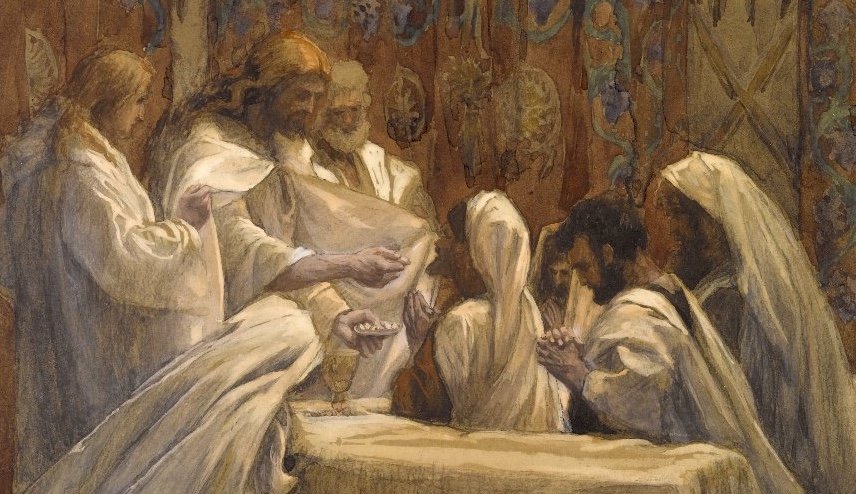
Today (Sunday July 28th), after reading the story of Jesus feeding the five thousand with five loaves and two fish, our Deacon gave an excellent homily on the purpose of the Eucharist, that is, Our Lord’s gift of himself in the Sacrament of his Body and Blood, to nourish our souls. This is above and beyond the physical nourishment which he gave the five thousand through the multiplication of the loaves and the fishes. He explained that the people came to Jesus with a desire for something greater than food. They desired to hear his words. They were seeking him.
Jesus knew that they had risked much to travel to see him in such great crowds, without money or food. He knew that they sincerely desired to hear his words and receive the Good News. Knowing this, he provided them with these, but also with an abundance of food through the miracle of the multiplication. The loaves and fishes fed everyone and there were twelve baskets of scraps.
Our Deacon pointed out that we often come to God with much less desire than those five thousand did. We often seek temporal things from God first, which, as Jesus shows, he is pleased to give us in abundance. We know he promises “all these things”1, meaning food, drink, clothing, to those who seek him sincerely as those crowds did. The crowds sought greater things, and received the lesser in abundance. We often seek lesser things, but God still offers us greater things, though we are blind to see it. In the Mass and in the Eucharist, he provides us exactly what those crowds sought, even to the point of overflowing in abundance. Knowing this certainly does move us to increase our desire of these higher gifts and cultivates our trust that the lesser things he will give in due time.
The crowds sought to gain faith by hearing Jesus’ words and receive him in person. We too, in the Eucharist, are able to gain faith by hearing and receiving Christ himself. St. Thomas says in his prayer, Adoro Te Devote:
“Sight, touch, and taste in Thee are each deceived; The ear alone most safely is believed: I believe all the Son of God has spoken, than Truth’s own word there is no truer token.”
We gain faith in the Eucharist through the “ear alone”, that is by hearing his words and believing them to be true, because Truth himself could not deceive. The Sacrament of the Eucharist fulfills exactly what those crowds desired – to hear the words of Christ and to receive him in the flesh, as it were.
So how does the Eucharist nourish our soul? We understand how loaves and fishes nourish the body, but how does the Eucharist nourish the soul? What does this even mean? This is where my study of philosophy, believe it or not, has provided some insight. These ideas are not worked out perfectly, as I said, but are just a reflection to spur further contemplation.
In Classical Reasoning, we learn that spoken words are symbols of the ideas we have in our souls. The ideas we have in our soul are impressions of the things received through the senses. We see a tree and gain an impression of a tree in our soul. The words that we speak, “That is a tree” signifies the truth both about what the thing is, and the true impression in our soul.
When Christ speaks the words “This is my body”, we don’t have the benefit of any impression in our soul of his body. We have not seen him. But, we do hear his spoken words through the priest at the consecration. In this way, as St. Thomas suggests, our faith comes through hearing – not sight, taste, or touch, each of which give us the impression of the bread and the wine. Our hearing, though, gives us a different impression: that it is his body and blood. Since these words come from Christ himself, we believe that he is telling the truth about what the bread is, and what the wine is, after consecration.
The nourishment that we gain, therefore, is the ability to conceive in our soul the true idea of Christ without having seen him first. “That is Jesus” we say of the Eucharist. And it is both true by faith, and true by reason.
Again, in reasoning, we learn that the ideas in our soul signified by human words are the same for all men, as are the things of which the ideas are the image. What is lacking in our experience of Christ is the sensible experience of his body and therefore no previous impression exists in our soul. But when we receive the Eucharist, hearing his spoken words signifying the truth, our souls are able, by faith, to conceive this true idea. He is there in our soul, truly, as any other true impression would be. Indeed, Christ teaches us as he taught St. Thomas the Apostle: “Because thou hast seen me, thou hast believed: blessed are they that have not seen, and have believed.”2
Moreover, recall that there is an overabundance in the gift of the bread after the people have eaten – that is, there is more bread than when they started, twelve baskets. In the same way, in the Eucharist, it is not simply the impression of Christ that is in now in our soul, but an overabundance: it is Christ himself since we have received his words by faith and his flesh itself, by partaking of the Eucharist. The words of Christ signify the truth about what the Eucharist is, and after receiving, there is more than the words, but also what the words signify, Christ himself, now in our soul.
This is what I think is meant by the idea that the Eucharist nourishes the soul. It gives an overabundance to the natural power of the soul to conceive of true ideas. The soul is now able to conceive of an idea it has not received through the sense, save through hearing. “No one has ever seen God.”3 But through the gift of the Eucharist, we are able to be nourished by the conception of both the true impression and the thing signified by the impression, Jesus Christ, in our soul.