
Return to Elementary Literature 7
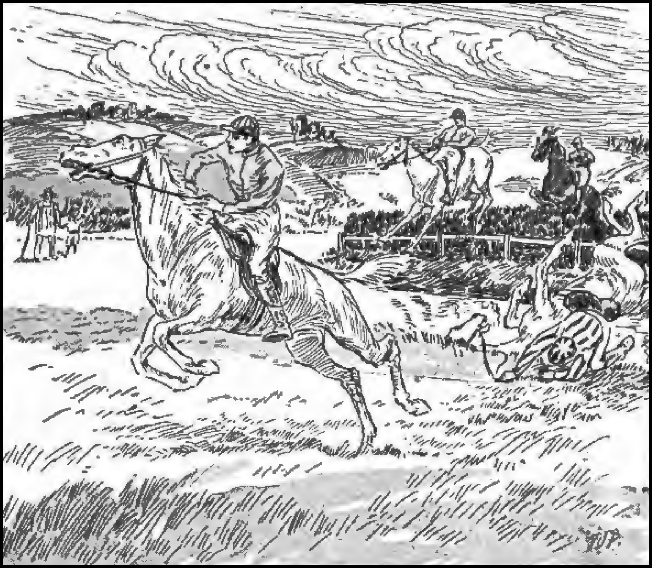
Thirty-two starters were hoisted up on the telegraph board, and as the field got at last under way, uncommonly handsome they looked, while the silk jackets of all the colors of the rainbow glittered in the bright noon sun. As Forest King closed in, perfectly tranquil still, but beginning to glow and quiver all over with excitement, knowing as well. as his rider the work that was before him, and longing for it in every muscle and every limb; while his eyes flashed fire as he pulled at the curb and tossed his head aloft, there went up a general shout of “Favorite!”
The thoroughbreds pulled and fretted and swerved in their impatience; one or two, over-contumacious, bolted incontinently; others put their heads between their knees in the endeavor to draw their riders over their withers; Wild Geranium reared straight upright, fidgeted all over with longing to be off, passaged with the prettiest, wickedest grace in the world, and would have given the world to neigh if she had dared, but she knew it would be very bad style, so, like an aristocrat as she was, restrained herself; Bay Regent almost sawed Jimmy Delmar’s arms off, looking like a Titan Bucephalus; while Forest King, with his nostrils dilated till the scarlet tinge on them glowed in the sun, his muscles quivering with excitement as intense as the little Irish mare’s, and all his Eastern and English blood on fire for the fray, stood steady as a statue for all that, under the curb of a hand light as a woman’s, but firm as iron to control, and used to guide him by the slightest touch.
A moment’s good start was caught-the starter’s flag dropped-off they went, sweeping out for the first second like a line of cavalry about to charge.
Another moment, and they were scattered over the first field; Forest King, Wild Geranium, and Bay Regent leading for two lengths, when Montacute, with his habitual “fast burst,” sent Pas de Charge past them like lightning. The Irish mare gave a rush and got alongside of him; the King would have done the same, but Cecil checked him, and kept him in that cool swinging canter which covered the grass-land so lightly; Bay Regent’s vast thundering stride was Olympian; but Jimmy Delmar saw his worst foe in the “Guards’ crack,” and waited on him warily, riding superbly himself.
The first fence disposed of half the field; they crossed the second in the same order, Wild Geranium racing neck to neck with Pas de Charge; the King was all athirst to join the duello, but his owner kept him gently back, saving his pace and lifting him over the jumps as easily as a lapwing. The second fence proved a cropper to several; some awkward falls took place over it, and tailing commenced; after the third field, which was heavy plowed land, all knocked off but eight, and the real struggle began in sharp earnest-a good dozen who had shown a splendid stride over the grass being done up by the terrible work on the clods.
The five favorites had it all to themselves: Day Star pounding onward at tremendous speed, Pas de Charge giving slight symptoms of distress owing to the madness of his first burst, the Irish mare literally flying ahead of him, Forest King and the chestnut waiting on each other.
Two more fences came, laced high and stiff with thorn, and with scarce twenty feet between them, the heavy plowed land leading to them clotted and black and hard, with the fresh earthy scent steaming up as the hoofs struck the clods with a dull thunder. Pas de Charge rose to the first: distressed too early, his hind feet caught in the thorn, and he came down, rolling clear of his rider; Montacute picked him up with true science, but the day was lost to the Heavy Cavalry men. Forest King went in and out over both like a bird, and led for the first time; the chestnut was not to be beat at fencing, and ran even with him: Wild Geranium flew still as fleet as a deer-true to her sex, she would not bear rivalry; but little Grafton, though he rode like a professional, was but a young one, and went too wildly-her spirit wanted cooler curb.
And now only, Cecil loosened the King to his full will and his full speed. Now only, the beautiful Arab head was stretched like a racer’s in the run in for the Derby, and the grand stride swept out till the hoofs seemed never te touch the dark earth they skimmed over; neither whip nor spur was needed. Bertie bad only to leave the gallant temper and the generous fire that were roused in their might to go their way and hold their own. His hands were low; his head a little back; his face very calm-the eyes only had a daring, eager, resolute will lighting in them: Brixworth brook lay before him. He knew well what Forest King could do; but he did not know how great the chestnut Regent’s powers might be.
The water gleamed before them; brown and swollen, and deepened with the meltings of winter snows a month before; the brook that had brought so many to grief over its famous banks, since cavaliers leaped. it with their falcon on their wrist, or the mellow note of the horn rang over the woods in the hunting-days of Stuart reigns. They knew it well, that long dark line, shimmering there in the sunlight-the test that all must pass who go in for the Soldiers’ Blue Ribbon. Forest King scented the water, and went on with his ears pointed and his greyhound stride lengthening, quickening, gathering up all its force and its impetus for the leap that was before; then like the rise and the swoop of a heron he spanned the water, and landing clear, launched forward with the lunge of a spear darted through the air. Brixworth was passed; the Scarlet and White, a mere gleam of bright color, a mere speck in the landscape, to the breathless crowds in the stand, sped on over the brown and level grassland·, two and a quarter miles done in four minutes and twenty seconds. Bay Regent was scarcely behind him; the chestnut abhorred the water, but a finer trained hunter was never sent over the Shires, and Jimmy Delmar was a great rider. The giant took the leap in magnificent style, and thundered on neck and neck with the “Guard’s crack.” The Irish mare followed, and with miraculous gameness, landed safely; but her hind legs slipped on the bank, a moment was lost, and “Baby” Grafton scarce knew enough to recover it, though he scoured on, nothing daunted.
Pas de Charge, much behind, refused the yawning water: his strength was not more than his courage, but both had been strained too severely· at first. Montacute struck the spurs into him with a savage blow over the head: the madness was its own punishment; the poor brute rose blindly to the jump, and missed the bank with a reel and a crash. Sir Eyre was hurled out into the brook, and the hope of the Heavy Artillery men lay there with his breast and forelegs resting on the ground, his hindquarters in the water, and his back broken. Pas de Charge would never again see the starting-flag waved, or hear the music of the hounds, or feel the gallant life throb and glow through him at the rallying-notes of the horn. His race was run.
Not knowing or looking or heeding what happened behind, the trio tore on over the meadow and the plowed land; the two favorites neck by neck, the game little mare hopelessly behind through that one fatal moment over Brixworth. The turning-flags were passed.
As the shout rose, Cecil’s left stirrup-leather snapped and gave way; at the pace they were going, most men, aye, and good riders, too, would have been hurled out of their saddle by the shock: he scarcely swerved; a moment to ease the King and to recover his equilibrium, then he took the pace up again as though nothing had changed. And his comrades of the Household Guards, when they saw this through their race-glasses, broke through their serenity and burst into a cheer that echoed over the grass-lands and the coppices like a clarion, the grand rich voice of Seraph leading foremost and loudest-a cheer that rolled mellow and triumphant down the cold bright air, like the blasts of trumpets, and thrilled on Bertie’s ear where he came down the course a mile away. It made his heart beat quicker with a, victorious headlong delight, as his knees pressed closer into Forest King’s flanks, and half stirrupless like the Arabs, he thundered forward to the greatest riding-feat of his life. His face was very calm still, but his blood was in tumult: the delirium of pace had got on him; a minute of life like this was worth a year, and he knew that he would win or die for it, as the land seemed to fly like a black sheet under him; and in that killing speed, fence and hedge and double fence and water all went by him like a dream, whirling underneath him as the gray stretched, stomach to earth, over the level, and rose to leap after leap.
For that moment’s pause, when the stirrup broke, threatened to lose him the race…
Certain wild blood that lay latent in Cecil, under the tranquil gentleness of temper and of custom, woke and had the mastery: he set his teeth hard, and his hands clinched like steel on the bridle. “O my beauty, my beauty!” he cried, all unconsciously half aloud as they cleared the thirty-sixth fence, “kill me if you like, but don’t fail me!”
As though Forest King heard the prayer and answered it with all his hero’s heart, the splendid form launched faster out, the stretching stride stretched further yet with lightning spontaneity, every fibre strained, every nerve struggled; with a magnificent bound like an antelope the gray recovered the ground he had lost, and passed Bay Regent by a quarter-length. It was a neck-to-neck race once more across the three meadows, with the last and lower fences that were between them and the final leap of all: that ditch of artificial water, with the towering double hedge of oak rails and of blackthorn that was reared black and grim and well-nigh hopeless just in front of the grand stand. A roar like the roar of the sea broke up from the thronged course as the crowd hung breathless on the even race; ten thousand shouts rang as thrice ten thousand eyes watched the closing contest, as superb a sight as the Shires ever saw while the two ran together-the gigantic chestnut, with every massive sinew swelled and strained to tension, side by side with the marvelous grace, the shining flanks, and the Arabian-like head of the Guards’ horse…
Sent along at a pace that Epsom flat never eclipsed, sweeping by the grand stand like the flash of electric flame, they ran side to side one moment more, their foam flung on each other’s withers, their breath hot in each other’s nostrils, while the dark earth flew beneath their stride. The blackthorn was in front, behind: five bars of solid oak, the water yawning on its further side, black and deep, and fenced, twelve feet wide if it was an inch, with the same thorn wall beyond it; a leap no horse should have been given, no steward of the course should have set. Cecil pressed his knees closer and closer, and worked the gallant hero for the test;… he heard nothing, knew nothing, saw nothing but that lean chestnut head beside him, the dull thud on the turf of the flying gallop, and the black wall that reared in his face. Forest King had done so much, had he strength for this?
Cecil’s hands clinched unconsciously on the bridle, and his face was very pale-pale with excitation-as his foot, where the stirrup was broken, crushed closer and harder against the gray’s flanks.
“O my darling, my beauty-now!”
One touch of the spur-the first-and Forest King rose at the leap, all the life and power there were in him gathered for one superhuman and crowning effort: a flash of time not half a second in duration, and he was lifted in the air higher, and higher, and higher, in the cold, fresh, wild winter wind; stakes and rails, and thorn and water, lay beneath him black and gaunt and shapeless, yawning like a grave; one bound even in mid-air, one last convulsive impulse of the gathered limbs, and Forest King was over!
And as he galloped up the straight run-in, he was alone. Bay Regent had refused the leap.
-From “Under Two Flags.”
Notes
Titan: giant.
Bucephalus: the famous war horse of Alexander the Great; a magnificent animal.
Olympian: In this passage, wonderful, like the stride of a horse of the gods.
Derby: a horse race run annually at Epsom in England for the Derby stakes.
Duello: contest between two.
Questions for Study
- How early in this story can you pick out the hero? How do you recognize him? What more could one want in a horse?
- See if you can guess from this selection what the preceding part of the novel would have told you—the different names used for the horses, who was the rider of each, and what branch of the army he represented.
- Find out from the story what sort of race this steeplechase was.
- Try to picture clearly this race from beginning to end. At different points, describe fully and exactly what you see.
Return to Elementary Literature 7
The lessons published on this site are freely available to read. If you wish to move from reading to formal study — with graded assessments, academic records, and the support of the Academy — you may enroll at any time. Enrollment is open year round, to students of all ages.
← Previous: Lesson 02. Vitai Lampada, by Henry Newbol | Contents | Next: Lesson 04. Four Things, by Henry Van Dyke →