
“After three days they found [Jesus] in the temple, sitting in the midst of the teachers, listening to them and asking them questions, and all who heard him were astounded at his understanding and his answers.”
(Luke 2:46-47, New American Bible Revised Edition)
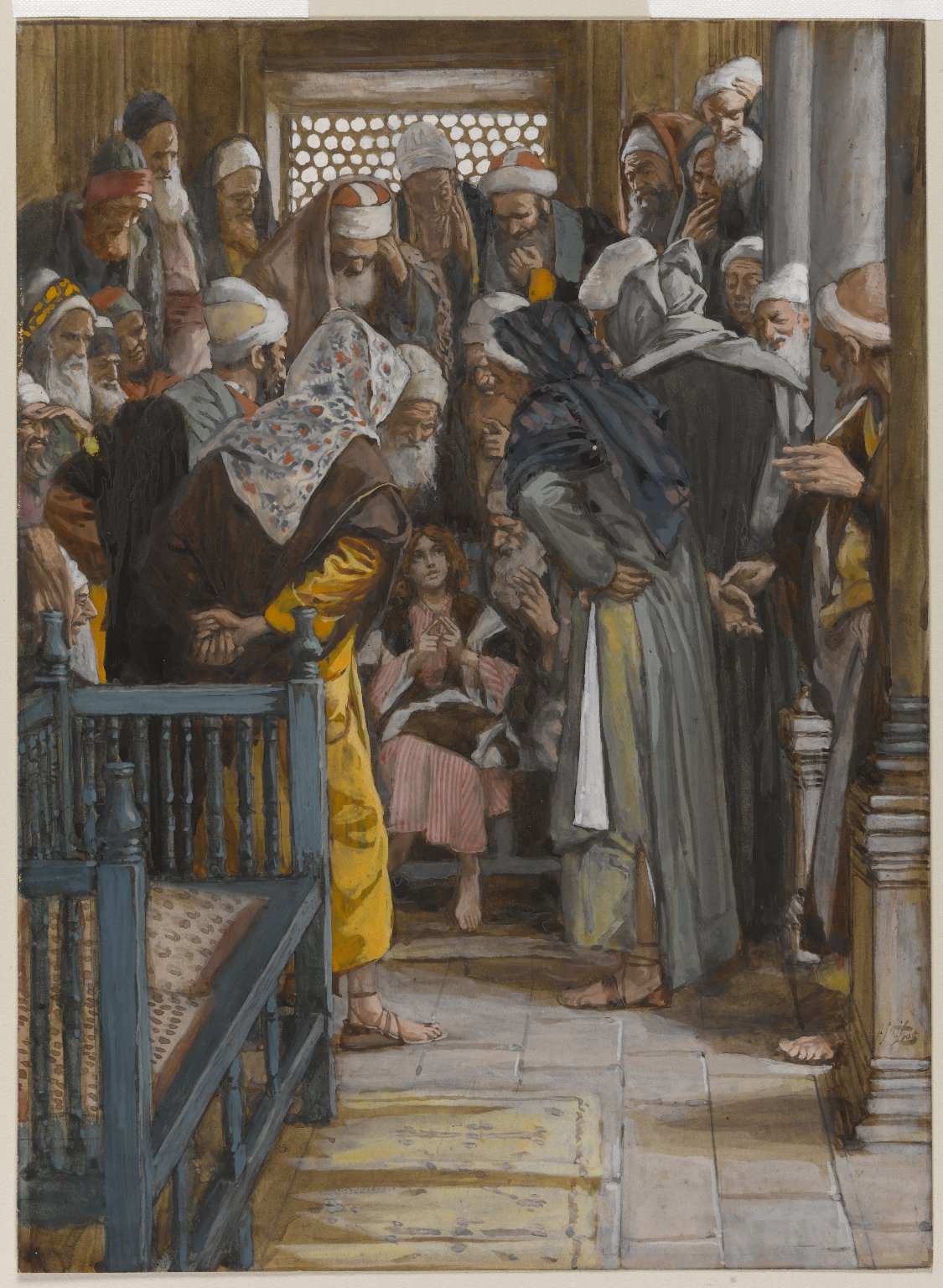
I was meditating today upon the fifth Joyful Mystery of the Rosary, The Finding of Jesus in the Temple. The significance of this mystery of Our Lord moved me. He is twelve years old, a school-aged boy, found among the wise men of the Jewish faith, listening, asking questions, and offering his own wise answers. This scene of dialectical discourse between the young Christ and the scholars situates him at the center of the wisdom tradition. This tradition began deep in Israel’s history.
We see it first in Isaac, the son of Abraham, who in Genesis 24:63 “was gone forth to meditate in the field.”1 We recognize that Moses, “educated in all the wisdom of the Egyptians”2 establishes the foundational works of the Torah. Then David, Solomon, Ezra, Daniel and the Prophets, all contribute to passing on this classical wisdom tradition finally present in the scholars of the Temple. These men were not ignorant of the Greek wisdom tradition (itself born of the wisdom of the ancients3) which would later be received by the Catholic Church as the Gentile world converted to Christianity. All of this is in the background as Christ, the Teacher, sits in the midst of the teachers.
The Proper Teachers
The primary lesson here is that the proper place for a Catholic school age boy (or girl) is with Christ among the wise men. Aristotle in his treatise on Metaphysics teaches that new learners must work through all of the “difficulties” or “doubts” about metaphysical questions before moving forward with the other sciences.4 That is, the great questions of philosophy need to be dealt with first if we are to expect fruitful outcomes in any of the other educational disciplines. Christ would not have been discussing popular “Great Books” with the Jewish scholars. Nor would he have been discussing practical mathematics or inductive science. He would have been discussing the questions which are proper to philosophers and theologians.
The Catholic Church has a rich two thousand year history of dealing with these important questions. It has systematized the studies which help us work out the answers. Students move forward in other disciplines after true metaphysics has enabled them. Yet, inexplicably, Catholic schools do not allow Catholic children to sit at the feet of the wise men of our tradition. That is, they ignore Philosophy, Reasoning, the classical liberal arts, and Theology. STEM studies and Great Books programs replace these! As Aristotle suggested, there cannot be authentic fruit in these studies without having answered the metaphysical and theological questions which are primary in the soul.
Knowing the Proper Direction of Education
Besides, we already have plenty of STEM schools, and the so-called “classical” Catholic schools which have gained popularity today use the name “classical” homonymously, that is, it is the same name, but it does not signify the same curriculum which is present in Catholic history. What is missing is true classical Catholic education, which delivers to the school aged child the full breadth of the classical liberal arts curriculum, philosophy, and theology, through their source texts written by wise men and Saints. Students who are not educated in this manner but who nevertheless pursue inductive sciences and practical mathematics become the kind of unfortunate men described by Aristotle: They “resemble those who are ignorant whither they ought to go: and, besides this, neither can they know whether they have found, or not, the object of their search.”5
Putting The Curriculum Back in Order
In short, what is missing in Catholic education…is Catholic education. While it may be true that most of us are ignorant of the great classical liberal arts patrimony that precedes us as Catholics, having two or three generations now educated without it, we can no longer pretend that this ignorance is excusable.
The Classical Liberal Arts Academy is an accredited online classical Catholic curriculum and provides access to all of the necessary studies which this patrimony contains. We have the ability to follow the example of the young Christ: to allow school aged children to sit at the feet of the wise men of our tradition, to work through the challenging questions in our soul, and to receive a true classical Catholic education. We must cease the substitution of sciences and practical mathematics for the philosophy and theology which are primary for Catholic students. It is our educational heritage, but we have removed it from the curriculum. It is long past time to restore it to its proper place. The Classical Liberal Arts Academy has done so.
Notes:
- New American Bible (Revised Edition) Genesis 24:63 ↩︎
- Ibid, Acts of the Apostles 7:22 ↩︎
- See Michael, Understanding Classical Catholic Education, Chapter III. The Arts in Ancient Greece ↩︎
- See Aristotle, Metaphysics (translated by Thomas Taylor) Book III, Chapter 1. For example: “For the power of acquiring posterior knowledge is derived from the solution of prior doubts. But it is not possible for any one to dissolve the bond of any thing, who is ignorant with what it is bound. The doubting, however, of the dianoetic part of the soul, or that part which reasons scientifically, manifests the bond respecting a thing. For, so far as this part of the soul doubts, so far it is similar to those who are bound; since neither he who is bound nor he who doubts is able to proceed any further.” ↩︎
- Ibid. ↩︎