
You will never guess the course of studies which existed at the beginning of the English university system in the medieval world.
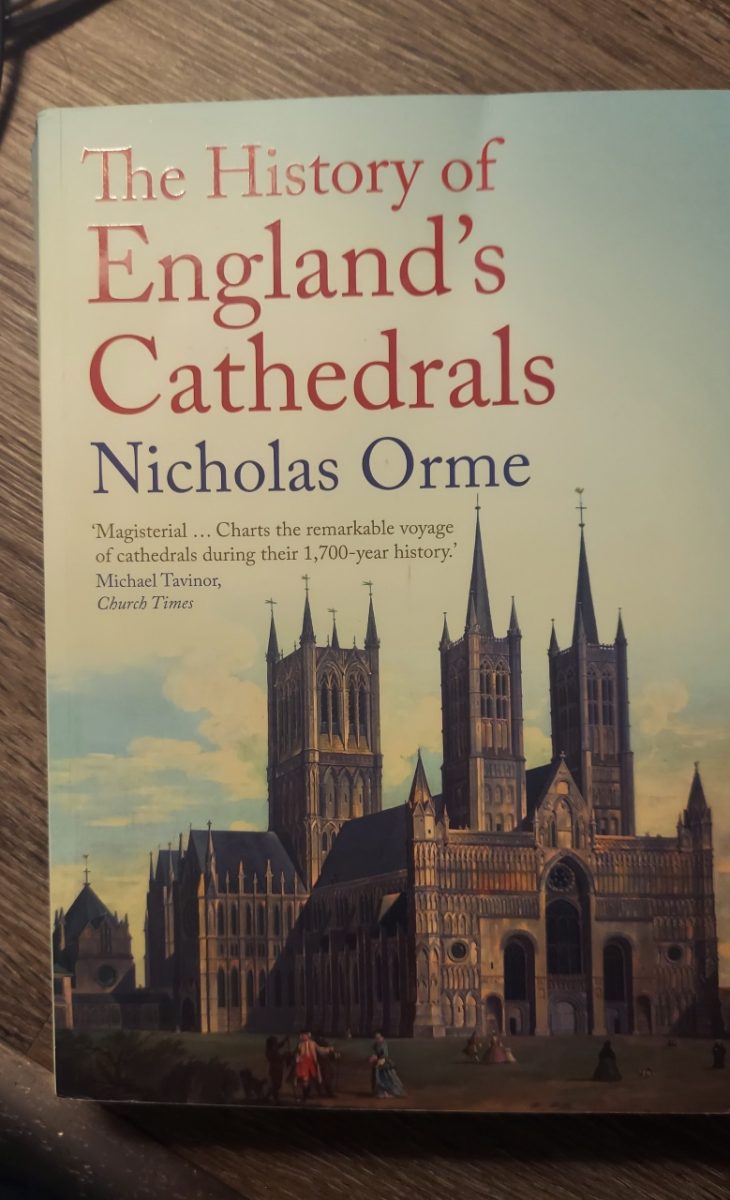
I am studying a course at the University of Oxford entitled The Architecture of the English Medieval Cathedral. One of the assigned texts is The History of England’s Cathedrals by Nicholas Orme. For those interested in church architecture and the history of English Catholic worship in general, it is a helpful read, even as it is told from a secular perspective.
One significant theme is the role played by Cathedrals (which were not so called until the modern age) as centers of learning. In the early medieval times, learning centered on the Opus Dei, or as we would know it, the Liturgy of the Hours. It was the cycle of worship and prayer which ordered the life of both monastic communities and secular clerics, both of whom maintained the various cathedrals and great churches of England. Learning to sing the hours in choir and the studying the art of music, learning Latin grammar, and being trained in the management and operations of a great church were part of the education for young men who had a future as a priest or monk. Alongside these cathedral schools would have been grammar schools in the cities where the churches existed.
But in later medieval times, studies expanded as the Universities of England were founded. Oxford (where I am studying) and Cambridge were established by 1210 AD. They were founded with the intention of supporting the cathedrals and the Church in general to carry out the Opus Dei and in developing excellent scholarship. For the most part, young clerics made up the student body as monks of religious orders or canons of secular cathedrals. What did they study?
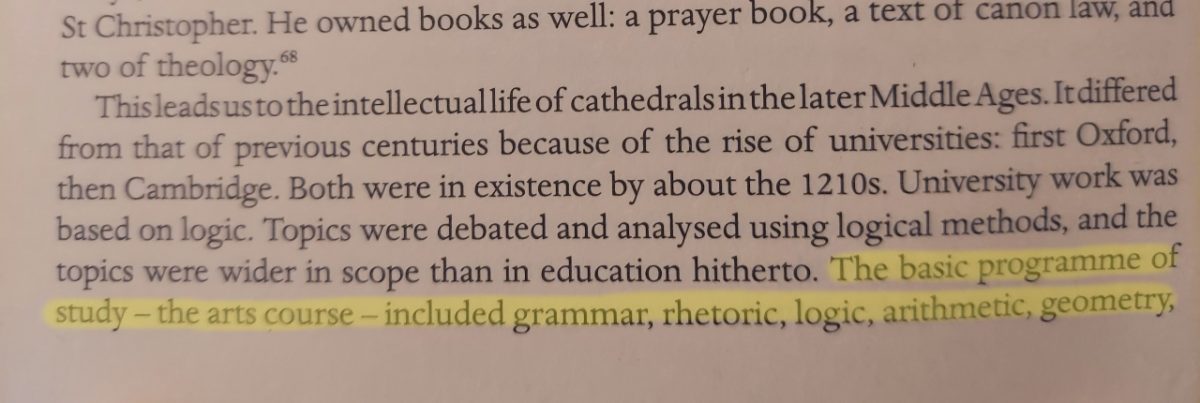
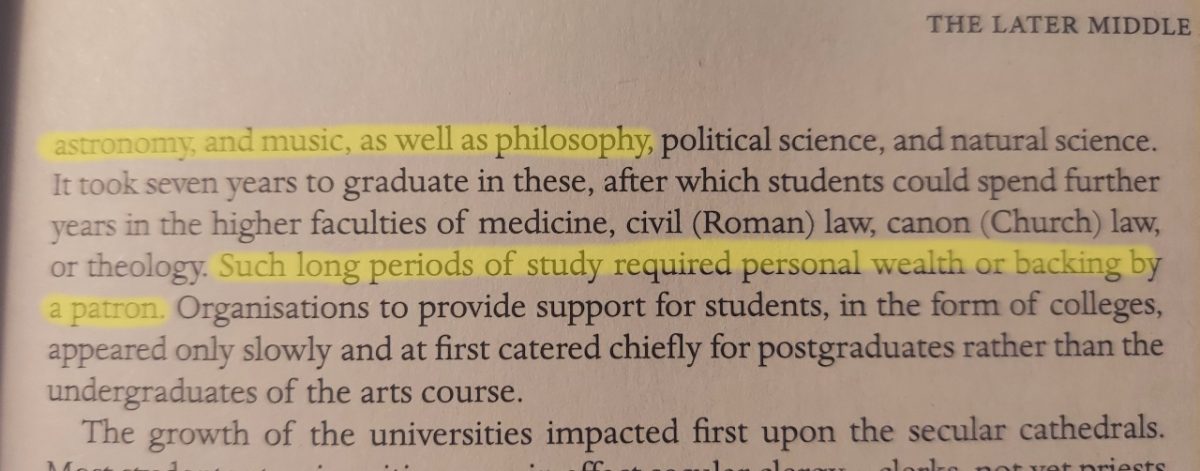
As the Classical Liberal Arts Academy has made plain in its research in the past twenty-five years, the program of Catholic study – before all the extra-curriculars became curricular – in its essentials has always been the same. Here we see listed the seven classical liberal arts, along with philosophy, followed by politics, physics, law, or theology.
In the CLAA the same course of study is commended to all students. Is there any other classical Catholic program which mirrors exactly the course of study which Oxford and Cambridge offered in 1210 AD? Or do these other “classical” schools rather burden their students with “Great Books”, Modern Math and Sciences, all before their students have mastered the arts or philosophy?
Further, such studies at that time, as noted in the text, were expensive. Only wealthy families or students sponsored by a wealthy patron could afford the years of study required for this education. But in the CLAA, the same course of study is offered without such necessary patronage. In God’s Providence, the course of studies which supported the cathedrals and monasteries of England (and all of Europe), as well as the foundations for all professions (law, military, government, business) are available to any capable and motivated student, regardless of their financial means. What great advantage we have in the modern age to be able to study in this way!
The Classical Liberal Arts College is taking shape around this same idea. The course of the liberal arts, mastered by college students, become the foundation for all of the nobler professions which are available to modern men. Yet, even as they would have been in the medieval world, they are also the foundation of vocational pursuits. For those who seek the life of contemplation, as the medieval monks and cloistered orders did, these studies lead to the deep, necessary, and fulfilling search for wisdom. For those seeking a secular life close to the heart of the Church, as a priest, active religious, or married lay person, these studies enrich our lives and keep us from the “strange teaching”1 of the world.
Do not let such providential opportunities pass you or your children by. Just as the classical medieval university did, the CLAA is offering the necessary course of studies for Catholics interested in participating in the Opus Dei and the intellectual life of the Church.
- Hebrews 13:9 ↩︎