
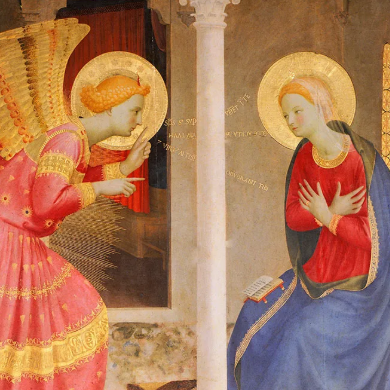
The Catholic Church has always taught that the faithful must “test the spirits” (1 John 4:1) before accepting any claim of divine origin. This principle is vividly illustrated in the Gospel of Luke, where the Blessed Virgin Mary both questions the angel Gabriel at the Annunciation and then travels to confirm Elizabeth’s pregnancy. Both actions model a prudent, faith‑filled discernment that guards the Church against deception. History shows that when believers neglect this discernment, heresies arise and the faith is endangered.
Mary’s Question as a Model of Discernment
When the angel announced that she would conceive “by the power of the Most High,” Mary replied, “How shall this be, since I am a virgin?” ((The Holy Bible Luke 1)) Far from doubting God’s power, she expressed a genuine wonder that required clarification. Augustine notes that Mary “did not doubt the power of God” but sought the “manner of it” ((Look on the Faith of Your Church: Mary’s Assent and the Task of Theology page162.)) Likewise, St. Bernard of Clairvaux praised Mary for “forestalling reason by faith,” contrasting her with Zechariah, who “tempted faith by reason” ((Look on the Faith of Your Church: Mary’s Assent and the Task of Theology page162.)) Thomas Aquinas explains that Mary’s question was not a denial but a “wonder rather than unbelief,” prompting the angel to give a reasoned answer (the example of Elizabeth). ((Summa Theologiae III, Q. 30, A. 4)) This dialogue shows that authentic faith welcomes questions that lead to deeper understanding, rather than blind acceptance or cynical skepticism.
The Church’s magisterial teaching on discernment reinforces Mary’s example. The Dicastery for the Doctrine of the Faith stresses that “the only way to know whether something comes from the Holy Spirit is through discernment, which must be sought and cultivated in prayer”. ((Norms for Proceeding in the Discernment of Alleged Supernatural Phenomena 9)) Pope Francis, in Gaudete et exsultate, reminds us that “the discernment of spirits liberates us from rigidity” and allows the “newness of the Gospel” to emerge. ((Gaudete et exsultate 173)) Mary’s question embodies this spirit of prudent openness: she accepts the angel’s message, yet asks for the “how,” allowing the Holy Spirit to illuminate the mystery.
The Visitation: Confirming the Spirit’s Word
After the Annunciation, Mary “went with haste to a Judean town in the hill country” to visit Elizabeth. ((The Holy Bible Luke 1)) This journey was not a mere social courtesy; it was an act of verification. The angel had mentioned Elizabeth’s miraculous pregnancy as proof that God’s promise could be fulfilled. By seeing the pregnant Elizabeth, Mary confirmed the angel’s testimony and received the prophetic affirmation, “Blessed are you among women”. ((Redemptoris Mater 12)) Pope John Paul II’s homily on the Visitation emphasizes that Elizabeth’s greeting “bears witness to Mary” and that the encounter “confirms the reality of the divine promise”. ((10 December 1994: Eucharistic Celebration at the Shrine of Loreto – Homily)) The Catechism likewise notes that John “was filled with the Holy Spirit even from his mother’s womb” because of Mary’s conception, showing the interconnectedness of the two pregnancies. ((CCC 717))
Mary’s travel thus illustrates another facet of testing the spirits: seeking external confirmation of a divine revelation. She does not remain isolated in speculation; she moves to a concrete sign that validates the angel’s words. This practice aligns with the Church’s admonition that “the Spirit alone can penetrate what is obscure…so that the newness of the Gospel can emerge in another light”. ((Gaudete et exsultate 173))
Consequences of Ignoring Discernment
When the faithful neglect the duty to test spirits, the Church has historically suffered the spread of error. Early heresies such as Gnosticism and Arianism flourished because their proponents accepted novel revelations without rigorous examination. The Council of Nicaea (325) was convened precisely because Arius claimed a divine insight that contradicted the apostolic faith, showing the danger of untested claims — a principle echoed in the modern “discernment of alleged supernatural phenomena” norms. ((Norms for Proceeding in the Discernment of Alleged Supernatural Phenomena 9))
Pelagianism offers another example. Pelagius taught that human nature could achieve salvation unaided, a doctrine that arose from a misreading of Scripture untempered by the Church’s magisterial guidance. The Church’s response, the Council of Carthage (418), reaffirmed the necessity of grace—a truth that had been obscured when believers failed to test the spirit behind Pelagius’s claims — mirroring Mary’s careful probing of Gabriel’s message.
Even within Marian devotion, the danger of uncritical acceptance is noted. Some medieval apocryphal texts inserted fanciful details into the Annunciation, such as the “great light” narrative in the Gospel of the Nativity of Mary that expands on Mary’s “perplexity” without scriptural basis. ((The Gospel of the Nativity of Mary Chapter 9)) The Church, through the teachings of the Fathers and the magisterium, has consistently warned that adding or altering divine revelation without discernment leads to doctrinal confusion.
Mary’s Example for Contemporary Believers
Today’s faithful can emulate Mary by:
- Asking thoughtful questions when confronted with new spiritual claims, just as Mary asked “How shall this be?” — a practice endorsed by Augustine, Bernard, and Aquinas. ((Look on the Faith of Your Church: Mary’s Assent and the Task of Theology page162.)) ((Summa Theologiae III, Q. 30, A. 4))
- Seeking tangible signs that corroborate a revelation, as Mary did by visiting Elizabeth. ((The Holy Bible Luke 1)) ((Redemptoris Mater 12))
- Balancing faith and reason, recognizing that “human reason can be related to the will of the believer…after the will to believe”. ((Look on the Faith of Your Church: Mary’s Assent and the Task of Theology page19))
By following these steps, believers guard themselves against the “rigidity” that Pope Francis warns against, while remaining open to the “newness of the Gospel”. ((Gaudete et exsultate 173))
Conclusion
Mary’s question to Gabriel and her subsequent journey to Elizabeth are not merely narrative details; they are concrete illustrations of the Church’s timeless call to “test the spirits.” Their example shows that authentic faith welcomes inquiry, seeks confirmation, and integrates reason with belief. History teaches that abandoning this disciplined discernment opens the door to heresy, as seen in the rise of Gnosticism, Arianism, and Pelagianism. By imitating Mary’s prudent curiosity and her willingness to verify divine promises, today’s Christians can protect the integrity of the faith and remain faithful witnesses to the living Word.
Mrs. Grace Peletier, O.P.