
Catholic families who hope to live faithfully and raise their children well in the modern world must begin with realistic goals. The conditions under which Catholic parents now live are not those of medieval Christendom, nor even those of nineteenth-century America. They live under the influence of compulsory education laws. They live in an economy that requires academic credentials. They live in a culture that often measures success by college admissions statistics and income levels. If Catholic parents attempt to compete with secular society on its own terms, while also trying to preserve the Faith in their homes, they will often find themselves exhausted and discouraged. The first step toward success is not greater ambition, but greater clarity.
Compulsory education laws place significant pressure on Catholic families. Whatever their personal convictions about education, parents are legally required to provide formal schooling that meets state standards. This requirement creates a baseline of accountability. Parents cannot simply raise their children in piety and good character without also addressing reading, writing, mathematics, history, and science. They must document progress. They must issue transcripts. They must satisfy legal requirements. The burden is real, and it is unavoidable.
At the same time, the Catholic clergy does not consider itself responsible for providing formal academic instruction for every Catholic child. The clergy is responsible for preaching the Gospel, administering the sacraments, and providing spiritual formation. Priests are ordained to sanctify, teach, and govern in spiritual matters. They are not commissioned to operate comprehensive academic institutions for every family in the parish. Historically, religious orders often carried the work of Catholic schooling, but even then, such schools never served all Catholic children. In most dioceses today, Catholic schools serve only a fraction of the Catholic population, and many parishes have none at all.
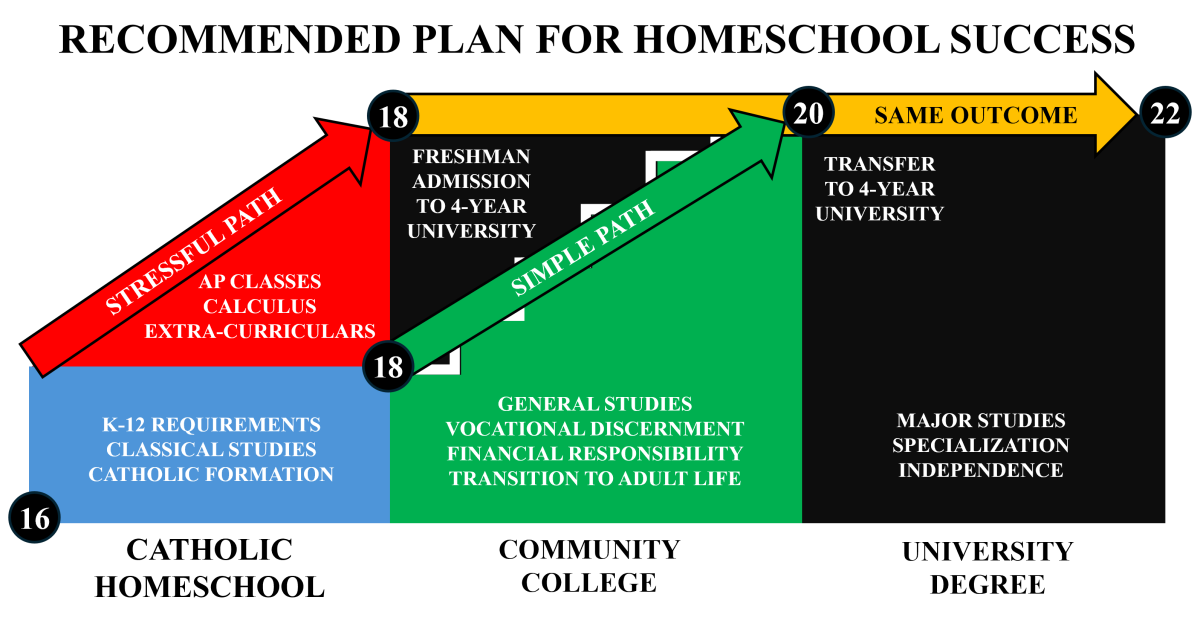
As a result, Catholic parents bear the primary burden of providing formal education for their children. This is not an innovation of modern times; it is a reaffirmation of an ancient principle. The Church teaches that parents are the first and primary educators of their children. In practice, however, modern parents often feel unprepared for this responsibility. They assume that education must be outsourced to professionals, that success requires elite institutions, and that failure to secure prestigious academic outcomes by age eighteen represents a permanent disadvantage.
Modern technology has changed this situation in a profound way. Homeschooling, once considered impractical for many families, has become possible on a wide scale. Online courses, digital textbooks, video instruction, automated grading, and structured curricula allow parents to provide formal education without needing to be experts in every subject. A family no longer needs to live near an excellent school in order to receive strong academic instruction. A stable internet connection, disciplined planning, and a well-designed program can accomplish what once required institutional infrastructure.
Yet homeschooling will only succeed if its goals are realistic. Many Catholic parents fall into the same error that dominates the broader culture: they believe that the purpose of education is to secure freshman admission at a selective university immediately after high school. This belief drives anxiety from the earliest years of childhood. Children are placed on competitive tracks at age twelve or thirteen. Every course, every test score, every extracurricular activity is measured by its perceived impact on elite college admissions. The result is often a distorted education that sacrifices depth, health, and spiritual maturity in pursuit of a narrow and uncertain prize.
Children do not need to be prepared for freshman admission at selective universities at age eighteen. In fact, the attempt to achieve this outcome for every child often ruins their education. It compresses adolescence into a résumé-building exercise. It encourages superficial achievement rather than intellectual formation. It produces stress and comparison rather than peace and confidence. It distracts families from more important goals.
Catholic parents should instead adopt three clear objectives for their children at age eighteen.
First, Confirmation in the Church. By age eighteen, a Catholic child should be fully initiated into the sacramental life of the Church and prepared to live as a responsible Catholic adult. This does not mean perfection. It means a firm grounding in the Faith, regular participation in the sacraments, and an understanding of moral responsibility. Spiritual maturity is more important than academic distinction.
Second, a High School Diploma. By age eighteen, a student should have completed a recognized course of secondary education. This diploma represents not brilliance, but competence. It certifies that the student can read, write, reason, and complete sustained academic work. It fulfills legal requirements and opens doors to further opportunities. It is a practical and attainable goal for nearly all students when education is approached steadily and realistically.
Third, good physical health. An eighteen-year-old should be strong, capable, and healthy. Years of chronic stress, sleep deprivation, and sedentary habits in pursuit of academic prestige can undermine long-term well-being. Physical health is not an optional luxury; it is a foundation for adult life. A healthy young adult has energy for work, study, service, and family life.
When these three goals are achieved—Confirmation, diploma, and health—the student stands at the threshold of adulthood with genuine freedom. At age eighteen, life is not finished; it is beginning. Many options remain open, and the direction taken will depend on the student’s character, decisions, and effort.
Any student with a high school diploma can begin college studies at a community college. Community colleges provide affordable access to higher education. They allow students to explore academic interests, complete general education requirements, and demonstrate college-level performance. A strong record at a community college can lead to transfer admission to respected four-year institutions. This path is available to students who were not admitted as freshmen to selective universities. It is often financially prudent and academically wise.
Any student with a high school diploma can also enter the military, whether in the Reserves, Active Duty, or through ROTC programs. Military service offers structured training, discipline, educational benefits, and professional development. It is a serious commitment, but it is a legitimate path to adulthood and further education. For some young men and women, it provides maturity and direction that academic life alone does not.
Beyond these options, there are many ways to move from high school graduation to graduation from an excellent four-year college or university. Students may work for a year or two, saving money and gaining experience before enrolling in college. They may attend a less selective institution, perform well, and later pursue graduate study at a prestigious university. They may combine employment and part-time study. They may pursue technical certifications before transitioning into academic programs. The path to excellence is not a single narrow road entered only at age eighteen.
Likewise, there are many ways to move from high school graduation to independent adult living. Some young adults enter the workforce directly. Some begin apprenticeships or trade programs. Some start small businesses. Some remain at home while working and contributing to the household, building savings for the future. Independence develops through responsibility, not through institutional labels.
Homeschooling is not responsible to place eighteen-year-old children directly into the best possible circumstances. That expectation misunderstands both education and human development. The responsibility of homeschooling is to prepare a young person for adult life, not to guarantee immediate arrival at its highest visible achievements. Education should cultivate habits of discipline, faith, health, and perseverance. It should provide tools. It cannot predetermine outcomes.
In contrast, Catholic schools often present an appearance of success that can be misleading. Promotional materials highlight graduates admitted to prestigious universities. They celebrate scholarship totals and athletic championships. Yet these schools serve only a portion of Catholic children in any given diocese or parish. Of those they serve, only a portion achieve the most visible successes. The public image does not always reflect the average outcome. This is not necessarily dishonesty; it is marketing. But Catholic parents should interpret it with caution. The fact that a few students enter elite universities does not mean that this is the typical or necessary path for all.
When parents measure themselves against these promotional narratives, they may feel inadequate. They may believe that unless their homeschooled children replicate the most impressive outcomes of well-funded institutions, they have failed. This belief produces unnecessary pressure. It shifts attention from steady formation to competitive comparison.
Humble, realistic, long-term planning relieves this pressure. When parents decide that their goal is Confirmation, a high school diploma, and good health at age eighteen, they can plan calmly. They can focus on daily habits rather than dramatic milestones. They can allow children to mature at their own pace. They can encourage diligence without fostering anxiety. They can accept that growth continues after eighteen, often in unexpected and fruitful ways.
This approach does not reject excellence. It redefines it. Excellence is not measured by early prestige but by sustained growth. A student who learns to work faithfully, think clearly, pray regularly, and care for his body has achieved something more durable than an impressive college acceptance letter. From that foundation, further achievements become possible.
The Classical Liberal Arts Academy provides a structured path for homeschool success built on these principles. It offers organized courses, automated grading, and a coherent curriculum that parents can implement without needing to invent a program from scratch. It allows families to meet compulsory education requirements while preserving intellectual depth and Catholic identity. It supports the goal of earning a legitimate high school diploma without entangling families in unnecessary competition.
The Academy’s structure makes it possible for parents to focus on formation rather than administration. Courses are clearly defined. Assessments are objective. Progress can be documented. Students can work steadily through a complete curriculum in the liberal arts. Parents remain responsible and involved, but they are not isolated or overwhelmed.
Most importantly, the Academy aligns academic work with realistic expectations. It does not promise automatic admission to elite universities. It promises disciplined study, intellectual formation, and measurable academic completion. It recognizes that the years after high school remain open. A student who completes a serious course of study in the classical liberal arts, receives Confirmation, and maintains physical health is well positioned for whatever path he or she chooses next.
Catholic families in the modern world must resist the temptation to measure success by external prestige. They must remember that their primary responsibility is to raise faithful, competent, and healthy adults. Compulsory education laws require formal schooling, and parents must provide it. The clergy provides spiritual formation, but not comprehensive academic instruction. The burden rests with families. Modern technology has made that burden manageable. Realistic goals make it sustainable.
If parents adopt humble, long-term planning, they will discover that homeschooling is not an impossible task but a steady vocation. At age eighteen, their children need not stand at the summit of worldly achievement. They need only stand as confirmed Catholics, educated high school graduates, and healthy young adults ready to take the next step. From there, many doors remain open. The future belongs not to those who rushed toward prestige, but to those who were formed patiently for life.
Mr. William C. Michael, O.P.
Headmaster
Classical Liberal Arts Academy
