
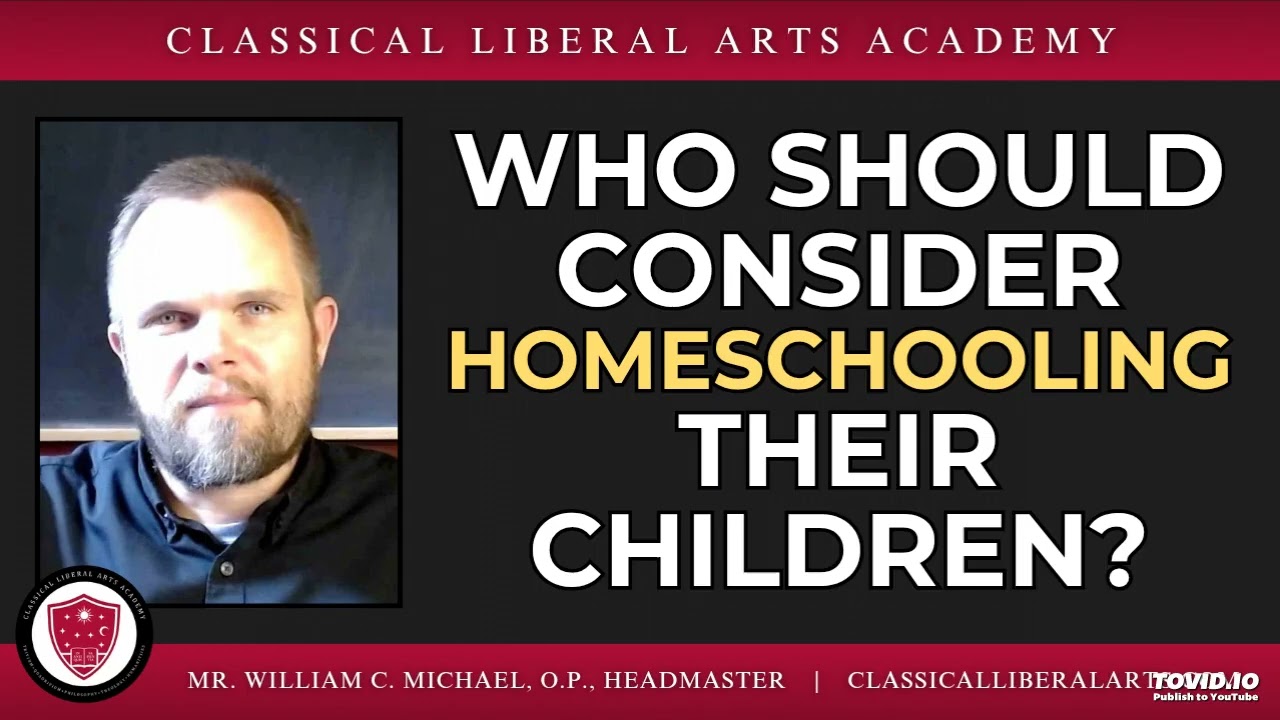
Today is September 26, 2024, and this is William Michael of the Classical Liberal Arts Academy. Day to day, throughout the week, I spend a lot of time speaking with homeschool parents through consultations and things like that, and almost every conversation that I have with homeschooling parents begins with questions that reveal a lack of understanding in the work of education. For example, parents will ask, what courses should my children take in the academy? Parents will ask, what sort of pace should we expect in the courses that our children are studying? All sorts of questions like these—questions that relate to course selection and pacing and achievement. And I answer all of these questions in the same way. What I say is, the answer to that question depends on your goals for your children’s education. It depends on what your goals are. And this is not just some nice, cute answer. Everything really does depend on the goals that parents have for their children. That’s what homeschooling is all about. When parents ask me, you know, my daughter is a fourth grader, what courses should she be studying? My answer again is, it depends on your goals for your daughter’s education. Most homeschooling parents really don’t understand what homeschooling is. They don’t understand what freedom they have. They don’t understand what benefits the Classical Liberal Arts Academy offers them, and they continue to operate as if they’re serving someone else’s authority, trapped within a system, and that’s simply not the reality. And so my first objective in speaking about education with homeschooled parents is simply helping them to understand what homeschooling is, and we always get these same questions, always these same anxieties, always these same expressions of anxiety that we’re not getting something done that needs to be done.
Now, to begin with, homeschooling is a form of schooling. It’s called homeschooling. Some parents speak about homeschooling inaccurately. They say, well, we’re keeping our kids home from school. No, that’s not true. A homeschool is as much a school as any public school or private school in town. A homeschool is a school. It’s a legitimate school. And when you register to homeschool your children, you become a school administrator. What’s unique about your school is that it’s only for your children, but it’s a homeschool. It’s a school. And as a homeschooling parent, you are a school administrator, and you’ve got to embrace that role. You’ve got to understand that role for good and for bad—for good in the sense that you’ve got lots of freedom to do, really, whatever you decide you’d like to do, and for bad in that that’s a lot of responsibility that you have to take seriously and make the most of. But that’s usually what I spend a lot of time communicating to parents. And that leads to two different kinds of parents moving forward. The first group is that group of parents which embraces that reality and says, wow, this is awesome. I’m a school administrator. I get to decide what my children study. I get to decide how they study it. I get to determine what the schedule will be, what the calendar for our studies will look like. I get to decide what my child’s grades will be. I’m the one who gets to give the diploma. I get to give the transcript, on and on. One group of parents learns this and realizes this and runs with it, and those are the families that have the greatest success in homeschooling. The other group is the group that really doesn’t want that responsibility, doesn’t want homeschooling to be what it actually is, but wants to pretend that they’re enrolled in a school. And unfortunately—and I really don’t know how they do this—but unfortunately, some homeschool programs encourage parents to think like that. They play that up. They pretend like the children are enrolled in a private school, and they provide the grades and the documentation, the transcript, even a diploma. They pretend that the child is in a private school. But that’s really not the case. The child is not in a private school. And the key to understanding this is that when a child enrolls in a school outside the home, that school is responsible for the child’s activities all day long. The child is dropped off at school, and the school plans the day. The school manages the schedule, the curriculum, the lessons, the grading, attendance, and so on. And then the school gives the documents when the studies are completed. No homeschool student is doing that. And so, you know, I really think that some of these homeschool programs mislead homeschool parents and make them think that they’re enrolled in a school where they’re really not enrolled in a school—they’re homeschooling. So that can be a complicated issue, because I think what homeschool programs do is misleading.
For example, when I was going through the accreditation process, I was communicating with the State Department of Non-Public Education, or basically the division of the State Department of Education that deals with private schools, and I asked them, is it possible for the Classical Liberal Arts Academy, which is really a digital learning program—is it possible for us to give diplomas and transcripts to our students? And the representative from the state immediately said, no, you’re not a private school, you’re an online learning program. And then what I said, what about if we’re accredited? What if we’re an accredited study program? We’re accredited by the same accrediting agency that all the public schools are accredited by, all the private schools are accredited by—the most reputable accreditation agency. What if we’re accredited? Are we allowed to give diplomas and transcripts? And that really baffled the state representative, and she said, well, you can give diplomas and transcripts, but it really doesn’t make any sense for you to do so, because there’s really just two groups of students. There’s private school students, and anyone who’s not enrolled and attending a school is considered a homeschool student. So there’s really only two kinds of enrollment: there’s students enrolled in schools outside their home, and then students who are studying in a registered homeschool. So it doesn’t make any sense why the Classical Liberal Arts Academy would be the one giving out diplomas and transcripts when it really doesn’t make any sense. If your children are studying at home with you and you are the administrator of the homeschool, you have the same authority that a high school principal has. You have the authority to determine your child’s curriculum, the child’s grades, to complete the child’s transcript and put all that together. You can decide what’s going on that transcript. You can make all of those decisions yourself. You can make a diploma for your child. You can make a diploma, and you can sign it because you are the administrator of your homeschool.
So these things are very important. It’s very important for parents to understand the authority, the freedom, the control that they have, because if they don’t understand that, what ends up happening is you lock yourself into a box that you’re locking yourself in for no reason—for no reason—and you have so much freedom and so much control, and you’re sacrificing that to almost pretend that you’re doing something else and really you’re not. So what I’d like to talk about a little bit is how parents should think about homeschooling to avoid this problem, how they should think about it. Because in a recent consultation, I got into this a little bit, and I said, yeah, that’s pretty helpful. When I just explained—I’ve never presented it in that way before, but that’s what I need to share with more parents, because I deal with this confusion all the time. So I’d like to talk about how parents should think about homeschooling.
Now, the first challenge, as I said before, is that parents have authority over their children. Parents are free to decide what the education of their children will consist of. It’s a responsibility and a privilege of parents. The Catechism teaches this. The Catechism teaches that parents have the right to choose a form of schooling for their own children. It’s a right of parents. The Catechism teaches that. So parents can choose the form of schooling. Parents determine what their children will study. And if we think of the Ten Commandments, the commandment “Children, honor your father and your mother” directly applies to education because the parents have authority over the education of their children, just as parents can determine what the schedule in the home is like, what the policies for television and internet use, what time bedtime will be, and so on. Parents have that authority, and children are commanded in the Ten Commandments. So these are grave issues—that children are commanded to honor their father and their mother, or, as Saint Paul says, obey their parents. This applies as much as in any other area of life to education. Children are to honor their father and their mother and submit to the decisions their parents make regarding their education. And while that sounds great, parents on the other side of that bear the responsibility to make decisions in their children’s education that actually honor God, who is the author of the commandments. So it puts a lot of responsibility, a lot of pressure on parents to make the best decisions.
Many parents choose to just outsource education, which really can be a neglect of duty if that school doesn’t serve the true ends of education. Just because you write a tuition check or you drop your children off in front of a school building doesn’t mean you’re now exempt from accountability. You are ultimately accountable for your child’s education. So that’s why, when I hear parents complaining about schools, it really doesn’t make any sense, because the only reason that your child is in that school is because you chose to put the child in that school. And if that school stinks, if that school is full of problems and the teachers are crazy people, you’ve got to give an account for why your children are in that school. Just because you pay property taxes doesn’t mean that your child has to go to the public school. You also pay for public prisons, but your child doesn’t have to go to prison to make good use of your tax dollars. Your children have no reason to go to a public school, and you really should only be thinking about a school based on the character of the school, the character of the teachers, the curriculum that’s taught, the culture of the institution, and so on—not cost. So when parents are complaining about schools that their children are enrolled in, they’re really making no sense, because it’s not any school’s job to educate a child. It’s not the state’s job to educate a child. It’s not the church’s job to educate a child. It’s the parents’ job. So parents really can’t complain about a school—they simply educate their own children or find a place that will offer education. And if they choose a place, they need to be quiet because they’ve chosen that school. And if they don’t like it, rather than harass that school, they need to go someplace else, and they always have the right to homeschool. So for me, it doesn’t make much sense to complain about schools, but parents have a great responsibility, and they need to take that responsibility seriously.
So when a parent sits down and thinks about schooling, and they don’t feel that there are any good options locally—options that actually fulfill their responsibility—they may choose to homeschool, and when they choose to homeschool, they have complete control. And so the first thing that parents need to figure out is, what are their goals for the education of their children? What are their actual goals? So all of this, you know, it’s easy to criticize, because when people criticize, they wait for other people to do things, and then they find fault. So for example, I can write an article that’s got 3,000 words, and before I wrote the article, there was nothing. I write an article with 3,000 words, and someone can find one phrase or one sentence that they don’t like and blow up, even though it’s a 3,000-word article. It’s very easy to criticize, because you can simply ignore everything good and focus on what you perceive to be bad. Criticism can be deceiving, because you think that you’re really smart, but you’re just critical. What actually takes wisdom or prudence and skill is to positively answer questions, to positively create solutions—not to criticize what exists, but to actually form the solution. And an illustration I like to use goes back to when we were in school, and you can remember we’d have an assignment of some kind—write an essay, write a paper, write a report—and a teacher would ask, would anyone like to share what they’ve written? Critics will never share what they’ve written. Critics will let other people share what they’ve written. They won’t share what they’ve written because they’re afraid of being criticized. But when other people share what they’ve written positively, the critic will find fault with it, even though he won’t share what he’s written. That’s the kind of person a critic is.
And when it comes to educating our children, we can’t be critics. We can’t just be fault-finders. We’ve got to actually answer questions positively. We’ve got to actually create plans that accomplish goals. And these things have to be objective. They have to be real, they have to be positive. We can’t make a list of all the things we’re not going to teach our children. We have to, at some point, make a list of the things that we are going to teach our children. So we have to move from this sort of idle, self-deceived critic who just finds fault with the government and the church and the schools and society in general, to a person who actually comes up with a positive solution, who actually answers questions positively. And yeah, that’s very difficult work. So the first thing that I always say to parents is, you’ve got to sit down together as parents, and you’ve got to figure out what your actual goals are for your children’s education. And you need to just make a list. You need to figure out what the goals for your children’s education are going to be. And then as you list those goals, that’s very easy. Oh, our children are going to do this. We want our children to accomplish this and this and this, and we want them to do this. We want them to study this, and we want them to do it this way, and we want that. That’s very easy—that’s idle talk, right? Talk is cheap. So you can make a big, impressive list of goals, but then the second step is to figure out how those goals would actually be achieved. And this is called objective-making—making objectives. Objectives are sort of intermediate steps by which you pursue a goal, and you’ve got to come up with objectives. And this is where prudence and practicality really come in—experience and so on.
So when you contact me, for example, looking for help with education, you should be on this second step at least. You shouldn’t be on the first step. You should already know what your goals are, because that’s your job as parents. You’ve got to figure out what the goals are. Once you’ve got your goals laid out and you feel good about the list of goals that you’ve made, then it might make sense to contact someone like me for a consultation and say, you know, we’ve got these goals, but we’re really not experienced in education and we’re not sure how we should go about achieving these goals. Well, that’s where an experienced educator can help. They know the resources, methods—they can begin to help bring those goals down to touch the ground, as it were. And as you start to do that, you may start to learn that your goals are mutually exclusive. You can’t do both of these things. You can’t do everything.
Another illustration I like to give parents is a very common one: there’s a, let’s say, a two-gallon pitcher on the table, and your different goals are like fruits—or let’s use a basket, since I’m talking about fruits. Imagine if there’s a fruit basket on the table and there’s a bunch of fruit all over the table, and only four or five pieces of fruit are going to fit in this basket. And so there’s lots of fruit there, and that’s like your goals, but the basket represents your resources. And that doesn’t just mean money—it also means time, ability, other things you have to do, and so on. So some people have a much larger basket than others. You’ve got to decide what fruit is going to go in that basket, and it’s especially challenging when you’ve got a smaller basket. So if you don’t have money, you’ve got a smaller basket. If you don’t have experience, you’ve got a smaller basket. If you don’t have support from family and friends, you may have a smaller basket. If your husband’s not with you—you know, if your spouse is not a believer, and you’re sort of doing this yourself—you’re going to have a smaller basket. And there’s nothing wrong with that, because all of our deeds, all of our works, are all relative. They’re all judged relative to our circumstances. That’s Biblical teaching. Jesus Himself said, “To whom much is given, much is expected. To whom less is given, less is expected.” So God is the one who determines how big our basket is—unless, you know, our own behavior is causing problems, like we don’t work—but we’ve got a basket that limits what we can do and can’t do, and we’ve got to figure out what needs to be chosen when everything can’t fit in the basket.
And sometimes parents don’t understand that different things they’ve listed as goals are not going to be able to fit in the basket. And I’ll give you a good practical example. I often get contacted by parents who say, we’re interested in classical education for our children, but we don’t want our children using the internet. And I say, okay, well, that’s fine if these are your goals. Now, the problem is, if you say, I don’t want my children to use the internet for a classical education, you’re going to need a very, very big basket, because this is going to be very expensive to study in print. You’re going to need a very big basket with respect to resources, because for a classical education like the education we offer in the academy, you’re going to need to buy a lot of books, and they’re going to be expensive books. And that’s why, you know, I would not recommend that. I would say, look, I don’t think you’ve got a big enough basket to pursue these two goals—to say, we want our children to have a classical Catholic education, an education like that which was enjoyed by saints and wise men in the past, but we want it in a certain way. You just made the challenge much, much greater, and most parents who say that are really not ready or able to do what they say they want to do. It sounds nice, but you’ve got to realize that there’s a reason why colleges and universities and monasteries and other schools use digital resources. The reason why we’re using digital resources is because it allows us to do so much more with the baskets that we actually have. It’s much more sustainable to set high goals in learning and use digital resources. It’s very, very practical. And you can say, yeah, but there’s all these problems and there’s this, and that’s right—those are problems, but those are other issues that can be handled in a number of different ways, and that’s a separate discussion.
But when we lay out goals, the second step—establishing objectives—is going to force us to analyze our goals, to evaluate our goals, and sometimes decide to leave some things out, because they’re going to cause all kinds of problems, or we’re going to have to put something else back. And really, there’s nothing else that we want to put back. So establishing goals, then moving to the objective part of planning, requires us to then go back, usually, to rethink our goals. And this is the kind of thing that I think is helpful to talk about with parents. It’s very easy to talk in ideal terms, to talk about all kinds of glowing, amazing goals, but you have to realize that one of the reasons why other schools, other families, other children are not achieving all of these goals that you’re talking about is because doing so is very difficult. Doing so is very difficult.
This is an important lesson that I taught my oldest son, or all of my older children, because when kids are growing up, they’re very arrogant. They think that they take their parents’ success for granted, and they just think they’re going to go and accomplish whatever they want. And you know, I would talk to my eldest son, I would talk about, let’s say, going to college, pursuing this thing, pursuing that career, pursuing this award, or whatever. And his response would often be, oh, that’s going to be easy. I could do that easy. And I stopped him, and I said, nothing is ever easy to actually do. Nothing is ever easy to actually do, and you need to stop thinking like that. Stop thinking that it’s easy to do things. It’s easy to understand what needs to be done. It may be easy for you to do them, to accomplish things in a vacuum. But that’s not how things actually get accomplished. To actually accomplish something, you’ve got to overcome every obstacle that arises, and you have no idea what those obstacles may be. So there are other people competing for these same awards. There are other people doing these same things, all kinds of other things going on. You don’t live in a vacuum by yourself. It’s actually very difficult to accomplish things.
And what happens is, you know, there’s a number of different kinds of people with respect to this understanding of the difficulty of real-world achievements. Some people understand the difficulty involved, and so they shrink back, and they don’t have the courage to pursue it because it appears to be difficult. Other people are arrogant. They think it’s going to be easy, and they run into it, and then they meet with the challenges and the difficulties, and when they meet with those difficulties, they act as if they have a right to pursue those things without those obstacles, and they settle to not pursue them and make excuses for why they couldn’t do it, and they’re perfectly content to walk away without accomplishing the goal as soon as they have a satisfying excuse. But to actually accomplish it, to actually accomplish it, almost always requires perseverance. There’s always going to be some unforeseen difficulty, some adverse circumstance, some competition, some problems, some difficulty, and in order to accomplish a goal, you’re going to have to overcome it.
And so it’s very easy to sit around talking about goals and criticizing other people and talking about what you’re going to do, but it’s very, very difficult to actually accomplish good things. We’re going to have to deal with all kinds of obstacles. We’re going to have to deal with all kinds of complicating factors. Kids are going to get sick. We’re going to have to change jobs. We’re going to have to move. One thing that I’ve run into a number of times is that an older parent gets sick or has some sort of health crisis, and now all of a sudden, a 35-, 40-, 45-year-old mother in the midst of homeschooling is responsible to take care of a 75-year-old mother, and that was never figured into the plans. And life can get very difficult. All of these plans can get very, very complicated. So there’s never an easy path to any significant achievement, and that’s not a sign that something’s wrong. It’s not a sign that you should give up. That’s not a sign that you should change your goals. That’s not a sign that you should quit or say, oh, I don’t think this is God’s will. We simply have to understand that the goals that we set, especially if they’re noble, are going to be very difficult, and we have to be ready for that difficulty. We have to welcome it. We have to be ready for that difficulty. We have to know that in order to achieve things, we have to overcome difficulties. We have to persevere through unfavorable circumstances, through adverse conditions, with all kinds of difficulties and trials along the way.
And honestly, most parents are not ready for that challenge. They criticize others for not achieving things. They talk about lofty goals. They say, oh, we’re going to do this and that, we’re going to do this, and we’re not going to, we’re not like these people. We’re going to do this and that. And that’s all great. It’s all great to have those lofty goals. But you’ve got to be ready for a long war to achieve those goals. Parents come in all the time—goals flying all over the place. So much excitement, so much zeal. Lofty, lofty goals. And I don’t get excited, because I know that this is going to be a long, long fight to achieve those goals, and so I’m ready, as the experienced educator, I’m ready to undertake that fight tonight with parents. I’m ready to enter into that battle for those goals, but I’m realistic. It’s going to be years and years to come in with a nine-year-old child or a seven-year-old child and say, we would like to give our children a classical education. We want our kids to do this. We want—great. That seven-year-old child needs to now work, and we need to help that child, not for a few hours today, not for the next few weeks. We need to be willing to help this child work for the next 12 years. Are you really ready for that? Are you really ready to roll up your sleeves and dig in and work together for 10, 11, 12 years? Until I see that, until I know that—and the only way we can know that is by the actual doing of it—I’m not going to get excited about talk about goals and things like that, because that’s easy.
And again, I often get parents who come in criticizing everyone—all the schools, that’s terrible. Schools are terrible. This country is going to the dump. Everything’s terrible. The church is a mess. The church schools are terrible, terrible. This is terrible, that’s terrible. So we’re going to homeschool, and the assumption is that you’re going to do everything amazingly, but you’re going to quickly learn why things are terrible. It’s because this work is very difficult, and when you learn about other families that accomplish all kinds of amazing things in homeschooling, you better understand that these people that you hear about—if the stories are true, first of all—when you learn about successful homeschool families, you better put the whole story in perspective and realize that they educated kids for 15, 20, 25 years, 30 years, and you’re just getting started, imagining that you’re going to throw 100 bucks on the table and be like them, and you’re not.
And I’ve seen some amazing homeschool parents. I work with some amazing homeschool parents. There are parents in the Classical Liberal Arts Academy who are much better homeschooling parents than my wife and I are—and really, homeschooling is one thing that we do. We’re really educators first, who homeschool our children. But there are some parents that we look at and we just say, wow, you know, this mother here, she’s got stuff figured out. I mean, her kids do amazing work. They’re consistent. They’re always working. They make progress over long periods of time. There are some amazing families. So when you hear about these success stories in homeschooling, you better dig for some details, because if you don’t have realistic expectations, you’re getting yourself into trouble. This is big boy work, educating children. This is long-term, long-term work that these families do, and you’ve got to respect that. You know, just take my family—my wife and I are 49 years old right now, our oldest child is 24. We got started with homeschooling when he was probably four years old. So we’ve been in this for 20 years—20 years, almost half of our life we’ve been working as homeschool parents, and we’re still figuring things out. Now, yeah, I can say my oldest children, they’ve all successfully gone on to military careers and college studies, even won awards in college and so on. You could look and say, wow, you guys have done an amazing job. We did a terrible job, and what our younger children are experiencing now is light years ahead of what our older children experienced, because we’ve continued to work and improve and evaluate what we do and improve, and that’s what it takes. It’s long-term.
It’s a long-term project that you’re undertaking. And so your goals, when you move to the objective level, you’ve got to start dealing with reality. And many parents, many, many Catholic parents who get into homeschooling—especially younger parents with young children—they’re just not realistic. They really don’t understand how difficult it’s going to be. And you see them start making excuses. You say, oh, well, we signed up for this program, but—yeah, but, but—you ran into reality there. There was nothing wrong. That’s just reality. That’s reality. My kids don’t—they don’t pay attention well enough with that. They like to use printed books. They don’t like—my son is a visual—look, all of these obstacles. All of these obstacles are normal. This is all normal. This is not something strange. This is all normal, and you better get ready, because it’s going to get crazier as time goes on, when your kids hit teenage years, and it just gets crazier and more challenging.
So when we move to objectives, we have to get practical, and we have to be positive. We have to stop with all of the immature criticism and fault-finding. That’s all irrelevant because we have to actually do something—actually do something. We have to actually propose positive goals, we have to actually establish positive objectives, and then we have to go about achieving those things in real life with a million different things going on that are out of our control. And that’s the challenge of all of this. And even if you enroll a child in a school, that’s not going to go away, because if you say, well, you know what? Maybe homeschooling is just too much for me. You’re going to enroll your child in a school and your child’s going to do poorly. And when you go to talk to the teachers or the administrators, they’re going to say, well, you’ve got to do your job as a parent. And by the time you get done learning what your job is for your children to do well in a good school, you’re going to say to yourself, I might as well just homeschool if I’ve got to do all this. Because when we find great students in schools, their parents live like homeschool parents. I really don’t understand why they have their kids in schools. Because if you can lead your children to great success in a school, you could have homeschooled and saved all that tuition money. But this is difficult work.
And so the first thing: you’ve got to establish goals, and then we’ve got to start laying out objectives. And this is in real life, in space and time, with thoughts about what things cost and how much time things take, what obstacles there are, what obstacles there might be. What happens if, you know, mom gets pregnant, and it turns out she’s got a pregnancy where she’s very sick—she’s got morning sickness real bad, and she—you can start making excuses, but you know what? That’s normal. Every homeschooling mother having kids has to deal with that, and they do. They deal with it, and the families have to find ways through all of these different challenges. Oh, dad lost his job. Yeah, that’s real life. Oh, we have to move. Real life. It’s not a homeschooling problem—it’s just a life problem. And you’ve got to be realistic, but you’ve got to set goals, and then you’ve got to work—got to work on objectives, and then you’ve got to re-evaluate those goals, and sometimes you’ve got to choose between different things.
I would love for my kids to live with printed books, working on wood desks, doing everything by hand, with Ticonderoga yellow pencils and all the rest. But when it comes down to actually doing things in space and time—real life, work—I just don’t think it’s possible. And so we have to begin asking, what are we going to do? How are we going to actually do this? Ideals need to be left behind, because we’re limited by real restrictions and obstacles. How are we going to do this? And those decisions are difficult, and what happens is a lot of the original ideals that you started out with—which may have been the wind in your sails in homeschooling—you have to leave them behind, and you’re challenged to go on, and you’ve got to ask, why am I really interested in homeschooling? Was it because of all of these accidental things, all of these unnecessary fantasy, romantic ideas I had about what life would be like? Or am I really concerned with giving my children the best possible education? Am I following the counsel of wise men and saints? Or am I lost in some storybooks or movies? Am I trying to live out a Jane Austen novel, or am I actually following the example of wise men and saints? It’s very difficult when you start to realize that much of your inspiration was fictional and not real. So those things are difficult.
Now, when you come to a program like ours in the Classical Liberal Arts Academy, one of the things that people don’t like about the Classical Liberal Arts Academy—one thing they don’t like about me—is I’m very realistic and practical, and I talk very frankly about things. I’m very hopeful. When parents come and talk about high goals and lofty ambitions, I’m happy. We should have those ambitions. We should have those goals. But I’m also realistic. And I’m going to give advice that’s experienced, because I know how difficult it’s going to be, and I’m going to tell you practically what’s going to be necessary. And when you start to say things that my experience suggests are not practicable, I’m going to say so, and you may disagree, and that’s fine. God bless you. If you think—you say, you know what? Mr. Michael, you don’t think this is possible, but I do think this. Well, great. Go do it. Go get it. I hope it’s successful. In my experience, though, I don’t think that that’s going to be sustainable. So that’s the challenge.
Now, remember what I said before? We’ve got all of this freedom. We’ve got all of this freedom. We’re the administrators of our children’s education. We have freedom to do whatever we want. But you see, it’s a freedom with real-world restrictions, and a lot of time in homeschooling, it takes time for parents to learn what those restrictions are. So that’s a real challenge. And again, in the Classical Liberal Arts Academy, where we’re willing to work through those issues—we our program is very adaptable, very flexible, and it’s designed to be so because I know what this work really takes. It can’t be a boxed curriculum, as cute as that may be—that doesn’t work. And what’s really valuable about our program is that there’s so much in terms of studies and courses—so much. It goes so far, so high, so deep—but at the same time, it’s very affordable on purpose, and it’s very flexible. So when we have a consultation meeting, what’s difficult is that there’s no limit to what we can do, to arrangements that can be made, to adjustments that can be made. There’s no limit. And so the parents often come to me with an overly simplified idea, and I’m sitting there with a blank sheet of paper saying, what do you want to do? What do you want to do? That’s step one. Then we need to talk about restrictions and resources you have and what’s available, how your life will actually support these goals and so on. And then my job—what I can do, that’s that I think is very helpful—is I can say, let’s work on a realistic, sustainable plan that allows us to pursue your goals as closely as possible in your real circumstances, and that requires patience.
You know, one of the things that you’ll learn in dealing with me in education is I’m very patient. I work on things one step at a time. If you look at the Classical Liberal Arts Academy, think about the scope of this project of working to restore classical Catholic education. Realize how vast a project it is, how complicated a project it is. And then ask, how do I stick with it and stay calm? How am I always calm and relaxed and positive moving forward? Can do—it’s just because of the virtue of patience. I understand it’s complicated. My goals are very lofty, but my expectations are realistic, and I intend to work on this until I die. And so when parents come in with children, I’m ready to help, I’m ready to work. I’m ready to set high standards, high goals, but I’m willing to work every day, all day, year round, year after year after year after year, and I don’t have any unrealistic expectations. If you’re coming in with a child and you want a classical Catholic education, I’m looking forward to seeing you fulfill your goals in 12 years. And so I’m not going to get all stressed out if you come in and you’re all flustered by homeschooling and this deadline and the cost of this and the—you’re going to have to learn to settle down, because this is long-term work. It’s long-term work. You’re going to have to settle down. You’re going to have to commit to a program.
Because, I mean really, homeschool programs—they just serve different goals. Like, you look at Seton, and if you ask, well, is Seton a good program? If giving your kids a basic K to 12 education—minimum requirements—is your goal, then yeah, it’s a good program. That’s not my goal for education. So for me, it’s not even an option. There’s nothing to even talk about. But if your goals are literally to check the grade-level boxes of modern education and do so with some Catholic pictures on the books, and if that’s all you want to accomplish, then yeah, it could be an effective program. But those are not my goals. And if they’re not your goals, there’s nothing to talk about. There’s no point comparing prices. There’s no point asking irrational questions like, how much time is required to complete this? That doesn’t make any sense. How much time is required? You know, I get that all the time, and it just makes no sense. Is your child Einstein? Then it might take a few minutes. Is your child normal? Well, then you might get the minimum requirements of public schools, which are offering education to the children of gang members and prostitutes. It may take your Catholic suburban family just a couple hours. But is that really your goal for your children’s education? Are the minimum K to 12 standards really supposed to be any Catholic’s goal for education? I don’t think so.
And so when we get all the goals on the table, we ask, well, what do the saints and wise men say? What are the subjects that need to be studied? What does the law say? What subjects need to be studied? And get all of this stuff laid out on the table and say, wow, that’s a lot of stuff. How in the world are we going to get through this? Most programs just chop it in half and only cover a part of it. I don’t think that that’s responsible. If we leave all of the subjects on the table and say, we’ve got to find a positive solution here—we’ve got to find a way to get through all this material. So we’ve got to think about what resources we’re going to use, we’ve got to think about what medium we’re going to use to share this information. We’ve got to think about what the assignments are going to look like, how grading is going to work, how we’re going to communicate, how assignments are going to be submitted—we’ve got to think about all kinds of practical issues, because we have a unique set of goals, and therefore everything we’re going to do is going to need to be unique.
And this is the main point that I want to make in this talk: when we consider that we have unique goals, and that our unique goals lead to unique objectives, and even within that, we have different circumstances—some CLAA families are very, very wealthy, others can barely afford their rent. Some are 45-year-old parents in established professions. Others are graduate students still living on campus. There are so many different circumstances that we’ve got to be willing to calmly, patiently, and positively work through the steps that are necessary to actually achieve our goals. And that’s a complicated process. It’s not going to get settled by an email or by a phone call. We’re going to begin working together and continue working together over time, constantly making adjustments as we go. And if you’re not interested in that, then what’s going to happen is you’re just going to start removing things from the table that you didn’t need to remove if you were more patient.
And so what I’d like parents to think about is, if you have unique goals, lofty goals—goals that are extraordinary, as you should as a Catholic, you should have lofty goals—if you’re going to try to keep every subject on the table that should be on the table, you’re going to have to do things that other people aren’t doing, and you’ve got to be willing to do that. And you’re not going to figure it all out at the beginning. You’re not going to have some lazy, easy, step-by-step plan to follow, and your circumstances over time are going to change. And so when you look at that and you say, how in the world can anyone manage such a project? The answer is by simply focusing on what needs to be focused on right now, making sure you’re getting done what actually needs to get done right now, and taking no thought for tomorrow, as Jesus teaches. Take no thought for tomorrow. This is far too complicated to worry about what comes tomorrow. You have to make sure you get done what needs to get done today, or there will be no tomorrow.
So you need to learn how to get started, and you need to get started. You need to start getting things done. And then as time goes on, you need to constantly make adjustments and set new goals and new objectives. And commit to that process for the whole duration of your homeschooling years. And that’s the only way that you’re going to achieve the kinds of goals that we talk about in the Classical Liberal Arts Academy. It’s the only way. And so that’s what I want parents thinking about when they come to consider how they can give their children an education that follows the counsel of wise men and saints and also satisfies the requirements of modern educational laws—they’re going to have a very complex project on their hands, and the only way to work through it is to start at the beginning and get things done one step at a time, and leave the future for the future.
I often have students who come in and they want to talk about all kinds of subjects, and what I tell them is, get the first assignment finished and submitted. Get the assignments done. Stop talking about education. Stop reinventing the wheel every morning. Stop talking about how this and how that book, and could I do this, or should I that book? Or how about this? Or what? How am I going to study rhetoric? What am I going to do for philosophy? What about calculus down the road? And will this be? You’ve got to submit the first assignment. And all that matters is submitting the assignments, completing the tasks. That’s what actually matters. Complete the tasks. Complete the tasks, because if you complete today’s tasks, you qualify yourself to move on to tomorrow’s tasks. And if you don’t complete today’s tasks, your talk is just idle. There’s going to be nothing tomorrow because you didn’t get today’s work done.
And so my advice is, don’t try to wrap your mind around the whole project. It’s much more complicated than you can imagine. Set your goals—set your long-term goals—set your goals, lay out your objectives, figure out what needs to be done first, and get that done. Stop rethinking and rethinking and reinventing and starting over and changing this and changing that—the net effect is that you’ve gotten zero tasks done. And so what I always tell new families that come into the academy is just start getting tasks done. And some parents will ask, well, how do we know if our child has mastered the lesson? Submit the assignment. Submit it. Get a grade, get some feedback. It will put bumpers up that you can walk through. But start submitting assignments, start getting some feedback. Start seeing what the assessment standards feel like. To satisfy the first few lessons, I always coach the kids through. I know they don’t know what to expect. I know they’re trying to find their way, and that’s what I do in the first assignments of a subject. I usually give them some study advice. I talk about the standards, explain what they need to do, explain how to do it. And I’m lenient in the first lessons as they get started, and I just let the kids focus on the present. We’re not going to get everything done in the first lesson. Let’s just get the first tasks done, because what we’ve got ahead of us is a very long journey with all kinds of adventures and unexpected turns of events, and we’re just going to deal with them one by one as we go.
And when we come to the end, the kids are 18, 19 years old, and they’re ready to move on to their own adult, independent lives. All that will matter—all that will matter—is that we did everything we could while we had time. That’s all that matters: that you do as much as you can. You may not accomplish every goal, but you may be very close. You may not do everything the way you wanted to do it, or as far along as you wanted to do it, but when you’re 60 years old, and you get ready for bed at night, you’ll lay down and you’ll think to yourself and say, we did everything we could. We made the most of every opportunity. We tried to make the best decision at every step of the way, and we persevered and worked as hard as we could, day by day for years and years, and then when we finally reached the end and it was time for the kids to move on and go and claim their own adult independence, our opportunity ended. And all that mattered was whether or not we did all that we could. And ultimately, that’s what’s going to determine your success as a parent—not any objective goal or objective standard or artificial measure of achievement, but just whether or not, in your unique circumstances, you did everything you could.
And if you have that attitude, and if you have that outlook, you’ll be able to accomplish very great things. And that’s what I’d like parents to think about—to think about all of this rightly. There should be harmony between what your Christian life teaches you about life in general and what your philosophy of education calls for. They should be saying the same thing. And so when we hear our Lord saying things like “take no thought for tomorrow, for today has enough trouble of its own,” “how many of you, by worrying, can add anything to your stature”—when we hear our Lord teaching that, that’s the spirit of the Christian life. That should also be the spirit of our work in homeschooling and parenting. And in the Classical Liberal Arts Academy, I know that that is the spirit that parents can and do follow to accomplish great things.
So I hope that’s helpful. I don’t want to go on anymore, but I’d like parents to take their role in homeschooling seriously, set lofty goals, but be realistic about those goals. It’s a very, very great journey. I always say homeschooling is a heroic undertaking. We have to work patiently. We have to persevere. We have to overcome unexpected obstacles, difficulties, disadvantages, all kinds of trouble—even the resistance of our children. We have to persevere, because in the end, we’re doing this for God’s sake. We’re doing this because we love God, and we want Him to be glorified in our children’s lives. He’s given us these children—we want to give them all that we have, not for their sake, but for God’s sake. And if we do that, God will be pleased. And that’s the ultimate goal that we have in homeschooling. I hope that’s helpful. God bless you.
Mr. William C. Michael, O.P.
Headmaster
Classical Liberal Arts Academy
https://classicalliberalarts.com
