
Today is Saturday, December 14, 2024, and this is William Michael of the Classical Liberal Arts Academy. This week, I received an email from a homeschooling mother who asked me to share my thoughts about the Charlotte Mason homeschooling method or Charlotte Mason homeschool programs.
She noticed on the Classical Liberal Arts Academy website that I don’t have much to say about Charlotte Mason, and in her homeschool circles, it seems that Charlotte Mason is most of what the homeschooling mothers talk about. And so she asked if I would share my thoughts on Charlotte Mason and Charlotte Mason homeschool programs and things like that.
It’s no coincidence that I rarely say anything about any Charlotte Mason homeschool programs or educational methods because I’m a classicist, and I’m concerned with real classical Catholic education, neither of which has anything to do with Charlotte Mason.
The way I think about it is like this: my desire, my mission in the Classical Liberal Arts Academy, is to provide my students with the same quality of learning, the same studies, and the same objectives that were enjoyed by wise men and saints throughout history. I’m going back into history asking the question: What did the wise men and saints of history study? What did they study? What sources did they study? How did they study?
I’m going back to the sources, back to the Masters, back to the ancient wise men, back to the saints of Church history, back to the great schools of history, and asking, what did they study? What were their goals? How did they study?
As I do that work of researching, restoring, publishing, and teaching the classical Catholic curriculum, at no point in time does that research ever run into Charlotte Mason. She’s irrelevant as far as classical Catholic education is concerned.
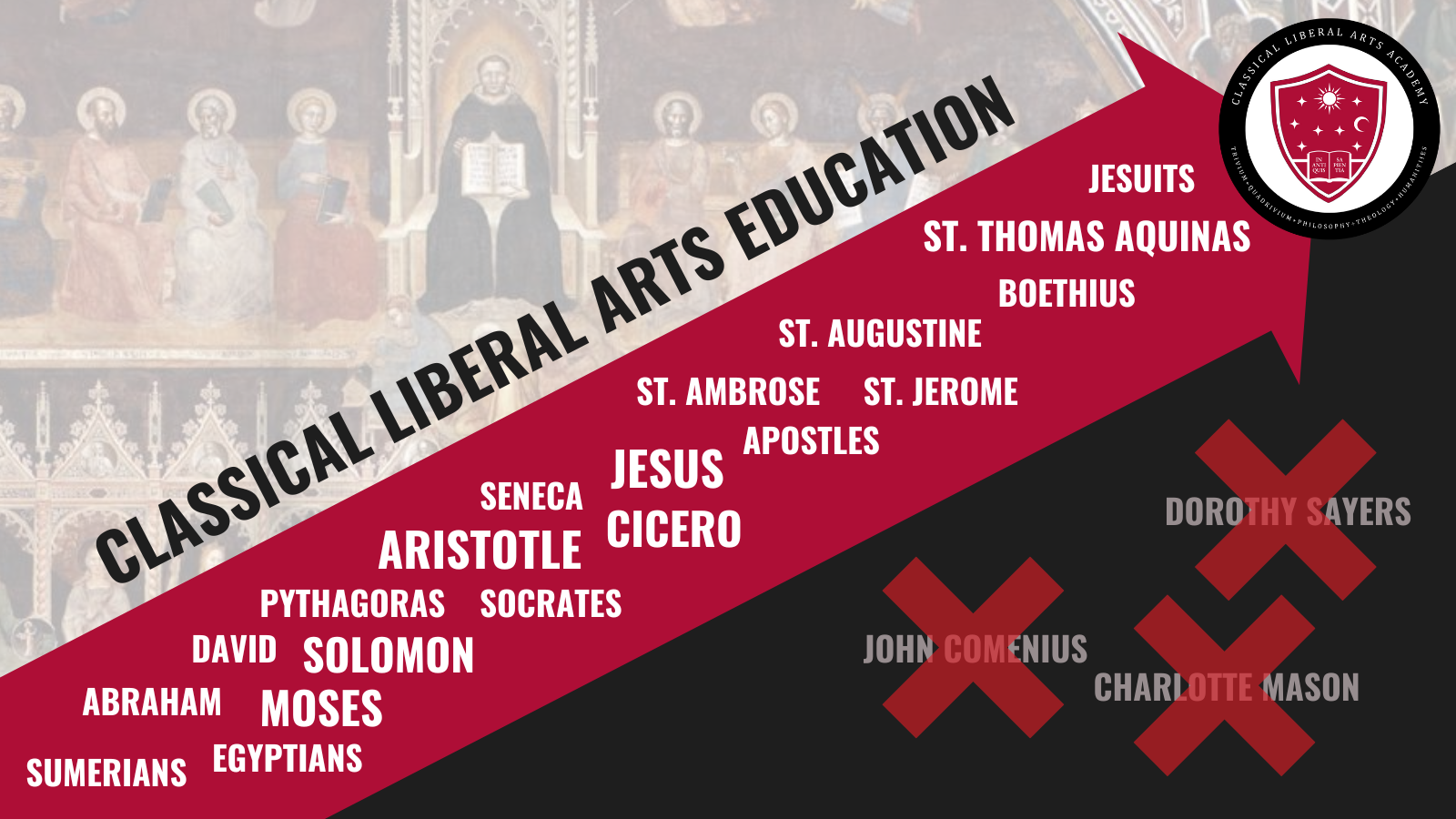
The timeline looks something like this: We go back into the ancient world. We have the ancient Babylonians, the ancient Sumerians, and the ancient Egyptians beginning human philosophy, studying the heavens, and developing the arts of mathematics and so on.
We then move into Greek philosophy and come to names like Pythagoras, Socrates, Plato, and Aristotle. We then move into Roman history and have names like Cicero and Seneca.
We then move into Christian history and encounter our Lord Jesus Christ Himself, with the divine revelation of His teaching in the New Testament. We have the Apostles and their teaching and writings in the New Testament and the foundation of the Church.
We then have the period of the Church Fathers, with men like Saint Jerome and Saint Augustine. We then go into the Middle Ages, where we have names like Boethius, and then into the Scholastic period with St. Thomas Aquinas, Saint Bonaventure, and Saint Albert the Great.
That brings us into the 1300s, and then we come into the 1500s with the restoration of classical learning by the Jesuit Order and the Ratio Studiorum, establishing Jesuit schools that teach the ancient curriculum again in the 16th and 17th centuries.
Then we come into the 1800s and have Pope Leo XIII calling Christians back to scholasticism, and Pope Pius X, in the 1900s, again calling Catholics back to scholasticism.
If you draw that timeline from the ancient world through all of the wise men and saints to the present day, never along that timeline do you run into anyone named Charlotte Mason. For real classical Catholic education, Charlotte Mason is completely irrelevant.
What I would ask any homeschooling parent, homeschooling group leader, or, God forbid, a private school administrator or teacher who’s promoting Charlotte Mason is one simple question: How did you come to learn about Charlotte Mason?
If you were interested in classical education, you would have returned to Aristotle, Plato, Socrates, and Pythagoras. You would have returned to Cicero and Seneca. You would have returned to the Classical Age and Greek and Roman writings on education and philosophy.
If you were sincerely interested in restoring classical education, if you were sincerely interested in restoring the Catholic education enjoyed by the Church Fathers and saints throughout Church history, you would have gone back to our Lord and the Apostles, to the New Testament.
You would have gone back to the Church Fathers. You would have studied Saint Augustine, who wrote broadly on education. You would have gone back to the Middle Ages. Most importantly, you would have gone back to St. Thomas Aquinas.
You would have gone back to St. Albert the Great. You would have gone back to the Jesuits. You would have gone back to the great schoolmasters and educators, to the great missionaries and religious orders of the medieval and modern periods of Church history.
If you were sincerely interested in restoring, preserving, and promoting historic classical Catholic education, you would have gone back to the Masters. You would have gone back to the sources. You would have pursued that education yourself before you set yourself up as a school administrator or as a teacher.
Before you undertook the work of homeschooling, you would have sought out that education for yourself, or you would have sought advice from people who have that education—that classical Catholic education.
If you had done so—if you had said, “I would like to see what people studied in the ancient Jewish world,” or “I would like to see what people studied in ancient Greece or in ancient Rome”—you would have said, “I want to see what people studied in medieval Europe when the saints were learning and teaching.”
You would have sought evidence. You would have sought proof of real, classical, and Catholic education. And you would never have heard the name Charlotte Mason or many of the other names that are thrown around in the so-called Classical Christian education movement today, because it’s fake.
Many parents have only themselves to blame. In talking about restoring classical education or seeking a timeless and trustworthy education, they have never asked for evidence. They have never asked for historical evidence that what is being sold to them has anything to do with the education of wise men and saints.
They simply don’t ask for any evidence. They don’t ask for any proof. They just listen, and if it sounds pleasing to them, they gobble it up, buy all of their supplies, pay their tuition, and walk around telling themselves and others that they’re pursuing classical education when there is no evidence that they’re doing any such thing.
As for me, I began my classical studies when I was 20 years old. I went back to the sources. I studied the ancient Greek philosophers. I studied ancient Near Eastern history and biblical history. I learned about the Sumerian civilization and Egyptian education.
I learned about Greek and Roman education. I collected resources. I started collecting resources when I was a college student in my 20s. I then studied Christian Church history and the writings of the New Testament, the writings of the Church Fathers, the history of education in the Catholic Church, actual schools where saints were taught, and, more importantly, where saints themselves taught other students.
I spent years collecting and researching and reconstructing the classical Catholic curriculum. Never—never in the history of my work and research—did I ever come anywhere close to anything done by Charlotte Mason.
In fact, I only hear the name Charlotte Mason from homeschool booksellers and homeschool mothers talking about homeschooling. Never in my work as a historian—I have a degree in classics and ancient history—never in my spiritual life as a lay Dominican, never in my classical studies, and I’ve worked in classical studies full time for 25 years now, never have I ever come into contact with Charlotte Mason.
She has nothing to do with real classical Catholic education. So there’s a reason why there are no articles about Charlotte Mason on the Classical Liberal Arts Academy website.
I don’t talk about Charlotte Mason. I don’t even pretend to know anything about Charlotte Mason, because she is irrelevant to the history of real classical Catholic education.
She’s not necessary. Whatever philosophy she developed, whatever methods she developed, are not necessary. They’re not relevant. I am quite certain that they are not the most efficient path to real, classical, Catholic studies.
I don’t see the fruits of any Charlotte Mason-educated students influencing the world as great educators. When I look around at the great educators in our generation, I see Dominicans. I see Catholics who study the classics.
I rarely see homeschool students talking about their “Great Books” education because the Great Books curriculum is a fake classical education. It’s got major problems. I know it looks better than what’s available in modern schools, but it’s not the solution to the problem. It’s part of the problem.
I would argue it’s actually the beginning of the problem. It’s where the problem in modern education started—with the idea of this love of reading, love of the Great Books, and literature. I would argue that’s where education ran off the rails.
Real classical Catholic education ran off the rails, and there were saints in history warning us of this. One whom I always quote and recommend is St. John Henry Newman, who lived in the 1800s.
An Englishman, he said in an age like this—and he was speaking in the 1800s, so we’re talking 200 years ago—”In an age like this, where books abound, it is common for men to confuse real learning with the love of reading.”
The love of reading, interest in literature, interest in books, interest in libraries, and all these things that are presented to us as signs of learning are not real learning.
Real learning has to do with studying and mastering the classical liberal arts. The seven classical liberal arts were grammar, reasoning, rhetoric, arithmetic, music, geometry, and astronomy.
You can go back through history and find images of the seven liberal arts painted in monasteries, illustrated in books, and carved into the walls of buildings. The seven liberal arts were the core curriculum for real Christian learning.
The love of literature developed as a distraction from that real, challenging, and difficult study of the classical liberal arts. It has to do, really, with the errors of the Renaissance and Reformation, where men turned away from philosophical and religious studies, turned away from the classical liberal arts, and gave themselves over to literature.
They gave themselves over to encyclopedic studies, where they were just learning information—like encyclopedia content—rather than the arts, the classical liberal arts.
So the Great Books program, the talk about literature, and the idea of having broad, wide knowledge that’s very shallow while being ignorant of the classical liberal arts is actually the problem with modern education.
What we see today in modern education is simply the consequences of that error having worked itself out over several hundred years. But if the problem goes back 400 years, and you only go back 100 years, you may be doing something different than what’s being done today.
You may be doing something that looks better than what’s being done today, but you’re actually on the same path of modern education.
There’s a deception in going back. For example, the Seton homeschool program takes Catholic students back to, let’s say, the 1950s and presents a 1950s view of Catholicism that looks better than what’s available today, but it’s already after the problems began.
The Great Books may look better than the modern public school, but the Great Books error is what led to the modern public school.
In order for us to restore real classical Catholic education, we have to go back to the seven classical liberal arts. If we don’t do that, we’re kidding ourselves.
If we don’t go back to the classical liberal arts, if we don’t go back to the study of classical philosophy, if we don’t go back to the study of Sacred Scripture and systematic Catholic theology, we’re kidding ourselves.
We can play around with all kinds of books. We can brag about books that we read that other kids today don’t even know about. We can pretend that our love of reading is a sign of real learning, but it’s not.
We can play this game. We can dress the kids up in school uniforms. We can have them study history. We can have them read all kinds of literature programs and piles and piles of books.
But unless we go back to the classical liberal arts, classical philosophy, and Scholastic theology, we’re kidding ourselves.
If you go back to the classical liberal arts, if you go back to classical philosophy, and if you go back to Scholastic theology, you will never encounter Charlotte Mason.
And that’s why I never talk about Charlotte Mason. The only reason I’m talking about her now is because a homeschooling mother asked me to comment on the Charlotte Mason, whatever.
And my comment is this: If you’re interested in real classical Catholic education, if you’re interested in providing yourself and your children or your students with the education that was enjoyed by wise men and saints throughout history—that education has nothing to do with Charlotte Mason.
That’s my answer to the question.
Mr. William C. Michael, O.P.
Classical Liberal Arts Academy
