
“You have one Master, and you are all brothers.” — Matthew 23:8
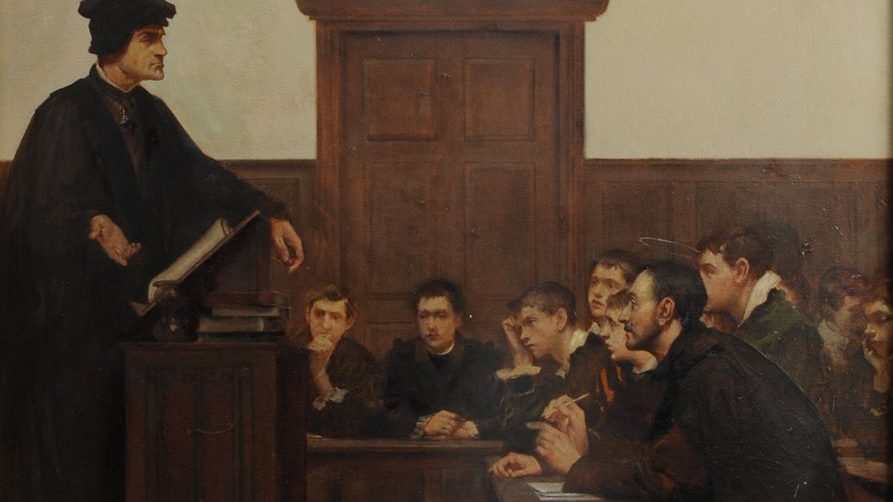
The revival of classical education requires the restoration of the method of study that made classical and Catholic learning so fruitful for centuries. The Studium is not a stage for a teacher’s performance, but a community gathered around the writings of history’s wisest and best men, seeking to understand them in Christ, our one true Master.
In this approach, the teacher is not an authority replacing the text, but a tutor and guide, whose ultimate value is his experience as a student. The students are active participants in the search for understanding. The center of attention is always the text itself.
A Spirit of Humility
The Studium is built on humility. Neither teacher nor student claims to “own” the meaning of the lesson. Instead, everyone listens together, studies carefully, and proposes interpretations that can be questioned and improved. A lecture in the Studium is not a delivery of conclusions, but a shared discovery of meaning.
The Seven Steps of the Studium Method
To preserve this spirit, the Studium follows a clear and consistent pattern. The word “Studium” simply means “Study”, and these seven activities make up the process by which this “Study” is conducted.
1. Praelectio — Announcing the Lesson
The tutor identifies the author, the work, and the specific passage or lesson to be studied. A brief, factual, orientation may be given, but no interpretation. This ensures that the focus stays on the text, not on the teacher’s opinions.
2. Oratio — Prayer Before Study
Every lesson begins with prayer for divine assistance. Students recognize that all true wisdom comes from God and place the work of study under His guidance. St. Thomas Aquinas’ “Prayer before Study” provides a good model.
3. Lectio — Reading the Lesson
The text is read aloud carefully. A second reading is sometimes necessary. Words or references that are essential for understanding may be briefly explained, but the teacher does not interpret or summarize. The text speaks first, and the class listens.
4. Divisio — Analyzing the Content
The class examines the structure of the lesson, identifying its main parts, divisions, and logical order. This step gives students a clear framework for understanding the author’s intention.
5. Interpretatio — Proposing the Meaning
The tutor, drawing from his own experience, proposes what appears to be the author’s purpose or main message, based on the structure and content of the text. This is a proposal dependent on evidence, not a dogmatic judgment. Students may question, challenge, or refine it. The strength of the interpretation depends on evidence. In this way, students are challenged to question and reflect on the text, and the understanding of the text improves over time.
6. Comprehensio — Taking Hold of the Lesson
The students work to make the lesson their own. This may involve re-reading, taking notes, memorizing, working through exercises, or preparing for assessments. It is the interior labor of learning — quiet, disciplined, and persevering — by which one makes knowledge his own.
7. Demonstratio — Proving student Mastery
Finally, students demonstrate that they have learned the lesson through a combination of recitations, discussion, written work, quizzes, tests, or disputation.
Disputation in the Studium
Because interpretation is offered as a proposal based on evidence, students may raise objections or offer alternative readings during the steps of analysis or interpretation. This is how the Studium refines itself over time. Objections hold tutors accountable to the texts studied and challenge students to improve understanding — evidence that the students are thinking carefully and participating fully in the work of learning. Objections may be proposed for disputation outside of class meeting time and are participated in in writing, asynchronously.
The Aim of the Studium
This method:
keeps the text at the center,
cultivates humility and clarity,
forms students to think carefully, not just to repeat, and
encourages critical learning rather than passive repetition.
The goal of the lecture is not to deliver the truth but to help students discover it. Tutors and students stand together under the authority of the text, seeking understanding with humility and care. This is the true spirit of the classical Catholic classroom — a shared pursuit of wisdom to which the gifts and efforts of all may contribute.
Mr. William C. Michael, O.P.
Headmaster
Classical Liberal Arts Academy
