
In this lesson, we will study Aesop’s fable of the Hawk and the Farmer. This fable is studied in lesson 108 in the Classical Liberal Arts Academy’s Aesop’s Fables course.
Let us begin by reading the fable.
Fable
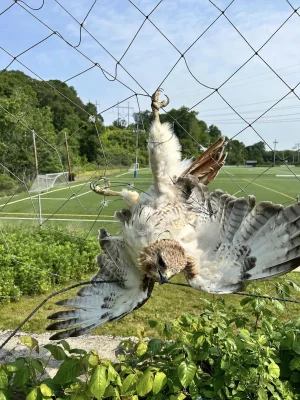
A Hawk pursuing a Pigeon with great eagerness, was caught in a net which had been set in a corn-field for the Crows. The Farmer, seeing the Hawk fluttering in the net, came and took him. The Hawk besought the Man to let him go, saying piteously that he had done him no harm. “And pray what harm had the poor Pigeon you followed done to you?” replied the Farmer. Without more ado he wrung off his head.
Exposition
In this fable we read of three characters: a Hawk, a Pigeon and a Farmer. We learn that the Hawk, a fast and powerful predator, was chasing a slow and peaceful Pigeon, when he was suddenly caught in a net that the Farmer had set up in the field to keep the Crows from eating his corn.
When the Farmer came upon the Hawk caught in the net, the Hawk begged (besought) him to let him go, that is, to be merciful to him. The Hawk argues weakly (piteously) that the Farmer should leave him alone because he has never done anything harmful to the Farmer.
The Farmer, however, had just watched the Hawk attempt to catch, kill and eat a Pigeon. Surely, the Pigeon had never done anything harmful to the Hawk, so the Hawk doesn’t truly believe in the rule he suggested to the Farmer.
The Farmer, refusing to listen to any of the Hawk’s fussing (ado) let the Hawk to be judged by his own behavior and put him to death.
Moral
As with all fables, it is possible for us to draw a number of different moral lessons from this fable. We can look at the story through the eyes of the Pigeon, of the Hawk or of the Farmer.
The Hawk gives us a warning of the danger of listening to dangerous people when they are caught doing harm. Those who bully and trouble innocent people like to be rough and cruel to weaker people when they think they will get away with it.
However, when they are stopped by someone stronger than them, they demand gentle treatment and warn the stronger, who is stoppoing them from doing evil, that they have no right to injure someone weaker than themselves.
The Farmer shows us to ignore their lying talk about mercy and give them the punishment the deserve. Those who wish to do harm to the innocent shall be punished severely.
Can you think of other moral lessons in this fable?
Application
We see a good example of this fable in current events. On October 7, 2023, members of a terrorist group (Hamas) from Gaza crossed the border of Israel and did great harm. The Associated Press reported the following:
“At least 250 people were killed and 1,500 wounded, making it the deadliest in Israel in decades. Hamas fighters took an unknown number of civilians and soldiers captive into Gaza.”
Associated Press
In response to this attack, the Israeli military launched an attack on Gaza to rescue the people taken captive and destroy Hamas. Being a small country surrounded on three sides by Israel and to the south by Egypt, who shut their border, the terrorists were trapped like the Hawk. When the Israeli army arrived, the people of Gaza began complaining like the Hawk that they didn’t hurt anyone and should be shown mercy, but the truth is that they knew of the terrorists’ activity and tried to protect them.
The Israeli army responded like the Farmer and destroyed Gaza, not listening to their false complaints about the need for mercy and peace.
Do you think Israel acted rightly? Can you think of another application of this fable?
Mr. William C. Michael, O.P.
Headmaster
Classical Liberal Arts Academy
Enjoy this article? Take a moment and share it with friends.
