As Catholic parents, we have a duty to evangelize our children, to raise them to know, love and serve God in this life. Outside of our relationship, there are billions of influences in the world that will seek to draw our children away from God, to their own service. There are a few influences in the world that will help us, but we will have the greatest influence on our children. The world seeks to separate our children from us, but how can they succeed? How can strangers possibly draw children away from Catholic parents who love them sincerely and offer them everlasting happiness?
The strongest weapon our enemies have is education.
If they can take control of our children’s education, they can separate them from us, turn their attention away from the Catholic faith, and persuade our children to serve their interests rather than God’s.
Still, how can they take control of our children’s education? We’d never give up control of our children’s education. Right?
Wrong.
Catholics have given up their children’s education in modern society because they have been deceived by a false argument from the world–a masterful fallacy.
What is the Fallacy of Modern Education?
The fallacy of modern education is this:
If your children aren’t interested in a classical Catholic education, then you should give them a good modern education instead.
This fallacy has turned all Catholic schools into public schools with private school tuition, and has make them both irrelevant and unsustainable in modern society. In fact, the fall of Catholic schools into this trap is likely the reason why you are considering homeschooling in the first place. You cannot justify paying private school tuition for a modern education in a Catholic school. It makes no sense.
Why Does This Fallacy Work?
I. The Underlying FAULTS IN PARENTS
The bad news is that this fallacy works because many Catholic parents aren’t committed to the Catholic faith. There is a secret doubt and disbelief in most Catholic parents that never allows them to commit to the Catholic faith as the “one thing necessary”. They say all the right things in casual talk, but in their hearts, they are not committed to them–especially when the going gets tough.
Many Catholic parents with young children want the best for their children. They want to give their children the same education that wise men and saints enjoyed in the past. They contact us, excited about classical Catholic education and sign their kids up for Petty School and Catechism classes.
Then, the trouble starts.
When Catholic parents begin to teach their children, they find that their children often resist Catholic learning. They complain about memorizing Catechism questions. They complain about studying Grammar. They don’t want to learn Latin. They don’t want to spend hours studying each day. They start crying, complaining, resisting, etc.
Then, the fallacy enters in, “If your children aren’t interested in a classical Catholic education, then you should give them a good modern education instead.”
The difficulty of the work, added to the parents’ secret doubts about the Catholic faith, prepare the soil for this fallacy to germinate and take root. It is completely false, but parents aren’t ready or willing to resist it because it is comfortable and excuses them from the sacrifice and work that they can see is going to be necessary.
LIttle by little, the parents begin yielding to the fallacy, replacing this course with that, this activity with that until, like the Catholic schools, they have abandoned the educational system of the wise men and saints and are giving their children a modern public school education in their private Catholic home.
Gotcha.
II. The False AppearanceS of Modern Schooling
The conditions that allow this fallacy to take root in Catholic families are only one part of the problem. There is another problem that allows this fallacy to work among Catholic parents and it is the false appeareance of modern schooling.
When Catholic parents attempt to educate their children without perfect confidence in classical Catholic education, they leave themselves subject to the influence of false appearances. They allow themselves to be deceived by things they don’t understand, and there is no anchor to keep their ship from drifting away with the current of modern education.
As Catholic parents, we fell lonely and isolated. We look around and see giant modern school buildings, buses loaded with children, and know that this is what almost everyone in our society is doing with education. The children are simply enrolled in modern schools, they all go to school, they all graduate and they all move on. Yet, here we are, wrestling with 8 year olds who don’t want to study subjects that aren’t even required in these modern schools. Why are we doing this?
Here, the fallacy speaks to us, “If your children aren’t interested in a classical Catholic education, then you should give them a good modern education instead.”
This vision of modern education, however, is deceiving us. What’s going on in modern schools is not what it appears to be.
When we work to teach our own children, we are working with absolute standards in education. We are responsible to seek a timeless standard of faith and morals, and we are responsible to seek this with every one of our children.
This is not what modern schools are doing.
When a community sends its children to a modern school, they all start out together. The elementary school teacher presents the same material to all the children and the school publishes it’s curriculum content, which appears to offer an absolute standard of learning to all children. The students all have access to the same resources (at school). The students all receive the same instruction (at school). The students are all given the same assessments (at school).
However, in the end, that teacher and that school take no responsibility for the learning of each child. The individual children are not lead to mastery of that published school curriculum. When their mastery is assessed, they are given grades–and that’s it. A few students master the content, but most don’t. The teacher moves on to the next lesson, and that’s that.
Homeschool parents can’t do that. Catholic schools should not do that. If our lesson content is important, we cannot give students grades and move on to the next lesson. We have to take responsibility for every child’s learning and lead them to mastery–and that’s what makes classical Catholic education difficult.
The modern school, however, does not do this. It simply grades the children and moves on, taking no responsibility for their mastery of the content.
As time goes on, the gap between students grows to the point that they can no longer be kept in the same classroom. Rather than merely give them different grades for the same lesson content, they have to be separated into separate classes and given different content. So, these graded students are then sorted into different levels. Half the students stay together and continue to learn the school’s published curriculum. The other half is separated into a lower class, where the standards are watered down because these children will not learn them. These children are not being taught the school’s published curriculum, but this reality is not spoken of.
At the end of the next year, students in each of these different classes are assessed and graded in their own classes, relative to their own level of study. Students receiving low grades in the higher class have not learned the content of the school’s stated curriculum standards. Students in the lower level aren’t even following them any more. Students receiving low grades in the lower class aren’t even mastering the watered down version of the curriculum. No one has any idea what they’re actually learning.
This grading and sorting the students goes on through the modern schools, but in the end something amazing happens. Every student with a passing grade is awarded with the same modern high school diploma. It’s a miracle! These students, who have not received the same education, and who have never demonstrated mastery of the school’s published curriculum, are given the certificate of completion as if they had done so
No one says a word.
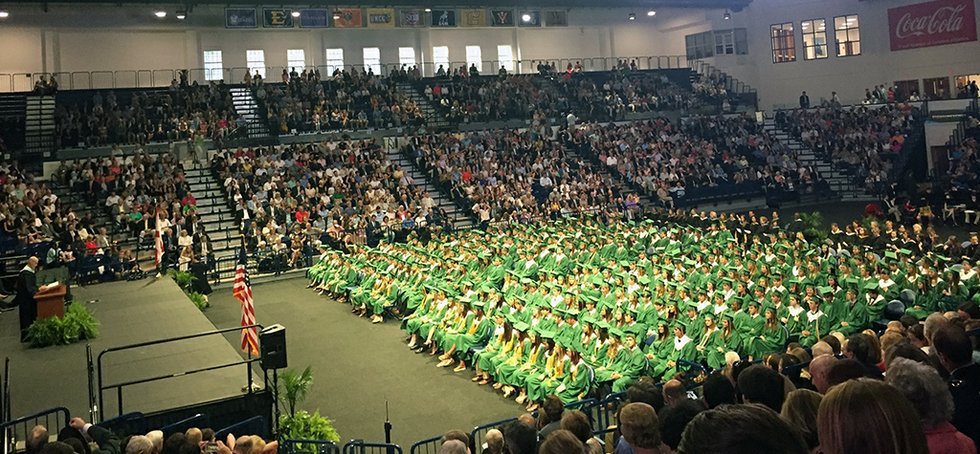
The graduation ceremony is help and “Pomp and Circumstance” blares from the speakers as these children, all dressed in the same caps and gowns, in a show of unity and accomplishment, march to the stage together, receive the same diplomas and are released from the schools, into the world, as if they’ve all accomplished the goal.
No one says a word.
Catholic parents aren’t allowed to do this. Catholic education doesn’t allow us to do this. In classical Catholic education, we understand that there is a standard of learning that is absolute. Yes, there is a diversity among children of gifts and resources and vocations, but this has nothing to with their Catholic education. The Catechism doesn’t change when two students fail to master a lesson at the same time. We can’t give students grades for their learning and simply move on to the next lesson with the kids who learned it, while ignoring the kids who didn’t. We can’t give the kids certificates of completion for a Catholic education–if they didn’t actually receive one.
This is what makes classical Catholic education difficult!
However, when we compare the work that needs to be done in classical Catholic education, with what modern schools are doing, we don’t compare apples with apples. We compare an education that serves abolute standards with an education that only pretends to do so. We compare an education where teachers take responsibility for the success of every student with an education that take responsibility for no one. We compare an education which, if not mastered by stuents, will leave students terribly disadvantaged in life to an education that throws a common cap and gown on every student and covers the glaring differences which leave most of them completely unprepared for what’s ahead of them.
We allow this false appearance of modern schooling to deceive us.
CONCLUSION
When children complain about the challenges of a classical Catholic education, the world slithers in and suggests that because of this difficulty, the children should not be given that education of wise men and saints. After all, if they do not want it, they will not study it, and if they will not study it, they will not master it. Therefore, it must not be the right educational program meant for them. It is argued that, instead, they should be given a modern school education because–just look at the graduation ceremony!–all students appreciate the modern curriculum and these problems don’t exist.
All of this is false–demonstrably false.
Students don’t embrace the modern school curriculum. The honors students do, and they would likely have embraced whatever program of study their parents set before them. If it was a classical Catholic education, they would have studied it and thrived in it. Instead, they worked to master a modern school curriculum that likely included little or no philosophy, theology or reasoning studies. The majority of students, who didn’t get As in honors classes, didn’t master the modern school curriculum, but resisted to various degrees and end up with a partial knowledge of that modern school curriculum. They certainly finished with little or no knowledge of theology, philosophy or reasoning studies.
If this is the case, why do Catholic parents give up on classical Catholic studies when students struggle with it? Why do they allow the argument that when a student does not embrace a program of study it should be abandoned for a program of study that most studens do not embrace? Why do Catholic parents allow themselves to be convinced that partial mastery of a classical Catholic education is a bad thing, but partial mastery of the modern school curriculum is a good thing?
The answer is because they themselves are not convinced that a classical Catholic education is, in fact, necessary. When they meet with resistance, they look for an escape, however irrational it may be, and pretend to have solved the problem. The false appearance on which modern schooling depends is ignored and everyone applauds when the students are given diplomas that we all know don’t mean what we’re pretending they mean.
In this, we fail our children and are unfaithful to the Catholic faith. We take no responsibility for their discipleship, but reduce our work to the pursuit of an empty ceremony.
There are no religious vocations today. There are not enough priests to provide the pastoral care that the Church requires. The majority of Catholic-born youth are leaving the Church. The society we live in is being left without evangelization.
But we’re all clapping at the graduation ceremony, telling our children, “You did it!”–when we know that they didn’t.
In the Classical Liberal Arts Academy, we’re not going to play this game.
Mr. William C. Michael, O.P.
Headmaster
Classical Liberal Arts Academy
mail@classicalliberalarts.com