
In this essay, I wish to challenge certain assumptions that are commonly taken for granted in modern explanations of planetary motion. Terms like “inertia” and “tangential velocity” are frequently invoked as if they were true causes, yet upon closer examination, they appear to function more as convenient descriptions than as genuine explanations. By examining the logic behind these concepts and applying them consistently, I intend to show that they fail to account for the actual changes observed in the earth’s motion. Moreover, I will argue that the notion of space as a “vacuum,” often used to support these explanations, is misunderstood and misapplied. My aim is not merely to dispute terminology, but to call attention to deeper inconsistencies and to seek a more coherent account of motion grounded in sound reasoning about causes.
Inertia and Tangential Velocity
“Tangential velocity” is introduced in describing the heliocentric model, but this is sophistical. There is no such thing as “tangential velocity”. It is a relative term that describes motion relative to an assumed circle and radius. When asked, “How does the earth continue in motion around the sun?”, the heliocentrist argues that “tangential motion is constant”. If we ask, “What is the cause of this tangential motion?”, the answer will be “The earth’s inertia.”
This, however, is impossible.
If we ask for a definition of “inertia”, we will get something like this:
“Inertia is the property of matter by which a body continues in its state of rest or of uniform motion in a straight line unless acted upon by an external force.”
By definition, inertia cannot be the cause of CHANGE in an object’s motion. Inertia is the cause of the continuation of an object’s motion.
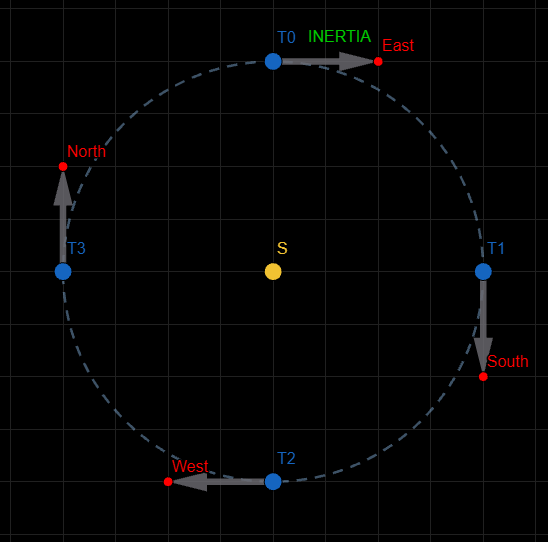
For the sake of illustration (see above), let us consider an image of the earth’s movement around the sun according to heliocentric theory. For the sake of communication, we will identify four points in the earth’s orbit: T0 (starting point), T1, T2, T3. We will use the terms “eastward”, “southward”, “westward” and “northward” to describe the earth’s motion.
At T0 (see image) we will grant that the cause of the earth’s eastward motion in “inertia”. We will not seek any more exact cause than that. According to Newton, that initial motion would continue unless acted upon by an EXTERNAL force.
Therefore, no change in the earth’s motion can be attributed to “inertia”. That makes no sense and contradicts Newton’s first law of motion.
At T1, the earth’s motion is entirely southward. This southward motion cannot be attributed to “inertia” again. At T2, the motion is westard. At T3 the motion is northward. Shall all of these changes in motion be attributed to “inertia”? That is impossible by definition. Inertia cannot cause of the earth CHANGE in motion.
So, how can “inertia” be named as the cause of the changes in motion?
By sophistry.
Rather than naming the motions absolutely (eastward, southward, westward, northward) or by using coordinates, the name “tangential velocity” is introduced. “Tangential velocity” is used to describe the earth’s motion relative to the direction of the force of gravity. This is, constant because the direction of the force of gravity is constantly changing, directed to the center of the sun. This, however, is used to present an appearance of unchanging motion. And this misleading reference to the earth’s “unchanging” motion is used to continue to attribute the earth’s orbital motion to “inertia”, which is impossible. Once you name “inertia” to be the cause of the earth’s initial motion, you can’t name it as the cause of any of the earth’s motion after T1 because all initial eastward motion has ceased. The earth’s “inertia” can’t make it to move both east and west.
Usually it’s here that one will answer,”Well, earth is moving in a vacuum.”. Let’s consider whether this idea makes any sense.
The Earth in a Vacuum?
As a follow-up to my last post on the sophistry of the terms “inertia” and “tangential velocity” in explaining the cause of the earth’s movement around the sun, I’d like to also object to the statement that the “space is a vacuum”.
When it is said that space is a vacuum, it is meant that there is no external resistance to the motion of objects as there is on earth in the presence of air.
Physicists talk about a “vacuum chamber”, where they remove air from a chamber and show how motion appears when not resisted by air. They show, for example, that objects of differing masses, when dropped “in a vacuum”, land at the same time.
The force isolated by the vacuum is the theoretical force of “gravity”.
The modern Physicists then leap from their air-free vacuum chamber to outerspace and say, “Space is like the vacuum chamber. When an object is set in motion it will continue in that motion unchanged because there is no other force to change its motion. For example, if the earth moves at a certain speed, it will continue forever at that speed because it is in a vaccum.”
This, again, is recklessly oversimplified sophistry.
The goal of an experiment is to isolate variables so that causes can be demonstrated. In the vacuum chamber, the variable scientists were trying to isolate was the force of gravity. They dropped objects to study gravity in isolation. The key here is isolation.
When we discuss the motion of the earth, however, the cause being sought is that of the earth’s tangential motion relative to the sun. The earth, with respect to that motion away from the sun at a given point, is NOT in a vacuum. That is, the earth is not in an environment where it is acted on by only one isolated force. The gravitational force of the sun is a second variable. The gravitational influence of the moon and other planets may be considered additional variables.
The absence of “air” in space does not prove what scientists pretend it does. The earth does not move freely in space, ever. Assuming the theory of gravity, it is constantly being pulled to the center of the sun. Any other motion studied is (at best) secondary.
To illustrate this consider high earth orbit satellites, which are released into orbit outside of the earth’s atmosopher. There is no air where they are released, yet as soon as they are released, they immediately being moving towards the earth. Being set into motion with no air resistance does not put them in a “vacuum” at all. In fact, many satellites are equipped with engines to keep them in orbit.
Now, I know that some will say, “The earth is not like a satellite, it is far more massive!” No, it’s not. I did my best to do the calculations and the earth’s momentum relative to the force of the suns’s gravitational force appears to be only 366 times that of a satellite to the earth’s. My calculations can be wrong, of course, but my point is that the satellite does not support the explanation for how the earth orbits around the sun.
So, if you push the earth away from the sun and there is no air resistance, the earth will not continue in the same path forever. It is immediately be moved away from its initial path (tangential) by the force of gravity, just as the feather and hammer are moved from the place where they are dropped in the vacuum chamber. That movement away from the initial path of motion would necessarily increase over time, causing the earth to move toward the sun with acceleration, just like any other object, regardless of its initial motion.
To keep the earth at a constant distance from the earth a constant source of force would be necessary that pushes the earth away from the sun. I would argue that there is no Newtonian or naturalistic source for such a force.
Mr. William C. Michael, O.P.
Headmaster
Classical Liberal Arts Academy