
In this lesson, we will study articles 67 and 68 in Algebra I. To complete the objectives of this lesson, complete the following tasks:
- Read the lesson once through, out loud.
- Study the lesson point by point for mastery.
The Associative Property of multiplication (Article 67)
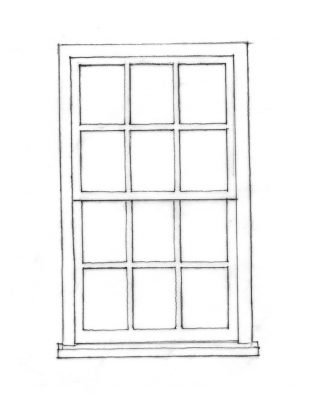
In Arithmetic, we learn that the product of two factors is the same, no matter which factor is used as the multiplier or the multiplicand. In other words, the order in which the factors are set has no effect on the product when they are multiplied.
In Algebra, we can demonstrate this principle and express it using letters to represent any quantity.
Suppose that in any window containing panes, there a vertical rows, and b horizontal rows of panes. These quantities a and b can change from one window to the next. For any window, there will be a panes in each horizontal row, and b panes in each vertical row.
Speaking in general terms of Algebra, how many panes will be in any window?
The number of panes in a window is equal to the number in one row, taken as many times as there are rows. As there are a vertical rows, and b panes in each row, the number of panes is represented by b taken a times; that is, by ab. Algebraically speaking, there will be a times b panes in any window. This will be true for any window with panes.
Again, since there are b horizontal rows, and a panes in each row, the whole number of panes is represented by a taken b times; that is, by ba. Algebraically speaking, there will be a times b panes in any window. Again, this will be true for any window with panes.
We see that the expressions ab and ba each represent the same quantity, therefore, it follows that ab = ba.
Thus, we have proven the following principle, which is called the “Associative Property of Multiplication“:
The product of two factors is the same, whichever be made the multiplier.
We can test this principle using the window pictured on the right. We see that there are 3 vertical rows, so a = 3. We see there are 4 horizontal rows, so b = 4. Therefore, if the number of panes for any window is ab, the number of panes in this window equals 3 x 4, which is 12.
MULTIPLYING THREE OR MORE QUANTITIES
In light of this, we can reason that the product of three or more quantities would also be the same, in whatever order the factors were taken. Thus, if there were two windows, the total number of panes would be 2 x 3 x 4, would be equal to 3 x 2 x 4 and to 4 x 2 x 3, since the product in each case is 24.
Rule of the Coefficients
Remember that when we see a quantity in Algebra that includes a numeral and literal coefficient, they are expressing a multiplication. For example, the expression 2b is equivalent to 2 times b. Likewise, 3a is equivalent to 3 times a. Therefore, is we multiply 2b x 3a, this is the same thing as multiplying 2 x b x 3 x a. And, since we can multiply factors in any order, this is equivalent to 2 x 3 x a x b. We can simplify this to 6 x a x b, or 6ab.
We have found, then, that when two “monomials” are multiplied, we can multiply the numeral coefficients and find the product. This leads to the following “rule of the coefficients”:
In the multiplication of one monomial by another, the coefficient of the product is obtained by multiplying together the coefficients of the multiplicand and multiplier.
If we take any two factors, as 2 x 3, and multiply either by any number, as 5, the products will be 10 x 3, or 2 x 15, either of which is equal to 30, which is the true answer. Hence,
When either of the factors of a product is multiplied, the product itself is multiplied.
Memory Work
- The product of two factors is the same, whichever be made the multiplier.
- In the multiplication of one monomial by another, the coefficient of the product is obtained by multiplying together the coefficients of the multiplicand and multiplier.
- When either of the factors of a product is multiplied, the product itself is multiplied.
Exercises
- What will 2 boxes, each containing a lemons, cost at b cents per lemon?
One box will cost ab cents, and 2 boxes will cost twice as much as 1 box; that is, 2ab cents. - What is the product of 2b, multiplied by 3a?
The product will be represented by 2b x 3a, or by 3a x 2b, or by 2 x 3 x ab, since the product is the same, in whatever order the factors are placed. But. 2 x 3 = 6; hence, 2 x 3 x ab = 6ab.
Review
- Prove that 3 times 4 is the same as 4 times 3.
- Prove that a times b is the same as b times a.
- Is the product of any number of factors changed by altering their arrangement?
- In multiplying one monomial by another, how is the coefficient of the product obtained?
- If you multiply one of the factors of a product, how does it affect the product?
