
To complete this lesson, complete the following tasks:
- Study the lesson below, carefully and completely.
- Read the instructions for translation exercises.
- Complete translation exercises.
- Memorize all lesson vocabulary.
- Work to earn a perfect score on your lesson exam.
Lesson
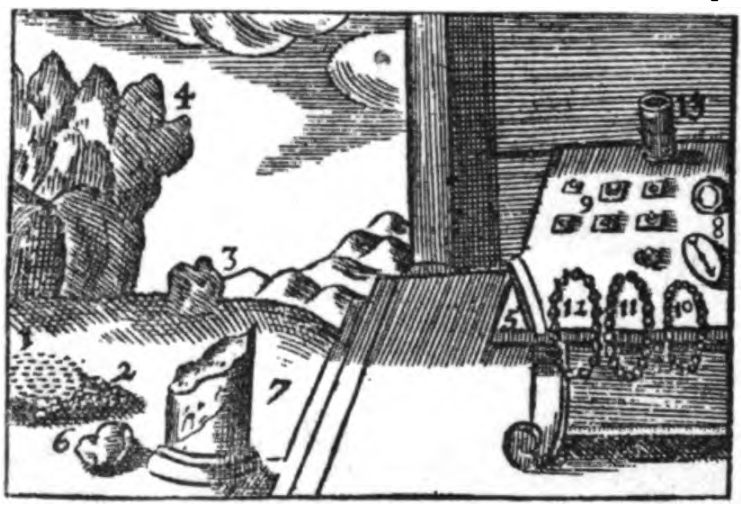
Arena et sabulum est lapis comminutus. Saxum est pars petrae (cautis). Cos, silex, marmor sunt obscuri lapides. Magnes adtrahit ferrum. Gemmae sunt pellucidi lapilli, ut adamas candidus, rubinus rubeus, sapphirus caeruleus, smaragdus viridis, hyacynthus luteus et micant angulati. Margaritae et uniones crescunt in conchis.
Exposition
Arena et sabulum est lapis comminutus.
- arena: substantive noun, “sand”
- et: conjunction, “and”
- sabulum: substantive noun, “gravel”
- est: verb, “is”
- lapis: substantive noun, “stone”
- comminutus: perfect participle, “broken into bits”
Translation: Sand and gravel is stone broken into bits.
Saxum est pars petrae (cautis).
- saxum: substantive noun, “great stone”
- est: verb, “is”
- pars: substantive noun, “a piece”
- petrae: substantive noun, “of rock”
- cautis: substantive noun, “crag”
Translation: A great stone is a piece of a rock (or crag).
Cos, silex, marmor, sunt obscuri lapides.
- cos: substantive noun, “whetstone”
- silex: substantive noun, “flint”
- marmor: substantive noun, “marble”
- sunt: verb, “are”
- obscuri: adjective noun, “ordinary”
- lapides: substantive noun, “stones”
Translation: A whetstone, a flint, a marble are ordinary stones.
Magnes adtrahit ferrum.
- magnes: substantive noun, “magnet”
- adtrahit: verb, “attracts”
- ferrum: substantive noun, “iron”
Translation: A magnet attracts iron.
Gemmae sunt pellucidi lapilli, ut adamas candidus, rubinus rubeus, sapphirus, caeruleus, smaragdus viridis, hyacynthus luteus et micant angulati.
- gemmae: substantive noun, “jewels”
- sunt: verb, “are”
- pellucidi: adjective noun, “clear”
- lapilli: substantive noun, “stones”
- ut: conjunction, “as”
- adamas: substantive noun, “diamond”
- candidus: adjective noun, “white”
- rubinus: substantive noun, “ruby”
- rubeus: adjective noun, “red”
- sapphirus: substantive noun, “sapphire”
- caeruleus: adjective noun, “blue”
- smaragdus: substantive noun, “emerald”
- viridis: adjective noun, “green”
- hyacynthus: substantive noun, “jacinth”
- luteus: adjective noun, “yellow”
- et: conjunction, “and”
- micant: verb, “they glister”
- angulati: perfect participle, “cut into corners”
Translation: Jewels are clear stones as the diamond white, the ruby red, the sapphire blue, the emerald green, the jacinth yellow, and they glister being cut into corners.
Margaritae et uniones crescunt in conchis.
- margaritae: substantive noun, “pearls”
- et: conjunction, “and”
- uniones: substantive noun, “unions”
- crescunt: verb, “grow”
- in: preposition, “in”
- conchis: substantive nouns, “shell-fish”
Translation: Pearls and unions grow in shell-fish.
Translation
Sand and gravel is stone broken into bits. A great stone is a piece of a rock (or crag). A whetstone, a flint, a marble are ordinary stones. A magnet attracts iron. Jewels are clear stones as the diamond white, the ruby red, the sapphire blue, the emerald green, the jacinth yellow, and they glister being cut into corners. Pearls and unions grow in shell-fish.
