
In Greek Vocabulary, we are studying an old Greek book, which gives us a good exercise in the real work of classical studies. We need to learn to make use of such texts.
The text we are studying is a Greek version of the text we study in Latin Vocabulary, and it is intended to be studied by students who have already studied the Latin Vocabulary course.
In each lesson, we see three columns. In the middle column (2), we have the Latin text, which should be familiar to any student who has studied Latin Vocabulary. A student in this course should be able to read the Latin text with understanding.
In the first column (1), we find the Greek translation of the Latin text. This should be studied by comparing the Greek text with the Latin text, just as we studied the Latin text by comparing it with the English text in Latin Vocabulary.
In the third column (3), we are provided with all of the words and information we need to understand the Greek text. It is a brief Greek dictionary. For nouns, we are shown the gender in the article, the nominative form of the noun, the genitive ending and the simple Latin meaning. For verbs, we are shown the 1st person singular, present tense form and the Latin meaning.
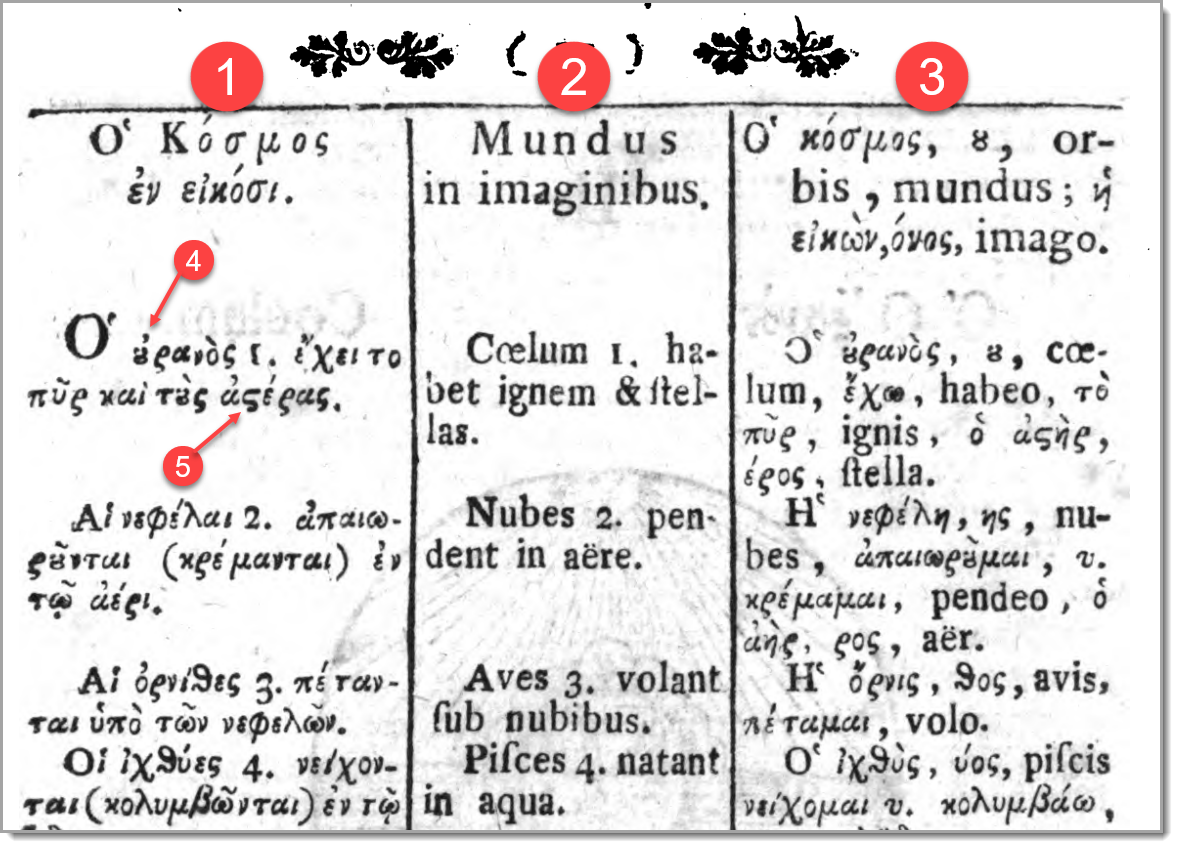
Note that two unfamiliar symbols are used in the Greek text. The first sentence begins with ho ouranos (Lat. caelum), where we see a symbol (4) used for the diphthong ou. In the last word of that first sentence, we see asteras (Lat. stellas), with a symbol (5) used for the two consonants sigma and tau.
While the first few lessons may be challenging (as studies should be), good students will get used to the work and be able to move along through the course.
If help is needed, please post questions on the course forums.
God bless your studies,
Mr. William C. Michael, O.P.
Classical Liberal Arts Academy
