
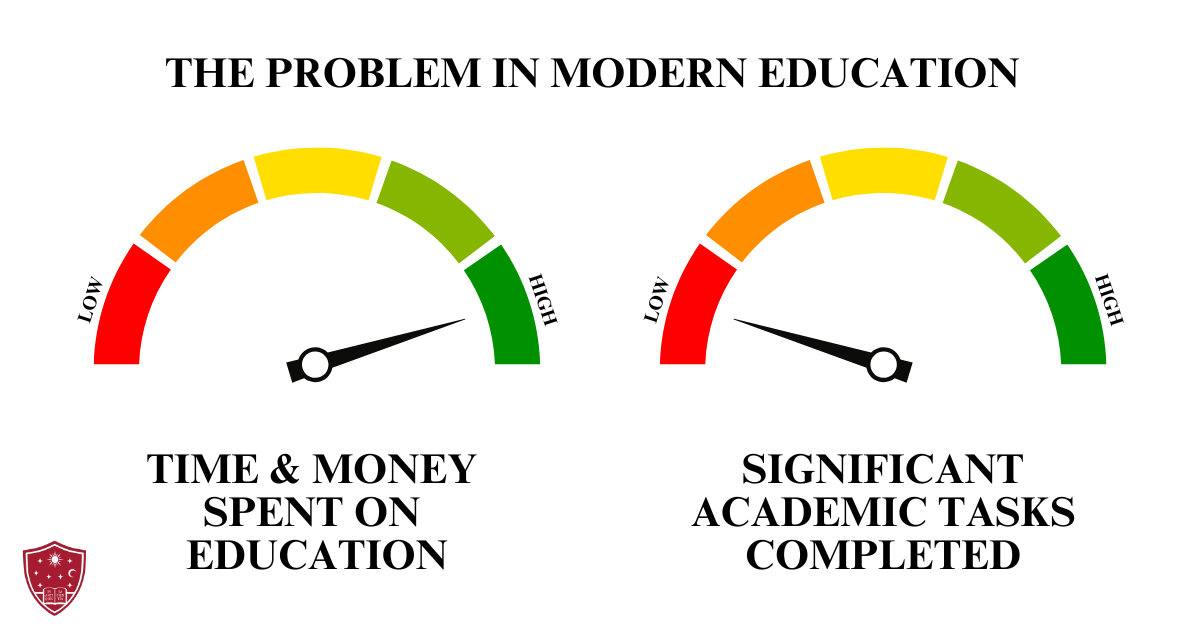
In modern education, enormous amounts of time, energy, and money are expended on things that have little to do with real learning. Parents and students alike are constantly busy, but their busyness does not translate into measurable progress. At the heart of the problem is a failure to distinguish between activities that “feel” like schoolwork and those that actually demonstrate mastery of knowledge and skills. True academic progress depends on significant academic tasks—assignments, quizzes, and exams that develop ability and reveal measurable results. Everything else, no matter how time-consuming or emotionally charged, contributes little to nothing toward actual education.
The problem is most clearly seen in the daily routine of homeschooling families. A student may read a lesson, and the parent may check it off as complete, but what does that mean? One child might spend ten minutes skimming the text, another might spend an hour slowly turning the pages, but neither has demonstrated comprehension. Reading, though necessary, is not measurable in itself. Only when the student sits down to take a quiz or complete an assignment does the parent and teacher gain real evidence of learning. That is the moment when education is no longer an appearance of effort but a proven reality.
Significant Academic Task: a task that actually develops and demonstrates student mastery in a measurable way, such as quizzes and assignment.
Unfortunately, families often avoid these significant tasks. A student may submit an assignment and earn an 87%. In a system where 90% is the passing mark, the path forward is clear: review the feedback, revise the work, and resubmit until mastery is achieved. This is not busywork; it is the very essence of education—improvement through correction. Yet instead of focusing on this direct and fruitful work, many parents divert into endless discussions about grading standards, fairness, or methods of evaluation. Hours are wasted on emails, explanations, and debates when the assignment could have been completed in minutes. The “time and money” meter is drained, but the “significant tasks” meter has not moved at all.
This misplaced focus is not a small issue. Over the course of ten or more years of schooling, the pattern compounds. Day after day, energy is poured into non-productive activity. Parents feel exhausted, students feel overwhelmed, and yet measurable progress lags far behind the investment of resources. Families forget that formal education is not about appearances, emotions, or debates—it is about mastery of content, demonstrated by clear and objective results. Quizzes, assignments, and exams are the building blocks of true academic growth. They are not optional hurdles to be resented, but the very means by which students are formed in knowledge and skill.
Parents and students must therefore discipline themselves to focus on what matters. Every time an assignment comes back with a score below mastery, the immediate response should be to get back to work, improve, and resubmit. Every time a quiz exposes a weakness, the task is not to complain but to study again and try once more. This habit of directing time and energy into the tasks that yield measurable results will not only ensure academic success but also cultivate the virtues of perseverance, humility, and diligence. By contrast, wasting effort on endless discussions, excuses, or distractions only forms habits of avoidance that cripple long-term growth.
In the end, the principle is simple: real education is measured in significant academic tasks. Reading lessons, listening to lectures, and discussing ideas may prepare the soil, but the fruit of mastery only appears in the completed quiz, the revised assignment, the passed exam. Parents and students who recognize this truth and order their time accordingly will find their studies both efficient and fruitful. Those who do not will continue to spend years exhausting themselves on everything except the one thing that truly matters: measurable mastery of knowledge.
God bless your studies,
Mr. William C. Michael, O.P.
Headmaster
Classical Liberal Arts Academy
