
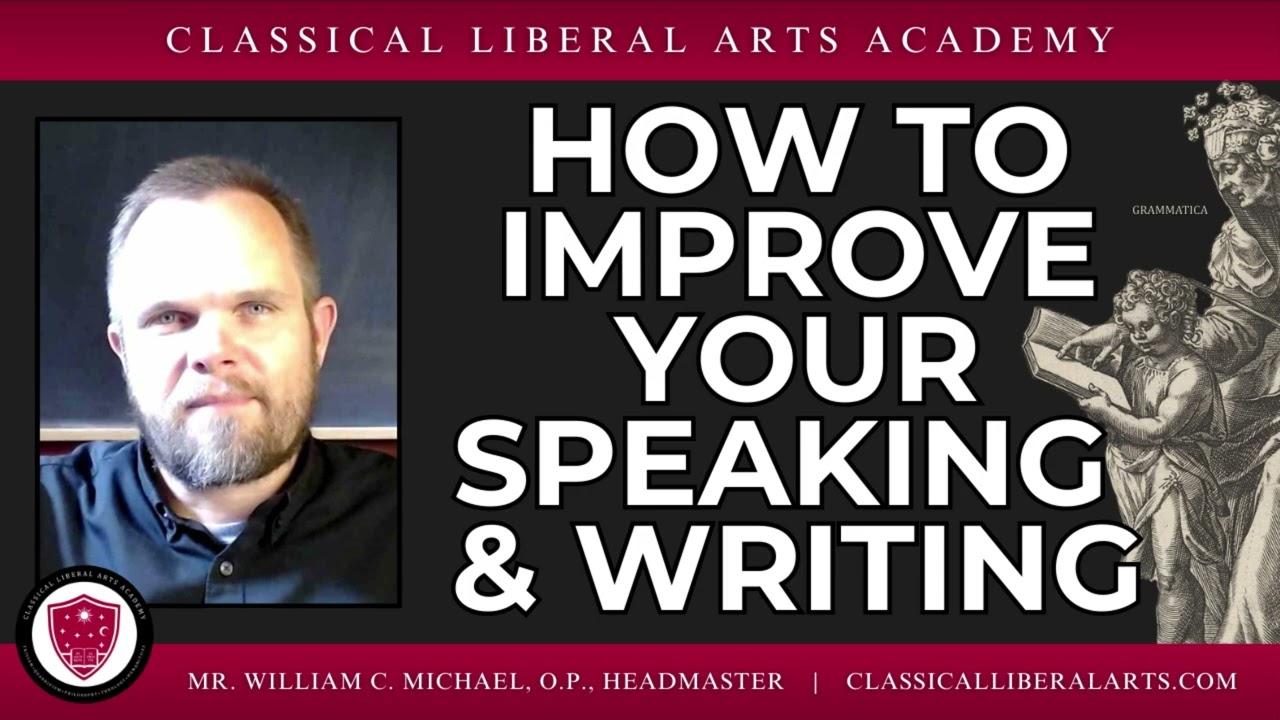
Today is September 26, 2025. This is William Michael. I’m the headmaster of the Classical Liberal Arts Academy. I received an email this evening that expresses a concern that I am pretty confident is shared by most adults living in America, especially Catholic adults, who, through their spiritual and intellectual interests, come to value communication skills and realize that they don’t have very good communication skills because they didn’t receive a very good education. I’m thankful that I was a very poor student when I was in my school years from K to 12, and I really never paid attention to the teaching I received until I converted and then I began my college life as a convert, and I took education very seriously, and was able, by God’s grace, to sort of start from scratch as a new convert and build my education in light of the Christian faith as a classic student, by the way, which just all worked out in God’s providence. What I’d like to do today in this talk is offer some help with this question of, how do I improve my communication skills, my language skills, and so on. Because I do think that there is a solution. I think it’s an attainable goal that any Christian adult can pursue, but it’s very important that we understand how to pursue it, because modern methods, modern advice, modern resources, will not bring it about, and the way to it is largely unknown today, and I’d like to share how it works, how we can learn what is really nothing more than the art of grammar. And when I say the art of grammar, I’m not talking about a modern English class, grammar that’s learned in high school or college or anything like that. I’m talking about the first of the seven liberal arts, the art of grammar, the art by which we learn how to speak and write rightly. That’s the art of grammar. That’s what modern adults don’t have. They don’t possess in their souls the art of grammar, and they struggle with that reality throughout life. The email that I received actually says the following: I admit that I can’t tell you the difference between an adjective and an adverb, the true function of a comma, a semicolon, and a colon. I don’t think my past teachers and professors noticed this, and they would just give me A’s for the content that I wrote. He says, I desire to improve this, but I have no idea where or how to even begin. Is there a course you would recommend that would help me in these specific areas of my writing? And as I said, the answer is yes, it’s the art of grammar that you need to study. However, I really want to qualify what I mean by the art of grammar. I’d like to explain the art of grammar as it is in the classical liberal arts curriculum as it was understood through history. I’d like to also provide something of an overview of the art of grammar, and then tell you how you can study and acquire this art rather conveniently, I think today, within the confines and restrictions of real life and our normal responsibilities.
So let’s begin by considering what is the art of grammar. Human beings, you know, what’s really great about true education is that it starts with human nature. What are we, you know, what are we intended to be? And we all know that we’re rational creatures. We’re rational creatures. And yet, when we talk about this rational character, very few have any clue what that actually means. We may think that it means logical or we’re able to think critically, but it’s more profound than that. It’s that God has given us a mind, a soul that has powers that even the ancients who lived before Christ, Gentiles in the world, thought of as a kind of divine power, this power of reasoning. There’s something divine about it. It makes us like God. And so the ancients wanted to understand this power, and that’s why we have Aristotle writing book after book of the different parts of the science of reasoning, beginning with the Categories, then into On Interpretation and Prior and Posterior Analytics, the Topics, and Sophistical Refutations. We have this whole system of philosophical teaching on the art of reasoning, that is the method of using this power of reason that we’re given by nature in a perfect way, learning how to actually make perfect use of this natural faculty of reason. It’s just like being given muscles. God gives us muscles and ligaments and bones, but just because we have them by nature doesn’t mean that what we actually have and use is what God intended, because God gave us muscle, but he also gave us the ability to study our own body, to learn how it works, and then to improve it by means of subjecting it to training, by controlling our nutrition, exercising, stretching, doing all sorts of agility exercises, learning skills, and so on. We can perfect this raw natural power that exists in potentiality in our muscles and bones, and the faculties of our soul work the same way. So we have this power of reasoning, and we can develop it and perfect it by the study of the art of reasoning. And the master of the art of reasoning was and is Aristotle, which is why we study his works directly in our classical reasoning courses. But when you get started with the art of reasoning, it all begins with a focus on our ideas, how ideas work, on our words. You know what words actually are, and we have to spend a lot of time thinking about and learning about words and ideas, because there can be no reasoning, no advanced reasoning, no effective communication if we don’t rightly understand how our minds work, what words really are, how words are used, and then learn to use them like tools to share ideas which are in our minds with other souls. That’s really what communication is, what language is. We have ideas in our own souls, to think of it as Aristotle would. And what we want to do as human beings is share those ideas with another soul. And so we’ve got to transfer these ideas, and the only way we can transfer them is to represent them accurately in words. And so the greater our mastery of words is, the more effectively we can communicate, but we can also communicate more and more complex ideas with greater and greater accuracy, which is what we see in the writings of ancient wise men. We see especially in someone like Aristotle or Albert the Great or Thomas Aquinas, we see this profound mastery of language, which we often mistake for reasoning. We also see it in the writings of the great ancient poets like Homer and Virgil and in medieval times, in Dante, this incredible power of language that is so vivid and so clear and so moving, because the ideas can be transferred so effectively that it arouses our own will, our own passions, and so on. But when we look at these skills, what we really see is that what sets these men apart is they have a mastery of language, and that comes from the art of grammar. They have a mastery of the art of grammar, which allows them to use words like a master craftsman, to share ideas in very precise ways. An uneducated, ignorant person can express crude ideas like a caveman, just kind of bumbling, barely expressing ideas with the most limited vocabulary and language. What’s really frustrating about lacking language skills is that you can’t communicate certain ideas. There are things that you want to share that your language skills don’t allow you to share, and this is why we see people doing things like cursing. We’ll see people cursing and yelling foul words because they’ve got powerful emotions and they have no ability to articulate those feelings in clear words, and so all they can do is let out what are called interjections, which are expressions of emotion. And that’s what curses are, just sort of frustrated expressions of feelings and ideas that they don’t have the ability to communicate effectively. We can go back and read Homer’s Iliad and Odyssey, or Virgil’s Aeneid or Dante’s Divine Comedy, and we can find the most moving scenes, the most moving moments. And when I say moving, I don’t just mean moving us to sorrow or pity. I mean moving us to anger, moving us to love what is virtuous, and so on, with no cursing, no foul language, none of that. And that’s the goal. The goal is to develop our language skills to the extent, and this is very simple, to the extent that we can communicate our ideas accurately. That’s really all we want to do. We want to be able to communicate our ideas accurately. A good illustration I used to give my students was: imagine if there was an artist who wanted to draw pictures and express and share ideas through his drawing, but he only had a box of eight Crayola crayons, so all he had were the basic colors, black, white, green, yellow, red, orange, blue, whatever. He had the basic eight crayons, and he would sit down and try to draw images that communicated powerfully and effectively what it was he wanted to communicate, but he could only use eight colors. He would get frustrated at times, he might scribble on the page in frustration. But then someone comes along and gives him the box of 64 crayons, and now all of a sudden, he’s got all kinds of colors, aquamarine and orchid. You know, you remember all the colors of the Crayola crayons when you were a kid. All of a sudden, he has the ability to add things, to add details, to add shades of meaning to the drawing, because he’s got all of these different colors that can express complex things with much more subtlety. That’s what it’s like to have mastery of the art of grammar, and that’s what should motivate us to study the art of grammar.
So when we think of the art of grammar, I’d like to recommend you learn to think of it in this simple way. The art of grammar was defined as the art of speaking and writing rightly. That’s what you’ll read in old grammar books. But I’d like to say even further than that, the art of grammar is the art of being able to share your ideas completely and accurately with others. That’s really the power and advantage of possessing the art of grammar. It enables us to communicate complex ideas, subtle ideas, powerful feelings, in ways that are socially acceptable. The art of grammar allows us to do that. And so when we get into the art of reasoning, we see that Aristotle begins by turning our attention to the art of language, of words and ideas, and then the art of reasoning grows out from that art of grammar. If you were to go to a bookstore or amazon.com, or a library, you could find dozens and dozens and dozens of grammar books, and most of them would not help you, because they are written for purposes other than the cultivation of this true art. They’re written to sell to school teachers who need a book to cover the required topics for the school curriculum, for diploma requirements, for essay prep, whatever the objective may be. But they’re not true books that express the art of grammar as it truly is. And you might ask, well, how do you know? How can you know what the true art of grammar is? And the answer is simple: the true art of grammar is that art which prepares you for success in the arts of reasoning and rhetoric. The true art of grammar. So it comes down to things that are subtle. It comes down to things like the definitions of terms, as I’ll show you in a few minutes. When you have a high school English teacher that really doesn’t care at all about the pursuit of wisdom, but is just trying to get a bunch of ninth graders through the required curriculum, that teacher is not going to be interested in the best definition. That teacher is going to use whatever definition is good enough. And often the definitions are entirely false. They’re not even true, but it just becomes the normal school definition, and I’ll give you an example. When you were a kid in school, you probably learned that a noun is a person, place, or thing. A noun is a person, place, or thing. I surely learned that in elementary public school: a noun is a person, place, or thing. But just think about how dumb that definition is. A noun is a place. So the city of Paris is a noun, the place itself. So if I get on a plane and travel to Paris and I land, I land in a noun, in a place? No, of course not. That’s not what a noun is. A noun is a word. A noun is one of the parts of speech which is used to represent or name a person, place, or thing. That may seem subtle, but the distinction between saying a noun is a place and a noun is a word used to represent the idea, which itself represents the place, that is actually a very significant difference. So when we look at the art of grammar, like I said, you can’t just go get a grammar book or go on ChatGPT or go to Wikipedia and start gathering information, because the true art of grammar has to prepare us. It has to work within the true art of reasoning. And the true arts of grammar and reasoning need to work in rhetoric, and they all need to work in the study of philosophy and theology and so on. Just think about Catholic theology. Try to explain the Eucharist. Explain what a sacrament is. Try to explain the character of God. Explain the Trinity. You’re immediately limited by your words, maybe by your ideas, but even if you have a clear idea in mind, you can say, you know, I understand that, I just can’t explain it. That’s because you lack the art of grammar. And when we look at the great theologians, we look at the Thomas Aquinas and St. Alberts of church history, we see that their vocabulary, their not just vocabulary, but their understanding of language, helped them to clearly, accurately, precisely define terms that are extremely complicated, and when we look at the great divisions in church history, right? So we look at the controversies, we say, man, these controversies were like splitting hairs philosophically. And these men took these things so seriously because they were masters of the art of grammar, and they could take them that seriously, and they understood that ideas and words have consequences, and they were very diligent in guarding the language and evaluating and criticizing the language, and today we can barely communicate anything, let alone mysteries of the Catholic religion. So this just all leads us to the art of grammar, and that’s the disability we can feel in ourselves, is that we don’t have the command of language necessary to share our ideas with others. That’s really the goal of the study of the art of grammar.
And the good news is that the art of grammar is actually very simple and easy to learn because we already use language. We’re just not very skillful in the use of language. We imitate people who we grow up with, live among, listen to, read, and so on. Most of our language is just imitation of things that we’ve heard. You can see examples of this. When people will say things, they’ll use phrases or expressions that they don’t really know the meaning of; they’ve just heard it used in that context. You’ll see people say, for example, I should have gone to the store, and they will write, should of, and you can see that they use an expression the meaning of which and the origin of which they really don’t know. It’s just an expression that they’ve heard used in a certain context, and they use it in that context, should of rather than should have. We can see things like that all the time. You’ll hear somebody say, speaking of a list of things, they’ll end with the Latin phrase, ex cetera, et cetera, and, etc. Anyone who knows what that actual phrase is knows it’s not ex cetera. It’s et cetera. It means and the rest or and the others, et cetera. But you’ll hear someone say ex cetera, because they’re repeating a phrase that they’ve heard other people use in a certain context, and they themselves don’t even know what that phrase is. They’re just imitating the language of others, imitating the expressions of others. The art of grammar takes all of that away and it allows us to actually know the language, know the words, and not just imitate what others say, but choose words to express exactly what it is that we want to express. A good example of this can be seen in modern mathematics, where the teacher says, okay, today we’re going to learn how to find the prime factors of a number. And the teacher says, watch me, this is what you do. And the teacher gets on the board and shows you start with this number. And then you think, you know, what numbers can be multiplied to reach this number? We say, 48, six times eight. And then we ask, well, what numbers multiplied give us six? Two and three. How about eight? Two and four. Can we break this down any further? Yeah, four can be broken down into two and two, two by two, and then you have this tree of prime factors. And you’re just shown this method. And then you’re told, okay, do that. Go. Do that. Imitate what I did. And the kids learn to find the prime factors of a number. But they really have no idea what they’re doing. They have no idea why they’re doing this. Why do we need to know the prime factors? They don’t know why. They’re not really thinking of the principles or the nature of numbers. They’re just shown what to do to perform a certain operation, and they’re told, do what I did, imitate me. And that’s modern mathematics, which is not the art of arithmetic, it’s just imitation, and it’s really not even education. So that’s the idea, that’s what’s wrong. Our language is almost entirely imitative. It’s not grammatical. What it means to speak or to write grammatically is to do so in light of our knowledge of the art of grammar. What’s great about becoming grammatical is that you can start with ideas, and you can think of 100 different ways to share those ideas in all different contexts, in all different ways. And that skill, that ability to express an idea in all different ways, is necessary, obviously, for the art of rhetoric, where we’re thinking about different places and times, different audiences. I want to share this idea, but I’m speaking to an audience who’s not going to like it. So how can I explain this idea or express this idea with words chosen to not offend this particular audience at this particular time? That’s to speak rhetorically, but ultimately it’s to speak grammatically. It’s to use the art of grammar to be able to do that. That’s what a real master is. That’s what a real craftsman is. You can put him in any situation, in any context, and he can figure out how to perform his work, because he knows the principles of the art. He’s not simply imitating something that he was shown. He knows how to bring about a desired effect, exactly what his patron or sponsor or client wants him to make. He can make it in any different context. That’s a real master. So with language, that’s what we want to become. We want to become masters of language so that we can communicate rhetorically, reasonably, and ultimately, grammatically. That’s the goal of studying the art of grammar. And most, almost all grammar books that you’ll find are not written to teach the art of grammar. They’re written to fulfill the requirements of a school course or a college course, or whatever. They’re not actually written to teach this art of grammar, to prepare you for the arts of reasoning and rhetoric, because they’re not even part of the school curriculum.
So if we want to learn the art of grammar, we’ve got to go back into history, to a place and time and author who taught the art of grammar for the sake of the art of grammar. We’ve got to go back before the scientific revolution and before public schooling and modern schooling. We’ve got to go back before that, to when men studied and went to school for the sake of preparing them for philosophical studies or theological studies, where there were real consequences for their education, where the grammar school really was something significant, because it had the task of preparing students to go on to the study of reasoning and rhetoric and philosophy and theology. That was the goal of the grammar school. It was a very serious work. Now we can go back through history and realize that, well, we’re talking about different languages, right? We’re talking about ancient Greek and ancient Latin, Medieval Latin, and then the arrival of English and the modern Romance languages and so on. And to speak any of these languages, you have to know the art of grammar. And the art of grammar is largely the same for all languages. The details of the languages themselves are different, but the core art of grammar is the same for all of them because of an important idea that Aristotle explained. And this kind of stuff is really enjoyable to think about. Aristotle said that all men, being in the same world, we all live in the same world, we all perceive the same objects. We see the sky, the sun, the moon, the stars, the trees, the oceans, the animals. We all see the same things, and in our minds, the same images, the same ideas are formed of those things. So if you take an English-speaking man and, let’s say, a Spanish-speaking man who knows no English, let’s say the Englishman knows no Spanish, and the Spanish man knows no English, and you bring them down to the shore and let them stand at the edge of the ocean and look out over the waves, out to the horizon, let them see, you know, here in North Carolina, we’ve got seagulls and pelicans, and let them watch the sun set on the horizon. You have one man who knows the Spanish language and another man who knows the English language. If they stand there silently, simply watching, the same ideas will be formed in their minds, like photos of the things that they perceive. They’ll have the same idea of the sun setting. They’ll have the same idea of the waves, the same idea of the seagulls and pelicans and clouds and sand and so on. But if I point to the sun and ask the two men, what is that? The idea, which is the same in both of their minds, will be given a different name. The Spanish man will say “sol,” and the Englishman will say “sun.” The same object perceived by both of them, the same idea in the souls of both of them, but two different words. And so what Aristotle explained was that the objects are the same, the ideas are the same, but language is established by convention. That is, men make it up by agreement. There’s nothing about that setting sun that requires it to be called sun or sol. Men make up the names. There are reasons for those names, but it’s established by convention. So the process of thinking and communicating, which is the art of grammar, is the same in those men; the words are actually different. And so we’ve got a difference in grammar, but there’s an underlying process that’s going on with how the mind works, how language works, that’s the same. And so there’s a universal art of grammar, and then there are localized special grammars for each different language. So if we want to learn multiple languages, we’ll have to study the different special grammars, as it were, but if we understand the universal art of grammar, it’ll make that much easier, because we understand the process and can then quickly learn the unique characteristics of different individual languages. That’s why you’ll often see someone who learns a second language or a third language can easily learn 20 more. And you’ll often hear about people who know lots and lots of languages, because once you start to learn multiple languages, you begin to pick up the universal grammar. And it’s like you know what to look for in all the different languages and can attack them and understand them more quickly. When we think back to the famous Jesuit missionaries who went into foreign countries where no one knew the languages, many of the languages had never been written, and they would learn the languages from scratch and would translate Christian books into languages that never even had writing before, that language mastery was owed to their mastery of the art of grammar. So there is a universal art of grammar, and then there are special arts of grammar that apply to individual languages.
And as we think about the study of grammar, we’re really interested in that universal grammar. That’s really the art of grammar that we’re interested in. So when we go back and we look at English, French, Italian, Spanish, we see these different languages. They’re all called Romance languages because they’re derived from Latin. Latin is the mother tongue, and this is why it’s especially helpful for us to study the Latin language, because the universal grammar, to some degree, can be seen in Latin in a way that we would not be able to see it if we studied French or Spanish or English. It’s best to learn Latin grammar first and then look at the Romance languages to see how they differ, what’s unique about them. That’s actually what needs to be studied as we study those languages. But we go back to Latin and Greek, these ancient mother languages from which other languages and vocabularies have derived, and we really learn the foundation of this universal grammar. That’s why classical education always focuses on Greek and Latin. They’re the mother tongues. They’re the languages through which we learn this universal grammar to a greater degree before we look at individual, specific language grammars. So a good place to start, if you want to learn the art of grammar, this universal art of grammar, a good place to learn is Latin grammar. That’s what I would recommend. And I recommend Latin grammar rather than Greek grammar, because for anyone who knows Spanish or Italian or French or English, the alphabet is the same in Latin. It’s easier to get started with. To get started with Greek, you have to learn a whole different alphabet, and that can be an obstacle. But we can learn universal grammar by the study of the mother tongue Latin, and as we study the art of grammar in Latin, we’ll learn a good portion of the grammar of all of the Romance languages that I mentioned before. The problem, however, just like with English grammar, is that to study Latin grammar, most modern Latin grammar books are just written for schools. Parents will always ask me, what about Henle’s Latin? What about Oxford Latin course? What about this or that? And I say those Latin courses, those books were not written to teach the art of grammar. Those books were written to serve the needs of modern schools, schools that already have an artificial calendar, already have an artificial amount of time for study. Those books were written to just serve those modern school needs. They were not written to teach the art of grammar. So I would not recommend modern Latin books, not because they’re false or they’re bad, but they’re not written for the purpose that we seek in studying what I would refer to as classical grammar. The modern books are not written for that purpose, and so I wouldn’t use them to learn what we want to learn.
When we go back into history, we find a history of Latin grammar teaching. We can go back into Roman times, and you can think there had to be Roman grammar teachers, right? There had to be Roman grammar teachers. We find men like Varro, a Roman grammar teacher, or Donatus, Roman Latin grammar teachers who lived in Rome, who were Romans. And so there was an art of the Latin language that was established. And what’s also good about these men is that these were ancient, philosophically minded men. They were not modern men teaching Spanish for travel or Spanish for business. They were men teaching language, teaching grammar for the sake of philosophy. They understood what the goal was, and they were studying and teaching language to equip students for those pursuits, those pursuits in the seven classical liberal arts, in philosophy, in theology, and so on. So their books for our purpose are better. Their books for our purpose, for our goal, they’re better. It’s not some kind of prejudice or chronological snobbery. It’s a real goal-based judgment of different Latin books. And again, it’s not a criticism of modern books. It’s simply a distinction to say we have this goal; those books were written for that goal, therefore those books are not proper for us. We need something else. And when we go back into Roman history, we can find Roman Latin grammarians. And if you’re interested in those names that I mentioned, Varro, Donatus, and there are others, you can go on the Classical Liberal Arts Academy Study Center, and you can hit the link for the Loeb Classical Library and go find their writings on the Latin language in the Loeb Classical Library. But as time went on, when Christian education developed in the Middle Ages, those works by those ancient grammarians were improved, and they were continually developed because the Latin language was still being used. And so we have a tradition of some great grammarians within Christian circles, and there are a few important names to learn.
Now, it’s important to note that through the early Middle Ages, I guess through most of the Middle Ages, those old Roman grammarians were the grammar sources. They were the teachers. But then around the time of the Renaissance and Reformation, there came a great interest in the study of grammar, because the disputes between Protestants and Catholics led to all kinds of biblical disputes, and they realized that these disputes were often settled through arguments drawn from the languages, from the original languages. And so there was a great improvement in grammar teaching through the Renaissance and Reformation. And this is true both in Protestant circles and in Catholic circles. And if we’re fair, these Catholic and Protestant circles at the time of the Reformation weren’t black and white. They sort of overlapped. And I’ll give you a good historical example. If we go back to, let’s say, English history, and we say, well, how did Shakespeare study grammar? What did Shakespeare do to study grammar? What book, what author did he study? I mean, obviously, he’s one of the masters of the English language. How did he learn grammar? His language skills are incredible, and we find that Shakespeare studied the works of an English grammarian named William Lilly. He studied from a book that was titled Lilly’s Grammar, which was the king’s official grammar in English history after the Reformation. It’s actually called the King’s Grammar. That was Lilly’s Grammar. And we can go back. You can go to archive.org and search for Lilly’s Grammar, and you can find copies of Lilly’s Grammar from the 1500s. What’s interesting, however, when you get into a study of the history of grammar, which I’ve spent the last 30 years studying, you’ll learn that Lilly didn’t just sit down and write this book by himself. There were other men involved, his friends and colleagues and fellow scholars at the time. These were all Christian men. But one of the men, or I should say, two of the men involved behind the scenes in Lilly’s Grammar were Desiderius Erasmus, famous Catholic humanist—we refer to him just as Erasmus in history—and the second was Saint Thomas More. Saint Thomas More was very involved in educational disputes of his day, was a very learned man, was friends with Erasmus, and was also friends with another man named John Colet, C-O-L-E-T. I could give you dates for them, but I don’t have any notes or anything in front of me, so just bear with me. You can look these people up with a quick Google search, find their dates and any other information you want. But the three names I mentioned, four names: William Lilly, he was the grammarian who wrote Lilly’s Grammar, which was the grammar that Shakespeare and all other English students studied at the time. Lilly was influenced in his work by Desiderius Erasmus, who was a Catholic scholar, St. Thomas More, who most of us know, a famous Catholic lawyer, writer, but also grammarian, and then John Colet. John Colet, interestingly, was the schoolmaster. He founded what is known as St. Paul’s School in England, and John Colet was the one who led William Lilly to put the book together. So all four of those men, Desiderius Erasmus, Thomas More, John Colet, and William Lilly, all contributed to what became known as Lilly’s Grammar, and that was the grammar that Shakespeare studied. And if I was to pick one grammar from history that I would love to teach the most, it would be Lilly’s Grammar. However, I don’t teach Lilly’s Grammar in the Classical Liberal Arts Academy because there’s another strain of grammatical teaching, and we find it in the Jesuits and in the work of the Jesuits around that same time to revive classical Catholic learning, because my focus is really classical Catholic learning, which is very much focused on preparing students for the study of Aristotle and Scholastic philosophy. So for that, I would recommend going to the Jesuits.
And we go to the Jesuits again. We’ve got these old Roman grammarians, Varro and others. And the Jesuits wanted to restore, to preserve, and propagate real classical Latin grammar studies, because they were concerned with philosophy and theology. And so Emmanuel Alvarez is the famous name. He synthesized the existing grammars that were available back in those days, and he put together what is called Alvarez’s Latin Grammar. And this is the grammar that was used in the Jesuit schools. And again, when I talk about Jesuits in educational history, I’m not talking about the Jesuits at Boston College. I’m talking about the original Jesuits before the order was suppressed by the Church in the 1700s. I’m talking about men like Ignatius of Loyola, Francis Xavier, and so on. But the great grammarian among the Jesuits was a man named Emmanuel Alvarez, and he’s hard to search for if you’re looking for resources, because his name had a number of different spellings in the past. You’ll find it as Alvarez with a Z at the end, Alvarez with an S at the end. You’ll find Emmanuel spelled differently with an I at the beginning, with an E at the beginning. You’ll also find him referred to as Manuel in Spanish countries. So his name changes a lot, but Emmanuel Alvarez was the great Jesuit grammarian, and he put this master grammar system together, a set of three books that taught the entire art of grammar, and that was the work that was studied in the Jesuit schools, as the Jesuits fought against the influences of Protestantism, and eventually against the influences of modern inductive philosophy, or the scientific method. That Jesuit fight began with a study of Alvarez’s Latin Grammar, and in the Classical Liberal Arts Academy, if you take our Latin Grammar course, we study Alvarez’s Grammar for that reason. So we can’t just go to the local bookstore or hop on Amazon and order grammar books and think we’re going to learn the art of grammar. We’ve actually got to go back to these men again, not because they’re old, but because their goal in studying and teaching grammar was to actually learn this art of grammar for the purpose that we are seeking to learn the art of grammar. As Catholics living in the 21st century, we share that goal, and therefore their textbooks are the best textbooks for us to study. So we’ve got Lilly’s Grammar, which was the grammar, the Latin grammar for England, which Thomas More and Erasmus were involved in. And then we’ve got Alvarez’s Grammar, which was used in Spanish-speaking countries and also in Rome, where Jesuit schools were established. It’s mentioned by name in the Ratio Studiorum that was published by the Jesuits in 1599. So if we want to learn the art of grammar, we should study Lilly or Alvarez. As I said, I think Lilly’s is actually easier for English people to study. I think it’s organized a little more simply. I don’t think it’s as good as Alvarez’s, but I think it’s easier to study. And there’s another benefit of Lilly’s Grammar in that there were a lot of resources published and put together by great schoolmasters in English history to teach Lilly’s Grammar. So there was a great grammarian who, I think he taught in the 1700s, a man named Charles Hoole, H-O-O-L-E. Charles Hoole was a great schoolmaster who developed the teaching method for Lilly’s Grammar, and he put together all kinds of resources. So you can go again to archive.org and search for Charles Hoole and find all kinds of old textbooks that were used to teach Latin, lots of interesting stuff, the kind of stuff that teachers would actually use with students, like conversational books and things like that, just interesting stuff. But so with Lilly, you have a number of supplemental resources that you won’t find with Alvarez, and that’s one of the teaching advantages of Lilly, is that there’s more stuff available. But Alvarez is more the hardcore Catholic Aristotelian scholastic grammar teacher, which is why we use his work in the Academy.
But anyway, so what do they teach? What do they actually teach? And let’s take some time now that we’ve looked at the history, we talked about the goal of grammar and the history. And I’m sorry if this is a little disorganized; this is all off the top of my head as I just want to reply to this email today. But what does the art of grammar actually teach us? What do these books teach us? Well, first of all, the art of grammar, remember, its goal is to prepare us to speak and write rightly, to be able to communicate effectively, to communicate everything we would desire, to communicate in an appropriate way. That’s really the goal of grammar. And so there are a number of parts of grammar. It begins with what’s called orthography, O-R-T-H-O, orthography, which is the study of letters and sounds, like the building blocks, the basic elements of language. We learn to pronounce the letters, we learn how to read, how to spell. That’s orthography. Once we learn how to actually read and write the language, and I mean just physically write and read the letters, pronounce the letters and the sounds, we then move on to the second part of grammar, which is called etymology, which is the study of the parts of speech. And the parts of speech are the more complex building blocks. So orthography deals with the most simple building blocks, which are the letters themselves, and then etymology, the second part, studies how words are formed, how, and remember, words, spoken words, are symbols of ideas. Ideas are symbols in our minds of things that are perceived outside of us. The ideas are produced by the mind, and words are spoken symbols that are used to represent those ideas, and written words are written symbols that are used to represent not ideas, but spoken words. And so there’s this process of representation. It begins with objects in the world, things that we perceive or understand. It then moves from the objects through our senses. That’s the act of perception. It moves from the object in the world into our minds, where it’s represented by an idea, we could say, a mental image, as it were. And then those mental images are represented by spoken words, which we can share in speech, and then written words, which, again, it’s important to note, they are not symbols of the objects. They are not symbols of the ideas. They are symbols of the spoken words. That’s why, in order to understand how to read or write, you’ve got to first know the spoken words, because what we’re writing in written words are symbols of sounds. You get this idea of phonics in reading and writing. So there’s a process here, moving from the objects to the ideas to the spoken words to the written words. And so the first part of grammar is orthography. We learn about the letters and sounds, how the letters are used to signify sounds. Second part is etymology. We learn how letters are put together to form words and what the different forms of words mean. And we call words the parts of speech, because speech is produced by means of words. The parts of speech, once we learn about how words are formed and what ideas different words and different forms represent, we then move on to the third part of grammar, which is syntax. And the word syntax comes from a Greek word that really expresses the idea of cement, putting things together. The art of grammar studied in syntax, the third part, is learning how sentences are formed, how the parts of speech are cemented or joined together. So we learn about sentence making. Think of syntax and sentence; syntax is the art of sentence making. And then finally we get to the fourth part of grammar, which is prosody, P-R-O-S-O-D-Y, prosody. And prosody is the art of pronunciation, poetry, you know, the use of language in creative or poetic ways, which you can see relates to the art of rhetoric, prepares us for the art of rhetoric, the ability to use language to communicate in ways that go beyond mere assertions or logical arguments, but communicate feelings through the language itself, through the rhythm, through the meter, through the sound of the language, through the pronunciation, the stresses, the accents, and all of that. All of that comes together in the art of prosody.
So there are four parts of grammar, and you can see that the true art of grammar, which I just described, how it prepares us for the study of reasoning, where, again, when we start reasoning with Aristotle’s Organon, we start with a study of words. We sort of go back to etymology and think more about words, not from the perspective of language and communication, but from the perspective of reasoning. And we then move from the Categories in the first book of the Organon to On Interpretation, which is like syntax. It’s talking about the rules of making propositions, sentences, which are of peculiar interest to the art of reasoning. And then from there we move into logical arguments, which are joining propositions together and so on. You can see how the art of reasoning proceeds from the art of grammar when it’s rightly taught for the sake of these higher purposes. And then rhetoric. We talk about the arts of persuasion. We talk about three persuasive appeals. We talk about the effective ones: character, ethos; we talk about the role of the emotions in persuasion, which is pathos; and then logos, or the arguments and the reasoning and the proof. But when we think about ethos and pathos, you know, the voice of the speaker, the articulation of the speaker, he can have a respectable, solemn disposition, his pronunciation, his accent, his dialect, and so on. All those things relate back to grammar, but they become influential in rhetoric. Just think about in English film and entertainment, anytime there’s a serious role to be played, we find a British actor with a British accent. Because, for some reason, the British accent is seen as more noble and honorable than an American accent. You know, if we want someone to read a book, we seek a man with a deep voice to read a book. And we have this deep radio voice that we’re used to. You can see how the sound of the language comes into consideration when we think about persuasive appeals in rhetoric. We then get into questions of poetry and things like that, and the use of different artistic features in languages themselves, forms of communication in poetry, all of that kind of stuff that all belongs to rhetoric, but it assumes a mastery of the art of grammar. So you can see how those three arts all work together. And that’s why, when we look for a grammar book or ask, how can we study this? There are objective answers to those questions. It’s not just preference. We have to ask the question, which grammar text will best prepare us for these higher goals that we have in the study of grammar.
So grammar breaks down into four parts, which is why, you know, you come to the Classical Liberal Arts Academy, you see we’ve got three different levels of grammar courses. Level one covers orthography and etymology. Level two covers syntax. Level three covers prosody. That’s what’s going on. So what’s actually taught in these grammar courses? You know, it’s actually very simple, and I’d like to just share this to bring this talk to an end, because I think it gives you enough to get started with. We look at language, right? And we just see thousands and thousands, millions of words. There’s just words all over the place. It looks like just an endless ocean of words and forms, different kinds of words and so on. Like this friend I mentioned, who said, I have no idea what the difference is between an adjective and an adverb, a comma, semicolon. It just looks like an ocean of words and punctuation marks and all this kind of stuff. And we sit in a modern English class and it just all feels so subjective, like, how do you know what’s right and wrong? What is good grammar? How do I know how to use a comma? All of these different questions. And it just all feels so subjective, because in the modern schools, there really is no established art. They’re not teaching the art of grammar. And so it just comes down to these rules which the teachers teach. The teachers find their own rules. The different books have different rules, and then all of a sudden, you’re accountable to these rules that change from one teacher to another, from one school to another. And it just feels like there’s no real art to any of this, which is why we hear people say things like, I’m not a good writer, I don’t understand how to write, I can’t write, and so on. Writing is an art. It’s a skill that’s gained by learning a method and by practicing that method. So when we hear people saying, I’m not a good writer, I can’t write, we’re hearing the testimony that the art of grammar is not being taught.
So when we come to the art of grammar, the first thing that it does is it takes away all of that feeling of confusion and chaos, and it brings language down into a very, very simple order, and you hear this phrase, you know, he’s a master of the language. He’s got real mastery of the language. Once you get started with real grammar study, you can gain mastery of language, and it starts with etymology, the second part of grammar, because we learn one very simple thing. The first thing we learn in grammar, in etymology, though there be many thousands of words, yet there are only eight different kinds of words. Though there be thousands of words, maybe millions of words, though there looks to be this great, chaotic ocean of words, there are actually only eight kinds of words. And when we learn the definitions of these eight kinds of words, we now have a classification system, and we can look at all words in a systematic way. The eight parts of speech is the first and most significant lesson learned in etymology. And so you say, I have no idea what an adjective or adverb is. Well, those are two parts of speech, and they’re very easy to understand if you actually study a good grammar textbook. The eight parts of speech, and I can name them: noun, that’s the first. It’s actually better to clarify that when we say noun and talk about classical grammar, adjectives are included as a kind of noun. So noun includes both substantives and adjectives. But we say noun is the first part of speech, and then verb is the second part of speech, pronoun is the third part of speech. A pronoun is simply a word that stands in the place of a noun, so it’s just a placeholder for a noun. So we’ve got noun, verb, pronoun, and the fourth is participle. And a participle is a special kind of word that partakes of—that’s why it’s called a participle—it participates in both the qualities of an adjective, noun, and a verb. So it’s sort of a verbal adjective. So the first four parts of speech—noun, verb, pronoun, participle—those are the four kinds of words that in a language like Latin, in English, in Greek, have different forms. So they express more complex ideas, and they have different forms. Again, nouns, verbs, pronouns, and participles. The other four parts of speech have only one form. They are not inflected, they’re not declined. And these are adverbs, prepositions, conjunctions, and interjections. Adverbs, prepositions, conjunctions, and interjections, those are the eight parts of speech. That’s all there are. So when you say, I have no idea what the difference is between an adjective and an adverb, pronouns, demonstrative pronouns, relative—it seems like a chaotic mess. It’s very, very simple. There’s eight kinds of words. You can show me any word, and I can tell you into which of those eight classes it belongs. That’s where mastery of language begins. We can look at a sentence and read through it and identify each word, what part of speech it belongs to, and then everything we know about that part of speech applies to that word, and that’s where the mastery of language begins.
Once we learn the eight parts of speech, we then learn, as I said before, different forms of the first four of the eight parts of speech, and what those different forms represent, and so on. And then the latter four parts of speech, conjunctions, adverbs, prepositions, they’re really just used in combination with the first four parts of speech to express compound ideas. An adverb, for example, just look at the name adverb. It means next to a verb. It’s a word that’s placed alongside a verb to add more detail. So I can think of a man running and just realize the natural process of what’s going on. We said the goal of grammar was to be able to communicate any idea accurately. So imagine you say the man is running, and you’re just not satisfied with that expression, because he’s not just running. He’s running really, really fast. And you don’t want to say the man is running, because the audience can think of some big, obese man who’s running, but he’s slow. And you’re thinking, that’s not the idea I want to communicate. I want to communicate the speed at which the man was running. Well, that’s why we have the noun man, and we’ve got the verb, or we could say a participle, running, but it doesn’t communicate the idea that I have in mind. Well, that’s why the adverb can be placed next to the verb to add more detail to the idea. I can say the man runs quickly, and quickly is an adverb. So when we study the parts of speech in a good old grammar book, all of this stuff becomes very simple. What is a preposition? Well, it means preposition, pre-position, a word that’s set before, pre-position, position before what? A noun. And that allows more complicated ideas to be communicated. So, for example, if I said, Mary went to the store, but there’s more that I want to communicate. I want to also communicate that not just Mary went to the store. I could say Mary went to the store with Elizabeth. With is a preposition. It allows me to join another noun to the first noun. So now I have Mary with Elizabeth. I have a compound subject, and what allowed me to express that compound idea was a preposition. I then have conjunctions. All a conjunction is is a word that joins things together. So if I say Mary and Elizabeth, I join two nouns into one subject, and the conjunction allows me to do that. And so you can see it’s not complicated. Once you learn the names and definitions of the eight parts of speech, you can then classify any word as one of the eight parts of speech. And the last one I mentioned was interjection, and I mentioned that earlier, that’s just an expression of emotion. So you see a friend walking down the street, and you want to get his attention. What do you do? You just yell, hey! Hey is an interjection. It’s just a verbal expression of an emotion. I said before, curses, when people curse, they express emotion with a relatively meaningless utterance, and that’s called an interjection. You stub your toe walking through the living room at night, and the pain is very intense, and you have all of this anger that wants to come out, and you just blurt out a meaningless emotional utterance. That’s an interjection, and there are many of them. Curses are just one kind of interjection, and they’re usually, for some bizarre reason, they’re crude words that are not appropriate to be spoken, and that’s why it’s a sign of bad grammar, poor education. You don’t have a proper word to express that feeling. You must not know the art of grammar.
So we’ve got eight parts of speech: noun, verb, pronoun, participle, adverb, preposition, conjunction, interjection. And as soon as we learn that, we can start categorizing all words, and whatever we know about the parts of speech, we know about every word that belongs to each of those eight classes, and all of a sudden you can start feeling yourself getting a handle on language. You’re starting to gain mastery of the language. And then that just goes on as you continue studying through all the details of etymology and get into syntax, sentence building, a lot of things. You already do all of these things by imitation, but you don’t do them grammatically. You don’t do them with understanding. You don’t do them intentionally. You don’t know when to use different forms to bring about different effects, because you don’t possess the art of grammar, and that’s why you struggle to speak, or you struggle to write. You have an idea. You can say, ah, I know what I want to say, I just can’t say it. That is what it means and what it feels like to not know the art of grammar.
So the answer to this question, you know, what do I need to study? You need to study the art of grammar. How should I study it? You need to study classical grammar. If you study classical grammar, you’ll learn a lot of the principles of universal grammar. And then as you look at different languages, you can see that, you know, for example, if I say, you know, I’d like to learn French, because I know grammar, I know exactly how to go about learning the French language. I need to learn the orthography, I need to learn the etymology, I need to learn the syntax, and I probably don’t need to learn the prosody, but definitely orthography, the alphabet, the pronunciation, and so on. Then I need to learn the parts of speech, how ideas are expressed, how are the words divided? What are the classes? Are they the same? Are they the same eight, or do they use different forms? Maybe for different parts of speech, get into some of those discussions, but I know what to look for. And then the rules of sentence building, I already know the universal rules of sentence building. Are they the same in French? Is there some difference? I may only need to learn what’s different, and the same is true for Spanish or German or any other language. I know what I need to know to become fluent in the language. And that’s one of the benefits of knowledge of the art of grammar.
So it’s the first of the seven classical liberal arts. It’s the gateway of the arts. And this lesson, this subject that modern students don’t learn, as simple as it may sound, and even though they’ve taken classes and have been told they were studying, they’ve never studied real grammar. As far as what you should study, my recommendation in the Classical Liberal Arts Academy is to study our classical grammar course, the Latin Grammar 1 course, and there’s two different versions. One uses the old Alvarez Grammar. One uses a modern textbook, I think it’s Gildersleeve’s. I recommend studying Alvarez’s Latin Grammar. That’s the best way to learn grammar. And the things that you learn in Latin grammar, you can say, yeah, but I need to know English. No, no. Learn Latin grammar and then use Latin grammar to direct your English communication, and you’ll see it’ll make you a more effective English communicator. You won’t just be imitating what other English people say and how they say it. You’ll actually have a knowledge of the language that allows you to sit down and say, how can I express this so that I communicate exactly what I’m seeking to communicate? That knowledge of classical grammar will give you much more flexibility and skill than you’ll get from studying an English grammar book. So my recommendation, you know, at the end of all of this, study Alvarez’s Grammar. You can also study Lilly’s Grammar if you want, but I recommend Alvarez’s Grammar, and you can do that in the Classical Liberal Arts Academy.
So I hope that’s helpful. That’s the answer to this question: how can you improve your writing by improving your language skills? When your language skills are strong, then you can move on to the study of reasoning and improve your reasoning skills. When your language and reasoning skills are strong, then you can move on to rhetoric and improve your, we can say persuasive skills, but really it means effective communication, right? That’s what we mean by persuasion, just effectively communicating, delivering to your audience the exact message that you’d like to deliver. So that’s the answer. I hope that’s helpful. That’s what we do in the Classical Liberal Arts Academy. Every wise man in history studied the art of grammar, everyone. That’s why, when we look at the New Testament, and it says the men were amazed that the apostles were filled with wisdom because they were not lettered, what it means is that they had never studied the art of grammar, and yet they had this linguistic power to them, which was a sign of the presence of the Holy Spirit. They were speaking in ways that uneducated men, men who did not study the art of grammar, are not capable of speaking. And that was the sign of the work of the Holy Spirit. When Jesus told the disciples, stay in Jerusalem until the Holy Spirit comes, because he will give you power, and then they go out and they speak with all of this confidence and courage and articulate language, persuasive speech, all of that came to them from the Holy Spirit. Saint Paul also distinguished the difference between classical learning and that preaching that’s empowered by the Holy Spirit, when he explained that I do not come to you preaching with human eloquence, words of wisdom, but in a demonstration of the Holy Spirit and power. And remember, the apostles were also working miracles. So that adds to the ethos quite a bit when you can raise someone from the dead, or get bitten by poisonous snakes and not be affected by it. So that, again, relates to the art of rhetoric, but it’s a divinely empowered rhetoric. So lots of interesting stuff to talk about there, but the answer to the question is, study grammar. Very simple. I hope that’s helpful.
God bless you.
Mr. William C. Michael, O.P.
Headmaster
Classical Liberal Arts Academy
