

Today is Thursday, January 9, 2025 and this is William Michael, the headmaster of the classical liberal arts academy. I’m in communication with parents every day, all day, and I’m often dealing with the same handful of problems that cause all kinds of trouble in Catholic families, all kinds of trouble in the lives of Catholic students, all of which can be easily avoided. I myself, even though I’m the director of a growing online study program that’s accredited on and on, I’m a homeschooling father myself. I have 10 children. We’re in the midst of our homeschooling years, six of our children have graduated from our home school, and we’ve got four children still studying at home. And my wife and I enjoy freedom from the problems that I spend most of my time talking to parents about and my children are also free from the problems that we spend most of our time dealing with when discussing the academic lives of children, whether they be public school students, private school students, Catholic school Students or home school students, the problems in modern education are dragged through every different form of schooling. And again, I want to stress that the problems of modern education are present all throughout home schooling. So I’d like to take some time to try and deal with these issues in a way that I can record once and then share with parents in the future. I’d like to discuss what the causes of the problems in modern education are and how they can be avoided very easily. The challenge we face in educating our children is actually quite a simple challenge, not necessarily easy, but simple, and the problems that most families have are self inflicted and they can be easily avoided.
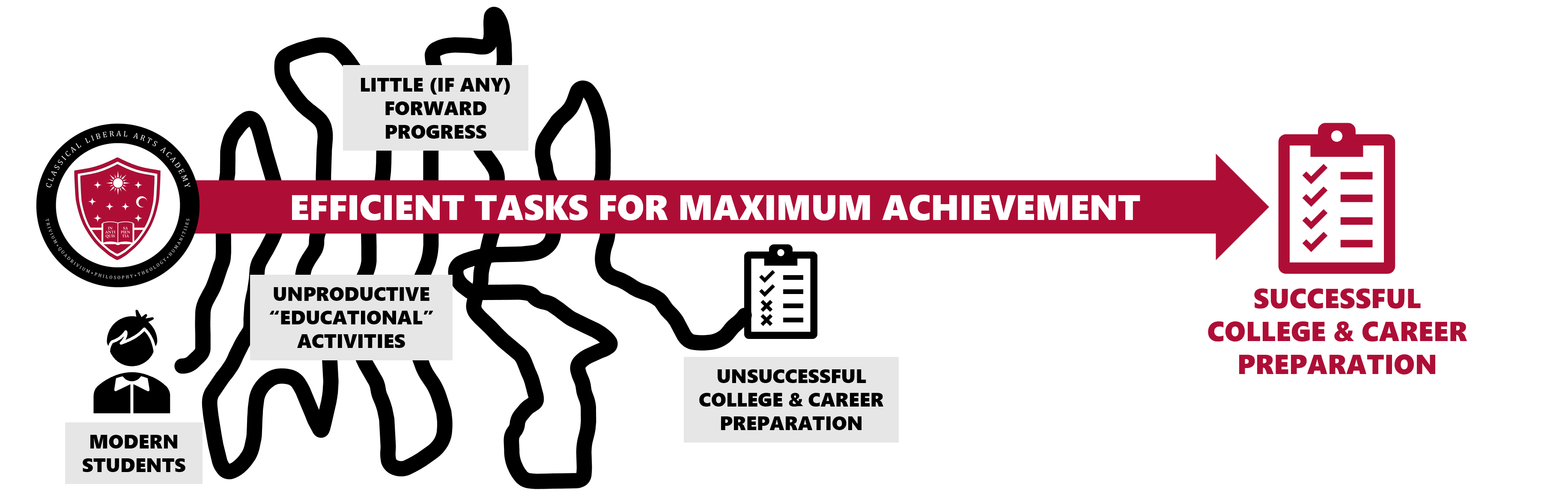
Now I share this message with enough experience to know that most parents won’t take my advice. They’ll do what everyone else does. They’ll do what seems right in the eyes of inexperienced parents, and they’ll end up with all the same problems down the road, but with the hope that there may be a few families, a few parents who who can take advice and practice it. I offer this talk as a source of answers for how you can avoid the problems of modern education. Now the key problem, I would argue, is that in modern society, we have learned to look at schooling as a source or a solution for a multitude of needs in our children’s lives and in our own lives. As adults, we’ve learned to look at schooling as a one stop shop for everything that a child needs, and so schools, modern schools and home school publishers market themselves as these one stop solutions for everything that families need. But if we look at what is advertised by schools and by home school programs, if we look at what they advertise, we’ll find that it actually has very little to do with the real ends of schooling and is focused on all kinds of corollary, supplemental, extracurricular issues that really are no business of schools. And the reason why schools do this is because it’s much easier to offer parents all of this supplemental junk in exchange for high tuition than it is to actually do the real work of education in schools when parents are willing to. Pay tuition for all of these other activities and services and let the schools off the hook. Intellectually and vocationally, schools are happy to make that arrangement. They’re happy to be daycare centers. They’re happy to be organizers of extracurricular activities. They’re happy to be sources of social activity and so on. If schools can be excused from Objective intellectual standards and objective, measurable vocational responsibilities, they will happily accept that opportunity to collect tuition, to basically do nothing, and parents are to blame, because parents allow this to happen in modern schools. Parents, for example, will be concerned that their children make good friends, and they’ll turn to schools for that which is not the responsibility of a school. Parents will be concerned that their children receive good moral influence, and they’ll turn to schools for that when that is really not the role of a school. They’ll be concerned about their children’s religious formation or spiritual development, and they’ll turn to schools for that, when that is really not the responsibility of a school, all of these different interests and concerns and they go on into ridiculous things like Sports and extracurricular activities. Parents will turn to schools as the source through which all of these concerns and needs can be satisfied lazily with a single tuition check. And either the bus comes and picks the kids up and shuttles them off to this fantasy land, or the parents just drop them off and tell themselves that by writing the tuition check and dropping the kid off at school, they have fulfilled all of these different needs in their children’s life, and this is just completely false, these different needs that our children have have real natural solutions. They have real sources where we’re to seek these things, for example, the development of social life and and morals these sort of things. These are naturally done within the context of family and community life. We we have natural relations in our families between grandparents and grandchildren, parents and children, children and siblings, children and their cousins, uncles and aunts and so on. We’ve got natural social relations that exist in the family that should be cultivated, and this is the proper context for a child’s social life. We also have neighborhoods in which we live in communities, and these communities extend to the Catholic Parish, and we can see that there’s a natural, real source of social relations and and these relations come with with real life consequences. They’re necessary, they’re good, they’re natural. And the social relations that develop have morals, moral obligations, moral responsibilities, woven all through them, these are real social relations. To substitute the school for these real relations was the idea concocted by John Dewey in the early 1900s when he said that the school should replace the local neighborhood, the school should replace the family. That was a modern socialist idea promoted by, as I said, John Dewey. You can, you can read the writings of John Dewey. He wrote a work titled democracy and education, which explains how the school is the new center of human society. That was a modern idea, and it’s false, of course, but that idea has become so commonplace that even Christian parents, even homeschooling parents, are incapable of discerning the influence of that modern idea on their views of their children’s relationships and education and as as Christians, we’ve got to restore real. Social Life, which begins with the family, reaches to the extended family, reaches to our actual neighborhood where we live, reaches to our parish community and so on. That’s where our real social life is to be developed and cultivated. But you can see how parents try to outsource that to the school, and so the children are sent to the school to go and, quote, unquote, make friends. And yet, the school is not a place where socializing is supposed to take place. School is supposed to be a place that’s focused on individual learning and study, not social life development. But again, schools are happy to provide that because it’s very lucrative for the schools. It’s very easy. It’s much easier to organize a dance at the school than it is to actually teach children a rigorous academic curriculum, so schools are happy to accept the role of social event organizer, but parents should not ask or allow schools to take that role, because there’s a natural place For those social relations to develop. Meanwhile, children are not learning to actually obey the commandment which teaches them to honor their father and their mother, and included in that command is the whole range of social relations in family and community life, as the church explains in its catechisms. So you see, we’re substituting real social life for this artificial school supplied social life, which isn’t real social life at all. So that’s one example. Another example would be to look to the school to be a source of religious formation, to be a source of spiritual formation. Now, if we look back to the Middle Ages, where parents could send their children to live in a monastery, as St Thomas Aquinas was sent to live in a Benedictine monastery when he was five years old, we might say it’s possible to have our children provided with religious and spiritual formation at school, but that school would actually be religious life. To have modern Catholic schools set up, really as Catholic copies of public schools, where the teachers are not priests. They’re not religious. The environment itself is not religious. There’s very little prayer. There’s very little religious study or religious discipline or cultivation of contemplative life and so on. It’s really not an institution designed for religious or spiritual formation. In fact, it makes profane use of religious activities like masses and so on by making them school you know, school events rather than sacramental institutions as they actually should be in a holy place in the sanctuaries of the church. And so we’ve got this again, this artificial substitution of the school for the real place where religious and spiritual formation is to take place, which is in our local parish, which is in the church, which is in monasteries and convents and so on, and even in the home where the Catechism teaches that parents should be cultivating a religious environment in the home where the Catholic faith is studied and practiced. So again, you see schools being used as a substitute for the real religious and spiritual formation that should be taking place in homes and in parishes, in monasteries, convents and so on. This is, this is again, the problem with modern schools, and the schools are happy to present themselves as these places for religious formation because it’s much easier to decorate the school with religious symbols, to have a weekly mass in the school building, and to and to and to do these sorts of of of religious activities, rather than bear responsibility for the intellectual and vocational formation of the children, which is their actual job, schools would be much happier to say, Oh, we provide children for the you know, for the price of tuition, we provide children with the opportunity to attend Mass. No one needs a school to attend mass. Mass is already available. Available in the local parish. So you see how this substitution of the real work of education for all of these other activities corrupts modern schools, and again, the parents are responsible for allowing this to happen. The third problem is parents with poorly conceived plans for their household economy look to schools as being a source of child care that allows both parents to work. The school is looked at as as an assistant to the to the parents professional lives and the chi and it’s just turned into a glorified daycare facility so that parents can earn more money, so that they can live beyond their natural means often, so that fathers can neglect the responsibility of providing for the Family and split it with with their wives, who then have to come away from the children, and the school becomes the willing savior for this, this foolish household economic structure that’s that’s common in modern society. And so the school becomes a daycare service that just pretends to give attention to academic needs. So there’s all of these reasons why modern schooling is corrupted, and it’s primarily because the schools are used as a substitute for needs that the children have, needs that the parents have, that have that have other appropriate solutions, but the school is just used as a lazy catch all for every need in the family life. Parents do this to try to save money. They try to do this because it simplifies things. Just send the kid to the school and you can take care of all of these issues, they say, whereas there are necessary and natural solutions for these needs that the parents just don’t want to deal with. And so the corruption is not present only in the school. It’s also in the church and in the family. It’s really a larger social problem that manifests itself in problems with education, unsustainable educational programs, unsustainable tuition, ridiculous construction of massive facilities in the name of education that really have nothing to do with education. Meanwhile, real education is completely neglected, and no one cares, because they’ve got all these other bells and whistles going on, and they’re all pretending that they’re doing something real, when, in fact, they’re not. They’re doing something that’s artificial and ineffective. So anyway, that’s that’s the source of the problems in modern education. And we can go on and on about that, complaining about modern society, but that doesn’t actually help us to fix anything. And it doesn’t matter what anyone else does. It doesn’t matter what our society does. It doesn’t matter what the even with the church is doing what the clergy does or advises doesn’t matter what other families or what our neighborhoods are doing. What ultimately matters is what we should be doing, and thankfully, we live in a society, a democratic society, that allows us to educate our own children. The Church teaches that parents have the right to make decisions concerning their children’s education. Explains all of these things, but then doesn’t enforce the teaching of the Catechism in any way which is part of the problem. But we as individual Catholic parents have the responsibility of studying truth and wisdom and then practicing it. That’s that’s our responsibility. It doesn’t matter what others are doing. Doesn’t matter what the whole river of human custom says we should do or or is designed to do. What matters is what the truth and wisdom teach us to do. And thankfully, as I said, we live in a society that leaves us with the freedom to follow the truth and practice wisdom, even though we may need to do it alone. Now the good news is that, as I said, the two real ends of education, the two real ends are intellectual formation and vocational preparation, those are the two real ends of education. And I say that be in our society, because we could go back into into the past and say, well, vocational preparation is really not to be pursued in a school, and we might talk. About apprenticeships and craftsmen, guilds and things like that, where where people got to work and learned on the job, as it were, and that’s all still true, even though they don’t exist as they once did. If a student is interested in a particular craft or particular business, it may be best to pursue preparation for that vocation in that field, rather than in a school. That’s true. But in our society, because of compulsory education laws, because of just the way that that destination, institutions are arranged. They often hold formal education as a prerequisite, and so students have to move through that path in order to prepare for their their chosen vocations. I talk to my kids about this all the time, because my kids will reach young adulthood and then question whether it’s worth going to college and say, well, we could just, you know, we could just join the military and start our military careers without college or or we can get into business and get to work without going to college. There’s no need for a degree to do what I want to do. And what I always advise them is, I tell them what you want to do without a degree can also be done with a degree. So the question that you should ask yourself is, should I pursue this with a degree or without a degree? Which of those two situations is better? And pursuing our vocational plans with a college degree is almost always better. I know that it’s it’s common for people on social media to mock and criticize college education. Most of them have great college degrees, and they they criticize college as if it wasn’t necessary, taking it for granted that they have college degrees, but anything that can be done without a degree can also be done with a degree. And I would argue that it’s better for a young adult to take the opportunity as they transition into young adulthood, to go to college, get a general education, get a degree, and then pursue their vocation with that degree, because it just offers them many advantages for promotion and so on in the future. So that’s my advice to my children. And so no matter what vocation you are interested in, whether it’s a military career, work as a craftsman, a professional field like medicine or law, it’s best to pursue that by going through college studies in American society and then, and then pursuing those vocational things afterwards. Obviously, there’s a lot to talk about with respect to what school should you go to? How should you pursue that? Should you live on campus or at home? Should you study online or on campus? There are many options, and I think that the answer to those questions is really locked up in the details of each individual child circumstances. I don’t think there’s a one one answer for all circumstances with respect to how to earn a college degree, or from what school to earn a college degree, but I think the fact of earning a respectable college degree should be, should be a non negotiable for most children. Now, when we look at college admission as the destination after high school, what the colleges require is actually very simple and quite universal. They want to see the standard course of study for high school diploma requirements. That’s what they look to the transcript for they want to see a diploma from an accredited school. They want to see a transcript again from an accredited school, if possible, because that for them, for the admissions staff, that just takes away concerns they have that this isn’t some diploma mill or some Mickey Mouse factory generating transcripts for kids who really don’t study that the admissions departments don’t want to have to investigate every applicant’s educational background. And accreditation tells the school that others have already examined the school and have confirmed that good practices in education are being followed. So accredited diplomas and transcripts are very valuable, and college admissions representatives will make that very clear. That doesn’t mean they’re necessary, but they are preferred because of the certainty that they offer. As as shallow as that certainty may be, it’s. More than the alternative allows for so an accredited diploma or transcript is the best way to prepare for applying to college. Now, there’s all of this talk, all of this talk in high school circles, even even earlier nowadays, because people are just crazy. But there’s all this talk in high school circles of of what colleges look for. And they we talk about, oh well, they’re interested in extracurricular activities. They’re interested to see that you’re well rounded. They’re interested to see that you’re involved in community service. They’re interested and it’s, like academics is almost left off the list, whereas, if you talk to college admissions representatives, you’ll find the opposite. They will say, Yeah, sure, we’re interested in those other things. We’re interested in the full picture of a student’s personality and interests and skill sets and so on. But that all is only true after we’ve established the students academic qualifications. So it’s not true that those are the things the schools look for. They only look to those things after the academic requirements have been found to be satisfied. It’s an academic institution, after all, they’re concerned with academics. If you go to a college website to their admissions information pages, they usually have a college profile or an about the college page, quick facts, something like that, where it lists important information about the school’s profile, and what you’ll see is they advertise the average GPA of students who are admitted, the average class rank of students who are admitted, the average SAT scores of students who are admitted, and so on. Those are the things that the colleges identify by. So a school is not going to accept a student who has a 2.0 GPA in high school because they’re really good piano players. That’s not how college admission works. They’re not going to have their school profiles suffer for the sake of any student. So they look to the academic qualifications first, and then when all of the academic criteria are equal among applicants, then they look for the fuller picture to try and build the best possible student body that they can through their admissions process. But it’s not true that they’re looking to those things rather than academics. So that’s a common myth among schools and parents that try to justify their own lack of academic achievement and say, Oh, well, that really is not that important. What really matters is that your child attends our school and participates in our theater program. That’s what the colleges are really that’s totally false. Colleges are academic institutions primarily interested in measurable academic achievement of students. If students have great academic achievement, they’re almost guaranteed admission to most selective schools. Now, when we talk about the elite institutions, Ivy League schools, elite technical schools like MIT or Cal Tech, obviously those are going to have separate requirements because all of the students applying will have the similar academic achievements. They’ll all be great students, and so they’ll look to that fuller picture of the student profile, because they’ll all be equal academically. So elite students, yeah, we need to talk about other issues, but we’ve got to have all of the academic achievement established first, or we can’t even be considered for admission when we come down from those elite top level schools to the second level, where We have highly selective universities and colleges normally a student with a great transcript, with great academic achievement, with with measurable academic achievement at an accredited institution that students going to be admitted, that academic achievement is going to get a student admitted to a selective college or university, and so all of the craziness about the extracurriculars and all this and that that’s almost always irrelevant for the students whose parents are talking about those things. And so again, that’s one of the sources of the problems in. In modern schooling, just ignorance and irrational talk about the admissions process as if a child with a weak transcript, with weak grades, weak academic achievement, is going to gain admission to a highly selective university because he was on a was on a traveling soccer team. That’s just that’s false. It’s an academic institution, unless the student is one of the greatest, you know, athletes in the world, that that extracurricular activity is not going to change the fact that the student is weak academically. And so my point is, what ultimately matters is academic achievement, measurable, documented academic achievement that is the ultimate factor in preparation for destination institutions that will play an important role in our children’s vocational preparation, academic achievement is the principal thing. It’s the principal thing, and it will guarantee admission to good schools, so long as it is rigorous, challenging, and the student shows great, great skill in academics. A strong academic record will guarantee admission to a selective university. All of the other junk is unnecessary. Now, another reason why parents talk about all these other things is they talk about scholarships and paying for college and all this, all this kind of nonsense and and the reason why the parents get all into this is because they’re anxious about having to pay for their children to go to college. There’s no reason for parents to worry about paying for their children to go to college. There are many different ways that the costs of college can be dealt with, and writing a tuition check is rarely ever the way that they’re dealt with. In fact, most parents who are doing that simply don’t know what they’re doing. Of course, if you offer to write a tuition check to a college, they would accept that. So just the fact that people do that does not mean that that’s how it needs to be done. There are many other things to consider, and this is where this mess of modern society becomes so obvious. For example, when mom chose to go to work and double the family income, she will likely push the family into a financial bracket that now doesn’t qualify for financial assistance when the kids apply to college. So this lack of financial assistance that a family may have when their kids apply for college may be caused by their desire to make more money, and so you can see how they’ve created that whole problem themselves by thinking that making more money is always the solution. Making more money at any cost, having mom go to work because it allows our family to make more money can also cause your family to be disqualified from financial assistance in in in college admission, and so now you’ve got this financial burden to bear, and now you’ve got this whole wacky system of plans and ideas about how to beat this college cost by by trying to get The kids scholarships and all this kind of stuff, when, when the actual cause of the problem was the desire to make more and more money as a family, because you may have made more money, but you didn’t make enough money to actually start writing tuition checks to universities, so you’ve bumped yourself up into a higher bracket financially, but it’s not a significantly different bracket, and so you end up causing yourself trouble. You’ve paid more income taxes. You now don’t qualify for financial assistance. You lose all the benefits of being an American citizen when it comes to college attendance because of this stupid, shallow idea that trying to make more money by any means necessary is going to help you, quote, unquote, pay your bills. And in fact, it’s not how our society even works. So. So this is why this, this, this shallow view of family life, which is what everybody practices leads to this, to this culture of complaining about how expensive it is to raise children. It’s expensive for people who choose to try and make more and more money and are forced. To pay not not even full price, because it’s not how pricing really works, but they’re made to pay sticker prices because they don’t qualify for any of the discounts and programs that are built into our society. So it’s just this stupid, self defeating view of family life. And obviously that’s that’s a whole separate issue to take up. But solving one problem in the wrong way can actually cause problems to multiply, which is the actual situation that most families are struggling with. Their solution to the problem of family finances has actually created an avalanche of problems that they can never afford, and so all of their talk of making more money has actually made them poorer and poorer over time. The way that college finances actually work, if you look and you see college and universities are all accredited. The reason why they’re accredited is because that qualifies them for government subsidies. Because the American government supports American children going to college. The American government supports college attendance. It’s part of how our economy works, and so children receive financial assistance from the government to attend accredited colleges and universities. So when a child applies for college admission, they also apply for financial assistance with a FAFSA application. And that FAFSA application looks at the students financial circumstances and determines whether the student qualifies for financial support programs that that are funded by the American government to strengthen and build our economy by sending kids to college and promoting higher education kids whose parents can’t afford to write tuition checks to pay for college tuition have no problem going to college. Now, some may say, Oh, well, you know, they’re just going to use student loans and get you know, the average student has $30,000.30 $1,000 in student loans, blah, blah, blah. And there’s all this talk about about student loans, and the problem with that is that it’s not qualified. There are students who make imprudent use of student loans, and there are also students who make prudent use of student loans, and so these things have to be considered in the details of their circumstances. For example, I paid for my own college education by taking my time and paying my tuition, but there were times where I couldn’t afford to pay my tuition, and so I used student loans when I graduated. I graduated with with an honors degree in in classics and history. Was inducted into phi, beta, kappa. I had, I think, $14,000 in student loans, which was largely because of housing. It really wasn’t tuition. It really had to do with housing and and that housing was necessary at that point in my life. It allowed me to go to school and also to work and also to get married and start a family, because we were in what was called graduate family housing at the time. So to finish that degree and to be able to do all of that, and to enter into a teaching career and have the bill be $14,000 was a ridiculously good deal. So the issue with student loans is not yes or no student loans or no student loans. It’s all a matter of prudent decision making in light of the circumstances of students lives. For example, a student can obtain a highly valuable degree and earn great grades by living on campus, having high expenses while in college and using student loans to cover those costs, working efficiently to get done quickly, get through college without distraction, get great grades, earn a valuable degree, and move on and have the next 1015, years to pay off those student loans. That may be a great financial decision. There may be another student who lives 10 minutes away from the campus of the school he attends who chooses to go and live on campus because he wants to hang out with friends and takes on student debt to support his social life, and that’s a terrible use of student loans. So just throwing out these numbers and saying, oh, students have 30,000 without considering the person. Purposes for the loans that are taken is just part of the shallow talk about education, if living on campus and paying for your education with loans allows you to avoid working a part time job, focusing all of your attention and energy on your studies, earning awards while in college and earning a valuable degree from a from a great university, that loan is going to pay itself off, whereas taking out a loan to fund your social life during four years of college, end up with no awards, a pretty unimpressive transcript From an unimpressive school. That student loan is a totally different story. So it’s more complex than just this silly political talk that Christians are often guilty of. But anyway, financial concerns are rarely ever a real issue in college admission and attendance, and there are so many ways of funding school. For example, students can join the military. They can join the Army Reserves, serve a four to six year reserve contract as young adults, which is which is very simple, and have their tuition paid for by the US military. There are many different ways to do it. No one needs to go and sign up for the basketball team to find a way to pay for college. That’s just that’s just nonsense, wives tales. That’s not how college admission and finances even work. So many of the problems with talk about education, thoughts about education, excuses for neglecting education. They’re founded on false statements, false ideas about education, and that’s another big problem among parents. They just don’t know what they’re talking about when I want information about college admission, I speak to college admissions directors and representatives and get answers from them about what the colleges actually look for and desire. I don’t talk to my my friends at the coffee shop. I don’t talk to people at church. I talk to admissions directors and I talk to the directors who are at selective universities, and I get their input, and it’s almost never what is being said among parents and other Christian people about college and admission and preparation for college and so on, because we live in A society that promotes higher education preparation for most vocations should go through college and end with a college degree. Anything that can be done without a degree can also be done with a degree, and entering into one’s vocational life with a degree is simply a better position for future success. Now, when we think about that, we think about the fact that admission to a selective college or university is important for many different reasons. Admission to the best possible college or university is important because the best colleges and universities have the greatest resources, all of which become available to us as students, that admission becomes one of the chief goals of one’s high school education. And what the colleges are looking for, what the selective colleges are looking for, first of all, principally and most importantly, is a rigorous course of study in high school that is represented on a transcript that shows the completion of all of the requirements of high school diplomas in modern society and beyond. So the question is not, did you complete the diploma requirements, that’s assumed. The question is, did you challenge yourself to go beyond the diploma requirements? So for example, a college or a state may say that a high school diploma in our state requires two years of science, three years of math, two years of a foreign language, and so on. And so you can earn a diploma by doing two years of science, two years of foreign language, three years of math, and have your diploma. The problem is that if you then take that diploma and transcript and apply to a selective college or university, they’re going to want to know why in four years of high school you only took two years of science, why you only took two years of foreign language, why you only took three years of mathematics, and you’re going to have to explain why you did only the. Bare minimum, and whether that shows you as being worthy of admission to a selective university. And the answer will be, No, you’re not worthy of admission to that university because you’re obviously not a student who loves to study. You’re doing the bare minimum, and so you’re going to get denied to a selective university. The universities want to see that you, as an individual student, pursued the most rigorous courses available to you and and that you yourself have an eagerness and interest in learning because they want to find students who are going to make the most profitable use of the university’s resources, and obviously a kid who just checks the boxes of minimum requirements is not that student. Those students go to inferior colleges which have lower standards, but the selective schools are looking primarily to see whether a student has chosen the most rigorous possible course of study available because those are the students who are going to make the best use of their resources. Now, when we consider that, we consider that the students are the colleges are looking at a transcript, no Baloney, no talk, they’re looking at what has been achieved, what has actually been done, and they’re looking at the transcript for that information. They want to see an impressive list of high school level courses on that transcript with high grades. They want to see rigorous studies, studies that were not required for graduation, but which were pursued for their own sake. And they want to see that students do well in those subjects. Now that means that students have to do more, and this is where we get to the most important point in what I want to talk about. Students have to do more they have to get more lessons done. They have to get more courses complete. They have to study more courses, enroll in more courses, and so on. And so the key to this preparation of a transcript for admission to a selective college, a most selective college, the key is that the school has to make those studies available as efficiently as possible so that they can actually be completed by the student, the method of study becomes important, not just the subjects, but the method of study becomes important because it has to be efficient. We can’t waste time. We’ve got to get these lessons finished. We’ve got to study and move forward efficiently, and that’s where, again, modern parents and modern schools and modern students fail, because here’s what happens, inexperienced parents with fussy children who don’t like to study, start complaining. They complain that this lesson is too hard. They complain that this this textbook, is difficult to study. They start complaining and getting wrapped up in all of these modern fads. All my child’s learning style requires videos, requires live teachers, requires therapy sessions, requires manipulatives and visuals and illustrations and active projects and class trips and activities and so on and so on and so on. And they think they’re so clever with all of this talk about all of these gimmicks and methods of learning, all of these highly expensive, inefficient, unsustainable methods, and they do this at the beginning of their studies, and they do this In the minimum requirements available in high school, and then they think that they’re so smart because they’ve they’re talking all the talk using all the jargon. They’ve got all of these different methods and materials and resources involved, all these different professional experts, therapists, gurus, involved in their children’s education. They’re driving all over the place, going to different offices and different therapists, all of this activity. They think they’re so smart, but what they’re ignoring is the fact that they’re not making any progress. They’re not completing courses. They’re not completing subjects. X in a way that will allow them to get to more advanced studies. And so all of this talk about the learning methods and all of this multiplying activities. Oh, look at me. I’m so clever. Look at this interesting activity I invented to help my children study fractions. Look at how we we buy pizzas and we have them all cut into different slice numbers and, Oh, we’re so clever. You’re taking days to study concepts that require minutes in an efficient study program. And the reality is, is that if your child actually needs that kind of crazy supplemental teaching and all of that, all of that extra time and attention and resource, your child is not going to make progress, and he’s not going to be admitted to a selective college or university. So the question is, what are you actually accomplishing? What are you actually accomplishing by all that you’re not actually thinking of what the end is going to be. You’re just wrapped up in all of this crazy talk about modern educational methods and strategies and projects and crafts and activities and therapists, and you’re ignoring the actual goal in schooling, which is to accomplish as much as possible, as efficiently as possible. And so when you come to the classical liberal arts academy and I say, Look, we offer children the most rigorous transcript available anywhere. But we want students to learn to study texts and complete assessments with no nonsense, study the text, complete the assignment, complete the quizzes, demonstrate knowledge of the content and move on, because there is so much that needs to be done. We can’t waste time playing games with parents who want to start lesson one and start inventing activities, or think of how fun it would be to take a class trip so they can learn about American and there’s no time for that nonsense. There’s no time for that nonsense, and it serves no purpose in the child’s life. It really makes no sense. And again, we’re corrupting education because we’re trying to use it as a source of family activities. We’re trying to use it as a source of who knows what motivates. You know, these things parents do, it makes no sense, serves no purpose. So there’s only one method of study that’s possible for high achievement. It’s it’s text based, efficient study. We can’t waste time. And I tell parents this all the time, because home school parents will contact me saying, oh, Tommy doesn’t like this book because it’s black and white and it’s boring and he has a hard time reading on the screen, and he has a are there video lessons available? Are there lie. These parents are looking for entertainment. They’re not thinking about the ends of education. They’re not thinking about the fact that little Tommy is sitting there in a chair with his arms crossed as if he’s already achieved success in the world, dictating what he’s going to do and what he likes, and the parent, rather than acting like the experienced adult in the room, is acting like some sort of servant to the child who has no idea what he’s talking about and has no right to start making demands about how he’s going to learn what resources he’ll accept and not accept. What that child is doing is actually disqualifying himself from admission to a selective college or university. He’s disqualifying himself from having an impressive transcript for studies, and what the parents should be doing is communicating that to the child, really ignoring the child because they’re the parents, and telling the child what he needs to do, and then finding ways to motivate the child to do what needs to be done in the way that it needs to be done. So in the classical liberal arts academy, we’re making it possible for children to attain high levels of achievement in academics by presenting them with an efficient system of study that’s very affordable, very efficient, very simple. And it’s not accidental. It’s not like we don’t understand how to make less. Complicated and multiply all kinds of activities with videos and illustrations and all kinds of it doesn’t take a genius to understand how to make things complicated. The challenge, however, is actually achieving great academic success in the most rigorous and broad course of study possible. And the only way that that can be done is by the efficient study of text based lessons with straightforward assessments. And so my last word of advice here for parents is stop wasting time on 1,000,001 different activities that don’t actually get lessons and courses done. Stop wasting time. Stop thinking that you’re so clever, because you can find ways to explain concepts that are simple, that you understand, even though you may not be the most well educated person, and thinking that by dragging out those subjects and coming up with all kinds of interesting, entertaining, curious ways of illustrating them or explaining them, you’re helping the child to achieve things, because the child is is for all of that, for again, for all of the the activity, for all the bells and whistles, the child is standing still, academically, he’s not moving for all of that activity. And there could be lots of money involved as well, for all of that expense of time and energy and financial resources, the child is not moving forward. That’s the reality. That’s what the transcript shows for all of the talk, for all of the time, for all of the so called home schooling, work and attention, the transcript shows a child who didn’t do much, and that’s what ultimately matters, because the world we live in deals with transcripts. It deals with facts. It deals with achievements and records of measurable achievements. It doesn’t deal with this silly school culture with these clown show teachers coming up with, you know, goofy ways to illustrate things that should be explained and assessed in a few hours, but end up taking weeks of lesson plans and activities and field trips and whatever other Crazy gimmicks these schools get away with now, again, teachers love to do that because teachers don’t want to be challenged to lead students to high achievement, because the lessons get more and more difficult as they go, they want to stay in baby land and just play and Get Paid $80,000 to take the kids on a class trip to the grocery store. That’s what they would love to do that obviously, that’s the best way to make money. What they don’t want to do is have parents say, We want academic achievement. We want the most rigorous course of study possible. We don’t want students. We don’t want teachers making $80,000 a year to teach our kids about fractions in a middle school level math program. We want teachers teaching our kids calculus. We want teachers teaching our kids fluency in foreign languages. We want student teachers who lead our kids to know World History and Philosophy and Literature, who can write essays effectively, who can do research effectively? We want teachers who work. We want our children to have impressive, rich transcripts of academic achievement. We don’t want these clowns getting paid full time to entertain our kids so they can win Teacher of the Year awards. That’s the corruption of modern education. So my advice to parents with respect to education is to focus on the two ends of education, the two ends of education, which are intellectual formation, which comes through a true curriculum, which we offer in the classical liberal arts academy, intellectual formation and vocational preparation. And it doesn’t mean vocational preparation, you know, in Little House on the Prairie or in medieval Europe, it means vocational preparation in 21st century America, vocational preparation largely means college preparation. And the purpose of college is to obtain the most impressive, most reputable degree possible. And so that’s going to require a. Mission to a highly selective university, and the highly selective universities are looking for transcripts that show achievement in the most rigorous programs of study available. And the only way to create such a transcript is to enroll in a program that makes such studies available and does so in an efficient way, and as parents to focus on leading your children to study text lessons and complete assessments period. It’s got to be efficient and simple. If you start getting into fads, you’re just standing still. It’s got to be efficient. You’ve got to be task oriented. Get the next task done. Get the next task done. Parents ask me, Well, how much time should we no get the next task done. Help your child get the next task done. Task after task after task after task multiplied by 1000s and 1000s and 1000s of tasks over years and years of their time studying, it has to be efficient. There has to be high achievement, or for all of your talk and for all of your gossip about education, you’re just accomplishing minimum requirements and spending most of your time standing still academically, it’s got to be efficient, and the child should be motivated by that achievement, and you’ve got to teach The child to be motivated by that achievement so that is my advice for parents. That is advice that actually works. That is advice that is actually true. It’s not popular in modern society, where school is like Disney World and we’re trying to entertain all of these foolish, disobedient children who are lazy and irresponsible, and parents want to act like children so they can avoid conflict and not have to actually discipline their children or motivate them, because they don’t want to waste money by offering rewards to their children. It’s a lazy society that’s working backwards and has institutions upside down so serving no real purpose. The only solution for education is to focus on high academic achievement in the most efficient means possible. And you’ve got to find a school that allows you to do that, and the classical liberal arts academy is specifically designed for that purpose, which is why we do things the way we do them. I hope that’s helpful. God bless you.
