

In this lesson, we will begin the study the parts of speech in the Greek language, and the first of them, the article. To complete the objectives of this lesson, complete the following tasks:
- Read through the lesson from beginning to end.
- Study the lesson for mastery, taking notes.
- Complete the assigned memory work.
- Complete the lesson assessments.
The text of this lesson is translated into English by Mr. William C. Michael, from “Institutionum Linguae Graecae” by Jacob Gretser, S.J. (1767), for student in the Classical Liberal Arts Academy. No other use is permitted.
Lesson
Cum articulo, quem jam explicavimus, et reliquis partibus orationis, quas jam aggressuri sumus, variae dialecti accidant, operae pretium erit in hoc capite exponere generatim. Primo, quid sit dialectus. Secundo, quot sint dialectorum genera magis celebria et trita. Tertio, quidnam unaquaeque dialectus proprium et peculiare potissimum habeat. Dialectos autem singularum declinationum et conjugationum suis quasque locis enumerabimus; sic enim et confusio vitabitur laborque discentium minuetur.
Translation: With the article, which we have just studied, and with the other parts of speech, which we are soon about to undertake, various dialects occur, the value of the work shall be in this chapter to explain generally. First, what is dialect. Second, how many are the kinds of dialects more celebrated and used. Third, whatever each dialect proper and peculiar chiefly may have. Dialects however of each declension and conjugation we shall enumerate in their own places; for in this way, also we shall both avoid confusion and reduce the labor of learning.
Dialectus nihil est aliud, quam unius et ejusdem linguae nota et differentia, non omnibus qui illa utuntur, sed aliquibus tantum usitata; quorum ratione dialectus idioma seu proprietas dici solet; sive differentia haec consistat in solis literis ejusdem vocabuli, literarumque affectionibus, sive in sola pronunciatione, sive in verbis integris, sive in syntaxi et constructione. His enim quatuor partibus contineri videtur tota dialectorum varietas.
A dialect is nothing other than of one and of the same language notes and differences, not for all who use them, but by some only used; of which reason dialect idiom or peculiarity is accustomed to be called; either these differences consist in only letters of the same word, and of the sounds of letters, or in pronunciation alone, or in whole words, or in syntax and construction. For by these four parts appear to be contained all varieties of dialects.
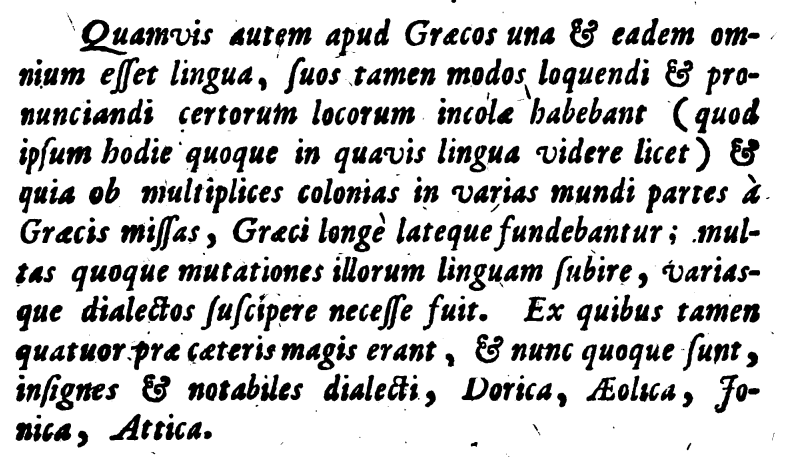
Translation: However much however with the Greeks there may be one and the same language of all, nevertheless their own modes of speaking and pronouncing the inhabitants of certain places have (which themselves today also in whatever language one is able to see) and because many colonies in various parts of the world by the Greeks have been sent, the Greeks have been established; also to undergo many changes their language, and various dialects to receive it was necessary. Out of which nevertheless four before the others were great, and now also are, outstanding and notable dialects: Doric, Aeolic, Ionic and Attic.
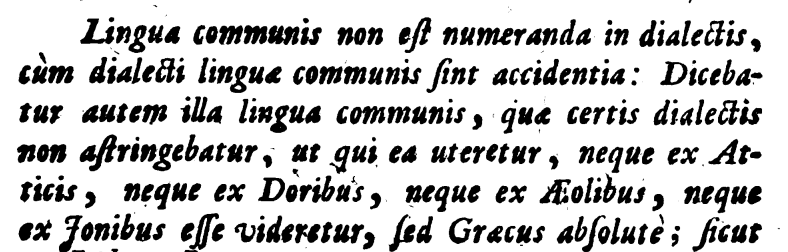
Translation: Common language is not to be numbered in dialects, when
Conclusion
In this lesson, we have begun the study of the eight parts of speech in Greek. We have learned the names of the eight parts of speech, the names of the five cases used in Greek and the three numbers.
God bless your studies,
Mr. William C. Michael, Headmaster
Classical Liberal Arts Academy
