
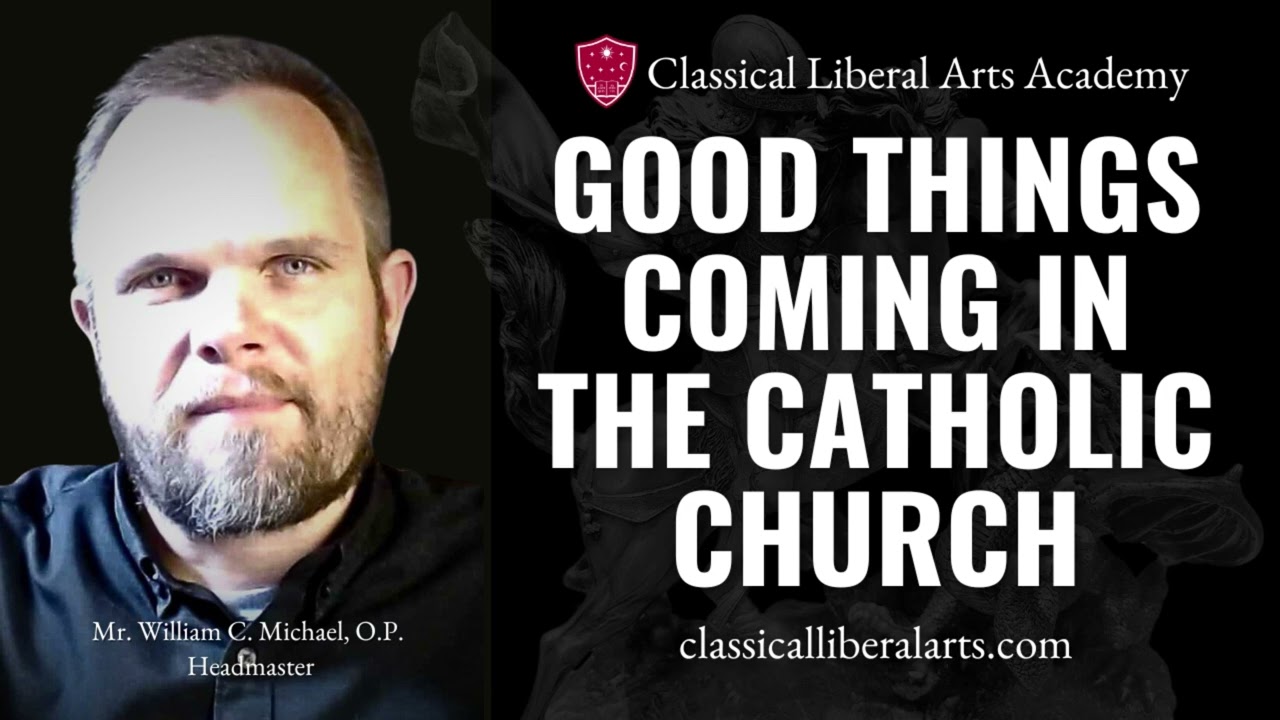
Today is July 4 2024. And this is William Michael, of the classical liberal arts academy. You might have heard a week or so ago, my wife and I spent a few days at Catholic University of America, in Washington DC. We had a great time there, we were there because my wife is enrolled in a master of catechesis program that’s, that’s offered at the university. And she’s got a week of residency activity that needs to be fulfilled each summer. So with her, having that scheduled, they invited me to join her. So I spent a few days with, with my wife getting to know her professors and classmates. And it was great time, I got to attend all the lectures and Tanya and I could spend the evenings talking about things I got to know some of the people in the program and I was really impressed, really impressed with the intelligence of the people involved the sincerity, the diligence with which the students are working. You know, people from all over the country, really impressed with the program and with, you know, with my first visit to Catholic University, really beautiful place I loved the week there with my wife, we had a great time, and are very happy to be associated with the university. And you’ve probably seen on the website that I’ve taken some time to recommend the university to CLA students. And I’ve provided a bunch of reasons why I recommend that why my wife was interested in it in the first place. And her initial interest was certainly confirmed this this past week.
But anyway, if you’ve listened to my talks, you know that I sort of stand in an odd position in the Catholic community because I’m a classicist, I study Latin and Greek classical philosophy. And I’m a Dominican allayed Dominican. So I study scholastic philosophy, Sacred Scripture. I’m a member of a religious community that was founded in the 1200s. The same community to which Thomas Aquinas and St. Albert the grade, and Catherine of Siena, were members. And so you you hear that I’m a classicist, and that I’m a member of a religious community that’s 800 years old. And you might assume or expect that I would be a big supporter of, you know, the TRad Catholic message. And, and again, if you listen to my talks, you know that I’m not a big fan of the whole Trad Catholic movement. In fact, I speak against it quite a bit for many different reasons. But one of the main reasons that I’d like to talk about which was really clarified, for me this past week, because I had a chance to have a conversation with one of the professors of Theology at Catholic University, I’m not going to give any names, but I was able to have a good conversation about some of these issues. And I want to share some of the fruit of those of that discussion because I think it’s helpful and encouraging. I’ve objected to the TRad Catholic message, I mean, for obvious reasons, like the contradiction of the Pope and bishops, which is just, you know, a glaring red flag. I’ve always objected to any disobedience or disrespect to the magisterium, which is found in the Pope and bishops in union with Him and nowhere else. Not in history, not in some other Pope or other bishops but in the Pope and the bishops living in the church today. So I’ve always talked against any kind of disrespect, insubordination, disregard disobedience to the Pope and bishops. That’s the clearest. I mean, that’s the reason why I became a Catholic was because I was persuaded of the authority of the papacy. So I’ll go to my grave, arguing for submission to the papacy and as it Dominican, it’s one of the, the key qualities of the Dominican Order is that all through history, the Dominican Order has always been faithful to the magisterium, faithful to the Pope. And you know, that’s something that I’m actually proud of as a Dominican is that I’m a member of a group that has always been faithful to the Vicar of Christ. But there are many other reasons and some of the reasons are historical. I think that the the the narrative that the TRad Catholic movement, that it’s sort of mouthpieces on the internet, which is where they, they really the only place they exist. There’s a historical narrative, that’s, that’s just false and irrational, that that is another reason why I reject that whole message. And I think that this narrative that they have, leads to, leads to something of a sense of despair, in modern Catholics, because we see things are not what we would like them to be, we see things aren’t as good as they could be, we imagined that they might have been better at some time in history, and rather than actually work obediently like, like Saint Francis, to reform them and improve them, by our own sacrifice in our own work, at our own expense. We get involved in this crowd of people who just sit around complaining, like it’s somebody else’s job to fix everything, so that we can just participate in, in a perfect church. And just that whole message is is ridiculous. But the historical narrative goes something like the church was, you know, flying along for 919 160 years, when all of a sudden, all kinds of hell broke loose in the church. And suddenly, the, the leaders of the church, the bishops, the Pope, all different influential officers in the church were corrupt. And they called for the Second Vatican Council and chose to reject true Catholicism to abandon true Catholicism, to destroy the sacraments to destroy the mass and Institute all kinds of changes and innovations that that effectively destroyed the Catholic faith. And so our duty is now to rebel against this movement, and to fight for the restoration of the pre Vatican two, culture. That’s your that’s the historical narrative. And of course, if you would just think about it, it’s, it’s irrational, because if the corruption of the church occurred, as they say it did, and and it’s worth noting that Protestants use the same argument that there was this time of corruption, this apostasy that took place which no one can actually identify in history. But you start with this, this rumor of some great corruption or apostasy. And then you you basically argue that that anything done in opposition to the authority is actually a resistance to the apostasy. And it justifies just anything you want to do. That’s contrary to the actual church. This is what Protestantism is. And it’s what this Trad Catholic movement boils down to. But if the falling away did occur, when it is said to have occurred, it did so under the supervision or the pastoral duty of what would have been pre Vatican two clergyman so so no matter what you’re going to end up not just faulting the modern priest or modern Pope’s modern visions, but but also those who would have been the shepherds at the time that this great collapse took place, who allowed it and so it doesn’t help the TRad Catholic cause it actually condemns what would have been the last generation of Trad Catholic bishops and priests and Pope. So it’s just an irrational historical argument. But the reality of what has taken place in the church, which I’d like to talk about the reality is that the church being This timeless universal institution faces some some challenging times when major changes take place outside the church in the world, changes for the worse, very great sweeping, universal changes caused by calamities or wars, or some, you know, major events that take place in in secular society. And so the context outside the church changes, and the church is forced to consider whether its present practices actually serve the current state of affairs in which the church lives and works. And this, of course, is directed by the Holy Spirit, directed by the Holy Trinity. And the Holy Spirit works through the hierarchy of the church to do all things decently and in order, as St. Paul says. And so when the Holy Spirit works, no, God tells us My thoughts are, are not your thoughts, as the heavens are higher, or above the earth, so are my thoughts higher than your thoughts. And so there is going to be some mystery. There’s going to be some confusion. And it takes time for us to learn what’s going on what the Holy Spirit is actually doing, how God is actually leading the church. And then in time, we sort of see it all come together, and we say, oh, man, that was so wise, that was so good. God’s providence was so so generous to us to do this, and that and to prepare this and to move us like this, and then to bring us to this place so that when this thing came to pass, we were already in the right place at the right time. And oh, man, only God could do that. And it’s always comforting to know that the church is in God’s care, who knows all things can do all things. It’s never left to men. And so when we come to something like the Second Vatican Council, we can see that some strange activity is going on. Different people in different places are moved in similar ways. And the next thing we know, we’ve got this Universal Council called in Rome, and bishops from all over the world are assembling, which is a major event. And it seems that every aspect of church life is on the table for reform. And all of these documents are put together. There’s all of these signs of God’s blessing and Providence on this council. And then we’ve got the promulgation of all these reforms, the reform of the mass, the revision of the Divine Office, many, many reforms. But those reforms, as I as I said, they occurred, or were introduced into a context that was in all kinds of trouble. That’s why the reforms were needed in the first place. And so when the reforms enter into the hands of men, and those men in the context of a of a ruined 20th century culture that was that was destroyed by the world wars and many other movements that had accumulated in the early to mid 1900s. Those reforms in that context led to all kinds of what I call goofiness. And I was joking with a friend today that if you look back at the 1973 Ford Mustang, and see how that generation could take something like the 1969 Mustang and turn it into the dorkiest ugliest car ever made. You can understand what happened in the church. So the reforms of the Second Vatican Council were necessarily received by a goofy generation I just think back to my own life growing up as a kid. I remember in our house we had a living room with a royal blue rug and orange couches and my mother drove a purple Pinto. My father drove a pickup truck, a two tone ford f 150. Where the outside was a pale yellow color. And the inside of the two tone paint was brown. So it was a yellow and brown. But it was a pale yellow and ugly, just terrible looking thing. It was like a generation was colorblind. And you can see all kinds of wackiness from Nigeria. You just see there was something about the culture, the tastes of that generation. You had the hippies in the 60s and all that wackiness. And then you had the 70s and all their ugliness. And then it was like you got into the 80s Ronald Reagan became president. And it’s like things started to get normal again. You had sort of the restoration of that, like Dwight Eisenhower, General MacArthur culture, come back into American society. And then things got cool in the 90s. And, you know, we’ve got the 21st century. And there’s lots of signs, in my opinion that that the West is correcting itself. We’ve had this experiment with liberalism, we’ve had this experiment with all this sexual revolution, craziness, all this technology, we’ve had it, we’ve had our taste of it all. We’ve checked it all out. And we’re ready to get back to normal. That’s my judgment of, of the world at present. We see this in many places we see right wing political parties, winning offices. Proposing just to return to to responsible economics, things like that. Focusing on family life, getting back to traditional morals, rejecting this crazy LGBTQ culture, rejecting all this transgender, craziness, wild economic ideas. And just going back to normal, like going back home, like the prodigal I feel like the West is correcting itself. But when we look at the church, we can see that from 1964. So through the 70s and 80s. There was just a lot of wackiness. I remember because I was a kid in CCD class back in like 1982 1983. Getting ready for my first communion. And I remember some of the weirdness. I remember a lady coming to our CCD class and they brought us into this like, auditorium. And she was teaching us these guitar songs like these sort of goofy guitar songs. And you know, I was a cool kid, I was a public school kid. 1982 83 I was listening to like Def Leppard and Rick Springfield and watching MTV. So to go to the Catholic Church and have some some strange guitar songs, I can still remember one of them. I’d sing it, but it’s too embarrassing. I had this feeling that the church was kind of weird. You know, I didn’t I wasn’t disrespectful. I actually admired the church. I loved being at church when I was a kid, but but I felt that there was some of the people were a little strange. But it was the culture. It was that you know, sort of like Camp Fire John Denver, hippie culture, I don’t know. But the question is, what was what was supposed to happen after those reforms were published? I don’t think anything could have happened other than what happened there was just a necessary problem. That was temporary. The reforms were made under the influence of the Holy Spirit. And they were made in a context where they would necessarily be taken advantage of by people who had problems, which is why the reforms were made in the first place, but the reform was not yet complete. The reform was still incomplete at that time. And so what happens is this Trad Catholic critic living in the 1990s 2000s 2000 10s. Now 2020 is the critical Trad Catholic looking to find fault judges, the Second Vatican Council based on what took place between 1965 and 19, what are 2000 2020? Whatever he looks at that period after the after the council and he says this is what the council did. The council changed these things, introduced these reforms, and then all this wackiness came in. That is what the council caused. The council did nothing good. The council ruined everything that was good, and introduced the circus as it were. But I would argue that the Second Vatican Council and the reforms of the Second Vatican Council were incomplete until the mid 1990s. And something happened in the in the mid 1990s. That I would argue, brought the Second Vatican Council to its perfection in terms of creating the means by which the church would adapt to the changing circumstances outside the church. And what was it? What do you think it was in the mid 1990s? That sort of brought all of the goofiness to an end? Something happened in the mid 1990s in the church that reined in, or at least made it possible for the bishops to rein in all of the wackiness which none of them desired. What it was, was the publication of the Catechism of the Catholic Church. The Catechism the new catechism was published in 1994. And the new catechism eliminated all of the looseness, it put an end to all of the freedom for everyone to interpret the Second Vatican Council for themselves. The Catechism was published and established a measure against which everything done in the church could now be held accountable. And so we see that from 1965 or so until 1995. Yeah, there was this time of transition. The Second Vatican Council introduced these reforms. We got to see what those reforms look like in the hands of some strange people. We got to see what the problems are in this in this culture in which these reforms were introduced. And then in 1994 1995, we got to see the church’s response. Were all of that is brought under control. And I would argue that since the publication of the Catechism, the bishops and priests leaders of the church have been studying the Catechism if you read the introduction and prologue to the Catechism, you’ll see it was intended to begin this new study. This new development is new evangelization, new catechesis. And since the mid 1990s, the bishops have been working to sort of allow the Catechism to enlighten every aspect of church life and bring everything into obedience. And so now, if you if you if you pay attention to the right people in places in the church, you’ll see all kinds of wonderful things developing wonderful resources being produced by the bishops of the church that are possible, because of the Catechism. And you’ll see the craziness of the 60s through 90s. being cleared out of the church, bit by bit. And what’s making that possible. This is, this is what I talked about with that professor, that theology professor at Catholic University. What I said was, you know, I feel like the church is in a state of self correcting. I said, I can see that there were, there were abuses and problems and all kinds of mess in the church, after the Second Vatican Council, but I feel like the church is, is correcting that stuff and fixing itself. And it’s, it’s moving in the right direction. It’s like a ship after a storm that’s been spun around and beaten up and sails are torn and all this. And then the, the crew gets to work on the ship, they get the sails repaired, get everything put back together. And then after maybe a couple of weeks, all of a sudden the ship is back moving in the right direction. I feel I feel like that’s happening in the Catholic Church. And when I said that the professor sort of lit up and said, That’s exactly what’s happening. And I said, well, well, what what do you think it is like, what what is it that you think is responsible for this perceptible change and movement in the right direction? And without hesitating, the professor said, The Catechism. The Catechism. And so I, I think it’s really important for us to realize how significant the Catechism is, and how important it needs to become. In our lives. We need to commit ourselves to the study of the Catechism, the Catechism in this era, this post Vatican two era, the Catechism is really our guide. And when we talk about the new evangelization, what we’re talking about is this, this new catechesis, this new instruction that’s been made possible by the publication of the new catechism. And so we’ve got to commit as Catholics, we’ve got to commit to making a concentrated effort to study and learn the content of this catechism because it is the guide that leads us to make right use of the reforms of the Second Vatican Council, which no matter what anybody says, is legit. So it’s the Catechism the Catechism is the writing of this 20th 21st century ship in the midst of this stormy sea, the Catechism is what is allowing the bishops all in unity, to work to make good use proper use of the reforms and get the church moving in the right direction in this stormy sea of modern society. And in time, we’re going to see the wisdom of God the goodness of God in in the work that the Second Vatican Council accomplished and in this amazing new catechism. When I converted to Catholicism, back in 2004 2005. I was struggling to find answers. And I would, I would, you know, look at different books or look at websites with questions I had as I was considering Catholicism, trying to learn different things. I didn’t know any Catholics who were serious. So I spent my time just sort of researching, looking for answers to questions I had. And I wandered until I found the catechism and it was 2005. I learned about the Catechism got a copy of it and wore that thing out. Because I just couldn’t believe how good it was. I couldn’t believe how how good explanations of Catholic teaching were I couldn’t believe how clear it was. I couldn’t believe how well organized it was how helpful. The organization of it was. I couldn’t believe how cool it was that it had scripture references and references to the church fathers on every single point that it covered. It was just a treasure. And it was my guide into the Catholic Church and really has been my guide ever since. I mean, if you listen to my talks you or read articles I write, you’ll always see the Catechism referred to some of my most important talks like on the duties of parents are just taken straight from the Catechism things I teach about relationships between parents and adult children straight out of the Catechism. And you can see how the Catechism really is intended to guide us through this difficult time and, and provide order and guidance from the magisterium, down to every individual layman. Just just an amazing, amazing gift that God has given us through the church to be able to have the Catechism. And there’s online versions, print versions, it’s just just such an amazing resource. When you think about what it is, it’s just mind boggling. And so the Catechism or I should say, we should never talk about the Second Vatican Council until we include the Catechism. And now we’ve got sort of like both bookends, holding everything together. And now we can see in hindsight, we can see. Because remember, 30 years of church history is like a blink of an eye. For those who lived through that period, it may have felt like a long time, it may have been difficult to bear. But if we step back and think that the church is 2000 years old, a 30 year period is nothing. And the difficulties and the struggles and the craziness of that time after the Second Vatican Council. As time goes on, it’s going to prove to be invisible, really. And it’s unfortunate that you’ve got this group of people, a small noisy group of people on the internet trying to amplify the significance of a period of time that really is going to be insignificant, especially when you realize that it was just a matter of time until the catechism was made available to bring it all into order. And of course, those who judge the church in the 60s in the 70s, and the 80s, those who set themselves up as judges and critics, they had no right to do so they had no no authority to do that they shouldn’t have taken that position. They shouldn’t have said the things they said they shouldn’t have stirred up the trouble they did. They shouldn’t have criticized as they did spoken against popes and bishops as they did, but it revealed their own character. And now they’re going to be exposed. When I face things in a church that I don’t understand, and it happens all the time, there’s lots in the church that I don’t understand. But I don’t assume that I know everything that I’m right, and that the the bishops of the church don’t understand Catholicism. I think about the Virgin Mary, who had to live through the earthly ministry and life of Christ, which was a mystery. Every aspect of it was mysterious. And we see all of these moments in the Gospels where Mary’s standing there watching Jesus do something and has no idea what’s going on. Because it’s it’s just, it’s mysterious. Like when the angel Gabriel says to her, she’s going to bear a son. She’s just she’s not doubtful. She’s not unbelieving. She just she doesn’t understand what she’s supposed to think she doesn’t understand what exactly is going on or how these things can be. And during the life of her son, we see times where it says, and Mary pondered these things in her heart. Mysterious stuff was going on. Mary was watching these things. And she was just keeping it all inside, she was just observing, paying attention, and reflecting on what she had seen and heard. And in that she’s the model for us, of life in the church. When we see things that we don’t understand when it appears that things aren’t, as we think they should be, instead of assuming were right, and jumping on the churches, if the churches is foolish, we should just wait and ponder and allow things to work out. So we can see what exactly is going on, as Mary did as the apostles did. Remember how many times Jesus would say to his apostles, things like, you can’t understand this now. But you will. We have that same experience in the church, especially when there are changes. So you see that those who desire to find fault Well, while they jump on the opportunity, and it’s it’s, it’s a revelation of their own poor character. But for those of us who want to respond rightly, we need to just be quiet, mind their own business and observe and wait, before we make any judgments. And I would argue that now we’re beginning to see or maybe not see it, because I think a lot of the stuff that the bishops are, are working on and doing is not well known by Catholic people. And I can give you some examples because I’ve, I’ve been able to learn about some behind the scenes stuff that that’s pretty cool. If for example, last last semester, my wife learned about a book published by the bishops in the United States called the adult catechism catechism for adults for American adults. And what this catechism does is takes the Catechism of the Catholic Church and presents the teaching of the Catechism of the Catholic Church in a way that’s specifically intended for American adult Catholics. And this is what the catechism was actually intended to be. It was intended to be a complete guide to the Catholic faith that was to be used by bishops for the creation of local catechetical materials and programs. And our bishops have been working on this. And so one example is the adult catechism. And in the classical liberal arts academy, we’re actually offering a course that covers that, that book, which is an adult catechism program, because we often get converts coming in to learn about the academy and say, Hey, I’m new to the faith, you know, what do you recommend I study? What can what can i What can I study? And before we might have said, well, you know, you can do this or that or, you know, start reading the scriptures. But now, we’re going to tell them, look, we’ve got the perfect thing. The bishops of the United States have published this catechism for adults. That’s what you should study. So it’s a great tool, that that’s one example of something that the bishops are doing now that the Catechism is published, and they’ve had time to study it and begin to think about how to use it. To serve the people of the church, we’re now seeing these new publications, we’re seeing first the revision of the divine office at the time of the council. And now we’re seeing a revision of the Liturgy of the Hours, I’ve got a copy of the hymnal that’s being published and it’s awesome. You know that the hymns and songs of the the original Liturgy of the Hours you know, that they’re not the best. And the bishops know that. And rather than judge and rather than assume that the bishops you know, hand picked all these songs, and it’s their favorite songs. We’re learning now that know that. That was a that was a good supply of music for Catholic prayer and worship, but there certainly can be an improvement and that improvement is coming. And like I said, you can get a copy of the, the new divine office hymnal and it’s a it’s an awesome hymnal. And so the music of the Liturgy of the Hours is going to be greatly improved. In the revision which is coming. I think in the near future I learned about another resource that the bishops are working on. The bishops are working on breaking the Catechism down into a guide into a system that can actually give direction to what children need to be taught at different ages and grade levels. So there’s sort of like a prioritized system of Cata cases that can be followed. You know, there’s a series of books published by an educator named Edie Hirsch. And these these books are titled what your second grader needs to know what your third grader needs to know what your sixth grader needs to know, and so on. And the bishops are basically working on a program that takes the Catechism of the Catholic Church and breaks it down to say, This is what your third grader needs to know. Not that those divisions are real, but it’s just a helpful guide for Cata cases, because there are significant milestones in the kids lives like you know, cat, First Communion first, first confession normally comes in second grade. So you can see that second grade year, that’s big year, then you’ve got confirmation, which comes at age 15, or 16, you know, your 10th or 11th grade, those are big years. So it’s good to have a guide to say, this is what you should be talking about focusing on with a first grader, second grader, third grader, 10 year old, 14 year old, and so on. The visuals are working on these things. But they couldn’t be done until the catechism was put together. And then it took time to study the Catechism to discuss it and and really understand it and think about how to make use of it and then begin working on projects that put the Catechism to work. The bishops are doing that. It’s just a matter of time. And we’re judging them for what took place in the 60s 70s and 80s. Rather than realizing that they’re working in the light of the new catechism today, and the church is correcting, and redirecting things that developed after the Second Vatican Council. And so, I just want to say for those who have seen those things over the past 4050 years, and get discouraged or confused or frustrated, you just have to chill out. You just have to chill out. The church is 2000 years old. Because you’ve had a few bad experiences or a few rough years, the sky is not falling. There are changes taking place outside the church, which the church has no control over. And the church has to respond pastoral Lee to these changes under the direction of the Holy Spirit. And that’s that’s none of our business as laypeople. And these changes take place as they did through the Second Vatican Council. We can’t throw tantrums because for 2030 years, there’s some uncertainty and reorganizing and confusion after these changes. We’ve got to step back and say, look, the church is 2000 years old, it’s guaranteed by the promise of Christ. To endure to the end of time, it’s not going to collapse any wacko, coming up with some conspiracy theory about how the papacy has been destroyed and the chair of St. Peter is now vacant. That’s just foolishness. The church is working, doing exactly what it’s supposed to do. There are times when that work is difficult. There are times when the life of the church is confusing. But if we step back and ponder these things in our hearts, rather than jumping to on founded conclusions. If we’re if we’re patient and allow these things to work out and trust, that God is directing the church that God Himself is protecting the church will see them come to fruition. And I believe we’re going to see these things working themselves. out, as I said, there are already many, many things in the works. being published presently, I got to see a few books from a priest who is with us at Catholic University that aren’t even out yet but have already been to the press, there’s stuff coming out that’s going to make a lot of sense out of out of the confusion that we’ve we’ve had to deal with at times. And we’re going to see that the bishops are working, the church is doing what it’s supposed to do, the hierarchy is doing what it’s supposed to do. So now you can go onto the internet, and you can find some, some crazy YouTube, priest or so called theologian criticizing the church spinning conspiracy theories, still talking about the church like it’s 1980, just ignoring the reality of the direction that the church is in. Or you can just go study the catechism and actually focus on becoming a better Catholic and being obedient. It’s obvious what we should do. And my purpose for raising this topic and talking about this today was to encourage you. To turn away from all of that Trad Catholic nonsense. It’s really just a bunch of ignorant foolishness. And instead, instead of looking backwards at the last 40 years, which again, is a blip in church history, instead of looking at that, and letting Taylor Marshal spin all of his conspiracy theories, to sell his goofy books, or listening to someone like Archbishop Vigano, who’s now in danger of being excommunicated. Or someone like Bishop Strickland, who has been removed from office, instead of associating with people like that you shouldn’t be associating with the people who are actually working to study and teach the Catechism, or actually preaching the gospel and evangelizing the world. You know, it takes somebody like, Father Mike Schmitz, and I don’t particularly like him, as, you know, I don’t like the sort of cool guy, youth pastor, a vibe that I get from him. A lot. I’m much more boring than that. But he’s, he’s incredibly popular. And what he’s doing is exactly what we should be doing. He’s studying and teaching the Catechism making use of modern media making use of social media to promote what the church is actually doing and teaching. And, you know, for my fustiness and not really liking the whole youth, Pastor, vibe, like I said, when I do catch things that I once in a while, I’ll listen to something that that that Father Mike publishes, and I listened to it. And I said, yeah, that’s pretty good stuff. You know, I can, I can say, I’m not I’m not a fan. But the stuff that he does teach, sometimes it’s it’s pretty moving. It’s good stuff. It’s evangelistic content, and it’s great. It may not be your taste or my taste, but we’re supposed to be preaching to me, especially me as a as a as a lay Dominican, and the Order of Preachers. So we’ve got our own personality, our own interests, but the Catechism is given to us as a full statement of the teaching of the Catholic Church, on faith on the sacraments, on Catholic morals, and on Catholic prayer, it’s, it’s the whole thing, the whole faith. And we’re supposed to be taking up to that catechism and studying it. And allowing it to direct what we do in the 21st century. That’s the purpose of this catechism and if we’re not doing that, then we’re not living in line with the mind and counsel of the church. And we need to fix that. Another great example of of modern evangelization and Catholic catechesis, who I respect very much is Bishop Baron Bishop Baron is a brilliant man, you know if you if you listen to his talks and especially especially what what he’s most impressive in is answering challenging questions, you know off the hip on his feet, that’s where you can really see how gifted he is. And you see, he’s another example of of a Catholic bishop, Catholic evangelist, Catholic teacher, Catholic preacher, who’s just preaching the Catechism. You know, really just bringing the Catechism bringing Sacred Scripture to this generation. That’s what that’s what this new evangelization is, and we’re all supposed to be involved in it. So rather than you know, talking about what tie you’re going to wear, when you go to church, and you know whether the prayer is going to be in Latin or not, or whether the priest is going to wear this or that vestment or face this or that. Why not focus on what you actually are responsible for, which is to study the teachings of the Church, and to preach the gospel, to your own neighbors, to your own family members, to your own co workers, and so on. If you would focus on your responsibility, you would have no time to talk about nonsense or read fairy tale books from online. I don’t know what they’re called con men. You’d be busy doing your own work. Teaching your own kids studying on your own, praying the Liturgy of the Hours, which you’re supposed to pray now it’s it’s been revised, so that even the layman can pray it, you can work on that. You’ve got a giant three inches thick catechism to study. And you’re told in light of the Second Vatican Council to get involved in the ministry of the church, and not think of yourself as a spectator. So if we look at the Second Vatican Council, see what it’s calling us to do see what it’s not only directing us to do, but equipping us to do, we’ll see that this is an exciting time, we’ve got lots of stuff to do, we’ve got great resources to make use of and there is a ton of work to do. It’s not for us to sit around and complaining. But to do it. And if you see problems that annoy you, you should work to help fix those things. Not be just a gossipy old crank that fusses about everything, but pick up a broom and help clean things up. So I think we’re in a time where the church is, is correcting itself, where even even more broadly, the West is correcting itself. And rather than sit around whining and complaining, we need to read the signs of the times as it were and get involved and do what we’re supposed to do. And make sure we’re not getting information from sources that we really have no business even paying attention to. But rather that we’re watching the Holy Father watching the bishops, listening to what they tell us, trusting in the providence of God, and studying these great resources that they’ve given us, and amending our lives, reforming our lives, to bring it into harmony with this direction, with this spiritual direction from the church, that’s what it means to be Catholic. So anyway, I hope that’s encouraging. I know it’s encouraging to me. When I hear the Boo birds and you know, sometimes when I struggle with that kind of stupid thinking myself. I have to just think of things and step back and ponder. Realize the church is 2000 years old. These problems over the past 3040 years. It’s a blip. Not significant, not some major falling away or any of that nonsense. It’s a change largely caused by problems outside the church which the church is trying to respond to so that it can minister effectively to a miserable modern society. And rather than try to find fault with the Church and its leaders, we should be trying to figure out how we can help and equipping ourselves to do so. So let’s commit to studying the Catechism. Let’s confess sins that we’ve we’ve committed in in doubting and speaking against the church disrespecting the Pope and bishops. And let’s take a more positive approach to the Catholic life and ask what we can do to help and to improve things and bring the vision of the Second Vatican Council to fulfillment by our own efforts. I hope that’s encouraging and helpful. God bless
Transcribed by https://otter.ai
