
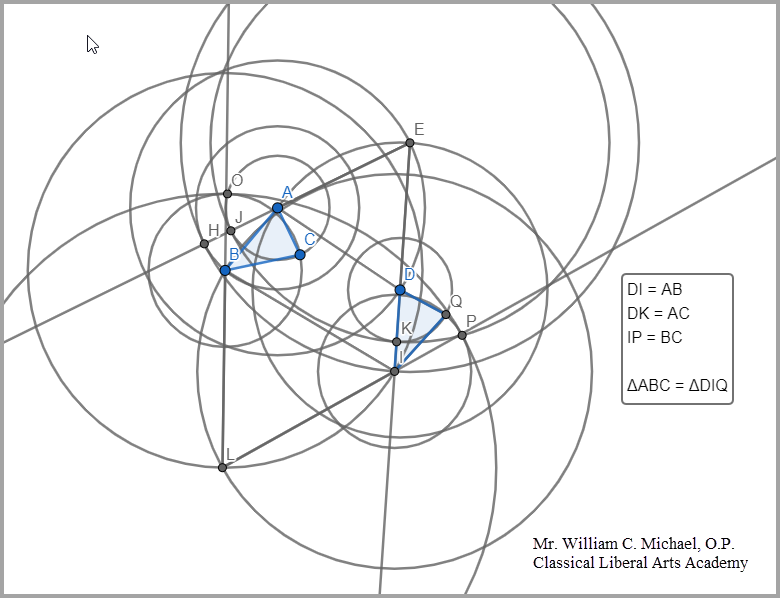
Proposition I.4 presents Euclid’s proof of what is called the “Side-Angle-Side Theorem” in modern schools. The question students often ask is in Classical Geometry, when studying proposition 1.4 is, “How can we just assume the two triangles with two equal sides and a common angle between them?”
That does seem to come out of nowhere.
These two imagined triangles can be produced using the Elements and Propositions I.1-3. See image above. To summarize:
- Transfer line AB to point D. (Prop 1.2)
- Transfer a line equal to AC to point A. (Prop 1.2)
- Transfer a line equal to BC to point I. (Prop 1.2)
- Draw circle from point D at distance K. (Post. 1.3)
- Draw circle from point I at distance P. (Post 1.3)
- Point Q must exist at the point where circles IP and DK intersect.
Those who have studied propositions I.1-3 should be able to see how this was done. Follow the letters in alphabetical order. I haven’t formally proven this yet, but I think it can be proven. The ultimate question is how to place point Q, which I believe can be done at the point where circle IP and circle DK intersect.
I’m assuming that the reason why Euclid (?) attempts to demonstrate this theorem indirectly is to show that if point Q is placed anywhere other than where the two circles instersect, no triangle composed of straight lines would exist.
Anyway, this is for the Quadrivi-ites.
Mr. William C. Michael, O.P.
Classical Liberal Arts Academy
