
The minute one enrolls in college, the costs begin. Tuition is due as the first classes begin and students don’t pay for a college degree, they pay to attend college. Many students are scammed into terrible situations by colleges that serve little purpose other than to fund their own operation. A number of statistics give parents an insight into what’s really going on at different colleges–and these stats aren’t mentioned much.
Admission Rate
Colleges receive applications and, supposedly, select the best candidates. The quality of student admitted to a college is very important because these students are our children’s roomates, classmates, etc.. The more selective a college is, the more likely our child (if admitted) will enjoy quality relationships among students who are mature and serious about their studies.
When we look at the Ivy League, we find the highest level of selectivity. Harvard University receives 60,000 applications and admits only 3% of the applicants. They turn away 58,000 applicants. Princeton University receives 38,000 applications and admits 6% of those applicants. They turn away 36,000 applicants.

Private universities are a step lower, but still very selective. The University of Notre Dame received 26,000 applications and admitted only 13%. They turned away 23,000 applicants. Boston College received 40,000 applications and admitted only 17%. They turned away 33,000 applicants.
Then come large state universities. Ohio State admitted 53% of 65,000 applicants. North Carolina State admitted 47% of 35,000 applicants.
As we continue, we come to smaller private colleges, and the numbers are misleading. These schools will often advertise their “small class sizes” and “low student to faculty ratio”, but this isn’t necessarily a good thing. For example, Belmont Abbey College, a Catholic college in North Carolina received around 2,000 applications and admitted 97%. Wingate University, a private Baptist college near me, received 20,000 applications and admitted 86%.
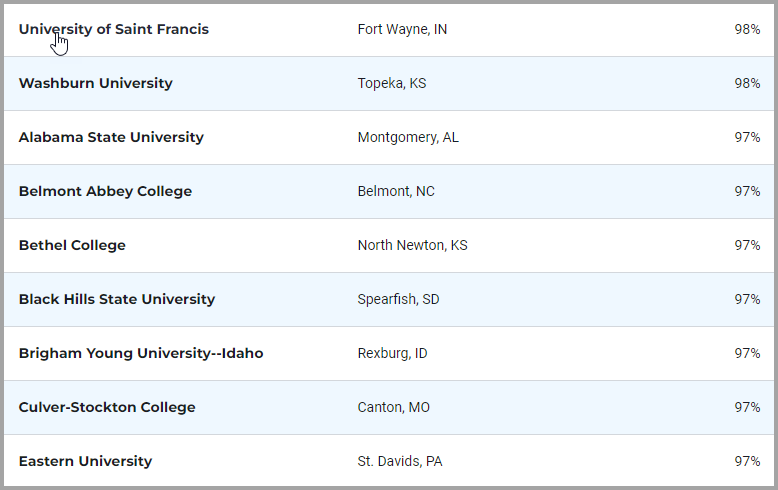
Small colleges are not to be confused with selective colleges.
1st Year Retention Rate
Now, I am sure someone will object and say, “Maybe good students choose small schools they desire to attend and that’s why a large percentage get admitted.” That sounds like a good argument, but there is another statistic that allows us to examine this: retention rate.
At great colleges, students who are admitted, stay there.
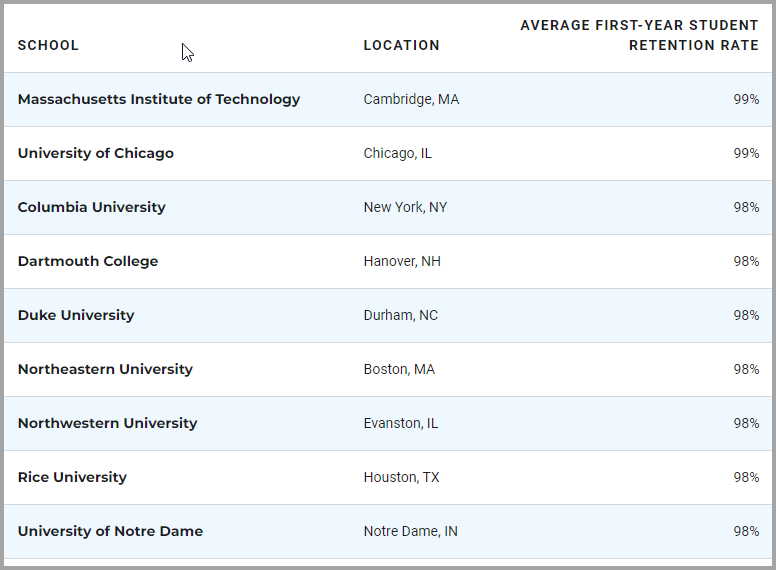
On the other hand, at Belmont Abbey College, only 66% of the students remain after the first year. At Ave Maria University in Florida, only 73% of students come back for a second year. Many small schools don’t even publish these numbers.

That’s a revealing statistic prospective students should be looking at: The students who attend the colleges don’t stay at them.
4 Year Graduation Rate
A third important statistic to look at is the rate at which students graduate in 4 years. Remember, tuition is collected from day one, so if one doesn’t graduate, one is paying for nothing.
When we consider the quality of the school, we have to consider whether or not a selective school retains its students (i.e., they’re happy) and graduates them (they’re successful).
In the table below, we can see that a few very selective schools, Notre Dame and Duke, graduate a very high percentage of their students. Kids going to those schools get their degrees in 4 years.
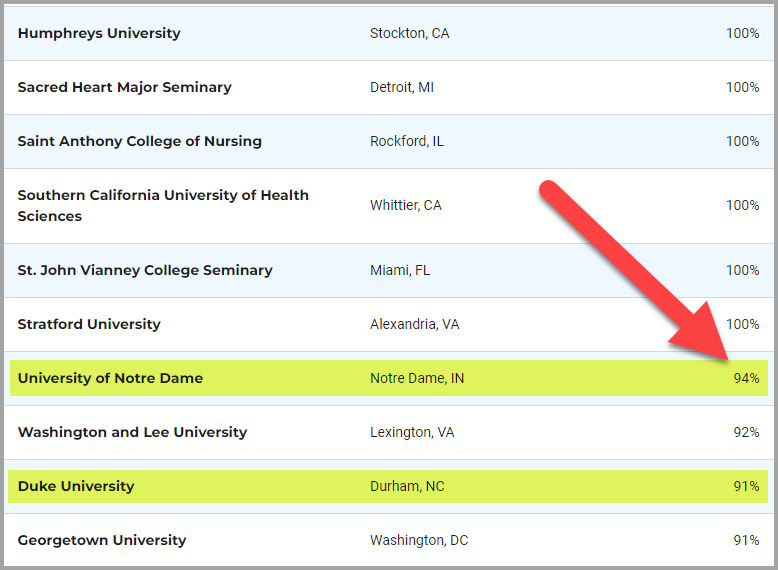
The talk about “small class sizes” and “low student to faculty ratios” doesn’t translate into higher success rates for the students. At Belmont Abbey College, less than 42% of students graduate in 4 years. At Christendom College, a tiny Catholic college in Virginia, only 63% of students graduate–after 6 years!
Conclusion
When considering a college, students need to look at meaningful statistics. Comparing “Tuition” is often silly because colleges have different levels of financial aid, retention rates, graduation rates, resources, quality of life, on and on.
The colleges that are actually ranked as offering the “best value” will surprise most people. The value on the chart below is the actual cost of attendance after receiving grants:

Many complain that “the rich get richer, and the poor get poorer”–and it’s true. However, the things you hear people saying when it’s time to talk about college admission prove why this is so. Kids are paying more to attend low quality schools they will not graduate from than kids are paying to attend the best universities in the world.
Moral of the story: If you want a great college experience you need to work to gain admission to the best universities.
Mr. William C. Michael, O.P.
Classical Liberal Arts Academy
