
I recall when I first studied Aristotle’s On Interpretation in the Classical Liberal Arts Academy’s Classical Reasoning course, I came across a passage that struck me. Upon explaining what the focus would be of his treatise, Aristotle clarifies that the purpose of On Interpretation is the study of enunciative speech, and that the study of other kinds of speech would be omitted. One such omission he provides:
“Thus, for instance, a prayer, is, indeed, speech, but is neither true nor false.”1
It made me curious. What is the nature of prayer? Is it a distraction from human study? Is Aristotle dismissing prayer as vain or unnecessary?
The Ruin of Education
Recently, Mr. Michael posted a talk on whether the use of technology is ruining education. It is worth listening to because it furthers the important discussion of exactly how Catholic students ought to approach the use of technology in their lives, both in education and otherwise. More importantly, it moves our thoughts towards essential questions about education and man. What is learning? What ought we study? If technology is capable of doing many tasks that humans have done, are these truly human tasks? If not, what are humans to be doing? What is the work of man?
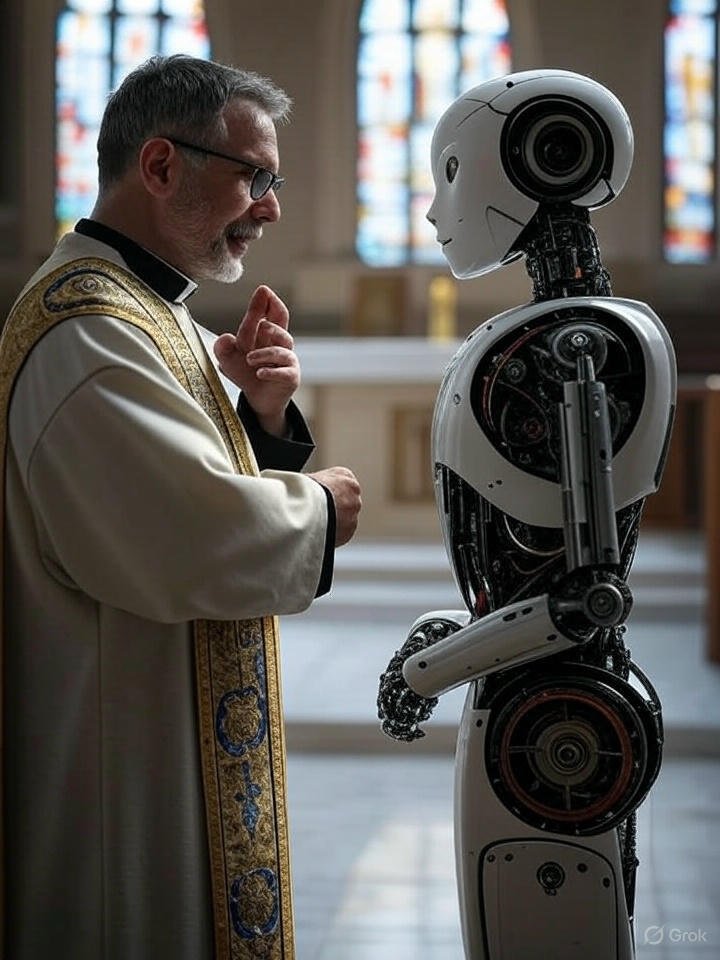
These questions, when we mediate upon them and interact with the wisdom of the ancients, provide us with a helpful orientation. The conclusion of Mr. Michael’s talk is that technology is not ruining education. Rather, to the contrary, it is, or could be, enhancing it to a more human and more challenging work. Aristotle had already taught the world three centuries before Christ, what this true work of man must be. In his Ethics, he explains:
“…the work of man is the energy of soul according to reason…2
And he shows that
“…the work of man to be a certain life, and this to be the energy of the soul, and actions in conjunction with reason, but by a worthy man…”
So that he might conclude
“…human good will be the energy of soul according to virtue.”
We fail to consider how wise and insightful this clarification of the purpose, work, and end of man is coming from a man who had none of the benefits of Catholic philosophy that we have today. It makes us aware of the fact that it really is not technology which has ruined education, but our own abandonment of the classical Catholic curriculum.
The movement of modern technology to replace all of the inhuman tasks that make up so much of our daily lives may be the very thing that opens up again the truly human and necessary work of man. It might awaken us again to the existence of the soul, which, without the exercise of our reason and the discipline of virtue, remains like a dead thing in the bodies of so many busy humans.
Can Robots Pray?
Aristotle’s omission of prayer as a focus of the study of the art of Reasoning is not speaking to the vanity of prayer. Rather, it is a distinction of category. Enunciative speech is the means by which we assert the truth or falsehood in our predications. Prayer, not being part of such a category, is not about asserting truth or falsehood but a more fundamentally human activity, indeed, a kind of energy of the soul according to virtue.
Where is all of this technology leading men? We could say that it might be freeing him to do more human things. Deeper, more authentic study in philosophy and theology, for instance, which cannot be achieved by AI bots, is left undone in modern education. And more to it, technology, freeing us from mundane inhuman tasks, could be leading us to pray more.
The Catechism of the Catholic Church teaches us
“Man is by nature and vocation a religious being. Coming from God, going toward God, man lives a fully human life only if he freely lives by his bond with God.”3
Solving a Crisis We Created Ourselves
We see nearly everywhere in the Catholic Church today that we have what is termed “a vocations crisis”. We normally associate this crisis as a lack of priests. However, the Catechism refers to a more common vocation, that of our nature as religious beings. Without virtue, study, prayer, and other such energies of the soul, we are not even human. Isn’t it true that all of the activity of man since the Scientific Revolution has been activity which has moved us further away from such energies? Isn’t the vocations crisis really about what we are failing to do in education, as we direct young persons to science and math curricula to the neglect of the liberal arts, philosophy and theology? And would it not be entirely ironic that the actual outcome of all of this modern scientific activity is to invent a technology which can do all such robotic activity better than we can, revealing to us that what has been left undone is the energy of our souls according to reason? AI bots cannot live according to a “bond with God”. But humans can. Have we forgotten this? The problem is not in the AI bot. It is in us.
In truth, all of this is revealing to the Catholic Church that a thoughtful, prudent, and rigorous embrace of modern technology can free us to solve the vocations crisis. After all, what activity is left to men which AI is unable to do better than us? What life is available to men whose inhuman tasks are already taken care of by robots? The Religious life! A life of virtue. A life of contemplation. A life of study. A life of prayer. And this, all directed towards what Aristotle called “human good” and what the Catechism reminds us is nothing other than God himself.
The Academy is Leading the Way
The Classical Liberal Arts Academy provides an example for how thoughtful, wise, and prudent use of technology can fix education and solve the vocations crisis. For twenty-five years, the Academy has been researching and restoring the classical Catholic curriculum and has shown that the abandonment of this curriculum is the cause of so many crises in the Catholic Church. But what is more, the Academy makes use of, and continues to explore, Artificial Intelligence as a tool which frees us to consider ourselves as truly human. It has demonstrated that those academic and educational tasks which can be completed by bots are not the highest tasks. It is further demonstrating that relinquishing such tasks to AI does not leave us without any work to do. Rather, it reveals all the work that has been left undone since the dawn of the modern age. The truly human, religious work which was the known to the ancients as the work of the soul according to virtue, directing us to our proper human end in God.