
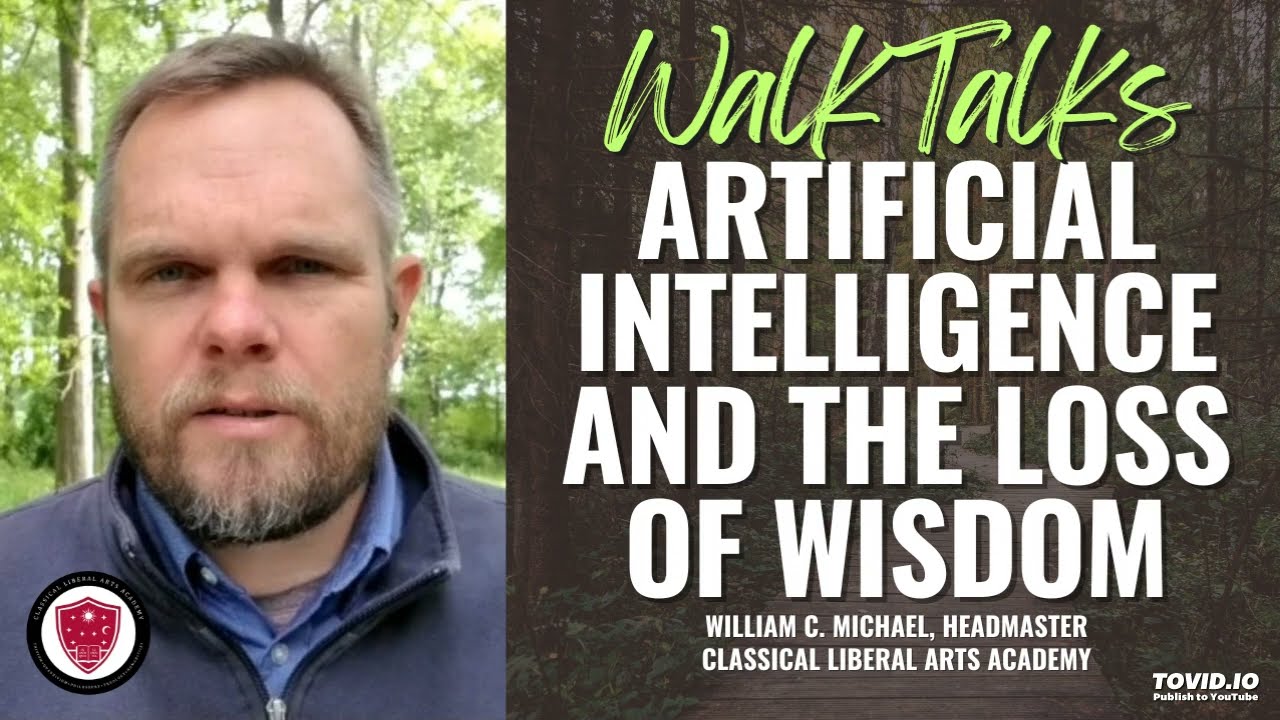
William Michael of the Classical Liberal Arts Academy, suggests that Christians have been led astray from the Church’s intellectual tradition, influenced by political, religious, and philosophical trends over centuries. He argues that while modern tools like artificial intelligence can be impressive and useful, they may also distract from the chief end of man and contribute to a degradation of the quality of human (i.e., intellectual) life. He emphasizes the importance of intellectual cultivation, warning against the dangers of superficial learning and the neglect of sacred scripture and philosophical study. He advocates for a return to serious study of classical philosophy and Scholastic theology, warning that without it, future generations will stray further from true wisdom.
Transcript
Today is Saturday, March 2. And this is William Michael, of the classical liberal arts academy. I wasn’t planning on doing a talk today, I don’t usually do talks on Saturdays. But I have to admit that what’s developing with modern technology, especially as we get into artificial intelligence and chat, GPT, and and these different, these different tools that are coming into use, I’m really getting stressed out. Because I feel like Christian people have been deceived by modern society. And for literally centuries, centuries, not, not a few years, not the past 20 years, not the past 50 years, not since the Second Vatican Council and all this nonsense. But for several centuries, Christians have been following influences in society at all different levels, political influences, religious influences, philosophical influences. And rather than looking to the doctrines of the church, the perennial, timeless, teachers of the church, instead of looking to them, and trusting them, and clinging to them, they have just left themselves to their own opinions. They’ve left themselves to make decisions on whether things that arise in society seem good to them, or not. And they’ve been completely deceived. And what’s happening, generation after generation is that these modern movements unfold and reveal another level of what they’re actually leading us towards. And it gets worse and worse, and worse. Now, the tools in and of themselves. The tools are very impressive, very powerful, in some ways, very useful. But what’s happening is, while all of this interesting, impressive, useful, technology is being played with, on the surface with all kinds of relatively frivolous applications, what’s happening is the chief end of man is being neglected. Man’s actual purpose is being neglected, as he literally plays with these tools. And man has become like the proverbial frog in the pot. Slowly boiling unconsciously. And this is true of Christians, I think, to some degree even more than non Christians. I think these I think these developments have an even more negative effect on Christians than on non Christians, because Christians seem to be so eager, so eager to go with the flow of society, so, so averse to resisting currents in human culture. And these technological developments, these developments in society are leading Christians further and further and further from the life I should say, from the quality of life, that they should be leading and when I say Quality of Life I’m not talking about anything carnal or materialistic. I’m not talking about better food or nicer clothes or nicer buildings to live and work in. I’m not talking about a materialistic quality of life, I’m talking about a quality of human life. That’s being degraded generation after generation as human beings and most inexcusably as Christians abandon what’s great about their humanity if we go back into ancient philosophy, and I mean, pre Christian, pagan philosophy were human beings that did not have access to divine revelation, human beings living outside of God’s people in the world, left to their own devices, left to their own senses, left to their own reasoning, asked ultimate questions in life and devoted their whole lives to finding the answers to these questions. And it was never the majority, the majority of human beings were always pleasure seekers, they were always living an animal like life. But a few the virtuous pagans as they’re called, in Catholic tradition, a few sought to actually understand and obtain the true end of human life. Ancient wise men. Ancient wise men understood that the defining characteristic of a of a human being the defining characteristic is the understanding. What makes a human being to be a human being, is not his body. Because animals have physical bodies. Animals have eyes, animals have legs and feet, we could say they have hands to a degree. Animals have not only do animals have physical bodies, but their bodies are often superior to the bodies of men. Horses can run faster. Oxen can pull heavier weights. Donkeys can carry heavier burdens, on and on. We can find animals that Excel men in strength, and agility. Animals even live longer than men, we can find species of animals that live men many, many decades, even hundreds of years in some cases, so the physical characteristics of man, man’s physical body is not that impressive. Man’s physical body is not what distinguishes him and if man is just a body, then man is not even the greatest of animals. And we see this all the time we can see examples of men being killed, or maimed or gored by animals and animals proving themselves superior to men. And to the degree that men live like animals, they become weaker and weaker, even subject to the animals. But these ancient wise men knew that what distinguishes man and what makes man to be the greatest of all creatures is his intellect, his understanding what the ancients called the soul the ancients understood that what makes man man is the soul. And so they devoted themselves primarily to the operations of the soul. And they understood that that’s what wise men do. And what they saw and proved, was that by the intellect, by the intellect, by the understanding, which dwells in the soul of man, which is immaterial, and eternal. By the soul, by the powers of the soul, man with an inferior body, rules the world. To borrow a phrase from a famous basketball coach Pete Carril from Princeton, the smart take from the strong, the smart take from the strong, smart man can defeat a strong man, an intellectual, can defeat a physical man. And the ancients devoted themselves the wise men devoted themselves to the cultivation of the soul. Because they understood that the soul made man the master of the world as it were, and men could accomplish far more through understanding than through any physical effort, physical work. And in the ancient world, that’s how society was ordered. That’s why we see monarchy as the principal form of government in the world not not that the kings were the wisest men. But the Kings ordered their kingdoms. By the Council of wise men, we see a perfect example of this most famous example. In the life of Alexander the Great work through the council and education he received from Aristotle, he became conqueror of the entire world but the ancient wise men and this this tradition of ancient wisdom climaxed among the pagans in Aristotle, who became the real master of the philosophical sciences, which is why St. Thomas refers to him simply as the philosopher. This life devoted to wisdom came to its perfection humanly speaking, in the person of Aristotle. When the Catholic Church was founded, by Christ Himself, this philosophical tradition was not scoffed at or rejected, rather it was perfected. It was incorporated into this Christian life it’s a complex process by which this union took place but we could say providentially it was God’s will, for the two to become one. While this, this climax of this union between philosophy and Christianity can into paths in the 12th century of the Christian era, under the influence of men like St. Albert the Great and St. Thomas Aquinas, what we call scholasticism it was already developing. Under the earlier Church Fathers, most importantly, St. Augustine. St. Augustine was a pagan philosopher who converted to Christianity and brought all of the virtue of pagan philosophy into the Christian church. And the same was true of many of the other church fathers, men like St. Jerome, St. Ambrose, and so on. Many of them were wise men first. And Christians second. Many of them became wise through philosophy, and later came to embrace the Christian faith, I experienced this process myself as I was a really a clueless, convert, studying classical philosophy. And then through my classical studies, I came to understand the Catholic faith and converted to Catholicism. I was a philosopher first who became a Catholic. So I, I understand this process, and how different that mind is than the mind of most Christian people, who are often completely ignorant of philosophy, or the life of philosophers, the virtues of wise men, secular wise men, and who learn the religion and receive it by faith, and then remain in that state of life where they sort of live a double life, they have a life in the temporal world, that they live according to their natural understanding. And then a separate life, their their Christian life, which they live by this disconnected faith. And the Christian life is not supposed to be led, or lived in that way. And so we’ve got Christian people who hold the articles of faith. But those articles of faith are not understood. And they’re not integrated in the actual temporal life of the Christian people. And this leads Christian people into all sorts of confusion, self contradiction, self defeating practices, and can ultimately lead them to such a state of vexation that they consider abandoning the Christian faith. We see Christians doing this all the time we see Christians walk, walking into schism being led by false teachers, who don’t understand who are not virtuous. They follow these men into schism, even heresy. Criticizing Pope’s criticizing bishops, disobeying the hierarchy of the church, because what the Church teaches they can’t understand. Or they don’t have the virtue to understand how to live in the church because they’ve been influenced by non Christian secular ideas that they that they don’t understand and can’t discern the evil of. And I’ve talked about this all the time. For example, the spirit of democracy is an anti Christian spirit. The spirit that everyone should do what’s right in his own eyes and live by his own understanding, trust in his own prudence, live by his own votes, and so on. That that concept of life is foreign to anything Christian. Foreign to anything philosophical. It’s a movement of rebels. It’s a movement of the ignorant mob. And yet many Christians have embraced this spirit of democracy, and it drives them into all kinds of anti Christian thinking and behavior. It was just announced today on social media that the church militant organization is officially closing. After its founder who spend years and years publicly criticizing the Pope and bishops and having a huge following of Catholic people who loved his criticisms of the leaders of the church, criticisms of the hierarchy, turned about turned out to be a total fraud. As if no one could have expected such. Today, they had to publish public apology to a member of the clergy because they wrote a nasty story about him that was completely false. How many Catholics? How many Catholics supported that institution? Supported Michael Voris, you can go back a few years back, I published a talk, what’s wrong with men, like Michael Voris, explained spiritually, philosophically, what’s wrong with that mentality, that mindset. And it’s no surprise to me that not only him, but that whole organization is finished. Because your sins will always find you out. That whole mentality is sin. And there are many more of these men. In Catholic circles, there are many more organizations who do the same thing. And these fools will simply move from following that man in that organization to the next one. And the same thing happens again and again. And again. Because fundamentally, there are deeply rooted errors in the way modern Christian people think, because they have imbibed anti Christian ideas and practices from modern society that they do not discern. And the reason why they can’t discern them is because they learn the Christian faith within the context of this modern thought and culture. They take this modern thought and culture for granted. This modern thought and culture which has developed from anti Catholic sources, they take it as the baseline and consider it to be normal. And so everything feels normal to them. Whereas if they would study the doctors of the church and the sacred scriptures as they’re supposed to, and acquire, acquire the spirit of the apostles, the Spirit of Christ Himself, the spirit of the doctors and Fathers of the Church, if they would acquire that spirit and then come into consideration of modern culture, they would feel how great the differences between these two spirits they would be, they would be sensitive to ideas and practices that are completely contradictory to what the doctors to what the true timeless teachers of the Catholic faith both both taught and practiced. But modern Christians neglect all of these studies they neglect all of these studies. They study books that are published about Catholicism, all of this little cheap paperback junk that’s published by all these modern publishers. They sit around watching YouTube videos. Rather than studying philosophy rather than studying the doctrines of the church, they they listen to a 10 minute video where someone says, oh, I can explain to you the Scholastic philosophy, all you need is 10 minutes. And here’s this dopey modern Christian soon Oh, I just, I just need 10 minutes to learn. Yeah, you just need 10 minutes. All of the philosophers who spent their whole lives seeking wisdom, they didn’t understand that you could get it in just a few minutes. But you see, when you have ignorant, lazy, and arrogant people, when those when those characteristics come together, ignorance, laziness, and arrogance. You get this idea that something virtuous, something something great, can be easy. And that’s never true. No one in the no one in history ever believed that wisdom or virtue was easy. If you read the book of Proverbs, and I’ll ask you do you read the book of Proverbs? If you don’t, I’m not surprised. And I’m sure that you’ve read 20 other books instead books by modern authors books by modern publishers, but you haven’t read the book of Proverbs. Ancient, divinely inspired wisdom. You have not read if you would read the ancient book of Proverbs given to us by the Holy Spirit himself, as an infallible source of wisdom, it teaches us that we can obtain wisdom. If we seek her we seek wisdom, as the only thing as the greatest treasure as the only thing we desire. If we do that, if we seek wisdom, as the only thing we desire in life, the Proverbs tell us that we can obtain her we can obtain wisdom. And Solomon is the model of that life for us. When given the option by God, to make a choice of anything he wanted in the world. Solomon asked for wisdom. That’s what the Scriptures teach us. Men are supposed to seek wisdom as the most valuable, the most important, the most essential thing in life. And that makes sense when you consider that man is a rational animal. And his defining characteristic is understanding. Therefore, the perfection of that understanding is the perfection of his humanity. And an ignorant man is a disgrace. A foolish man is the most useless of all creatures. Yet we see it even in modern Catholic culture, we see this this desire to try to promote some kind of Christian manliness and by by manliness. They don’t mean that you should seek the perfection of your nature. As a rational animal, what they mean is that you should you should imitate the world and try to have some appearance of physical strength. You should lift weights you should grow a beard. You should smoke a cigar. You should drink alcohol. You should be a tough guy you should have a gun. That’s what it means to be manly. You should boss your wife around. Be the boss in your house that’s, that’s a Christian man. They talk about Christian man hood. Ignorant foolishness. The perfect Christian man is Christ himself. The models of Christian manhood are the saints. Men like St. Francis. Men like St. Dominic intellectuals like St. Augustine and St. Ambrose and St. Jerome and St. Thomas and St. Albert. ascetics like St. Catherine of Siena. St. Clair mystics like St. Teresa of Abila, humble St. slank, St. Teresa of the XO that’s what God and the church calls us to to imitate the saints. And yet you see this ignorant foolishness in modern Catholic culture with men imagining that following modern trends in fashion, in this obsession with the physical body which is ultimately driven by a secret sexual desire an inordinate sexual desire or on the opposite side of things to be to be balanced here on the opposite side we have those who reject, reject physical fitness and discipline and, and run to the opposite, extreme error. Who are a bunch of effeminate weak men who, just like the others, neglect real study, neglect philosophy, neglect the study of the Scriptures and of the doctors and Fathers of the Church and give themselves over to childish literature. I’d call these the GK Chesterton crowd. And they share some of the characteristics of the other men, you’ll notice them talking a lot about food and cigars and their alcohol and material. material desires, physical pleasures and comforts. And you’ll notice that their studies the things that they read and study are not the things commended to us. by wise men and saints. They’re not pursuing the study of the ancient philosophical curriculum, they’re not pursuing the study of scholastic philosophy. They’re playing with literature, like children. And part of this modern ignorant, Catholicism is always reacting to whatever modern fads one doesn’t like and pretending that rejecting a modern fad is virtue. And we see this among people who promote reading, as if reading is intrinsically valuable, as if reading is itself virtuous. The television was developed and what the 1940s began coming into homes in the 50s. People didn’t watch television before the mid 1900s. So what did the lazy silly foolish people do? Before the television was even around? Well, you could say they listened to the radio, sure. But even before that, what did the silly lazy people do? They read books They read all the time. But the difference was what they read. The difference was what they read. They read popular literature, they read books, designed for entertainment. They read vain books, useless, silly books, they read literature. The wise men didn’t read those things. The wise men were in down at the local bookstore picking up the latest bestsellers. And St. John Henry Newman warned about this. And I talked about this ad nauseam. But St. John Henry Newman warned about this in the late 1800s, when he wrote on the idea of university, and was trying to warn people about these things, even before the television and radio age, because books were a problem to St. John Henry Newman, and what he complained about was that there are many people. And again, this is the pre television, pre video game, pre radio, pre Internet Society of the 19th century. And St. John Henry Newman was complaining about books. He said, in an age like this, in an age like this, where books abound. People imagine that a love of reading is, is real study. And he explains that what moves these people to read is not a desire for wisdom, or virtue. But what moves these people to read is simply a desire to be entertained, to come upon something new. To have their emotions stirred up by an interesting story. Maybe a mystery novel or a romance story. St. Augustine ridicules his own sinful habits of getting himself all emotionally bound up in classical literature like the anointed. He criticizes that foolishness this love of reading, which is really just television watching before television was invented. And yet, because we’ve got television, as an as a new fad, we can have this fake morality whereby we, we scoff at television, and go sit in the other room and read a useless book and pretend were somehow virtuous. Because we don’t watch TV. The problem is the same spirit that leads someone to watch something foolish on TV leads a person to read something unnecessary, some shallow junk food, literature. And as St. John Henry Newman explained, this is not real study. This is not what wise men mean by study. This is not intellectual culture, to be able to rattle off titles of books and names of authors and scenes or events or characters from from, from leisure reading, that’s not learning. Real learning is about the perfection of the soul through the cultivation of arts and sciences. And this is the kind of learning that people don’t like, especially modern Christians, they don’t like it. They don’t like scientific study. They don’t like philosophy. They don’t like arts. They’re difficult. They’re mentally exhausting. The writings of wise men are are intense. It’s very difficult to read. It’s very difficult to make progress because individual sentences are packed with complex ideas that need to be meditated on and unfolded. There is no way to zip through a book. It doesn’t matter how many books you have on your shelves. If you haven’t read them if they’re philosophy books, and that’s why Seneca and ancient philosopher said that we shouldn’t read many books, but that we should read a few books much Sacred Scripture teaches the same, the book of Ecclesiastes teaches that there’s no end to the writing of books. And that study is, is in fee billing studying is wearisome to the flesh. And therefore, we have to be careful that the time we spend reading is spent on essential studies. Otherwise, we make ourselves weak. And Ecclesiastes teaches us that the writings of the wise men are what are to be studied, and the wise men are not the popular writers. And so in modern schools and modern Catholic schools, Catholics pretend that they’re virtuous by pursuing these great books, programs, where they read all of this literature. But if you look at these literature lists, and ask yourself, did St. Thomas Aquinas read these books? Did Cicero read these books? Did Aristotle read these books? Did the doctors and Fathers of the Church read these books? The answer is no. These are not the books that wise men read. And even if they do have some writings of wise men in those book lists, they blitz through them, ignore half the content pick and choose what passages they want students to read passages that they think they understand. To pretend like we’re, we’re giving some sincere treatment to the wise men. But they just move through them to get to the next book, and the next book and the next book and the next book. And there seems to be more concern for the number of books that one has read through, rather than any objective question of whether a person has actually given careful study or gained mastery in the essential books. Most importantly, Sacred Scripture. It’s amazing to watch Catholics avoid Sacred Scripture. As if the inspired writings of the prophets and apostles just can’t make their way into the daily reading list. There’s nothing more absurd and ridiculous and telling than the Catholic avoidance of Sacred Scripture. And when we consider what’s what’s the next most important source of information for men who desire to be wise after the sacred scriptures, well, we can say only the Catholic Church can rightly interpret. So it would be the works in which we find the scriptures interpreted, they would be, obviously the next most important writings. And when we get into those works, we find that those writers the great interpreters of the scriptures, were men of philosophy. They weren’t shallow literature men. They were philosophical men. Men like St. Augustine and St. Jerome and St. Ambrose. And later Thomas Aquinas and St. Albert. These were men who when they opened the scriptures, they saw in the Scriptures, the teachings of the ancient philosophers made perfect. And their knowledge of the ancient philosophers allowed them to discern in the scriptures, philosophical teaching and when men come to the Scriptures without that philosophical knowledge without that background, they read words. And remember, words are signs of ideas. They read words that signify ideas, that they’re I’m not even conscious of. And so those words have no effect. Or they imagined that those words written by the prophets and apostles, under the inspiration of the Holy Spirit, are the words of ordinary men, signifying common ideas, ideas that are out in the streets, among the ignorant, and we get this in modern Bible interpretation, we’ve got people who’ve never done any serious study, presenting themselves as expositors of the sacred scriptures. And while we can say that’s an extreme error on one side, the neglect of Scripture by Catholics is the extreme error on the opposite side. And the reason why Catholics neglect and avoid the scriptures is because they know that these studies are complex and difficult. You can’t fake it. You can’t fake the study of Sacred Scripture. You can’t you can’t give it five minutes before your childish lack of attention wanders onto a million other subjects and topics. You can’t do it in your spare time. It’s, it’s a priority. It’s a focus of life. If you seek her as for silver, then you will find her Proverbs says. That’s wisdom. That’s what we seek in the sacred scriptures. And we seek it not as some interesting story to talk about over a cup of coffee. But we seek it as the guide of life, the wisdom that directs everything we do, that allows us to discern every idea, every spirit, every influence every event that comes up in our lives. And modern Catholics don’t have that knowledge. They don’t pursue that knowledge. And that’s not my opinion. That’s objective fact, I can demonstrate it by showing you a Catholic school curriculum, and show you that the study of the sacred scriptures and philosophy is not a part of that program. And if I were to look at that curriculum and ask, where did you get this idea from? For this curriculum? There’s only one answer. It’s what everybody else is doing. And you say, yeah, the Catholic schools, they really stink. No, no, go look at the home schools. Go look at the Catholic home schools, they do the same thing. In fact, I would say they’re even worse. They’re worse. They do even less for all of the talk for all of the hype. The homeschoolers do less, it’s even worse. And then we come away from the schools and I say, Well, let’s look at the lives of Catholic men and women. If I were to ask you, what are you studying? What have you studied? What do you study? What is your daily study routine or weekly study routine? What do you study? Make a list of the last 10 books you’ve read. What kind of books are they? Are the author’s doctors of the church? Is it Aristotle? Is it Cicero, Seneca Plato? Is it Thomas Aquinas and Augustine? Notice I didn’t even ask if it’s the sacred scriptures or is it junk? Is it modern, Catholic publishing junk? You can’t fake the pursuit of wisdom. And this is what most people desire to do. They just want to fake it. They want to fake it. Tucked in a recent walk, talk about the loser spirit, where men just look for excuses for things. They’re content, to lose their content to fail their content to just retreat from everything, and hand it over to others and pretend that pretend that this glorious Catholic retreat from public life is some kind of some kind of virtue, that there’s some kind of martyrs, because they’ve sacrificed every institution to anyone in the world, willing to take it. And they imagine that by retreating by walking out of the institution, and creating nothing in its place, creating nothing superior, just walking out from the institutions of our society, there’s some kind of brave soul. As if men running from the battle, are the brave. There is a time for sure, for a strategic retreat, but it’s for the sake of organizing an attack, there’s a time to withdraw from an institution whose foundations have been destroyed, in order to organize and found a new, better institution. That’s really not a retreat. That’s more of an advance. But what we see in modern Catholic society is just the celebration of a continued retreat from society, and then a celebration, a celebration as these institutions get worse and crash and fall apart. As if their destruction is somehow our victory. When we haven’t produced anything better in their place. The society is just getting worse. And the stupid Christian people are celebrating the decline of society, when their mission is to go into the world and make disciples. They’re celebrating that their neglect of their duty is leading to the collapse of society as if the suffering and injury and spiritual ruin of other human beings is actually God’s will. You see this deluded? mindset. But what’s truly telling about this Catholic society is that there are not superior institutions being established. And I’m not saying there aren’t other institutions being established, but they, they, they’re marked by the same faults. We have, for example, the the fake classical education movement, where where people withdraw from the modern schools, withdraw from the modern Catholic schools, and create schools that they call classical, which they just invent, out of Protestant ideas, again, completely incapable of discerning the difference between modern education and ancient education, but again, arrogantly assuming that they know assuming that they know though, they have not studied themselves, assuming that they know. And if you were to ask these school boards and school founders and school administrators, what works? What doctors of the church, what Scriptures have you studied, which provide you with the principles for this so called classical education? Where are you drawing, the principles? The content, the methods, where are you drawing these things from? The answers will be embarrassing. The truth is, these Catholics are following ideas that were promoted by Protestants in modern times, and they’ve just absorbed them into their Catholic life and literally may Take up history, and pretend that they’re doing something that no wise man or Saint would even understand. They make no sense at all. And when you look at the curriculum you find it’s the same curriculum. But what’s different, it’s got this superficial, silly, great books, literature, encyclopedic learning added on top, this so called Western civilization, which means trivia from European history. That’s what’s meant by Western civilization. If you want to talk about real Western civilization, you’d have to talk about Catholicism, Benedictine monasticism, monarchy, and so on. That’s Western civilization. These silly modern schools have no connection at all, to Western civilization, no connection to ancient Greece, no connection to ancient Rome, no connection to Judeo Christian history, no connection to ancient philosophy or scholastic philosophy, no connection at all. It’s just this conservative, political, shallow, silly culture. Now, the reason I, I wanted to talk about this today is because all of these faults, this lack of seriousness, this lack of discipline, this lack of honesty, and humility has led Christians to a place where they’re really in great danger, because all of the faults and problems of modern society. And I would say that this begins back in the 1500s, where you’ve got this, this foundation of several movements, several anti Catholic movements, the scientific revolution, the Protestant schism, followed by the rise of democracy. These anti Catholic movements have unfolded over the past several centuries. And again, most Catholics are lost in these movements themselves. But what’s happening now, in 2024, is we’re moving into a new phase of this unfolding, where artificial intelligence is going to take this to another stratosphere. Artificial Intelligence is going to lead men lead Christian men, further and further and further from where they should be, intellectually, spiritually, morally, and so on. And let me explain. I’ll try to be brief. 2400 years ago, 2400 years ago, Socrates or Plato speaking, in the person of Socrates warned, that the making of books threatened human intellectual life. The Making of books, Plato warned, threatened the human soul, threatened the human life. Now realize that when Plato warned about the making of books he was writing 1800 years before the invention of Gutenberg Printing Press. There were no books. In Plato’s time. He was warning about the danger of writing. He was warning about the danger of writing. And what he warned about was that men would be deceived by Writing, because they would imagine falsely, that what they possessed in writing was somehow their knowledge. They would assume that what they possessed in writing was somehow their knowledge. And we see this today, don’t we, we see men who want to make themselves look smart. Stand in front of bookshelves, we see people who want to pretend to be intelligent, talking about how they love buying books, and how they love collecting books, books, books, books, books, books, as if the shelves of books in your background is actually your knowledge, you see that deception, that delusion. And so you actually are led to imagine that because you stand in the presence of books, that you’re a smart person, you’re a literate person, you’re a wise person, you’re an informed person, because you have access to books, look at all these books I have. And Plato warned, that such a man actually knows nothing. Because knowledge, true science. True science, according to the wise men, true science exists in a man’s soul. True science exists in a man’s soul. And If knowledge is not in your soul, you don’t possess it. You are ignorant. You could have the sacred scriptures printed in a book, on your table on your desk, under your arm. But the knowledge of the scriptures is either in your soul, or it’s not. It’s either in your soul, or it’s not. And if it’s not in your soul, you don’t know the Scriptures. You can have a copy of a copy of the Catechism. But the knowledge of the Catechism is either in your soul, or it’s not having it on the table does not mean that you have the knowledge you have the book in which the knowledge may be written. But that is not knowledge. You do not possess the knowledge by possessing the book. Plato warned about the deception that would come to men through writing. And it’s no it’s no coincidence that history’s two most famous teachers, Socrates and Plato wrote, Nothing left no writing. Plato taught through dialogues. And yes, those dialogues are written down for men to study because the method of the dialogue forms the understanding if it’s studied, that’s why Plato writes, in the form of dialogues, the dialogue itself carried out between Socrates and some other participant. That dialogue in the writing of Plato is the process of development that takes place in the mind, of the one who studies the dialogue. Plato’s leading the mind, of the reader, to that understanding. That understanding is not had, when one purchases a copy of Plato’s dialogues. That understanding is had when one internalizes, and masters the content of Plato’s dialogues. The same is true of Sacred Scripture, the same is true of our prayers. The same is true of the writings of the wise and so on. Now, if you were to ask yourself, what knowledge actually exists in your soul, what knowledge actually exists in your soul and if you were to understand that that’s what you are actually are. That’s the quality and condition of your soul. Not what books you’ve purchased and stacked on your shelves. But that science or knowledge that actually exists in your soul. That’s what you are. And so if you think and you’ve got a soul filled with all kinds of junk, you’ve got jingles from advertisements. When you were a kid, you’ve got all kinds of silly stories and nonsense, maybe even worse, maybe pornography and all kinds of immoral crap you’ve got in your head. That’s what you are. That that’s what’s in your soul. And if you were to be asked questions about the teachings of Aristotle, or Plato, or the proverbs of Solomon, or the law of Moses, or the Gospels, or the writings of the apostles, and prophets, or the writings of the church doctors, and you were to respond with a blank stare. And say, I don’t know that stuff. That’s the state of your soul, and the science that actually exists in your soul. So you can see the danger. Now what why, why is this so important? I mean, can’t we can’t we just grab a book off the shelf for reference? We might think that that’s possible. But the problem with that idea is that it denies how the understanding actually works. It denies how reason actually works, and how we gain knowledge, True Knowledge. Reason, is an operation of the soul. If you study logic, you understand this. Reason is an operation of the soul. It’s something that the soul does. This soul does it often unconsciously. The soul does it by nature, the soul was designed to reason. If you have not studied the art of reasoning, which very few have, you won’t understand how this works. But the way that human beings learn is by joining existing ideas, to discover necessary conclusions that precede from those ideas. Reason is an operation of the soul that does this, by nature, automatically. All day, every day. When we’re walking, when we’re talking, when we’re driving, when we’re exercising, when we’re working, whatever we’re doing. Reason is at work, operating on ideas that exist in our souls, seeking to discover new knowledge that can be drawn from or deduced from our existing knowledge and therefore the knowledge that’s in our soul. The knowledge that we put in our soul is the knowledge on which reason works. I think a good example of this can be found in artificial intelligence. If you go to chat GPT and type in a question the question the question you should ask is, Well, how did it know that? How where did it get that answer from? It draws upon an existing existing body of information. It draws upon an existing body of information, and assembles an answer. From an existing body of information, reasoning works similarly. You control the body of information just as the owners of chat GPT control the body of information that serves as the source. What is in your soul? Is what reason works on. You are therefore accountable for what’s in your soul. All because you put it there most of the time voluntarily. So the books that are on your shelf, yes, it’s true. You could grab one and look something up. But that’s not how reason works. And that’s really not how our knowledge grows. It’s not how we work, not how it’s supposed to work. So when you read the sacred scriptures, and you read Deuteronomy, chapter six, which you should know. And Deuteronomy chapter six says, these words that I have commanded you shall be on shall be in your heart. And the Holy Spirit speaking through Moses tells us how the scriptures are to be studied. It says, You shall talk of them. When you rise up in the morning, you shall talk of them as you walk along the way as you do your work as you rise. And as you go to sleep, you are to talk about the scriptures, they are to be the constant focus of your attention. You are to drill them into your children. That’s how the human soul works. And so we can see the danger, the deception, of trusting in our libraries, as it were. Plato warned of that 2400 years ago, 1800 years before the printing press existed. Imagine how much worse that problem became, with the advent of the printing press. Now, the printing press is not intrinsically evil, because it can print the writings of wise men for study. By men seeking wisdom. The problem is that it it it prints junk to. And the good stuff that it does print men don’t necessarily study, like the scriptures. So it doesn’t necessarily solve the problem. And it can create new problems. And that’s just books. Now fast forward to the 20th century, we’ve got radio, we’ve got television actually, actively seeking us, a book is silent, a book lays on the table unless you open it and read it. The radio comes in gets you comes in gets your attention, like a person in the room. The television comes in gets you of course, if you if you buy one and pay for your cable TV service and set it up in your house. But it comes in gets you it’s much, much more influential than a book. And now we’ve got smartphones, which are potentially great if they were used for the pursuit of wisdom, but they’re primarily used for play for nonsense. And now on top of all this, we’ve got artificial intelligence, which is going to just raise the deceptive nature of written information. Exponentially. It’s going to raise the problem exponentially because now you don’t even need to look up something in a book. You don’t even need to study books to know where the content is. So you can use them as references. None of that’s even needed. Now you can just say, hey, Google, and ask your question and get an instant, lazy response. You can go on chat GPT and get instant information. Man, you’re so smart. Aren’t you so smart. We are. We’re so smart information at our fingertips. But the problem is that None of this information, at least the true information, the information that’s actually necessary wisdom, true learning Arts and Sciences. And when I say Arts and Sciences, I mean, arts and sciences like grammar and reasoning and rhetoric and arithmetic and geometry, music, astronomy, moral philosophy, natural philosophy, metaphysics, theology, Sacred Scripture. We can pretend we’re smart, because we can grab a quick answer. But the truth is that our souls are the souls of fools. Our souls are the empty souls of ignorant people. And this is the danger. This is the danger. The moment by moment, thoughts, the moment by moment, desires and activities or lack of activities, lack of thoughts, is the real effect of a lack of actual learning. Wisdom is supposed to be developing in our souls 24 hours a day, and we can’t even imagine what that must be like you can imagine when you open if you open the writings of Thomas Aquinas and you read and you’re just like, how could somebody? How could somebody know this stuff? How could somebody have such profound knowledge? It’s because he controlled what went into his soul. And then the faculty of reasoning operated on that knowledge. Year after year after year, 24 hours a day, seven days a week, every day of his life. From the time he was a child. Five years old, Thomas Aquinas lived in a Benedictine monastery, memorizing the divine office. His soul was filled with wisdom. Studied Aristotle, studied the writings of the Church Fathers studied the sacred scriptures heard the teaching of his own teacher, St. Albert the Great, his soul was so richly supplied with what a soul is supposed to be filled with, that his faculty of reasoning could simply operate on that. That body of information constantly, all day, every day, when he walked when he sat down, when he went to bed when he rose up, as he did his work. He carried that knowledge with him and the faculty of reasoning, which is our excellence. worked and worked and worked on that knowledge. This is what we’ve completely lost and Christians are just completely lost in this modern encyclopedic reference world of Wikipedia, Google Chat GPT, information, lost, lost, minds filled with a billion different pieces of useless trivia, stories, characters, songs, images. With a soul completely devoid of the information that is supposed to be in our souls, the writings of the wise writings of wise men, the Sacred Scripture is God’s own revealed words. That’s what’s supposed to be in our souls. That’s the purpose of education. That’s the goal of schooling. The goal of sending a child to school or arranging studies for a child is to fill his soul with that information. And we’re not doing that. The adults don’t have it. The adults don’t like it. The adults don’t even let their children learn it. And the adults dread take their kids into foolishness. Drag them into modern mathematics and modern sciences, which are almost useless in life. Drag their kids into all kinds of literature fill their heads with all kinds of encyclopedic, learning useless information, trying to make their kids smart kids neglecting Sacred Scripture, neglecting the Divine Office, neglecting the Liberal Arts and Sciences, neglecting grammar, neglecting reasoning, neglecting the real science of arithmetic, not modern math, but the classical liberal art of arithmetic and geometry, not even touching ancient philosophy, not studying any kind of scholastic theology in any systematic manner, just skimming around or bouncing around all over the surface, like a bunch of nets. Becoming familiar with a billion different pieces of disconnected, uncertain information, while remaining completely empty, possessing none of the science that the Christian soul is supposed to be filled with, through Christian education. And chat GPT, like I said, and the tools that are going to arise, it’s going to take this to a different stratosphere of delusion. So my, my advice, the reason why I’m posting this is to warn Christians of this problem. warn them that it’s going to get even worse and call them to take up serious, prioritized study of the sacred scriptures of the writings of the doctrines and Fathers of the Church of the writings of the ancient philosophers of the classical liberal arts and sciences. Because if you don’t take up these studies, and if your children aren’t provided with these studies, the problems we have today. The reason why there are no religious vocations is because these ideas are not even in the souls of Christian people. And if this doesn’t change, if if there’s not, as I said before a retreat for the sake of building something greater if there’s not a turnaround and pursuit of true wisdom and learning by the current generation of Christians, the next generation is going to be worse, worse. So I invite you, to put it, to put it politely, I invite you to take up the study of classical philosophy and Scholastic theology. The classical liberal arts academy exists for this purpose. You can join us and study for free. There’s nothing we could do to make it more accessible or easier. But it’s got to become a priority or it’s just going to get worse. And it becomes a conscious choice at some point. To allow it to become worse, or to cause it through multiplication by reproducing, having children and intentionally leaving them ignorant. It becomes worse. And this artificial intelligence stuff the the access to information that our children and grandchildren are going to have is going to multiply these problems and deceive them more and more. Unless they learn ancient wisdom, become conscious of it and then can use that to do discern, and I’m not criticizing modern technology in the hands of wise men. It’s very great, just like a tool in the hand of an actual craftsman. But to imagine that because you can go to Home Depot and buy some fancy drill or saw that you’re now a craftsman is just nonsense. These tools in the hands of wise Christians will be awesome. But they’re not in the hands of wise Christians. They’re in the hands of silly, simple minded, empty souls. And it’s just going to get worse and worse now they’ve got artificially intelligence generated pornography, this stuff is going to multiply to infinity. Unless of course, something like war just blows it all to pieces. But Christians have to make this a priority. Even the pagans understood the dangers of these things, but the Christians are worse than the virtuous pagan. So anyway, I hope that’s helpful. I hope that sheds some light on the current state of things. This is my concern. My concern as a Catholic teacher, because I just don’t see it getting better. I see Catholics actually running with the flow rather than standing against it. So hopefully, hopefully, some will wake up. God bless
