
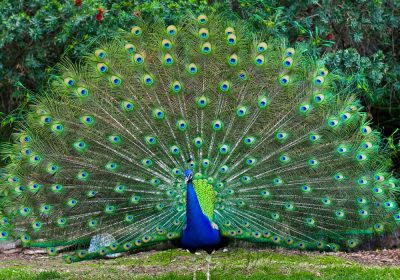
The Peacock complained to Juno that while every one laughed at his voice, an insignificant creature like the Nightingale had a note that delighted everybody. Juno, angry at the unreasonableness of her favourite bird, scolded him in the following terms: “Envious bird that you are, I am sure you have no cause to complain. On your neck shine all the colours of the rainbow, and your extended tail shows like a mass of gems. No living being has every good thing to its own share. The falcon is endowed with swiftness, the eagle, strength, the parrot, speech, the raven, the gift of augury, and the nightingale with a melodious note, while you have both size and beauty. Cease then to complain, or the gifts you have shall be taken away.”
Reflection
In this lesson, we are going to study Aesop’s fable of the peacocks complaint. Let’s begin by reading this fable together.
The peacock complained to Juno, that while everyone laughed at his voice, an insignificant creature like the nightingale had a note that delighted everybody. Juneau angry at the unreasonableness of her favorite bird scolded him in the following terms envious bird that you are. I am sure you have no cause to complain. On your neck shine all the colors of the rainbow and your extended tail shows like a mass of gems. no living being has every good thing to its own share. The Falcon is endowed with swiftness. The eagle with strength. The parrot with speech the Raven with the gift of auguri and the nightingale with a melodious note. While you have both size and beauty cease then to complain or the gifts you have shall be taken away.
This is the fable of the peacocks complaint.
Whenever we study a fable, the first thing we should do is read the fable carefully and make sure we know all of the details of the fable. The moral lessons usually depend on our knowledge of the details of the fable. We should also look at the characters that Aesop chooses to use and ask why he would choose these characters to teach a certain moral lesson. And then we can consider the moral lesson of the fable and there may be a number of different moral lessons because a fable can be looked at from a few different points of view. We can look at the fable through the eyes of the different characters, and we can often draw out different moral lessons when we do so. So let’s look at this fable more carefully and try to understand Aesop’s lesson in this fable.
Aesop chooses to use the peacock as the main character of this fable. The peacock is the largest and most beautiful bird. An amazingly beautiful bird with colored feathers that spread out like a fan the peacock is praised by everyone for its size and its beauty. Yet we find the peacock complaining to Juno, who we can understand as God the peacock is complaining to Juno because everyone laughs at the peacocks voice. Why would such a large beautiful bird be given a voice that everyone laughs at? This is the peacocks complaint. The peacock doesn’t understand why an insignificant bird like the nightingale would be given a beautiful voice and the peacock giving given a silly voice and so the peacock complains to Juno. June Juno becomes angry with the peacock and calls the peacock envious. And so we see here what the real moral fault is. With the peacock. The peacock is envious. The Peacock has its own gifts and abilities for which it is praised. But that’s not enough for the peacock. The peacock isn’t content to allow another bird to receive praise. The peacock wants all the praise. The peacock is not content. To see the nightingale receiving praise for its beautiful voice. The peacock envies the Nightingale and God says you have no cause to complain. no living being has every good thing to its own share. Let’s repeat that. No living being has every good thing to its own share. This is the moral principle of this fable.
God has designed the world so that all creatures depend on one another. Because God’s will for the world. Is is that we love one another. God wills for us to live in society. God wills for us to live in community and therefore to foster this community. God distributes different gifts and abilities to different individuals and leaves us dependent on one another. St. Paul compares the church to the body with its different parts. If we think about the body with all of the different organs in the body, we have eyes and ears, nose, mouth, all different organs inside of our body, a heart, lungs, intestines, and so on. All of these different parts of the body have an important function that no other part of the body can supply. No part of the body can live by itself, but is dependent on the other parts. Even the most beautiful and amazing parts of our bodies like our eyes are useless without simpler parts of our body. Like our intestines. And so we see in the body, a relationship between all the parts that illustrates for us the relationships that exist between people in human society. It’s God’s will for human beings to live in society and to foster this society, God has made all men dependent on one another by distributing different abilities to different individuals. We all need to understand that we have one job to do in society. And when we learn what that job is, where to do it with all our might. And we’re to understand that that is our lot. That’s our role in society and we need to look on other people and appreciate the different roles that they play the different abilities and gifts that they have and how when they offer those gifts and abilities to the good of the community to the common good. Everyone benefits and the quality of life that we all enjoy increases. This is the benefit of living in society.
One vice that wars against this society is envy. Envy, dislikes other individuals being appreciated for their unique gifts, envy, wants, all of the praise of the community. Envy once all of the gifts and the once all of the knowledge, all of the skills, all of the praise envy is never content with its own unique gifts and abilities. And v is never content with its just praise and appreciation from the community and V always wants more and we did despises its own abilities and refuses to mind its own business and the wants to have all of the skills and abilities and receive all of the praise and benefits. And this is the vice of the peacock in this fable so this fable teaches us to value community and to respect the gifts and abilities of other people.
This fable teaches us not to envy others, but to rejoice in the gifts and abilities that others have and the benefits that we receive from them teaches us to live in community to live with love and respect for others. It also teaches us humility to know who and what we are as individuals and to be content to mind our own business. Do our own job and perform the function of our own part of society. This is Aesop’s fable of the peacocks complaint.
Mr. William C. Michael, Headmaster
Classical Liberal Arts Academy
