
Modern education is driven by a public school culture that has existed since the late 1800s. We have all been raised with the image of the students seated in desks, facing a teacher who leads class activities and gives grades according to his/her own standards. The goal is the completion of minimum school standards that, again, have existed only since the late 1800s.
School meets only 180 days per year, and from around 8am to 3pm. Much of the “school day” is spent in non-academic activities (lunch, study hall, recess, changing classes, etc.). Most of the student’s life, even during his formal school years are spent outside of school, doing no academic work.
What’s worse is that many Christians imagine that this is too much academic work and choose to “unschool” their children by doing less academic work than is done in the schools designed for the poor and working class children.
How has Christian education fallen to such a place?
That’s a rhetorical question, obviously, because we know exactly how Christian education has reached the depths to which it has fallen. It has been infected by a number of anti-Catholic philosophical, religious and political movements including the secular Renaissance, the Protestant schism, the Scientific revoltuion, the rise of Democracy, and more. Rather than resist these movements, Catholics have chosen to follow them, as if they are necessary.
Catholic intellectual culture needs to be restored, but that requires a different way of life.
My intellectual life changed when I was in college and was studying the life of Jonathan Edwards. Edwards was a Protestent minister in the 1700s, who became president of what we call Princeton University. I admired Edwards’ writings and devout life and wanted to learn how to live and think like him.
Reading Edwards’ biography, I learned that he spent 13 hours per day in his study.
That was when my life changed. I was a strong student, but I knew nothing of the lifestyle of a historically great intellectual. I knew at that time that I needed to make a choice concerning how I was going to live. Would I live like my classmates, attending classes and completing required assignments–when required–or would I devote my life to study?
Before there can be any revival of Catholic learning, Catholics need to learn what the life of learning looks like. The loss of it is an important reason why religious vocations have dcereased, almost entirely. I argue that the acceptance of the modern view of schooling and American life, developed by the social engineers of the public school movement in the early 20th century, is the real cause of the disconnect between modern Catholic education and religious life, which is the end of such.
Consider this from Delatte’s commentary on the Rule of St. Benedict:
“A monastery is not a club, nor a house of retreat, nor an appendage to the universities. Doubtless it is a place of leisure, of liberty, and of repose; but this leisure has for its object the study of the things of God, and the training and education of His soldiers, His guard of honour. The monastic life is the school of the Lord’s service, the school where one learns to serve Him, where one is trained without cessation, in a novitiate which will last the whole of life.”
Thus, Catholic education cannot be separated from the monastery to merely satisfy secular public school standards. Catholic education should provide students with an initiation to the religious life, and be a “school of the Lord’s service”, modeled on the monastic life. In modern society, this may not be possible in a local K-12 school because the lack of interest in such a life makes such a school unsustainable. Most Catholic schools today cannot exist without watering down the curriculum and culture to be comfortable for non-Catholic students. This can be done, however, through remote learning among individual homeschooling families. It’s worth noting that St. Benedict’s vision of the monastery was based on the life of the Catholic family.
All Catholics are called by the Church to participate in the same devotional life that monks and nuns enjoy: reciting the Liturgy of the Hours. This system of Catholic prayer consecrates our time and divides our day into several “periods”:
- Morning Prayer
- Morning Work
- Midmorning Prayer
- Midmorning Work
- Midday Prayer
- Midday Work
- Midafternoon Prayer
- Midafternoon Work
- Evening Prayer
- Evening Work
- Night Prayer
We see here the model St. Benedict spoke of in his motto “Ora et Labora” (Pray and Work). Now, by “work” we mean our necessary daily work, but what that daily work will be is largely up to us. If we consider that we are called to lives of temperance, we will not burden ourselves with desires that place great pressure on money-making. In fact, our life’s work can be study.
The Church and the world need more men and women to devote their lives to study. We often hear of Catholic young men talking about wanting to be doctors and engineers, but this is not the essential work of Catholic men. We can find excellent non-Christian doctors and engineers to serve our temporal needs, but we will not find non-Christian monks, nuns and priests.
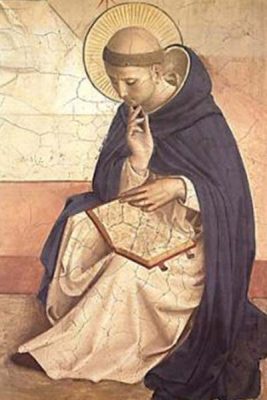
The religious life does not begin for a young man or woman when he is 18-23 years old. It begins much earlier. St. Thomas Aquinas, for example, was raised, from age 5, in a Benedictine monastery. His life of learning did not develop in schools or universities, but in the context of a religious life. Until we restore our commitment, as Catholics, to religious life, there will be no renewal of real Catholic learning.
God bless,
Mr. William C. Michael, O.P.
Classical Liberal Arts Academy
