
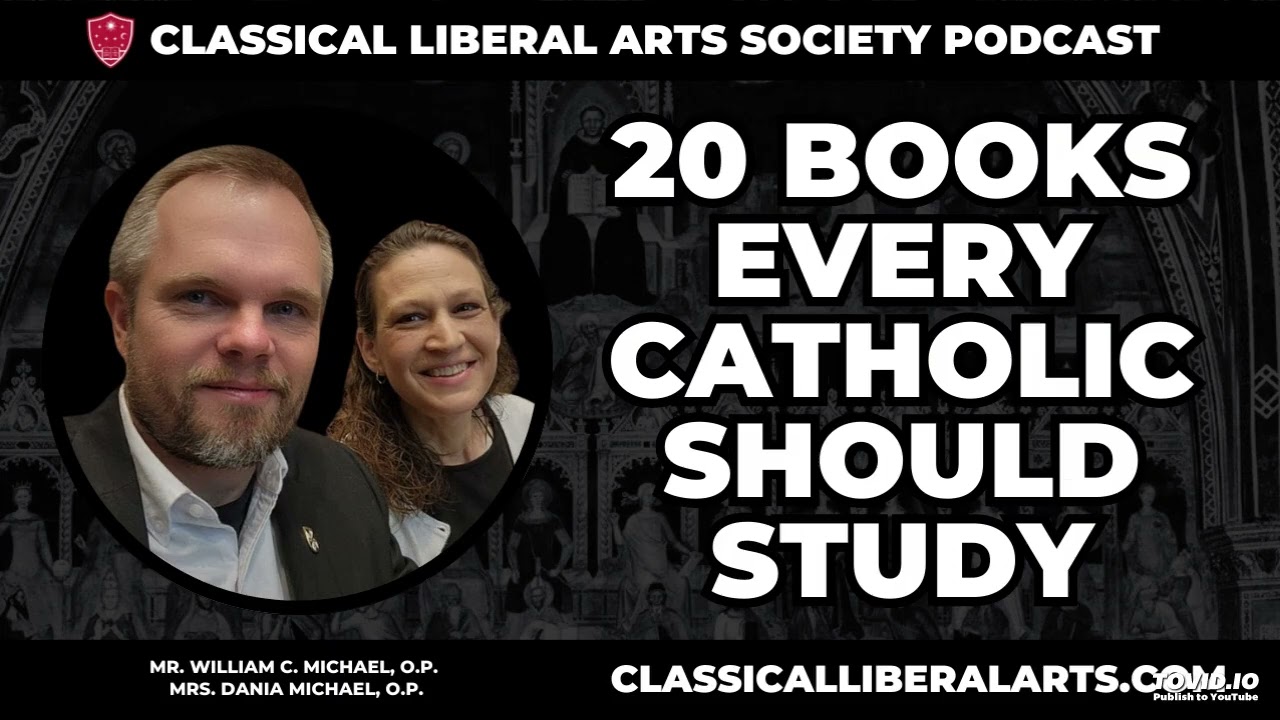
I’ve been studying and working as a classicist for almost 30 years now, and I was recently asked by a friend if I would recommend a list of 20 books that every Catholic man should study for spiritual and intellectual growth, 20 books. If I could pick 20 books that men should really soak in and read and study and reread, what would those 20 books be? And obviously we could debate this, but since I was asked, I put a list together of what I feel the 20 most helpful books are. And again, the goal is not for a man to become smart. It’s not for a man to be clever or to be, you know, an entertainer at a at a cocktail party. It’s 20 books that every Catholic man should study for spiritual and intellectual growth. And I’d like to walk through this list that I’ve made. I think it’ll be helpful. And before I get into it, I want to say that what I’ve done is I’m a big believer in the importance of history. I think that understanding the historical development of human thought is very important. I believe that evangelization largely consists of teaching the history of salvation. And so as I thought through these books, I arranged all of them in a chronological order. And the reason why I think this is so helpful is that if a man studies through this list, he will more or less study through the history of the development of human wisdom. And so, you know, I’ve talked about this before, where I think that an individual man, if he wants to understand how to develop intellectually, should look at human history, and see the entire history of human thought as really the development of man himself. And so this is how man developed, intellectually and spiritually over the past 6000 years of history. And so I’d like to walk through this list and identify these 20 books that I would recommend, and give a give a reason why I would pick these books. I’m going to warn you, if you’re looking for something exciting or new, you’re going to be disappointed. In fact, you might find this list very boring. Most people, most people who I talk to about what I study find what I study to be very boring. They’re always looking for something new and obscure or curious, and I tend to be a meat and potatoes intellectual but I’d like to walk through this list and provide a little bit of an explanation for why I would recommend each of these books as the 20 books that I’d recommend for Catholic men to study for spiritual and intellectual development, the first book that I would recommend, and again, this is not for the sake of familiarity, but for ongoing, lifelong study, meditation, reading, rereading, reflection, application and so on.
The first book would be the book of Genesis. And again, that may seem boring, but the origin of the human race, the origin of the history of salvation. The beginning of the history of salvation, the life of some of the most influential and significant men in salvation history is narrated, or the lives are narrated. In the book of Genesis, we have the creation of man, the fall of man, the promise of redemption, the early history of the human race, the flood of Noah, the origin of nations through the descendants of Noah. We then have the call of Abraham. We have the narration of the entire life of Abraham, and then Isaac, and then Jacob, we have the beautiful story of the life of Joseph, one of the most beautiful stories in all of of history or literature. The Book of Genesis is a treasure for meditation, because the life of Abraham is the life of faith, and as we are called to be like sons of Abraham, we’re called to live with the faith of Abraham. Studying the life of Abraham gives us a model for what it means to live by faith. Abraham is the model of the life of faith. So the first book that I would recommend, and again, this is not for casual reading, this is not for familiarity. This is for real study and meditation, spiritual reflection, you might say Lectio Divina, if you know what that is. The first book that I’d recommend is the book of Genesis.
The second book that I would recommend is the book of Job in the Old Testament. If you don’t know where that is, it’s right before the book of Psalms. The Book of Job is the first of the wisdom books of the Old Testament, but it tells the it narrates the life and experience of a man who is believed to have lived during the time of the patriarchs. So it’s an ancient, a very ancient story in God’s providence, it was the first book of the Bible that I ever read, and looking back, I thank God, because I think it was one of the most important books to build a Christian life on. In the book of Job, we read a very important story, again, the purpose of this list is for spiritual and intellectual growth. The Life of job teaches us about this man Job, who’s identified as as a righteous and good man who is attacked by the devil. And this book teaches us how to think with spiritual mindedness. It teaches us to be spiritually minded. It teaches us to be discerning. Sorry if there’s a siren passing through real quick. It teaches us to be spiritually minded. It teaches us to understand that things in this life are not as they appear to the senses, but that there is a world of spiritual beings, spiritual influences, which we often cannot understand, and it shows us how to live by principles and to be protected from the confusion of this life by the certainty of a good conscience. And so the story of the life of job is a real pillar for spiritual and intellectual life. So that would be my second recommendation, the book of Job.
The third book that I would recommend is the book of Exodus in the Old Testament. The Book of Exodus teaches us the life of the man who may be the most significant man in the Old Testament, namely Moses. We learn the life of Moses in the book of Exodus. We learn about the Hebrew captivity. We learn about God’s call of Moses. We learn about Moses’s leading of the people of Egypt, of Israel out of Egypt. We learn about the giving of the Law, we learn about the giving of the 10 Commandments and the establishment of the nation of Israel under the Prophet Moses. Now, one of the reasons why I recommend these early Old Testament books so strongly is because everything that comes after them is based on them. And so the man who understands the book of Genesis will understand the rest of the Bible. The man who understands the book of Job and Exodus will understand and be able to use that knowledge to interpret the rest of the Bible. And so these early books are really fundamental for the spiritual life or intellectual life. So the third book, again, I would recommend, would be the book of Exodus in the Old Testament.
The fourth book is really two books, but I’d like to keep them both in this list and not have them be separate. It’s first and second. Samuel, i. First and Second Samuel, two of the historical books in the Old Testament. And the reason why I, I would put these in a list of the 20 most important books is because in these two books, we learn the life of King David. The life of David is extremely important because David is the psalmist of Israel, even though he’s a king that that’s not his most important role. The most important role he plays is the role of the psalmist, the the man who’s responsible for composing the psalms that have been the material of the contemplative life for 3000 years and remain the material for contemplative life today, every priest, Bishop, Monk, nun, Pope, Saint, doctor, has spent his life reciting and meditating on the Psalms of David. And the Psalms of David can only be understood in light of their historical context, and in order to know that historical context, we have to become intimately familiar with the life of David, and we should really almost devote ourselves to the study of David’s life, because he’s so important. He’s a man of whom God himself said that he was a man after God’s own heart, just a beautiful, inspiring man whose life is just filled with spiritual riches worthy of meditation and imitation. So the fifth or the fourth book I would recommend is First and Second Samuel, the life covering the life of David in the Old Testament.
The fifth book I would recommend are the proverbs of Solomon. Solomon was the son of David and King of Israel. He was a man who famously prayed for wisdom, and God made him the most famous man in the world and filled him with divinely inspired wisdom. And Solomon wrote the proverbs of the Old Testament, Proverbs of Solomon. And so I would recommend that men, obviously study the book of Proverbs, if we just think of how crazy it is for men to be talking about wisdom, and have have these books of wisdom in the Old Testament that are 3000 years old, written by men who were divinely gifted with wisdom, who wrote under the inspiration of the Holy Spirit, and we simply neglect them. It’s just ridiculous to think of books men are reading, things men are studying while they neglect the proverbs of Solomon, the wisest man who lived in the ancient world. So the fifth book I would recommend are, is the book of the proverbs of Solomon in the Old Testament.
The sixth book is the first, the first reading in profane literature that I would recommend, and it’s Homer’s Odyssey. This is number six, the Odyssey of Homer as a as a student and a teacher. This has always been one of my favorite books. The story itself is beautiful. The story of The Odyssey, the life and character of Odysseus is very inspiring and virtuous, and it’s just a beautiful story filled with minor stories that provides us with a treasury of illustrations and examples and moral lessons to reflect on. And you know, I always think of examples when I have decisions to make or I need motivation, passages and examples from Homer’s Odyssey always come to mind. Some of the most influential passages in my life have been drawn from Homer’s Odyssey that was written around 750 BC. So the proverbs of Solomon, which I just mentioned, they were, let’s say around 950 BC. Homer’s Odyssey, around 750 BC, as we continue through this history of development of the human intellect, after Homer’s Odyssey.
The seventh book I would recommend is Aesop’s Fables. These are unfortunately considered children’s literature. They’re usually published in illustrated books for children, usually in the children’s section of libraries and bookstores, but there’s nothing child. Published about Aesop’s Fables. Aesop’s Fables are one of the most significant works in human history. The fables are all used to teach and illustrate moral lessons for us. They’re memorable, they’re profound. They have infinite application and use and any time spent, any time spent in ESOPs fables, is time well spent. It takes just a minute or two to read a fable, and then you can spend the rest of the day meditating on it. So remember, the purpose of this list was to provide 20 books every Catholic man should study for spiritual and intellectual growth. And the seventh book that I would recommend is Aesop’s Fables. Very, very important for intellectual life. And Aesop to give him a date, let’s say around 600 BC.
Next moving into Greek philosophy during the Classical Age, I would recommend a work of Plato. Plato, of course, is very famous. I think he’s, I think he’s, I think he’s celebrated more because Aristotle is too difficult for many people to read, rather than because he’s actually that significant in history. He’s obviously made obsolete by Aristotle. But if I was going to recommend one of the dialogs of Plato, which I think is the best for one’s spiritual and intellectual growth, it would be the dialog called first Alcibiades. That book, first Alcibiades is very important because it investigates the nature of man, and we get to see in that book. What’s very important about that dialog is that we get to see a very clearly established explanation or teaching of the of the nature of man, body and soul, as it was understood by Greek philosophers in the fourth century before Christ. So it’s remember the purposes for our spiritual and intellectual growth. And the one of the the principles of ancient philosophy, one of the maxims of ancient philosophy, was Know thyself. And that that maxim, the meaning of that maxim is found in this book. Again, the title is first Alcibiades by Plato. Probably my favorite of Plato’s works. I’d recommend that. And that brings us into the middle of the fourth century before Christ. That’s number eight.
Next would be the Nicomachean Ethics of Aristotle. Aristotle’s ethics. Aristotle, if we want to put a date on him, let’s say like 330 that’s when he died. He died around 322 so let’s just say 330 for Aristotle. But Nicomachean Ethics. The reason why these books are so important is because they show us. They show us where human moral philosophy climaxed before the coming of Christ into the world. They show us the extent to which human reason can reach by diligent study and meditation and and investigation, dialectical investigation and so on and so Nicomachean Ethics is something of A summary of of pagan moral teaching before the Christian era, not really invaluable work from Aristotle that has a very significant influence through all of Catholic moral theology. So Aristotle’s Nicomachean Ethics would be number nine.
Number 10 would be the book of Sirach in the Old Testament, which is another book of Proverbs. The book of Sirach. The reason why sir rock is so significant is that it was composed during the during the inter testamental period between what we might consider the time of the Jews in the Old Testament and the New Testament, when I would say the time of the Hellenistic world, after Alexander the Great conquered the world and sort of brought Greek culture everywhere, that intermediate period between the Old Testament world of the ancient. Jews and the New Testament world is is largely unknown by Christian people, unfortunately, and that that that leaves them susceptible to false teaching and false interpretation in the study of the New Testament. And so I would recommend the diligent study of the book of Sirach. Another reason why sir rock is so important is because it’s actually a commentary on the Law of Moses. So if we read Psalm one, and Psalm one teaches us that the blessed man is the man who meditates on the law of the Lord day and night. And if I were to ask you, how are you meditating on the law of the Lord to be like the blessed man of Psalm one one answer could and should be. I study the book of Sir rock, which provides many, many chapters of Proverbs that are reflections on the law of God given to Moses. So very important, very useful work, not only historically, but also spiritually and philosophically. So that’s number 10, the book of Sirach.
For number 11, I’ll move to Roman literature. I would move to the writings of Cicero, who was the greatest of the Roman philosophers. And out of all that we have, we have tons of works from Cicero, because he was studied and has been studied all through the Middle Ages, all through European history. But I would recommend, out of all his works for, again, for spiritual and intellectual development, I would recommend his work titled On duties, on duties. In a recent actually, there was a talk I gave recently to women on teaching morals, and I taught a concept of just society and how the exchanging of benefits is the foundation of good manners and etiquette, and that idea is articulated here in great detail By Cicero as he explains the significance of our moral duties. It’s basically Cicero’s ethics. Cicero was he considered himself to be an Aristotelian. He also has a hint of stoic philosophy, and is even friendly, in a way, to the Epicureans, but just just a master, philosopher and and communicator, and his work on duties is very rich and and invaluable. And that was written, He died in 43 BC. So that was written, you know, some, let’s say, let’s say 50 BC, somewhere around there, putting us just before the Christian era. We then have, you know, we’re then coming to the Christian era. So we have the life of Christ. But of course, Christ wrote nothing. We have the life of Christ in the foundation of the church.
The next book that I would recommend, Number 12 would be a stoic work by the Stoic philosopher Seneca, the collection of his moral epistles, the letters that he wrote. There’s also a collection of moral essays that he wrote. Both of them are are great, and I would just lump them together, the moral writings of the Stoic philosopher Seneca and he wrote in the first century. What’s important to know about Seneca, Seneca was a Roman. He was a pagan. Live a born same time Christ was born, died, around the time that St Paul and St Peter died. And what’s important to note about him is that st Jerome, living in the fourth century AD, actually included this Seneca, this philosopher, in his collection of illustrious men, which was basically like lives of the saints that was written by Saint Jerome. He included Seneca in that book, which is pretty significant. And there is a tradition in Catholic history that this Seneca, this stoic Seneca, actually converted to the Christian faith and corresponded with Saint Paul. There are letters between Saint Paul and Seneca that exist. You know they’re not they’re not verified like sacred scripture or anything like that, but they do exist, and they were considered to be genuine in church history. But whether that’s true or not, the life and writing of the Stoic philosopher Seneca his moral writings are really. Invaluable. So number 12 on this list, I would recommend Senecas moral epistles and that from around the time of St Paul. The other reason why I like Senecas moral epistles at that point in this reading list is because, again, it shows us the height to which pagan thought, pagan morality, had risen by the time that the church was established. If you study classics at any modern university, they love to they love to present the pagan world, the ancient world, the pre Christian world, as some kind of immoral, depraved society that Christianity ruined by, by puritanizing. And that’s that’s really just fabricated history. That’s not true at all when we look at the civil the ancient civilizations, they were, they were all religious. They had they were very strictly governed, normally by monarchies. They had developed great moral teachings that most civilizations had had, great laws that had been established and composed and published in some cases. So this idea that they were just a bunch of wild pagans until Christianity came and made them all miserable with rules and restrictions is just not true, and it’s good for us to read the writings of Plato and Aristotle and Cicero and Seneca on on their moral teaching, because it shows us just how great the understanding of moral philosophy was among pre Christian people. And even though, even though Seneca was not technically pre Christian, Christianity was, was not developed when he lived. It was, it was barely getting outside of of Israel at that time and and he wasn’t, wasn’t influenced by it. So he’s, he’s showing us the height of pre Christian pagan moral teaching, which is really quite amazing and helpful. Very helpful. Philosophy is helpful because philosophy is based entirely on reason, and the ancient philosophers have a way of arguing to persuade, arguing ruthlessly. So many times when we read Christian works, they’re sort of tempered by what we would call pastoral concerns a desire to be gentle, a desire to be patient. And the term used is pastoral philosophers aren’t concerned with being pastoral, they’re concerned with getting after the truth. And so the arguments that are found in philosophical works by really great philosophers, and I’m talking about great ancient philosophers is that they just, they just annihilate falsehood. They they, they destroy immorality, any false teaching. They have no mercy on it. They just absolutely annihilate it. And it’s, it’s very, very helpful to study the writings of the philosophers because you don’t. You often don’t get that from Christian writers. So Senecas moral epistles, the 13th book on the list.
Number 13 is the Gospel of Saint Matthew. Where we where we learn the life of our Lord, the the Incarnate Word, the Son of God coming into the world as God’s word to reveal the truth in all of its fullness, once and for all. And so if we, if we were to look, obviously, any and all of the Gospels are are excellent. But I would recommend Saint Matthew. If we have to choose one, I would recommend St Matthew primarily because it contains the Sermon on the Mount, where we have the most extensive collection of our Lord’s actual teaching. You can get the histories from the other gospels, but our Lord’s teaching is really most extensively contained, I believe in the Gospel of St Matthew and as a Dominican, it’s worth noting that St Dominic always carried the Gospel of St Matthew with him. So if there was going to be one gospel, I would recommend it would be the Gospel of St Matthew to learn the life and teachings of Jesus Christ in the first century. AD, so that would be number 13, the Gospel of St Matthew.
Number 14, I would recommend the study of the Acts of the Apostles. Written by St Luke, the Acts of the Apostles is the Apostol. Like, I should say the history of the Apostolic Church. It’s the history of the church in the first century. It’s the history of the life and works and teachings of the apostles themselves. So if we’re going to talk about Catholicism being the faith handed down to us by the apostles and the church as the one holy, catholic and apostolic Church. We should know the history of that original, Apostolic Church, and obviously the spiritual and intellectual value of that history is is priceless, and so number 14, I’d recommend the constant and careful study of the Acts of the Apostles.
Number 15, we move into the Fathers of the Church. And I would recommend, if we’re going to pick a work of the church fathers. Obviously, there are many. If we were going to pick one work of the fathers to study, I think we would be best served by the confessions of Saint Augustine. I studied the confessions of Saint Augustine as a Protestant, and there is no question that they were one of the greatest influences on my conversion to Catholicism. Now, the confessions, again, the purpose of this list is for books that promote spiritual and intellectual growth. So I’m not talking again about about historical books, or just like interesting and enjoyable literature, I’m talking about real, spiritual intellectual classics that are worthy of life long study and meditation. So if you were only allowed to have 20 books, these would be the books that I would choose as my 20 books for a lifelong study, meditation, prayer, devotion, spiritual and intellectual development. These would be the 20 books, and so number 15 would be Augustine’s confessions. When you study the, if you study the history of the philosophy of religion, Augustine is just a pillar. You know, he’s a he’s a great turning point in the history of philosophy. Basically everything after Augustine has to, has to explain how it relates to Augustine. He’s one of those, those pillars in the history of of spiritual and intellectual development in human history. And so we’ve got to immerse ourselves in the writings of Saint Augustine. And I think the classic of classics by by Augustine would be the Confessions.
Number 16, you know, if we move on from the time of Augustine, you know, before Augustine, actually, we have the conversion of Constantine. And so the nature of the Christian church changes its relationship to the secular world changes. St Augustine is still living in the in the midst of that change. But obviously there, there’s controversy in the union of the spiritual kingdom of God in the church and the secular kingdom of man in the state. And that controversy leads to some trouble. And I think it’s important for us to study this 16th book, which is the rule of st Benedict. In the rule of st Benedict, we have an attempt, or I should say, an example, of true church reform. We see an example of true church reform, the kind of reform we’d see later in St Francis of Assisi, but we see true church reform where we have holy men in the church, obedient to the to the magisterium, faithful, loyal to the Pope, seeking to purify and reform the church as it’s influenced by external forces, you know, one of them being, like I said, the secularization of of the church and all of the trouble that was caused by that, by the conversion of of the Roman Empire to Christianity. Same Benedict like like some other writers from that patristic period said, you know, hold on a second. We’re no longer living like the apostles. We’re no longer living the Apostolic Faith. We’re no longer practicing the apostolic way of life. The church is no longer acting like the. Apostolic Church. And so we see this reform in monasticism. We see this reform in the church, and this desire to return to the primitive or apostolic spirit of the early church. And so the study and practice and reflection on the rule of st Benedict is very important. And if we want to put a date on that, just for the sake of rounding, let’s say around 600 ad, five to 600 ad, that rule of st Benedict is credited with being the source of European culture. So when we look back at European culture and medieval European culture, it really can be characterized as a Christian culture that’s directed by the rule of st Benedict. And the influence of the rule of st Benedict really can’t be overestimated, the establishment of monasteries, monastic culture. I mean, that’s what medieval European culture is. It’s if there was something to be chosen as the sign of medieval European culture, it would be monastic life, and that comes from the rule of st Benedict. So I think that’s a really important book to study and learn and and use in life to draw principles from the rule of Saint Benedict and and apply them in our lives as solutions to real spiritual problems. I know that I’ve used, I’ve used the rule of Saint Benedict practically in my life, to answer basic questions like, What should we eat? What should we wear? How should we live? And so on. Very it’s it’s spiritual, but it’s practical, and it brings together faith and morals in a very important way that allows us to actually establish something that can be called the Christian culture, rule of Saint Benedict. That’s number 16.
Number 17, I would jump ahead 600 years and get to Saint Thomas, Saint Thomas Aquinas and the Summa Theologica. The Summa Theologica is not a book to be studied like the confessions would be, or like the Gospels or the Old Testament histories, the Summa Theologica should really be skimmed or surveyed so that we become aware of its content and its layout and then used as something of a reference book to Study topically. Even though it would be good to study from front to back, it’s usually not practical. If there was anything that I’d recommend, it’s just listening to the Summa Theologica in audiobook format, beginning to end, and just going over it again and again and becoming familiar, increasingly familiar, with the overall content, and then always using it as a reference to look things up when a decision needs to be made, when there’s a question about theology, to always go to the Summa as as a reference book, as a source for answers to difficult Christian questions. The Summa was finished, I think around 1267 ad, I think that’s the date the Summa was finished, 1267 so that puts us in the 13th century. AD, the Summa Theologica of Thomas Aquinas following. I should also note that Thomas Aquinas is significant in relation to the rule of st Benedict, because St Thomas, as I, as I mentioned all the time, was raised in a Benedictine monastery. And so again, it’s that monastic European culture that grows and develops in someone like St Thomas to just bear more and more fruit over time.
Number 18 would be The Divine Comedy of Dante. Number 18 really the only book in this list I would consider to be, well, no, obviously I have the Odyssey and the fables as literature, but Dante’s Divine Comedy is said by some to be an exposition or a poetic presentation of the life after death of human beings, according to the teaching of the Summa Theologica, what’s important to note about the Divine Comedy, you know, Dante, this 14th century Italian Catholic, goes on this journey through what we might consider the underworld, which is a recurring theme in ancient literature. Here, for example, in the Odyssey Odysseus takes a trip through the underworld. So it’s good to read and compare those. But what Dante experiences is the condition of souls in hell or the inferno in Purgatory and in heaven or paradise. So he goes on a tour through these three realms, the realms of the unfaithful dead in hell, the saints who died in an imperfect state and who are in Purgatory, and then the saints who are actually living in a perfect state in heaven. However, the time of this visit, what’s important to understand is it’s it’s after death, but before the final resurrection. So it’s the state of life in which departed souls, the souls of men who have died have moved on into their spiritual places after the death of their bodies awaiting the resurrection. So it’s it’s an exploration of, basically, what happens when we die, what happens when we die, when our soul is separated from our body, our bodies decay in the ground. Our souls depart. What happens during that state of our life between the time we die and the final resurrection that is explained in Dante’s Divine Comedy. Now the name comedy can’t distract us. It’s not some silly joke book. The idea of comedy in the ancient world, the classical idea of comedy simply means a story that turns out well, story with a good ending, whereas a tragedy would be a story with a with a sorrowful ending. So the Divine Comedy is called a comedy because the movement of the story is from the inferno, the place of suffering and misery, to Paradise, the place of eternal beatitude. So Dante’s Divine Comedy would be book number 18 that I would recommend, and that’s dated. I think Dante finished that in 1320 I’m giving these dates off the top of my head, so you probably should fact check them before accepting them. But I’m pretty sure Dante finished The Divine Comedy around 1320 ad, so 14th century, then for 19 and 20.
To wrap this up, 19 and 20 again, the question was, what would you recommend as the 20 books Catholic men should study for their spiritual and intellectual growth, and I’m left with only two spots after the Divine Comedy, and I have to give those two spots to the real foundations of our spiritual and theological life. And that’s number 19 would be the Liturgy of the Hours, and number 20 would be the Catechism of the Catholic Church.
The Liturgy of the Hours is the devotional Handbook of the Catholic life. You can go all the way back into the early years of the church, all the way back to the early church fathers and to the writings of men like John Cassian, who I would love to get in this list, but there’s just not enough room. But it was, it was a question from the very beginning. You know, we know that we’re supposed to pray without ceasing. We’ve got this, this giant book called the Bible, composed of all of these, these books by all these different writers, all divinely inspired me. And you look at all this stuff, and you’re like, How in the world are we supposed to actually use this? How are we, how are we supposed to actually live this life and make good use of of these divinely inspired resources? And from the very earliest days of the church, the Saints worked to organize the content, primarily of the Psalms of David, because that really is the devotional or contemplative material of the Christian life. They work to figure out how practically to pray the Psalms. And so they organized the Psalms, and they followed the Jewish tradition of praying at fixed hours of the day, called the canonical hours. And so they established hours of prayer, and they organized and arranged the Psalms to be recited in certain orders at certain times, so that the time of the day would would correspond to the. Content of the Psalm and so on. And that that work, which is called the Divine Office, is the official prayer of the Catholic life. The Divine Office is the official prayer of the Catholic life. And that system of devotion, that system of prayer, is something that has been continually developed from the the earliest period of the church all the way through to the present day. It’s constantly been a work of the church to improve and develop not the content of the Liturgy of the Hours, not the content of the Divine Office, but the arrangement and actual use of that content in the Christian life until the Second Vatican Council, the divine office was largely recited only by those in religious vocations, But it was reformed at the Second Vatican Council and simplified so that it could become the official prayer of all Catholics, and not not just the religious. So when you look back into traditional Catholicism, you see a focus on the rosary among laymen and the Divine Office among religious. Even though the religious also prayed the rosary, their real devotional life was focused on the Divine Office and the lay people who really couldn’t pray the divine office because it was too it was too much. And just to explain what I mean by too much. The Liturgy of the Hours that was prepared at the Second Vatican Council leads us through the recitation of the Psalms once every four weeks. So there’s a four week Psalter cycle in the modern Liturgy of the Hours, in the old Divine Office, the entire Book of Psalms was was recited every single week. So you could see that for lay people, the recitation of the Psalms every week was was simply not possible. That was really the work. That’s what divine office. It means that the work of God. That work was the work, the full time job of religious but at the Second Vatican Council, that was spread out over four weeks, so it could actually come within the reach of devout laymen, so that the laity could participate and that all of God’s people, both lay and religious, could pray and worship God, literally, with the same mind, same words, same devotions, which is, which is really a great gift that we enjoy in the modern church. So I would say the Liturgy of the Hours. I mean, it literally is a book, and you should study it and meditate on it. And I really don’t know how anything could be recommended as being supportive of greater spiritual and intellectual development than the Liturgy of the Hours. So I would recommend that at number 19.
And then lastly, bringing this whole list together as sort of the capstone of it all, I would recommend the Catechism of the Catholic Church. The Catechism of the Catholic Church, which was put together, published, I think, in 1994 is the summary, if we want to look back at St Thomas Aquinas and say he published a Summa Theologica in 1267, AD, the Catechism of the Catholic Church is basically a Summa Theologica of the 20th century. Catholic church really invaluable for us, because it addresses issues of our time, dilemmas and controversies of our time, and equips us, spiritually and intellectually, to fulfill our vocation, which is to go into the world and make disciples. So the last spot, number 20 here, I would recommend that men study, meditate on, soak in the Catechism of the Catholic Church.
So that’s the list of the 20 books I would recommend just to just to list them again, I’ll just read through them here.
- Genesis (Bible)
- Job (Bible)
- Exodus (Bible)
- First and Second Samuel (Bible)
- The Proverbs of Solomon (Bible)
- Homer, Odyssey.
- Aesop, Fables.
- Plato, Alcibiades.
- Aristotle’s Nicomachean Ethics.
- Sirach (Bible)
- Cicero, On Duties.
- Seneca, Moral Epistle
- Gospel of Matthew (Bible)
- Acts of the Apostles (Bible)
- St Augustine, Confessions.
- Rule of St. Benedict.
- St. Thomas Aquinas, Summa Theologica
- Dante, Divine Comedy
- Liturgy of the Hours
- Catechism of the Catholic Church.
If I had to pick 20 books, and I was only allowed 20, those would be the 20 books that I picked. And you know, really the Bible, the Liturgy of the Hours and the Catechism. If we had to narrow it down to three, those would be my three books. But that’s a list of 20. And again, my my goal was to respond to the actual question, which was, which was, what not, what are your favorite 20 books? Or, what are the 20 best works of literature, or the anything like that. It was, what would you say are the 20 books that every Catholic should study for spiritual and intellectual growth, and that’s my list. That’s my my recommended 20 now I know that there would be disagreement. I know that men will listen to this and say, Oh, but what about? What about, what about, there’s only 20 spots. And I’m not saying that there are only 20 significant books. I’m saying these are the 20 that I would recommend. And that was the question. The question was actually, what would I recommend? Now, if there are other books that you think that you could not only name as substitutes on this list, but you could also explain why it should be a substitute. So I’m not, I’m not as far as comments or feedback goes, I’m not interested in having a zillion people tell me that they would recommend a zillion different books, books that aren’t on my list. That’s, that’s, that’s just opinion. If there’s a book that you think you could really make a case for why it would need to be in this list in place of one of these 20 books. I’d like to know what that book would be and what your reasoning would be, why you would say that a book that I’ve listed here should be bumped out of the list and replaced by that book. So again, I’m not interested in just having names of books thrown at me. That’s just opinion. If you could provide a reason why a certain book should be included in this 20 instead of one of the books that I’ve listed, I would sincerely like to know what that book would be and what the reason would be. So if you’d like to provide some feedback, I’d appreciate that that’d be interesting to to hear from reader, from listeners, on and think about. But that’s my answer to the question, what 20 books should every Catholic man study for spiritual and intellectual growth? It’s a list that consists not only of Catholic books, not only of religious books, but also pre Christian philosophical works. You’ll notice, I don’t recommend many post Christian philosophical works or secular works, and there’s a reason for that. There’s a difference between pre Christian secular writings, and post Christian or non Christian secular writings. And I think that’s an important distinction, but that would be my list, my 20 books, top 20 books every Catholic man should study for spiritual and intellectual growth. I hope that’s helpful. Now, having said that, one thing I would like to say that’s come up recently in a conversation I had was that if you’re an adult Catholic man or woman, and you’d like to study, and you’d like some fellowship and study, and you’d like to maybe study with other Catholics. I’d like to know that, because in the classical liberal arts academy, adult students are welcome. And you know, I’ve been I’ve done this in the past. I’ve arranged evening studies for adults who wanted to get together, let’s say, once a week in a zoom, meeting and study through something and talk about some, some of these sorts of works for our own spiritual and intellectual growth and and fellowship, if you’re interested in something like that, if you’re if you’re an adult who really doesn’t have any support With studies, would like to study, but doesn’t know how to study or doesn’t feel comfortable studying in isolation. Would like to be able to talk about things and so on. I’d like to know that, because in the classical liberal arts academy, we have hundreds, over 100 Courses that are available to adults to study, and I think that adults will find them helpful, because there’s the studies are organized. First of all, you can chat and discuss them with with other Catholics who are studying them. There are assignments you could do. They’re optional, but you could do them. You could take quizzes to sort of test your knowledge, and there are written assessments that you could submit to, you know, to to develop your thoughts and and and work on communicating, articulating the ideas that you read. So if you’re interested in doing more than just reading by yourself, if you’re interested in actually studying and collaborating with others and communicating and sharing. I’d like to invite you to join us. To join us adults. It’s not just a children’s program. There’s also many adults studying in the classical liberal arts academy. But if you would like some accountability, fellowship, support, some classmates to enjoy the studies with. Consider joining us in the classical liberal arts academy. We’ve got tons of resources, and I think it’s it’s very helpful for adults to have that that kind of a community or environment for adult study, because it’s difficult to study with, with constant distractions and the busyness of life, it’s good to have some some fellow students to work with. So if you’re interested, just visit us at classical liberal arts.com what I’d recommend is, if you go to the website there, there’s a there’s a, first of all, there’s a free book available on the understanding classical Catholic education. That’s a free book that’s available. If you’d like that, you’re welcome to get a copy of that and read through it. Very easy to read. It’ll also give you some more information about other sources and authors that might be worth pursuing, because that book explains the history and principles of classical Catholic education, but there’s more simply. There’s a contact list on the front page of the website, if you’d like to just get in touch so we can start communicating. Fill out that form and submit it. That’ll come right to me. There’s a couple questions on there that I ask. But if you’d like to get in touch and start communicating and learn how you can study with me and others in the academy. Just do something that simple. Just fill out that form and get in touch. Give me your contact info and and I’ll follow up. Alright. So those are, as I said, my recommended 20 books, if I had to pick 20. And in light of providing that list, I’d like to again extend an invitation for you to consider joining us for adult studies in the classical liberal arts academy. I hope that’s helpful.
God bless you.
Mr. William C. Michael, O.P.
Classical Liberal Arts Academy
