
The following tasks are required to complete this lesson:
- Study the Lesson carefully
- Watch the lesson video, if available.
- Complete Comprehension Questions
Lesson
Study the following lesson carefully, including all footnotes. For help studying, please see the article, “How to Study for Mastery”.
The unevenly-even number is composed from both the evenly-even, and the evenly-odd number, and is a medium between both. But this number is such as may be divided into equal parts, and each of these into other equal parts, and some times the parts of these parts may again be divided, but this equable division does not proceed as far as to unity. And of this kind are the numbers 24 and 28. For each of these may be divided into two equal parts, and also the parts of these parts, and again the parts of these, but the division does not extend as far as to unity.
Hence, because this number receives more than one division, it resembles the evenly-even, and is separated from the evenly-odd number. But because the section does not proceed as far as to unity, it associates with the evenly-odd, but is separated from the evenly-even number.
It happens however to this number, that it possesses that which both the above-mentioned numbers have not, and obtains that which both of them receive. And it has that indeed which both do not possess; for in the evenly-odd number, the major term alone is divided into two equal parts; but in the evenly even number on the contrary, the minor term alone is deprived of this division. In the unevenly-even number however, neither the major term alone admits of this section, nor the minor alone is deprived of such a division; for the parts also are divided, and the section does not arrive as far as to unity, but prior to unity a term is found which cannot be divided. It also obtains what both the others receive; for some of its parts are of the same quantity and denomination, according to a similitude of the evenly-even number; but other parts of it receive a denomination contrary to their proper quantity agreeably to the form of the evenly-odd number. Thus, in the number 24, the quantity of the part is even, being denominated from the even number. For the fourth part of it is 6, the second part is 12, the sixth part is 4, and the twelfth part is 2, which appellations of parts are not discordant from parity of quantity. The parts however 8, 3, and 1 do not correspond in denomination to the quantities; for 8 is the third part, 3 is the eighth part, and 1 is the twenty fourth part. Hence in this instance, when the denominations are even, the quantities are found to be odd, and when the quantities are even, the denominations are odd.
Production of Unevenly-Even Numbers
But these numbers are produced in such a way as to designate their essence and nature even in their very generation; for they are the progeny of the evenly-even, and the evenly-odd numbers. For the evenly-odd are produced, as we have shown from the series of odd numbers; but the evenly-even from the duple progression. Let all the numbers therefore, that are naturally odd, be disposed in order, and under these all the numbers in a duple progression beginning from 4 as follows :
Naturally odd numbers: 3, 5, 7, 9, 11, 13, 15, 17, 19, etc.
Numbers in double progression from 4: 4, 8, 16, 32, 64, 128, 256, 512, 1024, etc.
If, therefore, the first number in one series, is multiplied by the first in the other, viz. if 3 is multiplied by 4, or if the same first is multiplied by the second number in the second series, i.e., if 3 is multiplied by 8, or the first by the third, i. e. 3 by 16, and so on as far as to the last term; or if the second term in the first series is multiplied by the first, or second or third, or, in short, by any term in the second series; or the third term in the first series, by any term in the second, and so of the fourth, fifth, etc. terms in the first series, all the numbers thus produced will be unevenly-even.
Observations
This also is admirable in this species of numbers, that if the disposition and description of them according to breadth is regarded, the property of the evenly-odd numbers will present itself to the view, but the property of the evenly-even, if the disposition of them is regarded according to length. For according to breadth, the two extremes are equal to the two media, or if there is but one medium, the double of it is equal to the extremes. But according to length, the property of the evenly even number will be discovered ; for here the product of the extremes is equal to that of the two media, or if there is but one medium the square of it is equal to the product of the extremes. The description of them however, according to length and breadth, is as follows:
The products arising from the multiplication of evenly-even numbers in an orderly series by 3, are to be placed in the first row. Again, the products arising from the multiplication of the same evenly-even numbers by 5, are to be placed in the second row. Those arising from the multiplication by 7, are to be placed in the third row, and so of the rest.
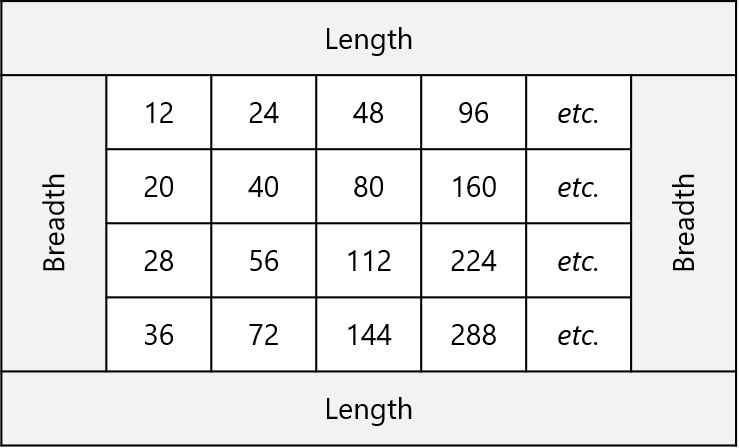
Here in the breadth, if three terms are taken, as for instance 12, 20, and 28, the sum of the extremes is double the middle term; for 12 + 28 = 40. Thus also 20 + 36 = 56 equal twice 28. But where there are two media, the sum of the extremes will be equal to the sum of the means. Thus 12 + 36 = 48 = 20 + 28. Thus also 24 + 72 = 96 = 40 + 56; and so of the other parts of the breadth. This however takes place according to the form of the evenly-odd number, in which, as we have before observed, this property is found.
Again, if we direct our attention to the length, where two terms have one medium, the product of the extremes is equal to the square of the medium or middle term2; for 12 × 48 = 576 = 24 × 24. Again, 24 × 96 = 2304 = 48 × 48. But where two terms include two media, the product of the extremes will be found to be equal to the product of the means. Thus 12 × 96 = 1152 = 24 × 48. And this is according to an imitation of and alliance with the evenly-even number, from the participation of which these numbers acquire this property. The same thing also takes place in the other rows of the length. Hence it is manifest that this number is produced from the two former numbers, because it invariably retains their properties.
Memory Work
Recite the points below until you are able to give the answer exactly, from memory, when asked the question.
- What are the two divisions of number?
The two divisions of number are the even and the odd. - What are the three divisions of the even number?
The three divisions of the even number are the evenly-even, evenly-odd, and oddly-odd. - What is the evenly-odd number?
The evenly-off number is the even number that receives a section into equal parts, but the parts of it immediately become indivisible. - How are the evenly-odd numbers generated?
All numbers produced by multiplying odd numbers by 2 are evenly-odd numbers. - What is the unevenly-even number?
The unevenly-even number is that which may be divided into equal parts, and each of these into other equal parts, and some times the parts of these parts may again be divided, but this equable division does not proceed as far as to unity. - How are the unevenly-even numbers produced?
The unevenly-even numbers are produced by multiplying the natural odd numbers by numbers in the double ratio from 4.
Assessment
Use the following comprehension questions to guide you through the study of this lesson.
