
Every Toddler Is a Gift from God
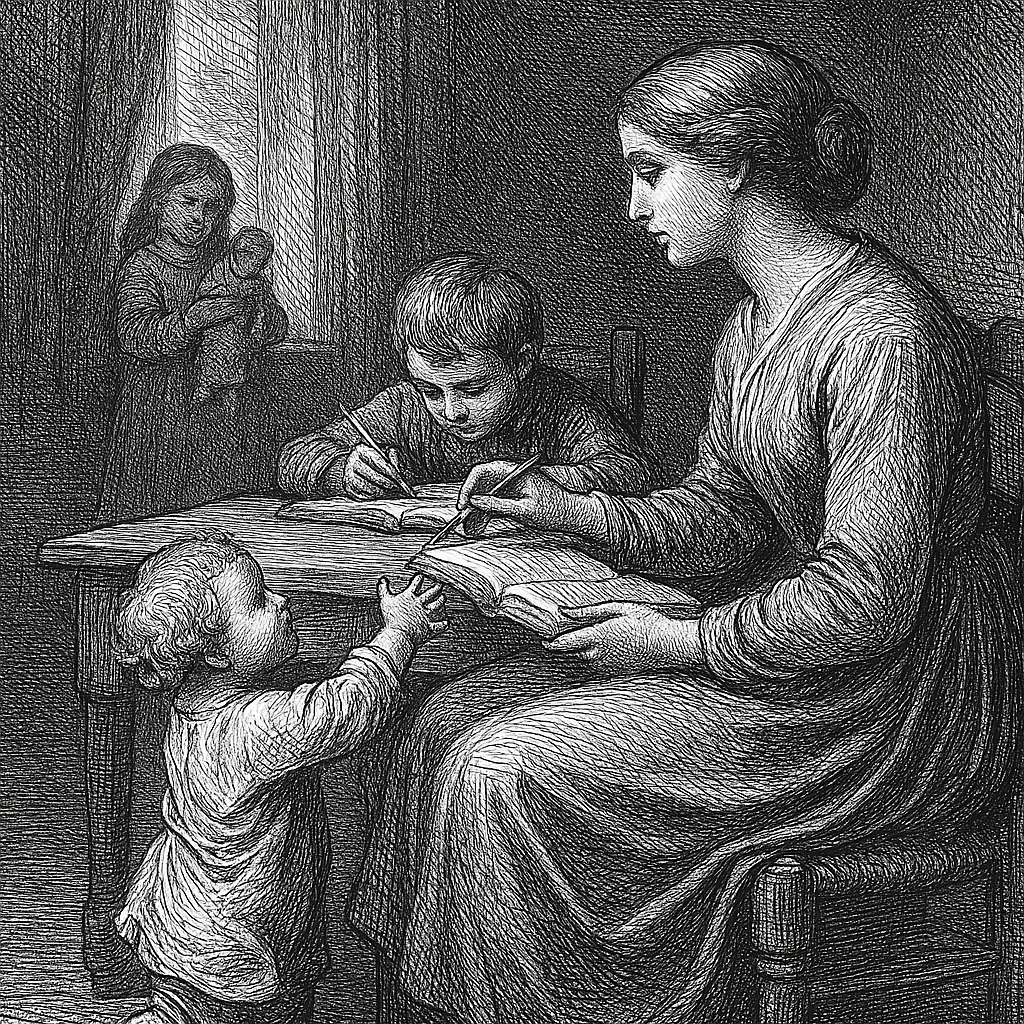
God gives children to families as blessings, not burdens. A toddler is not an interruption to the homeschool day, but a soul entrusted to you for care and formation. In the Classical Liberal Arts Academy, we teach mothers to educate their children in the same spirit that guided the great saints: with love, discipline, and order. This includes the youngest members of the household.
Caring for toddlers while homeschooling is possible. With wisdom and consistency, a mother can create a home where toddlers thrive, older children learn, and God is glorified. To help with this, we offer four guiding principles:
- Keep them safe
- Teach school readiness skills
- Teach them to be useful
- Teach them to pray
These principles help a mother form her toddler’s heart, will, and habits even before formal studies begin.
First: Keep the Toddler Safe and Secure
Safety Must Come Before School
The first and most urgent duty is to keep your toddler safe. This includes physical safety and emotional security.
Physically, toddlers explore everything. They climb, reach, open, dump, and chew. Their judgment is undeveloped. Because of this, the homeschool environment must be guarded carefully. Use child locks, gates, and outlet covers. Store school supplies like scissors and pens out of reach. Designate a safe space nearby where the toddler can play freely while remaining within sight.
Emotionally, toddlers also need order and predictability. If their day feels chaotic, they may cry, cling, or disrupt the school day. A regular daily rhythm helps them feel secure. For example, in the schedule recommended for CLAA families, a three-year-old can begin the day at 7:00 with dressing and chores, join in Morning Prayer with the family, and proceed through a regular cycle of play, rest, and meals. This rhythm fosters peace in the child’s heart.
As St. Augustine teaches, peace is the tranquility of order. The orderly care of a toddler builds that peace, both in the child and in the home.
The Mother Must Remain Watchful
You are both teacher and mother. Therefore, your eyes and ears must attend to both needs at once. During lessons, check on the toddler often. If they play nearby, glance up regularly. Most accidents happen silently. By remaining alert, you prevent many troubles before they begin.
This attentiveness is an act of love. Jesus teaches us to watch over the little ones. In the Gospel, He says, “See that you do not despise one of these little ones, for I say to you that their angels in heaven always look upon the face of my heavenly Father” (Matt. 18:10, NAB). Your toddler’s guardian angel stands before God, and you are that angel’s earthly companion.
Second: Teach School Readiness Through Habit and Imitation
Toddlers Are Already Learning
School readiness begins before school. A toddler learns through touch, sound, repetition, and imitation. Everything they see you do becomes a lesson. If you speak gently, they learn peace. If you tidy after lunch, they learn order. If you pray aloud, they learn reverence.
The CLAA toddler schedule includes learning tasks suited to their development. For example, at 9:30, the toddler can work on “Petty School Reading.” This does not need to be a formal time of study, but a time to sit with an older child and watch one of Mr. Michael’s Petty School Reading videos. Afterwards, a few minutes can be spent learning one of the memory work questions included with the lesson or practicing saying the vowel and consonant blends on their fingers. At 10:30, the child can work on “Petty School Writing,” and begin learning to trace letters with help. These moments foster early motor skills and the ability to sit and focus for more extended periods.
St. Thomas Aquinas writes that “man is perfected by habits” (Summa Theologica). The toddler who sits, listens, and imitates develops the habits that prepare him for Petty School courses and beyond.
A Toddler Can Participate in Family Study
Allow the toddler to sit at the table, or a smaller toddler table in the same room, during school time. You may want to create a “school box”, which you can prepare in the morning. It can include coloring pages, lacing cards, a wood puzzle, and other self-correcting learning games. Limit the activities to one at a time to prevent him from getting overwhelmed and taking out more than he can put away by himself. Encourage him: “You’re working hard like your big sister.” If he wanders off after a few minutes, that is fine. Praise effort, not endurance.
Read alouds also train the mind. Share picture books or saint stories before nap time. Repeat favorite rhymes. Toddlers delight in rhythm and repetition. As Proverbs teaches, “Train the young in the way they should go; even when old, they will not swerve from it” (Prov. 22:6, NAB).
Your toddler is learning even when it seems like play. Their little brain is practicing attention, memory, and self-control—qualities needed for future study.
Third: Teach Them to Be Useful in the Home
Toddlers Love to Help
Toddlers are drawn to work. They want to stir, carry, wipe, and sweep. This desire to imitate can be used to teach responsibility.
Assign small tasks suited to their strength. Let them put napkins on the table, throw away a diaper, or carry a clean towel to the bathroom. These jobs matter. They train the toddler’s will to love duty.
In the sample schedule, toddlers perform simple chores in the morning and again before dinner. This routine teaches them that everyone contributes to the household. Even toddlers can have a vocation of service.
As Aristotle writes, “The purpose of education is to make the pupil like and dislike what he ought.” By praising helpfulness and correcting laziness, a mother helps her toddler form the right affections.
Begin Training in Obedience
Toddlers must be taught to obey promptly and cheerfully. This is not harshness. It is formation. The child who learns to obey Mama now will later obey God, the Church, and his teachers.
Use simple commands like, “Come here,” or “Sit on the rug.” Say them once and expect a response. Praise the child when he obeys. If he disobeys, correct him firmly and with love.
St. Augustine reminds us that “obedience is the mother of all virtues.” A toddler who practices obedience early gains strength of will. Later, when school becomes difficult, he will already know how to choose the good.
Fourth: Teach Them to Pray and Love God
A Toddler’s Soul Is Open to God
Even before they can speak clearly, toddlers can begin to pray. Teach them to make the Sign of the Cross. Pray short phrases with them: “Jesus, I love You.” “Mary, pray for me.” “God, thank You for this day.”
In the CLAA family schedule, toddlers join Morning Prayer, the Angelus, the Rosary, and Evening Prayer. They may not sit perfectly still, but their presence matters. Let them kneel beside you, hold a soft rosary, or kiss a holy card. This forms their body in reverence, which prepares the soul for faith.
The Catechism tells us, “Education in the faith by the parents should begin in the child’s earliest years” (CCC 2226). Every prayer, every holy image, every hymn becomes a seed planted in the child’s heart.
Teach Them Stillness and Reverence
Start with one minute of quiet during prayer time. Sit with the toddler on your lap and say, “Let’s be still for Jesus.” Praise them afterward. Over time, increase the quiet time.
Display holy images at toddler height. Play Gregorian chant during playtime. The Classical Catholic Radio Station is perfect for this. Let them light the candle for family prayer or ring the bell. All of this teaches them that God is real, and He is near.
Jesus said, “Let the children come to me, and do not prevent them; for the kingdom of heaven belongs to such as these” (Matt. 19:14, NAB). When you teach a toddler to pray, you bring him to Jesus.
Bringing It All Together: A Day in the Life of a Catholic Toddler
Here is an example schedule for a three-year-old:
- 7:00 AM – Wake, dress, chores with siblings
- 8:00 AM – Join family for Morning Prayer
- 8:30 AM – Eat snack, sit nearby as school begins
- 9:30 AM – Petty School Reading
- 10:00 AM – Puzzles and tabletop play
- 10:30 AM – Petty School Writing
- 11:00 AM – Free play: blocks, cars
- 12:00 PM – Angelus and Bible time with family
- 12:30 PM – Lunch
- 1:00 PM – Nap
- 2:30 PM – Petty School Arithmetic
- 3:00 PM – Aesop’s Fables: Listening and drawing
- 3:30 PM – Rosary with family
- 4:00 PM – Outdoor play
- 5:00 PM – Chores with family
- 6:00 PM – Evening Prayer
- 6:30 PM – Dinner
- 7:00 PM – Bedtime
This rhythm offers balance: prayer, play, work, rest. With patience and consistency, it becomes the framework for a peaceful home and a well-formed child.
Conclusion: The Mother’s Work Is Holy
Caring for toddlers during the homeschool day is not a distraction from your work—it is part of your work. Every snack served, every toy picked up, every tear dried is a spiritual act. When done with love, it becomes prayer.
Jesus taught that “whoever receives one child such as this in my name receives me” (Matt. 18:5, NAB). When you serve your toddler, you serve Christ.
By keeping them safe, training them in learning, teaching them to help, and leading them to prayer, you prepare them not just for school, but for heaven.
Let every Catholic mother be encouraged. The Lord sees your labors, and they are not in vain.
Mrs. Dania C. Michael, O.P.
Homeschool Support
Classical Liberal Arts Academy
Notes
Catechism of the Catholic Church. Vatican: Libreria Editrice Vaticana, 1993. https://www.vatican.va/archive/ENG0015/_INDEX.HTM
New American Bible, Revised Edition. United States Conference of Catholic Bishops. https://bible.usccb.org/
Aquinas, Thomas. Summa Theologica. Translated by Fathers of the English Dominican Province. https://www.newadvent.org/summa/
Augustine. Confessions and City of God. Translated by Henry Bettenson. Penguin Books, 2003. https://ccel.org/ccel/augustine
Aristotle. Nicomachean Ethics. Translated by W. D. Ross. https://classics.mit.edu/Aristotle/nicomachaen.html
Holy Bible. Proverbs and Gospels referenced from NABRE. https://bible.usccb.org/bible
