
1. OBJECTS.
1. We have five senses: seeing, hearing, feeling, tasting, and smelling.
When we see, feel, taste, or smell things, or hear sounds, we are said to perceive them.
I drop a book upon the floor. A force, called gravitation, draws it toward the center of the earth. We can not perceive this force, but we are conscious of it, — that is, we know such a force must exist.
We are conscious of many other things that we can not perceive; as, love, hatred, joy, sorrow.
All these things are called objects. What, then, is an object?
2. An Object is any thing we can perceive, or of which we may be conscious.
When we think, we think of objects; when we talk, we talk about objects; when we write, we write about objects.
When we talk or write, we use ivords to express our thoughts. What, then, is a ivordf
3. A Word is a syllable, or a combination of syllables, used in the expression of thought.
Questions
- How many senses have we? Name them.
- Name some things that we can perceive.
- Name some things that we can not perceive, but of which we may be conscious.
- What is an object?
- What is a word?
2. DEFINITIONS.
1. Language is the expression of thought by means of words.
When we talk, we express our ideas by spoken words. This is called Spoken Language.
2. Spoken Language is the expression of ideas by the voice.
When we write or print our thoughts, we use letters which represent sounds. This is called Written Language.
3. Written Language is the expression of thought by the use of written or printed characters.
4. Grammar treats of the principles and usages of language.
5. English Grammar teaches how to speak and write the English language correctly.
Questions
- What is language?
- What is Spoken language?
- What is Written language?
- What is Grammar?
- What is English Grammar?
3. THE SENTENCE.
What is the color of chalk? It is white.
Chalk breaks easily: is it tough or brittle? It is brittle.
We can not see through it: hence we say it is opaque.
We will join the words white, brittle, and opaque with the word chalk, thus:
Chalk is white. Chalk is brittle. Chalk is opaque.
Each of these groups of words makes complete sense, and is called a Sentence.
1. A Sentence is a group of words making complete sense.
Each group is also called a Proposition.
2. A Proposition is a thought expressed in words.
In writing sentences, observe the following directions:
- Begin each sentence with a capital letter.
- Spell each word correctly.
- Place a period [.] at the end of every sentence that declares something, or makes a command.
- Place an interrogation point [?] at the end of every question.
- Never divide a syllable at the end of a line.
Questions
- What is a sentence?
- What is a proposition?
- Give the directions for writing sentences.
4. SENTENCE-MAKING
When I say, “The window is open,” I state a fact, using what is called a Declarative Sentence.
1. A Declarative Sentence is a sentence used in stating a fact.
When I say, “Is the window open?” I ask a question, using an Interrogative Sentence.
2. An Interrogative Sentence is a sentence used in asking a question.
Form declarative sentences out of the following words:
- Iceland, very, is, in, it, cold.
- Lesson, an, this, easy, is.
- June, cherries, in, ripe, are.
- Is, house, our, hill, the, under.
- Always, good, happy, are, scholars.
- Cap, river, into, the, fell, boy’s, red, little.
- Deep, our, is, lane, very, in, snow, the.
- Corn, spring, the, in, plants, farmer.
- Ice, the, smooth, when, I, skate, to, like, very, is.
Form interrogative sentences out of the following tvords :
- Lemons, where, grow, do.
- Is, sick, to-day, brother, John’s.
- Cold, it, very, was, yesterday.
- Aunt, does, the, toll-gate, live, your, beyond, river, the, over.
- Writing, exercise, is, pleasant, a, not.
- You, school, at, not, yester- day, were.
- Pick, white, I, this, may, rose.
Questions
- What is a declarative sentence ?
- What is an interrogative sentence?
- Repeat the directions to be observed in writing sentences.
When 1 say, “Clarence, open the window,” I make a com- mand; and when I say, “Do forgive me!” I express an entreaty. In each instance I use an Imperative sentence.
3. An Imperative Sentence is a sentence used in expressing a command or an entreaty.
When I say, “Oh, that window is open again!” I express some feeling or emotion, using an Exclamatory Sentence.
4. An Exclamatory Sentence is a sentence used in expressing some feeling or emotion.
An exclamation point (!) is usually placed after an exclamatory sentence.
Form imperative sentences out of the following words :
- Go, your, seats, to, boys.
- Home, go, once, at, Ponto.
- Me, your, lend, book, Jane.
- Minutes, lesson, ten, pupils, study, the.
- Question, Susan, this, answer.
- Skates, John, me, have/let, my.
- Book, put, shelf, the, on, the.
- Parents, obey, your, always.
- Team, into, the, drive, the, Jonas, barn.
Form exclamatory sentences out of the following words :
- Am, ha, ha, ha, I, it, of, glad.
- Clock, four, hark, strikes, the.
- Pretty, is, oh, she, how.
- Don’t, it, ugh, like, I.
- Alone, pshaw, me, let.
Tell the kinds of sentences in the following exercises :
- The winds bring perfume.
- Where is my new book?
- Go to the ant, thou sluggard!
- Pshaw, go away!
- Necessity is the mother of invention.
- Does God uniformly work in one way?
- Oh, how I trembled with disgust!
- Be not forward in the presence of your superiors.
- Lend me your wings! I mount! I fly!
Exercise:
Tell the kinds of sentences in your reading lessons. Change the form of these sentences from declarative to interrogative, etc.
Questions:
- What is an imperative sentence?
- What is an exclamatory sentence?
- What mark is usually placed after an exclamatory sentence?
5. QUOTATION MARKS
The man yawned, and said, “How sleepy I am!”
In this sentence, these marks ( ” ) are placed before the words that the man used, and these ( ” ) after them. They are called Quotation Marks.
Quotation Marks should be used, in writing, when we quote the exact language of another.
Such a quotation should begin with a capital letter.
When we state what another says, without using his exact language, the quotation marks should not be used. In this book, the answers supposed to be given by the pupils to the questions asked by the teacher, are usually not quoted.
Use quotation marks and capital letters properly in these sentences :
- Did your mother send you, said the merchant, gruffly.
- The general said, be ready to start at 5 A. M.
- Will you come into my parlor, said the spider to the fly.
- The pupils kept repeating, four times three are twelve, four times three are twelve, for at least three minutes.
Questions:
- When should quotation marks be used?
6. PARTS OF SPEECH.
“Scholars study.” What word is here used instead of the names of the persons of whom we are speaking?
“Scholars.”
What word tells what scholars do?
“Study.”
“Good scholars study.” What word here describes scholars?
“Good.”
“Good scholars study diligently.” What word here tells how good scholars study?
“Diligently.”
Words, then, not only have different meanings, but they are also used in different ways.
They can be divided into classes, according to their meaning and use. These classes are called Parts of Speech.
Parts of Speech are the classes into which words are divided according to their meaning and use.
It is necessary to know its meaning and use in order to determine to which class any word belongs.
Questions:
- What are parts of speech?
- What is necessary in order to determine the class to which any word belongs?
7. ORAL LESSON.
What are the words hoy, girl, city, door, window, book, desk? They are names of objects.
That is correct. They are the names of objects, not the objects themselves. Because each word is a name, it is called a Noun, which means a name.
1. A Noun is a name; as boy, John, railroad.
What are the words house, farm, garden, dog, horse, blacksmith, merchant?
They are nouns.
Why?
Because they are names.
What are the words Mary, John, Washington, Chicago, Ohio, America?
They are nouns.
Why?
Because they are names.
Can the name boy be applied to any boy in the school, or in the world? It can. It is a name, then, which is common to all boys; that is, it can be applied to each of them. So, also, the name girl is common to all girls; the name house, to all houses; the name city, to all cities. Objects of the same kind form what is called a class. The same name can be applied to any object belonging to a class. The names hoy, girl, house, and city are called Common Nouns, because they can be applied to any one of a class of objects.
2. A Common Noun is a name which may be ap- plied to any one of a class of objects ; as bird, door, lightning.
Can the name John be applied to all boys? It can not. Why? Because boys have different names, such as Charles, Frank, Samuel, Clarence. Why are boys called by different names? In order to distinguish one from another, or to dis- tinguish a particular boy from the rest of the boys in the school, or in the world.
Can the name city be applied to all cities? It can. Is the name Chicago applied to all cities? It is not. Why? Because it is the name of a particular city. That is correct; and the names given to particular objects to distinguish them from the rest of their class, are called Proper Nouns.
3. A Proper Noun is the name of some particular person, place, people, or thing; as, Susan, Rome, American, Mars.
What kind of noun is plow?
It is a common noun.
Why?
Because it can be applied to all plows.
What kind of noun is New York?
It is a proper noun.
Why?
It is the name of a particular city.
Remember: Proper nouns should commence with capital let- ters. A common noun should commence with a small letter, unless it is the first word of a sentence or is a word of special importance. The words / and 0 should always be capital letters.
Exercise:
- Write the names of five kinds of fruit.
- Write the names of five kinds of grain.
- Write the names of three articles of clothing.
- Write the names of five games.
- Write the names of five bad habits.
- Write the names of six farming implements.
- Writet the names of of four trades.
- Write the name of of six towns in your county.
- Write the names of of six large cities.
- Write the names of five large rivers.
- Write the names of five mountains.
- Write the name of seven of your classmates.
What are the words you have written? Why?
Which are common and which are proper nouns?
Exercise:
Tell which are common and which are proper nouns in the following list:
- Rain
- Snow
- College
- Augusta
- Palestine
- Barn
- Sarah
- Minute
- Volcano
- Black Sea
- Slate
- Organ
- Steeple
- Railroad
- Lake Erie
- April
- Boston
- Church
- Thunder
- Indianapolis
- Hour
- Lesson
- Temple
- Vesuvius
- Niagara Falls
Remember: Common nouns, when in a tabulated list of words as above, may begin with capital letters, just as if beginning a sentence.
Exercise:
Point out all the nouns in your reading lesson, and tell whieh are common and which are proper nouns, using the following model:
Model:
“Cicero was an orator.”
Cicero is a noun; (because) it is a name: proper; it is the name of a particular person.
Orator is a noun; (because) it is a name: common; it may be applied to any one of a class of objects.
Questions
- What is a noun?
- How many classes of nouns are there?
- What is a common noun? Give examples.
- What is a proper noun? Give examples.
- Which class should commence with capital letters?
- When should common nouns commence with capital letters?
8. Number
Does the word fan denote one object, or more than one? It denotes but one object. Does the word fans denote one object, or more than one? It denotes more than one object.
That is right. When a noun denotes but one object, it is said to be in the Singular Number.
1. The Singular Number denotes but one object.
When a noun denotes more than one object, it is said to be in the Plural Number.
2. The Plural Number denotes more than one object.
The last sound in the word fan readily unites with the sound represented by the letter s, and its plural is formed by adding s to the singular. The plural of any noun ending with a sound that will readily unite with the sound represented by s, is formed by adding s to the singular.
The plural of any word ending with a sound that will not readily unite with the sound represented by s, is formed by adding es to the singular, when the singular does not end with c; as, church, church-es ; mass, mass-es.
These are two ways of forming plurals. There are many other ways. Nouns ending in f or fe usually change these endings to ves; those ending in y, with a vowel before it, add s; those ending in y, with a consonant before it, change y to i and add es; those ending in o, with a consonant before it, add es. A few nouns are alike in both numbers; as, sheep, deer, trout, vermin. Letters, figures, marks, and signs add ‘s; as, b’s, 6’s, *’s, $’s.
Write the plurals of the following nouns.((The teacher should assist the pupil in writing the plurals of some of these words. They ought not to be required to remember and apply a large number of rules. The plural forms must be learned by practice in writing them.))
- Ox.
- City.
- Desk.
- Alley.
- Street.
- School.
- Girl.
- Fish.
- Koad.
- Child.
- House.
- Money.
- Boy.
- Man.
- Folly.
- Wind.
- Pencil.
- Wagon.
- Calf.
- Kose.
- Book.
- Knife.
- Vessel.
- Woman.
- Box.
- Plow.
- Chair.
- Fence.
- Potato.
- Monkey
Questions
- What does the singular number denote?
- What does the plural number denote?
- Mention some of the ways of forming the plural number.
9. ABBREVIATIONS.
“Dr. Vinton is a brother of Gen. Vinton, and the father of Mrs. Noble.”
In this sentence, the first word is Doctor; but in writing it the first and last letters only have been used. This is a short way of writing a word, and is called an Abbreviation.
The word General is also abbreviated, the first three letters only being used. In abbreviating the word Mistress, all the letters are omitted except the first, the fifth, and the last.
A period should be placed after an abbreviation.
Rem. Abbreviations generally begin with capital letters.
Write the following abbreviations and their equivalents:
- Esq. Esquire.
- Gov. Governor.
- Rev. Reverend.
- Hon. Honorable.
- Prof. Professor.
- Pres. President.
- Mrs. Mistress.
- Atty. Attorney.
- Capt. Captain.
- Supt. Superintendent.
Make the proper abbreviations in the following sentences:
- Major Whipple lives in Saint Louis.
- Moses Johnson, Esquire, is an uncle of Professor Collins.
- Lieutenant Wilson is a guest of Superintendent Furness.
- Doctor Metz lives on Wood Street, next door to Colonel Clark.
- Were Mister Jones and President Tappan in the city to-day?
II.
- Dr. = Doctor.
- Mr. = Mister.
- Cr. = Credit.
- St. Saint, or Street.
- Mt. = Mount.
- Col. = Colonel.
- Gen. = General.
- Maj. = Major.
- Lieut. = Lieutenant.
- Co. = Cgmpany.
N.B. Wm. Smith, Esq, lives in Utica, N. Y.
In this sentence, the first two letters, “N.B,” are the initials, or first letters, of the Latin words Nota bene, and are equivalent to take notice. “N.Y.” is the abbreviation for New York, the first letters of each word being used.
Write the following abbreviations and their equivalents :
- P. M. = Afternoon.
- A. D. = In the year of our Lord.
- C.O.D. = Collect on Delivery.
- A.M. = Forenoon.
- B.C. = Before Christ.
- U.S. = United States.
- M.C. = Member of Congress
- M.D. = Doctor of Medicine.
- P.O. = Post Office.
- P.S. = Postscript.
- R.R. = Railroad.
- M. = Noon.
- Bbl. = Barrel.
- Lb. = Pound.
- No. = Number.
- Ult. = The last month.
- Prox. = The next month
- Admr. = Administrator.
- Write the abbreviations for the days of the week.
- Write the abbreviations for the months of the year.
- Write the abbreviations for the States of the Union.
The abbreviations for weights and measures, as well as ult., and prox., should begin with small letters, unless they stand alone, or at the beginning of sentences. In some cases, small letters may be used as the abbreviations for forenoon and afternoon.
Make the proper abbreviations in the following sentences :
- Take notice. — The train will leave at 3 o’clock in the afternoon.
- Samuel Fish, Member of Congress, has removed to Buffalo, New York.
- Send the books to Joel Elkins, Master of Arts, and collect on delivery.
- My father left for Europe on the seventh day of the last month.
- Send me four barrels of flour this forenoon.
- I will pay you on the sixth day of the next month.
Questions.
- What is an abbreviation?
- How are periods and capitals used in connection with abbreviations?
10. CONTRACTIONS.
“Don’t fail to come.” In writing or printing do nt, a mark ( ‘ ) is used between n and t. It is called an Apostrophe. In an abbreviation or contraction like this, it shows that one or more letters are omitted.
Tell what letters are omitted in the contracted words in these sen- tences :
1. We’re going home. 2. We’ll not go with you. 3. I didn’t know that you told ’em not to go. 4. I’ll help you as soon as I ‘ve learned my lesson. 5. We came from o’er the sea. 6. They ‘re both truants. 7. The corporal said, ‘”Bout face.”
11. ELEMENTS OF A SENTENCE.
In the sentence, “Chalk is white,” chalk is called the Sub- ject, for it is that about which something is said, or affirmed.
1. The Subject of a proposition is that of which something is affirmed.
White is called the Predicate, for it is that which is affirmed of the subject chalk.
2. The Predicate of a proposition is that which is affirmed of the subject.
Is is called the Copula, for it is used to join the predicate to the subject, and the word copula means a link. The copula also affirms that the predicate belongs to the subject. It is sometimes a group of words; as, will be, shall have been, etc.
3. The Copula is a word, or group of words, used to join a predicate to a subject, and to make an assertion.
In the sentence, “Ice is cold,” what is the subject? “Ice.” Why? Because it is that of which something is affirmed. What is the predicate? “Cold.” Why? Because it is that which is affirmed of the subject. What is the copula? “Is.” Why? Because it is the word used to assert the predicate cold of the subject ice. Why is it called the copula? Because it links or joins the predicate to the subject.
Point out the subject, predicate, and copula in each of the following sentences :
- Air is transparent.
- Iron is heavy.
- Nero was cruel.
- Jane has been studious.
- Walter will be tardy.
- Mary should be kind.
- Ellen is unhappy.
- Martha was cheerful.
- George should have been industrious.
Point out the nouns in these sentences, and tell which are common and which are proper nouns.
Questions
- What is the subject of a proposition?
- The predicate?
- The copula?
- What does the word copula mean?
12. THE PREDICATE.
In the sentence, “Man is mortal,” the predicate mortal denotes a quality belonging to the subject man. Words which express qualities may be called quality-words.
Nouns may be used as predicates. When they are thus used, they denote kind or class.
In the sentence, “Horses are animals,” what is the subject?
“Horses.”
Why?
What is the predicate?
“Animals.”
Why?
What does the word animals denote?
It denotes the kind or class of beings to which horses belong.
What part of speech is it?
It is a noun.
Why?
What is the copula?
“Are.”
Affirm qualities of the following subjects:
- Iron
- Trees
- Fishes
- Oranges
- Play
- Books
- Apples
- Marbles
- Lead
- School Flowers Swimming
Model: Oranges are yellow..
Affirm the following qualities of appropriate subjects:
soft. hard. young. opaque.
wise. sweet. happy. mellow.
blue. round. square. transparent.
Model: Sugar is sweet.
Affirm hind or class of the following subjects:
Gold Oxen Sheep Wheat
Corn River Eagles Houses
Coats Silver Tables Wagons
Model. — Eagles are birds.
Questions.— What are quality-words? Can they be used as predi- cates? Give example. Give an example of a noun used as a predicate.
ELEMENTS. 21
13. ELEMENTS.
We have seen that a sentence is composed of parts. These parts are called Elements.
1. An Element is one of the distinct parts of a sentence.
2. The Subject and the Predicate are called Principal Elements, because no sentence can be formed without them. All other distinct parts of a sentence are called Subordinate Elements. The Copula is not called an element.
3. Analysis is the separation of a sentence into its elements. Any sentence can be so separated.
Analyze the following sentences, using this
MODEL.
“Iron is heavy.”
This is a sentence; it is a group of words making complete sense: declarative; it states a fact,
Iron is the subject; it is that of which something is affirmed: heavy is the predicate; it is that which is affirmed of the sub- ject: is is the copula; it joins the predicate to the subject.
is Iron heavv.
1. Indigo is blue. 2. Flies are insects. 3. Mary was tardy. 4. Boys will be playful. 5. Children should be careful. 6. Men may be imprudent. 7. John can be studious. 8. Roses are fragrant. 9. Julius should be diligent.
Point out the common and proper nouns in the above sentences.
Questions.— What is an element? What are the principal elements? Subordinate elements? What is analysis?
22
ELEMENTARY GRAMMAR.
14. COMPOSITION.
;\\V\
i.
Note.— The answers to the questions in this and similar exercises, should first be given orally, and then written on slates or slips of paper. The first answer should begin with the words, “I see.”
Look at the picture, and answer the following questions:
1. What do you see in this picture?
2. What are the boy and the girl doing?
3. Where is the bird’s nest?
4. Where is the bird?
5. Do you think the children will rob the nest? Head what has been ‘written.
COMPOSITION.
23
■S0£X/?0.^4
HA Hit?
II,
1. What do you see in this picture?
2. What is the dog doing?
3. How many rats has he killed already?
4. What are the rats trying to do?
5. Will the dog catch the one that is trying to climb the broom? Why?
6. Where do rats live?
7. What harm do they do?
Mead what has been written.
Note. — Select other pictures, and ask questions concerning what is to be seen in them. Should a painting or chrorno be used, call attention to the different colors; write their names, and compare them with similarly colored objects in the school-room — such as articles of dress, flowers, etc. This exercise may be used, with profit, at intervals during several years of school life; and it should not be dispensed with until pupils can use pictures, in composition work, without the assistance of a teacher.
24 ELEMENTAKY GKAMMAR.
THE TEEB
15. ORAL LESSON.
In the sentence, “Fishes swim,” what is the subject? “Fishes.” Why? What is the predicate? “Swim.” Why? Is there any copula expressed? There is not.
The predicate, then, can be affirmed of the subject directly; one word expressing both the copula and the predicate.
A word which can be used to affirm something of a sub- ject, is called a Verb. It usually expresses action, being, or state; as, I run, denotes action; I am, denotes being; I sleep, denotes state.
A Verb is a word which expresses action, being, or state; as, George writes, I am, he dreams.
What is the word “trot” in the sentence, “Horses trot?” It is a verb. Why? Because it affirms action of the subject “horses.”
What is the word “stand” in the sentence “Houses stand?” It is a verb. Why? Because it affirms state of the subject “houses.”
Write sentences, using the following verbs as predicates :
sail. look. loiter. whine.
pur. limp. listen. cackle.
run. mow. study. gobble.
sing. howl. neigh. reform.
play. walk. stand. scream.
reap. — — work. recite. whistle.
Model. — Birds sing. Point out all the verbs in your reading lesson.
Questions.— What is a verb? What does it usually express? Give the directions for writing sentences. (See page 9.) •
16. CLASSES OF VERBS
In the sentence, “Boys study grammar,” the word “grammar” is required to complete the meaning of the predicate “study.” That which tells what the boys study, completes its meaning, and is called an Objective Element, or Object.
1. An Objective Element is a word, or group of words, which completes the meaning of a verb.
Those verbs which require the addition of an object to complete their meaning, are called Transitive Verbs.
2. A Transitive Verb requires the addition of an object to complete its meaning.
Ex. — ” Columbus discovered America.” The verb ” discov- ered” requires the addition of some word, as “America,” to complete its meaning, and is, therefore, transitive.
Rem. — The object of a transitive verb is not always ex- pressed; but some word different from the subject can always be made its object.
In the sentence, ” Clarence walks,” no word is required to complete the meaning of the verb “walks.” Those verbs which do not require the addition of an object to complete their meaning are called Intransitive Verbs.
3. An Intransitive Verb does not require the addition of an object to complete its meaning.
Ex. — “Horses run.” The verb “run” does not require the addition of an object to complete its meaning. It is, there- fore, intransitive.
Rem. — Some verbs are transitive in one sense arid intransi- tive in another sense. To determine whether a verb can be used both transitively and intransitively consult a dictionary.
The copula is always a verb.
4. A Copulative Verb is used to join a predicate to a subject, and to make an assertion.
Ex. — “Lambs are playful.” The verb “are” is used to join the predicate “playful” to the subject “lambs.” It is, there- fore, a copulative verb.
Write seven sentences containing transitive verbs.
Model.-— John struck James.
Write seven sentences containing intransitive verbs.
Models. — Houses stand. Boys swim.
Write seven sentences containing copulative verbs.
Model. — The weather was warm.
Write sentences, using the following nouns as objective elements :
cars. — : — grass. books. churches.
laws. wood. wheat. elephants.
lions. boats. letters. geography.
trees. debts. pictures. mountains.
Model. — Fire burns wood.
Analyze the following sentences, using this
MODEL.
” Scholars learn lessons,”
This is a sentence; (why?): declarative; (why?). Scholars is the subject; (why?): learn is the predicate; (why?). “Learn” is modified by lessons, an objective element.
Scholars learn lessons.
‘ i r
1. Dogs hunt rabbits. 2. Jane studies botany. 3. Eli drives horses. 4. Horses draw wagons. 5. Men build houses. 6. Farmers sow grain. 7. Merchants sell goods. 8. Haste makes waste. 9. Soldiers fight battles. 10. Cats catch mice.
CAUTIONS. 27
Point out the verbs in the following sentences, using these
MODELS.
I. “The nights are chilly.”
Are is a verb; it denotes being: copulative; it is used to assert the predicate of the subject.
IT. ” Corn grows.”
Grows is a verb; (why?): intransitive; it does not require an object to complete its meaning.
III. ” Horses draw wagons.”
Draw is a verb; (why?): transitive; it requires an object to complete its meaning.
- Viola blushed.
- Stephen was a martyr.
- Boys may be useful.
- Merchants sell goods.
- Mechanics build houses.
- Fishes swim.
- James is sick.
- John should be careful.
- Dogs kill sheep.
- Henry struck William.
Point out the nouns in these sentences, and tell which are common and which are proper nouns.
Questions
- What is an objective element?
- A transitive verb?
- An intransitive verb?
- A copulative verb?
- Is the object of a transitive verb always expressed?
- Give a sentence in which it is not expressed.
17. INCORRECT LANGUAGE.
Caution I. Do not use saw for seen, or went for gone, after has, have, has been, or have been.
Exercises:
- I have saw a fine horse to-day.
- The little boy has went into the woods.
- George has went there several times.
- Have you saw Mr. Olds to-day?
Caution II. Do not use see or seen for saw in ex- pressing past time.
Exercises:
- Hiram see a flock of wild turkeys yesterday.
- I seen a dog running after a fox.
- I know John was whispering; I seen him.
- It is the largest peach I ever see.
Caution III. Do not use done for did, or come for came, in expressing past time.
Exercises:
- He done his work well yesterday.
- My father come home last week.
- I done my task before Eli come.
Caution IV. — Do not use is, was, or has been as the copula or predicate of a sentence whose subject denotes more than one object.
Exercises:
- The horse and the cow is in the stable.
- Weasels was plenty around there.
- Eliza and Sarah has been here.
- We was very much surprised.
- Are you sure that they was there?
Caution V. Do not use was for were as the copula or predicate of a sentence whose subject is you.
Exercises:
- You was there, we know.
- Perhaps you was trying to hide somewhere.
18. SENTENCE-MAKING
In the sentence, “John and Silas went to town,” two words are used as the subject — what are they? John and Silas. In the sentence, ” John, Silas, and Ezra went to town,” how many nouns are used as the subject? Three — John, Silas, and Ezra.
Observe that in the first sentence the two nouns used as the subject are joined by the word and. There is no comma ( , ) after the first word. Observe, also, that in the second sentence, there is a comma after the first two* nouns — John and Silas.
When several words are used in the same way, they are said to be of the same kind, or rank, and they form what is called a series. When more than twTo words are thus used to form a series, they should be separated by commas. Write the following rules for punctuation on your slates, and commit them to memory:
Rule I. Three or more words of the same kind, or rank, used together, should be separated by commas.
Rule II. Two words of the same kind, or rank, used together, are not usually separated by commas, but are connected by and, or, or some similar word.
Remember: When two words of the same rank, used together, are not connected by and, or, or some similar word, they are usually separated by commas.
Arrange the following words into sentences :
- Houses, mills, build, and, bridges, mechanics.
- Kaise, wheat, corn, farmers, barley, and.
- In, oranges, West Indies, lemons, grow, the, and, pine-apples.
- Metals, gold, are, silver, precious, and.
- Mary, Susan, cousins, are, Ada, and.
- New York, cities, and, large, Philadelphia, are, San Francisco.
Note. In writing these sentences, observe carefully the directions given in the two rules for the use of the comma.
Fill the blanks in the following exercises:
- I have _____ _____ _____ in my desk.
- _____ _____ _____ _____ are wild animals.
- A merchant sells _____ _____ _____ _____ .
- I can buy _____ _____ _____ _____ of a grocer.
- Have you seen _____ _____ _____ _____ ?
- _____ _____ _____ are _____ in Colorado.
- I can see _____ _____ _____ from my window.
- Violets _____ _____ _____ are _____ flowers.
- _____ and four and _____ and six equal _____ .
19. COMPOSITION.
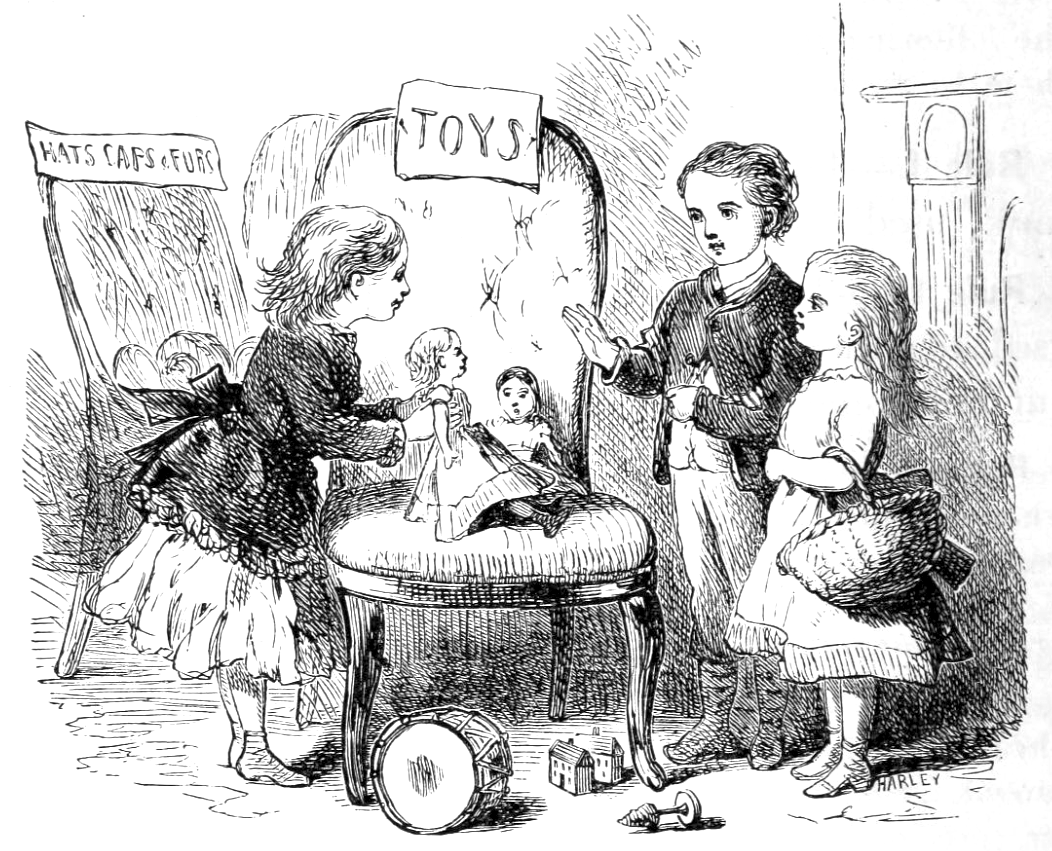
Tell what these children are doing. Give them names. Tell whether the two standing together are at home, or at the home of the little girl holding the doll.
Tell how old you think the little girl is that has a basket on her arm. How much older is the little boy?
Write a story about three children that played at keeping shop one afternoon.
Write a story about a brother and a sister that spent a day with their cousin, who lived in the country. Tell what games they played.
Write a story about three little girls that were left alone at home one afternoon. Tell how they spent the afternoon, what books they read, what games they played, etc.
Write a description of your play-house at home. Tell how large it is, and what playthings are in it.
THE ADJECTIVE. 31
THE ADJECTIVE
20. ORAL LESSON.
When quality-words are joined to nouns by copulas, they are said to be predicated of those nouns.
They may be written or printed in connection with nouns, without being joined to them by copulas; thus: white chalk, sour apples, a square table, good boys.
When thus used, they describe or restrict the meaning of nouns, but are not predicated of them.
Words that do not express quality may be used as modi- fiers of nouns. In the sentences, “This book is heavy,” “That book is light,” “Two boys were sick,” “Three boys were idle,” the words, this, that, two, and three, are modifiers of the nouns that follow them; but they do not express any quality. This and that point out the nouns to which they belong; two and three denote number.
Those words which modify nouns by expressing quality, pointing them out, or denoting number, are called Adjectives.
1. An Adjective is a word used to describe or define a noun.
2. There are two classes of Adjectives: Descriptive and Definitive.
All quality- words are Descriptive Adjectives.
3. A Descriptive Adjective describes a noun by ex- pressing some quality belonging to it; as, good, white.
Pointing-out words and number-words are Definitive Adjec- tives.
4. A Definitive Adjective limits or defines a noun without expressing any of its qualities; as; this, few.
32
ELEMENTAKY GRAMMAR.
Rem. — Most adjectives derived from proper nouns, should commence with capitals; as, American cotton, French customs.
Place each of the following adjectives before a noun:
Dry Bad Soft Good
Dirty Light Moist Warm
Rough Round Square Smooth
Spanish Healthy Pleasant Australian
Models. — Smooth ice. Clean hands.
What kind of adjectives are these? Why?
Place each of the following adjectives before a noun:
That Four Such Each
Some Many These Those
Latter Either Certain Sundry
Yonder Neither Another Fourfold
Models. — Much money. Sundry books. What kind of adjectives are these? Why?
Point out the adjectives in the following sentences, using this
MODEL.
” Fearful storms sweep over these islands.”
Fearful is an adjective; it is a word which modifies the mean- ing of a noun : descriptive ; it denotes a quality. These is an adjective; definitive; it defines without denoting any quality.
1. Both horses are lame. 2. Ripe peaches are plentiful. 3. Large houses are expensive. 4. You may take either road. 5. That boy has a kind father. 6. Every man carried a square box. 7. This lesson is hard. 8. The brave soldier received a severe wound. 9. That large cat caught this beautiful bird. Point out the nouns and verbs in the above sentences. Point out the adjectives in your reading lesson.
Questions.— What is an adjective? A descriptive adjective? A de- finitive adjective? What adjectives should commence.with capitals?
THE ARTICLE. 33
THE AETICLE
21. ORAL LESSON.
When we say, UA horse was stolen,” a denotes that one horse is meant, but it does not point out any particular horse. . When we say uThe horse was stolen,” the denotes that a particular horse is meant.
The words uAn and “The” in these sentences, are definitive adjectives, because they limit nouns without denoting any of their qualities. They are also called Articles.
A and an are different forms of the same word. A is used when the following words begin with a subvocal or aspirate; an, when the following word begins with a vocal.
1. The is called the Definite Article, because it points out definitely the object which it restricts.
2. A or An is called the Indefinite Article, because it restricts in an indefinite or general manner.
Place a or an before the following words, and tell wJiy it should be used :
egg. hour. hearth. memory.
ode. eagle. humor. measure.
■’©
cart. stand. orange. opossum.
goat. — house. turkey. elephant.
. oven. honor. vulture. advantage.
Use a or an instead of the da sites in the following sentences, and tell wliy it should be used:
1. Temperance is — virtue. 2. The house stands on —
hill. 3. — loud report was heard. 4. Life is but — vapor.
5. He is — honest man. 6. He has — ax to grind. 7. Father
has bought — horse. 8. My being — child, was — plea for
my admission. . El. Gr.— 3.
34 ELEMENTARY GRAMMAR.
Use the proper articles instead of the dashes in the following sen- tences :
1. Such — law is — disgrace to any state. 2. Repeat — first four lines in concert. 3. Love took up — harp of life, and smote on all — chords with might. 4. — fox is cunning. 5. — days are calm. 6. — wise son maketh — glad father.
Point out the articles in your reading lesson, using this
MODEL.
“The man was riding in a wagon.”
The is a definite article; it points out definitely the object which it restricts. A is an indefinite article; it restricts in an indefinite or general manner.
Questions.— What words are called articles? Which is the definite article? The indefinite article? When is a used? When is an used?
22. SENTENCE-MAKING. I.
Write sentences containing the following words, supplying words, ‘where necessary, to make complete sense:
1. Flowers, the, garden. 2. Fishes, sea. 3. Nests, birds. 4. Winter, go, robins, where. 5. Quarts, how, gallon. 6. Five, thirty. 7. Columbus, Ohio. 8. Lion, man, the. 9. Let, book, me. 10. Dog, that, cross, is, ugly, and. 11. I, in, large, live, a, roomy, house, brick. 12. Col. Smith, prudent, man, brave, and, honorable, a, is. 13. Sugar, grocer, soap, coffee, a, sells
Fill the blanks in these exercises, carefully choosing words,
1. America.
2. San Francisco California.
3. in the winter.
4. I have lesson.
5. when the ice is smooth.
6. Where do the birds ?
CAUTIONS. 35
II.
In the sentence, “I saw a little old man,” little and old are adjectives, but they are not separated by commas. The ex- pression old man is modified by little, and not the noun man only. When an adjective and a noun form a single expres- sion in this way, the adjective is not separated by a comma from another adjective placed before it.
Punctuate the following sentences properly :
1. The kind old man took the poor child in his arms. 2. Plain honest truth wants no artificial covering. 3. Mary is a gentle sensible and well-behaved girl. 4. The good man was loved esteemed and respected. 5. His large old-fashioned spectacles frightened the child. 6. That little mischievous boy is my nephew.
23. INCORRECT LANGUAGE.
Caution I. — Do not use a before vocal sounds, or an before sub vocals and aspirates.
Ex. — 1. An hundred cents make one dollar. 2. There should be an universal rejoicing. 3. This is a open country. 4. Henry is a honest lad.
Caution II. — Do not use these or those before a noun in the singular number.
Ex. — 1. I do n’t like these kind of apples. 2. These sort of people are good neighbors. 3. Those yoke of oxen belong to me.
Caution III. — Do not use them for those; this here for this; or that ‘ere for that.
Ex. — 1. Look at them tramps. 2. Do you live in this here house? 3. That ‘ere girl is not very handsome.
36
ELEMENTARY GRAMMAR
24. COMPOSITION.
Jff^
What do you see in this picture? What can be seen through the window? Is the storm approaching the house where the girl is, or has it passed it? Why do you think so? Does the picture represent a morning or an evening scene?
Write a description of the prominent objects to be seen from the door of the school-house — also, a description of any thing that may occur wThile you are looking at these objects.
Describe what may be seen through the windows and doors of the sitting-room and parlor at home.
Describe what may be seen from various places near your home — also, what may have occurred during your visits to those places.
THE PARTICIPLE. 37
THE PARTICIPLE.
25. ORAL LESSON.
“James saw the man plowing.”
What is the subject of this sentence? Why? What is the predicate? Why? What is the objective element? Why? What words limit or restrict “man”? The words “the” and “plowing.” What does the word “plowing” denote? It tells what the man was doing. Does it affirm any thing of man? It does not: it modifies it like an adjective.
The word “plowing/’ then, partakes of the properties of both a verb and an adjective. Like a verb, it expresses ac- tion : like an adjective, it modifies a noun. Because it par- takes of the properties of two parts of speech, it is called a Participle, which means partaking of.
1. A Participle is a word derived from a verb, par- taking of the properties of a verb, and of an adjective or a noun.
When we say, “The boy is writing’1 the participle “writ- ing” denotes a continuance of the act: the boy is continuing to ivrite.
When we say, “The letter is written” the participle “writ- ten” denotes a completion of the act: the writing of the letter is finished.
When we say, “Having written the letter, he mailed it,” the words “having written” denote that the writing of the letter was completed before the time represented by the verb “mailed.”
2. There are three Participles: the Present, the Per- fect, and the Compound.
38 ELEMENTAKY GRAMMAR.
3. The Present Participle denotes the continuance of action, being, or state; as, loving, being loved.
The present participle always ends in ing. This participle may be used as an adjective. It is then placed before the noun it modifies, as in the sentence, “Look at the twinkling stars,” and is called a participial adjective. It may also be used as a noun, as in the sentence, ” I am fond of reading.”
4. The Perfect Participle denotes the completion of action, being, or state; as, loved, been, lived.
The perfect participle usually ends in d or ed, but frequently in n} en, or t. This participle is frequently used as an adjec- tive, but never as a noun.
5. The Compound Participle denotes the completion of action, being, or state at or before the time repre- sented by the principal verb; as, “Having learned the lesson, he recited it.”
Rem. — The “principal verb” is the verb used as copula or predicate of the sentence in which the compound participle is found.
The compound participle is formed by placing having or having been before a perfect participle, or having been before a present participle; as, having learned, having been learned, having been learning.
Give the present, perfect, and compound participles of the following
verbs :
Go.
Spell.
Take.
Suffer.
Answer.
Sit.
Hope.
Make.
Enjoy.
Demand.
See.
Grow.
Learn.
Recite.
Enchant.
Help.
Come.
Write.
Arrive.
Resemble.
Find.
Paint.
Study.
Inquire.
Reconcile.
THE PAETICIPLE. 39
Point out all the participles in the following exercises, using these
MODELS.
I. “The boy, laughing, ran away.”
Laughing is a participle; it is a word derived from the verb laugh, and partakes of the properties of a verb and of an adjective: present; it denotes the continuance of an act.
II. “The lesson, studied carefully, was recited.” Studied is a participle; (why?): perfect; it denotes completion.
III. ” Having recited, we were dismissed.”
Having recited is a participle; (why?): compound; it denotes the completion of an act before the time represented by the principal verb.
1. Look at Dash playing with Rose. 2. I send you this note, written in haste, hoping it will reach you before you leave town. 3. Here it comes sparkling, and there it lies darkling. 4. Having finished the task assigned me, I will rest awhile. 5. The boy passed on, whistling as before. 6. The fort, situated on a high hill, was captured at day-break. 7. I see men as trees, walking.
Questions.— What is a participle? The present participle? How does it end? The perfect participle? How does it usually end? The compound participle? How is it formed?
26. THE PARTICIPIAL NOUN.
In the sentence, ” I like skating,” what part of speech is skating? It is a noun. Why? It is a name, the name of an action.
That is correct. It is a noun; but, as it expresses action, and is derived from the verb “skate,” it is called a participial noun. A participial noun is also a common noun; but it need not be called such in parsing.
40 ELEMENTARY GRAMMAR.
Point out the participial nouns in the following exercises, using this
MODEL.
“Miss Gray teaches writing.”
This is a sentence; declarative.
Writing is a noun; (why?): participial; it is derived from the verb “write,” and partakes of the properties of a verb and a noun.
1. He was in danger of losing his life. 2. Let there be no more running and jumping on the lawn. 3. These strawber- ries are of my own raising. 4. The two men commenced searching for a shelter. 5. They could not avoid being dis- covered.
Point out the participles and participial nouns in the following
exercises :
1. John would have avoided meeting him, if he could have done so without being called a coward. 2. Looking over the wall, we saw a fox caught in a trap. 3. Seeing is believing.
4. The poor woman stood at the door, wringing her hands.
5. Who told you of my being here? 6. Do you see the teacher pointing his finger at us?
Mead the following three times, then reproduce it from memory.
THE DOG AND THE PARTRIDGE.
As I was hunting with a young pointer, the dog ran on a brood of very small partridges. The old bird cried, fluttered, and ran tumbling along just before the dog’s nose, till she had drawn him to a considerable distance, when she took wing and flew still farther off, but not out of the field. On this, the dog returned to me, near the place where the young birds lay concealed in the grass. The old bird no sooner perceived this, than she flew back to us, settled just before the dog’s nose, and, by rolling and tumbling about, drew off his attention from her young, and thus preserved her brood a second time.
COMPOSITION.
41
27. COMPOSITION.
Where do you think these children have been? What are the man and the little boy talking about? Tell what time of clay you think it is. Are the children going to a picnic or coming home from one? Write a description of what you think they have been doing.
Write a story about a drive to a grove, a lake, or the sea-shore.
Write a composition about the last picnic in the woods that you attended.
Write a story about a foolhardy boy that was hart at a picnic by falling from a tree which he was told not to climb.
Describe a fishing excursion. Describe a walk on the bank of a river. Tell what you saw.
42 ELEMENTAEY GKAMMAK.
THE PEONOUS.
28. ORAL LESSON.
“John put John’s hat on John’s head.”
Is this a correct sentence? It is not. What word is un- necessarily repeated? “John’s.” How should the sentence be written? It should be written, “John put his hat on his head.” What word is here used instead of John’s? “His.” — This word is called a Pronoun, which means instead of a noun.
1. A Pronoun is a word used instead of a noun; as, he runs, she sings, they listen.
Point out the pronouns in these sentences:
1. He is your uncle. 2. His dog worried our cat. 3. She lost the book which he gave her. 4. Did you tell me who they are? 5. It can not find its way out. 6. Were you with them? 7. Yes; I was with them, and can tell you what they said. 8. It was the dog that died. 9. Sarah can not find her book. 10. Who will find it for her?
29. THE ADJECTIVE ELEMENT.
In the sentence, ” Small lakes are abundant,” what word modifies “lakes”? The adjective “small.”
In the sentence, “John’s hat is torn,” what word modifies “hat”? The noun “John’s.” In what manner does it modify “hat”? It denotes that it is the hat which John owns.
In the sentence, ” Mr. Jones the mason is insane,” what word modifies “Mr. Jones”? The noun “mason.” In what manner does it modify “Mr. Jones”? It tells his trade, or business.
These modifying words are called Adjective Elements, because they modify nouns.
THE POSSESSIVE. 43
1. An Adjective Element is a word, or group of words, which modifies a noun.
In the sentence, “Ripe peaches are plentiful,” what element is “ripe”? It is an adjective element. Why? Because it modifies the noun “peaches.”
In the sentence, “This boy has six peaches,” what elements are “this” and “six”? They are adjective elements. Why?
Write five sentences, modifying their subjects by descriptive adjec- tives.
Model. — Cold weather is unpleasant. Write five sentences, modifying their subjects by definitive adjectives.
Model. — Both horses are lame.
II.
In the sentence, “John’s hat is torn,” the noun “John’s” is called a Possessive, because it denotes ownership. A possess- ive always modifies a noun denoting a different object from itself, and sometimes denotes hind or authorship instead of ownership; as, Rays Algebra.
1. A Possessive is a noun or pronoun used to modify a noun different in meaning from itself. When a noun or pronoun is used as a possessive, it is said to be in the possessive case.
Rem. I. — The apostrophe ( ‘ ) is used to show that a noun is a possessive.
Rem. 2. — A possessive may be modified by another possess- ive and by an adjective. In the sentence, “John’s brother’s slate is broken,” the possessive “brother’s” is modified by “John’s.”
In writing the possessive case of nouns, remember that —
1st. When a noun denotes but one object, the letter s follows the apostrophe; as in John’s, Ifoses’s.
44 ELEMENTARY GRAMMAR.
Rem. — The apostrophe only is used after a few words; as in conscience’ sake, goodness sake, Jesus sake, etc.
2d. When the noun denotes more than one object, and ends with s, the apostrophe alone is used, as in ladies’.
3d. When the noun denotes more than one object, and does not end with s, the apostrophe is usually followed by s, as in men’s.
Note. — Illustrate these rules by writing on the blackboard ap- propriate examples of plural nouns in the possessive case. The ex- amples should always be used in sentences. Sbow, also, that the apostrophe is never used in writing the possessive case of a pronoun.
Model. — EW s uncle’s rich. His head is bald.
Write five sentences, modifying their subjects by posses sives.
Point out the possessives in the following sentences:
1. Your father’s brother is my uncle. 2. Mr. Eddy sells children’s shoes. 3. Our farm once belonged to your grand- father. 4. Her doll’s dress was soiled. 5. We met on the boys’ playground. 6. Did you ride in the ladies’ car? 7. The horse’s foot is lame. 8. Have you read Andrews’s Geology?
Correct the errors in the following sentences:
1. The flag was fastened to the ox’ horn. 2. The canary is not in it’s cage 3. The vessels sail’s are spread. 4. Alice’ lesson is learned. 5. The hook caught in the boys’ coat 6. We then went into the ladie’s parlor.
III.
In the sentence, ” The nest of the bird is very small,” what word may be used instead of the group “of the bird”? The word “bird’s”? What is that word? It is a possessive.
That is correct. A group of words beginning with “of” may frequently be used instead of a possessive.
THE APPOSITIVE. 45
Substitute groups for the possessives in the following sentences:
1. I grasped the boy’s hand. 2. Daniel was in the lion’s den. 3. The vessel’s owner was drowned. 4. Have you found the fox’s den? 5. We were startled by the lightning’s flash.
6. Were you at home when the barn’s roof was blown off?
7. An owl’s hoot was heard.
Substitute possessives for the groups beginning with “of” in the following sentences:
1. The head of the horse was hurt. 2. We loitered by the bank of the river. 3. The house of the squirrel was a hollow tree. 4. The hunters came to the den of a tiger. 5. The owner of the dog was much surprised.
TTV.
In the sentence, ” Mr. Jones the mason is insane,” the noun ” mason” is called an Appositive. An appositive always denotes the same object as that denoted by the noun it modifies, and usually expresses rank, office, or business.
1. An Appositive is a word, or group of words, used to modify a noun or pronoun by denoting the same object.
An appositive is usually placed after the noun or pronoun with which it is in apposition. Thus, in the sentence, “The emperor Nero was a cruel tyrant,” “Nero” is in apposition with “emperor.”
Rule. — An appositive is usually set off by a comma unless it is unmodified, or modified by the only.
Write five sentences, modifying their subjects or objects by apposi- tives.
Models. — Mr. Tod the mason died yesterday. I have seen Mr. Smith the engineer.
46 ELEMENTARY GRAMMAR.
Point out the appositives in the following sentences :
1. Mr. Whitcomb the lawyer is out of town. 2. Whang, the Chinese miller, acted foolishly. 3. Milton the poet was blind. 4. Stevenson, the celebrated engineer, lived in En- gland. 5. Have you seen Mr. Hicks, the man who sells strawberries? 6. I am reading the speeches of the states- man, Webster. 7. Washington, the capital of the United States, is situated on the Potomac.
Analyze the folloiving sentences, using these
MODELS.
I. “Sweet sounds soothe the ear.’1
This is a sentence; declarative.
Sounds is the subject; soothe, the predicate “Sounds” is modified by sweet, an adjective element; “soothe,” by ear, an objective element; “ear,” by the, an adjective element.
Sounds I soothe | ear. | sweet | the
II. “Frank’s father is a merchant.”
This is a sentence; declarative.
Father is the subject; merchant, the predicate. “Father” is modified by Frank’s, an adjective element: “merchant,” by a, an adjective element.
III. “Milton the poet was blind.”
This is a sentence; declarative.
Milton is the subject; blind, the predicate; was is the copula. “Milton” is modified by poet, an adjective element; “poet,” by the, an adjective element.
was
Milton blind.
| poet I the
THE PRONOUN. 47
I. Clarence is a good scholar. 2. Charles found an old knife. 3. Helen’s mother is sick. 4. Miss Young the milliner is dead. 5. Mary studied her spelling lesson.
6. The thief stole father’s horse. 7. The sheriff caught Hobbs the burglar. 8. Five boys earned three dollars. 9. Both vessels have sailed. 10. Each boy earned a dollar.
II. Several scholars were tardy. 12. Few men escaped. 13. Many men died. 14. Mr. Snooks the grocer boards Mr. Sears the tailor. 15. John’s slate is broken.
Point out the verbs, participles, and adjectives in these exercises.
Questions.— What is a pronoun? What is an adjective element? Can nouns be used as adjective elements?
What is a possessive? Give the directions for writing possessives. What is an appositive? Give the rule for writing appositives.
30. PERSONAL PRONOUNS.
In the sentences, “I write,” ” You read,” “They study,” what are the words “I” “you” and “they 7” They are pronouns. Why? Because they are used instead of nouns — “I,” instead of the name of the person speaking; “you,” instead of the name of the person spoken to; “they,” instead of the names of the person spoken of.
The name of a person speaking, or a pronoun used instead of that name, is said to be of the First Person.
1. The First Person denotes the speaker.
The name of a person spoken to, or a pronoun used instead of that name, is said to be of the Second Person.
2. The Second Person denotes the person addressed.
The name of a person or object spoken of, or a pronoun used instead of that name, is said to be of the Third Person.
3. The Third Person denotes the person or object spoken of.
48 ELEMENTARY GRAMMAR.
Those pronouns which show by their form whether the nouns which they represent are of the first, second, or third person, are called Personal Pronouns.
4. Personal Pronouns both represent nouns and show by their form whether they are of the first, second, or third person.
Rem. — The personal pronouns are I, thou, he, she, it, we, our, us, my, mine, ye, you, your, thy, thine, thee, his, him, her, its, they, their, them, myself, himself, etc.
Point out all the personal pronouns in the following sentences:
1. Thou callest. 2. I come. 3. She studies. 4. I like her. 5. They are honest. 6. Her lesson was learned. 7. I bor- rowed his books. 8. They have sold their farms. 9. You should study your lesson. 10. Ye are the people. 11. It can not find its master. 12. Thy fame hath preceded thee.
Analyze the foregoing sentences, and point out the nouns and verbs, using these
MODELS.
I. “It is he.”
This is a sentence; declarative.
It is the subject; he is the predicate; is is the copula.
II. “He has lost his book.”
This is a sentence ; declarative.
He is the subject; has lost, the predicate. “Has lost,” is modified by book, an objective element; and “book” by his, an adjective element.
III. “Their horses drowned themselves.”
This is a sentence; declarative.
Horses is the subject; drowned, the predicate. “Horses” is modified by their, an adjective element, and “drowned,” by themselves, an objective element.
THE SENTENCE. 49
Substitute appropriate pronouns for the dashes in the following sentences :
1. Steven died a martyr to faith. 2. house to
was a strange land. 3. said of son, ” is
brother.” 4. Let there be no strife betwixt and
. 5. Lend pen till write exercises.
6. How much missed brother and sister.
7. say are friends. 8. — — asked to visit
. 9. Would think right for to neglect
: garden?
Write five sentences, using personal pronouns as subjects.
Model. — We are scholars.
Write five sentences, using personal pronouns as subjects and predi- cates.
Model. — It was she. Write five sentences, using personal pronouns as objects.
Model. — Henry admires them. Write five sentences, using personal pronouns as adjective elements.
Model. — His book is in his hand.
I*oint out the personal pronouns in your reading lesson, using this
MODEL.
” His book is on my desk.”
His is a pronoun; it is a word used instead of a noun: personal; it represents a noun, and shows that it is of the third person.
My is a pronoun; personal; it represents a noun, and shows that it is of the first person.
Questions.— What is a pronoun? A personal pronoun ? Name some of the personal pronouns. What is the first person? The second person? The third person? El. Gr.— 4.
50 ELEMENTARY GRAMMAR.
31. POSSESSIVE PRONOUNS.
In the sentence, “This house is ours,” what is the subject? “House,” Why? What is the predicate? “Ours.” Why? It is that which is affirmed of the subject. What is the copula? “Is.”
What modifies “house?” “This,” an adjective element. What words can be used instead of “ours?” Our house. What does the pronoun “our” denote? It denotes that we own the house.
“Ours,” then, is used to denote both the possessor and the thing possessed. In this sentence, it represents both “our” and “house.” Because it does this, it is called a Possessive Pronoun.
Possessive Pronouns are words used to represent both the possessor and the thing possessed. The possessive pronouns are mine, thine, his, hers, ours, yours, theirs, our own, etc.
In the sentence, “That book is his,” what is the predicate? “His.” Why? What does it represent? It represents the words his book. What is it? It is a possessive pronoun. Why? Because it represents both the possessor and the thing possessed.
In the sentence, “That is his book,” what is the predicate? “Book.” What modifies “book?” “His,” an adjective ele- ment. What is “his?” It is a personal pronoun. Why is it not a possessive pronoun? Because it modifies the noun fol- lowing it, and does not represent both the possessor and the thing possessed. It is a possessive, because it is used as an adjective element; but it is not a possessive pronoun.
Write five sentences, using possessive pronouns as subjects. Model. — His is a hard lot.
POSSESSIVE PRONOUNS. 51
Write five sentences, using possessive pronouns as predicates.
Model. — That desk is mine.
Analyze the following sentences, using these
MODELS.
I. “Ours is an easy task.”
This is a sentence; declarative.
Ours is the subject; task, the predicate; is is the copula. “Task” is modified by an and easy, both adjective elements.
is Ours I task.
I an I easy
II. ” That factory is theirs.”
This is a sentence; declarative.
Factory is the subject; theirs, the predicate; is is the copula. “Factory” is modified by that, an adjective element.
III. “This land is our own.”
This is a sentence; declarative.
Land is the subject; our own, the predicate. “Land” is modified by this, an adjective element.
1. This book is hers. 2. Those apples are his. 3. Yours is a hard lesson. 4. Those marbles are mine. 5. This book is thine. 6. The evenings are our own. 7. The victory is ours.
Point out the possessive pronouns in these sentences, using this
MODEL.
” That book is mine.”
Mine is a pronoun; possessive; it represents both the possessor and the thing possessed: it is equivalent to “my book.”
Questions. — What are possessive pronouns? Name some of them.
52 ELEMENTARY GRAMMAR.
32. RELATIVE PRONOUNS.
When we say, “A rich man owns that house,” what element is the word “rich?” It is an adjective element. Why?
When we say, “A man who is rich, owns that house,” what words do we use instead of “rich” to modify “man?” We use the words, “who is rich.” What element do these words form? An adjective element. Why? Because they modify a noun.
Is the expression, “who is rich,” a proposition? It is. Why? Because it has a subject and a predicate. Wrhat is the subject? “Who.” AVhy ? What is the predicate? “Rich.” Why? What is the copula?
What part of speech is “who?” It is a pronoun. Why? It is a word used instead of a noun. Instead of what noun is it used? The noun man.
This sentence, then, contains two propositions: “A man owns that house,” and “who is rich.” The second proposition is an adjective element modifying the subject of the first. These propositions are called Clauses.
The pronoun “who” is not only the subject of a proposi- tion, but it also joins the modifying clause ” who is rich ” to the noun which it limits.
Those pronouns that represent preceding words or expres- sions, to which they join modifying clauses, are called Relative Pronouns.
A Relative Pronoun is a word used to represent a preceding word or expression, to which it joins a modifying clause. The relative pronouns are who, which, what, and that As is also a relative after such, many, same, and some other words.
Rem. — The suffixes ever, so, and soever, are sometimes added to these pronouns; as, whoever, whoso, whosoever.
The word or expression represented by a relative pronoun, is called its Antecedent.
KELATIVE PRONOUNS. 53
Point out the relative pronouns in the following sentences, using this
MODEL.
“A man who is industrious, will prosper.”
Who is a pronoun ; relative; it represents a preceding word, to which it joins a modifying clause. The word it represents
1. Tell me whom you saw. 2. Those who sow, will reap. 3. He that hateth, dissembleth with his lips. 4. This is the house which my father bought.
5. I gave him all that I had. 6. Judge ye what I say. 7. He will do what is right. 8. A kind boy avoids doing what- ever injures others. 9. Whoever studies, will learn. 10. What- ever ye shall ask in my name, that will I do.
Substitute pronouns for the dashes in the following sentences:
1. Death lifts the vail hides a brighter sphere. 2. Blest
are the feasts simple plenty crowns. 3. God, in
— trust. 4. The man paid the money, was the cashier.
5. The message sent, was received. 6. No one can
tell others may do. 7. will do is proper.
Questions— What are clauses ? What is a relative pronoun ? Name the pronouns in this class. What suffixes are sometimes added to rela- tive pronouns? What is an antecedent?
33. THE RELATIVE CLAUSE.
Clauses introduced by relative pronouns are called Relative Clauses.
A Relative Clause is a clause introduced by a rela- tive pronoun.
Write five sentences, modifying their subjects by relative clauses. Model. — The boy that studies, will learn.
54 ELEMENTARY GRAMMAR.
Write five sentences, modifying their objects by relative clauses. Model. — I have lost the knife which you gave me.
Analyze the following sentences, using these
MODELS.
I. ” The fish which you caught, is a trout.”
This is a sentence; declarative.
Fish is the subject; trout, the predicate; is, the copula. “Fish” is modified by the and the clause which you caught, both adjective elements.
is
Fish
trout.
| the
1^
which you caught
II. “I like a horse that is gentle.”
This is a sentence; declarative.
I is the subject; like, the predicate. “Like” is modified by horse, an objective element, which is modified by a and the clause that is gentle, both adjective elements.
I like A horse
| a | that is gentle.
1. A very old man who is wealthy, lives there. 2. I have a knife that has a white handle. 3. He who studies, will learn.
4. You have many blessings which I can not share. 5. Solo- mon, who was the son of David, built the temple. 6. He is a man that deserves respect. 7. The lord chastens him whom he loves. 8. They that forsake the law, praise the wicked.
Use adjectives instead of relative clauses in the following sentences :
1. I have an apple that is rotten. 2. A little boy who is lame, came to our house yesterday. 3. How far do you go with the rivers that flow? 4. I like people that are honest.
5. Will you buy me a knife that has four blades?
INTEKKOGATIVE PEONOUNS. 55
Use relative clauses instead of adjectives in the following sentences:
1. Industrious people always prosper. 2. There are many rich men in New York. 3. He has some counterfeit money. 4. A barking dog seldom bites. 5. The moldy paper was burned.
34. INTERROGATIVE PRONOUNS.
In the sentences: “Who is that man?” “Which comes first?” “What is he?” what words are used instead of the answers to the questions? The words “who,” “which,” and “what,”
These words, together with whose and whom, when used in asking questions, are called Interrogative Pronouns.
An Interrogative Pronoun is one used in asking ques- tions.
Rem. — The interrogative pronouns which and what are some- times placed before nouns. They are then called Interrogative Adjectives.
Ex.—” Which road shall I take?” The word “which” is an interrogative adjective, modifying “road.” “What noise is that?” The word “what” is an interrogative adjective, modi- fying ” noise.”
Point out the interrogative pronouns in the following sentences, using this
MODEL.
“Who visited your school yesterday?” Who is a pronoun; interrogative ; it is used in asking a question.
1. What did he say? 2. Who wrote that letter? 3. Which trots the fastest? 4. Whom did you call? 5. Whose house was burned? 6. What can he mean? 7. Who has learned this lesson? 8. Who discovered America? 9. Who borrowed John’s slate? 10. Whose book is this?
56 ELEMENTAKY GRAMMAR
Point out the nouns, adjectives, verbs, participles, and personal pro- nouns in, these sentences.
Analyze the foregoing sentences, using this
MODEL.
“Whom can you trust?”
This is a sentence; interrogative.
You is the subject; can trust, the predicate. “Can trust” is modified by whom, an adjective element.
You | can trust | whom?
Questions.— Define a relative clause. What is an interrogative pro- noun ? What words are used as interrogative pronouns ? Which of these are sometimes used as interrogative adjectives?
35. INCORRECT LANGUAGE.
Caution I. — Do not use him, me, or hep as the sub- ject or the predicate of a sentence.
Ex. — 1. Him and me were in the boat. 2. It was me. 3. Me and the doctor were there. 4. Him and you were tardy. 5. It is her. 6. You, and him, and me were boys together.
Caution II. — Do not use improper forms of pronouns.
Ex. — 1. Is that book your’n? 2. No; it is his’n. 3. She took my shawl, and left her’n. 4. You’uns were not with us last night. 5. No; we’uns stayed at home. 6. Will you let us have your boat? we have sold our’n.
Caution III. — The pronoun you should precede he, she, or they; and he, she, or they should precede I or me.
THE ADVERB. 57
Ex. — 1. He and you are brothers. 2. They and you attend the same school. 3. I and you must study hard this forenoon. 4. We and he will stay in at recess. 5. We and you must camp out next vacation,
Caution IV. — Do not use which to represent persons, or who or whom to represent animals, objects without life, or children not referred to by name.
Ex. — 1. The man which you saw is my father. 2. I love all which speak the truth. 3. Have they found the child who was lost? 4. The man always bowed to the children whom he met. 5. Was that your dog who was killed? 6. I saw the man which was here yesterday.
THE ADVEKB.
36. ORAL LESSON.
In the sentence, ” Birds sing sweetly,” does the word “sweetly” denote what the birds sing? It does not: it tells how they sing. Does it complete the meaning of the verb “sing,” like an objective element? It does not: it modifies it in another way.
In the sentence, ” Very large vessels were seen,” what is modified by “very?” The word “large.” What is “large?” It is an adjective.
In the sentence, “He rode quite fast,” what word tells how he rode? The word “fast.” What word tells how fast he rode? The word “quite.”
Words used in this manner are called Adverbs.
An Adverb is a word used to modify a verb, adjec- tive, participle, or adverb.
58 ELEMENTARY GRAMMAR.
Point out the adverbs in the following sentences, using this
MODEL.
“The wind blew furiously.” Furiously is an adverb; it is used to modify a verb.
I. That vessel sails slowly. 2. He built a house there. 3. Emma is quite late. 4. Those mountains are very high. 5. We were agreeably surprised. 6. I will shortly return. 7. You will never see him again. 8. I would gladly pardon you. 9. So thought Palmyra. 10. He afterwards escaped.
Point out the nouns, verbs, pronouns, find adjectives in these sen- tences.
Point out the adverbs in your reading lesson.
Write seven sentences, modifying their predicates by adverbs.
Model. — We should walk quietly.
Write seven sentences, modifying their subjects by adjectives, and these adjectives by adverbs.
Model. — Very loud reports were heard.
Write seven sentences, modifying their predicates by adverbs, and those adverbs by other adverbs.
Model. — He walks quite slowly.
37. THE ADVERBIAL ELEMENT.
A word or group of words used like an adverb — that is, used to modify a verb, an adjective, a participle, or an ad- verb— is called an Adverbial Element.
An Adverbial Element is a word, or group of words, used to modify a verb, an adjective, a participle, or an adverb.
ADVEKBIAL ELEMENTS, 59
Analyze the sentences in the preceding section, rising these
MODELS. I. “Our house is very small.”
This is a sentence; declarative.
House is the subject; small, the predicate; is, the copula. “House” is modified by our, an adjective element; “small,” by very, an adverbial element.
is House I small.
our | very
II. “We should study our lessons carefully.”
This is a sentence; declarative.
We is the subject; should study, the predicate. “Should study” is modified by lessons, an objective element, and by carefully, an adverbial element. “Lessons” is modified by our, an adjective element.
We I should study lessons | carefully | our
Questions.— What is an adverb? What do adverbs usually denote? What is an adverbial element?
38. THE ADVERBIAL CLAUSE.
In the sentence, ” Flowers bloom when spring conies,” what group of words tells when flowers bloom? The group “when spring comes.” What element is this group? It is an adverbial element. Why? Because it modifies the verb “bloom.”
Is this group a proposition? It is. Why? Because it contains a subject and a predicate. What is the subject? “Spring.” Why? What is the predicate? “Comes.” Why? The group is called an Adverbial Clause, because it contains a subject and a predicate, and is used as an adverbial element.
60 ELEMENTAKY GKAMMAR.
An Adverbial Clause is a clause used as an adverbial element.
Adverbial clauses begin with when, where, while, because, if, and a large number of other words.
Point out the adverbial clauses in the following sentences :
1. I left the spade where I found it. 2. John was whis- pering while you were talking. 3. The bear growled when he saw the hunter. 4, I can not go before my father returns. 5. Henry will play with yon, if you desire it. 6. We traveled slowly, because we wished to see the country. 7. I can go now, for my task is finished.
Analyze the above sentences, using the following
MODEL.
He trembles when it thunders.”
This is a sentence; declarative.
He is the subject; trembles, the predicate. il Trembles” is modified by the clause when it thunders, an adverbial element.
He I trembles
when it thunders.
Questions.— What is an adverbial clause ? With what words do ad- verbial clauses begin?
39. INCORRECT LANGUAGE.
Caution I. — Do not use such expressions as, I don’t see nothing, Do n’t tell nobody, etc.
Ex. — 1. I don’t want nothing to-day. 2. Don’t tell nobody nothing about it. 3. We didn’t catch no fish. 4. John don’t feel no better than he did yesterday.
CAUTIONS. 61
Caution II. — Do not use adjectives as adverbs.
Ex. — 1. I feel tolerable well. 2. Does not Mary dress neat?
3. Samuel speaks very distinct. 4. He was that cold he couldn’t move. 5. You ought to read slower. 6. I am ex- ceeding glad to see you. 7. How careless Julia holds her pen! 8. You should always speak distinct.
Caution III. — Do not use adverbs as adjectives.
Ex. — 1. I felt sickly yesterday. 2. We arrived safely at San Francisco last evening. 3. This flower smells sweetly.
4. Stand as nearly to me as you can. 5. The country looks beautifully after a shower. 6. Things look somewhat more favorably this morning. 7. The doctor said that his patient felt more comfortably.
40. COMPOSITION.
Mead the following description three or four times, then reproduce it from memory.
THE LION.
A full-grown lion is nearly nine feet in length, and be- tween four and five feet in height. The female, or lioness, is about three fourths as large as the male. The body of the lion is covered with hair of a tawny color. He has a long and thick mane, which he can erect at pleasure. A lioness has no mane.
The lion lives entirely upon the flesh of other animals. He usually crouches in a thicket, and watches until some animal passes within fifteen or twenty feet of him, when he leaps upon it, and generally seizes it at the first bound. Should he happen to miss his object, he returns to his hiding place, with a measured step, and waits for another oppor- tunity. He most frequently hides near a spring or a river, that he may seize the animals which come thither to quench their thirst. He rarely attacks men, unless wounded or driven by hunger.
62
ELEMENT AKY GKAMMAK.
THE PEEPOSITIOI
41. ORAL LESSON.
In the sentence, “A man of wealth rode by our house,” what does the group of words “of wealth” modify? It modi- fies the noun “man.” What element is it? It is an adjective element. Why? Because it modifies a noun.
What does the group of words “by our house” modify? It modifies the verb “rode:” it tells where he rode. What element is it? It is an adverbial element. Why? Because it modifies a verb.
The word “of” connects the noun “wealth” to the noun “man.” The word “by” connects the noun “house” with the verb “rode.” They are said to show the relations between the words which they connect, and are called Prepositions. The nouns which follow them are called their Objects.
A Preposition is a word used to show the relation between its object and some other word.
LIST OF THE PRINCIPAL PREPOSITIONS.
A = at, on, or in.
At.
Ere.
Till, until.
Aboard.
Athwart.
Except.
Through.
About.
Before.
For.
Throughout.
Above.
Behind.
From.
To.
According to.
Beside, besides.
In, into.
Toward.
Across.
Beneath.
Of.
Towards.
After.
Between.
Off.
Under.
Against.
Betwixt.
On.
Unto.
Along.
Beyond.
Over.
Up.
Amid, amidst.
But.
Past.
Upon.
Among, amongst.
By.
Kound.
With.
Around.
Down.
Save.
Within.
As to.
During.
Since.
Without.
THE PHEASE. 63
Point out the prepositions in the following sentences, using this
MODEL.
“He came from France to America.”
From is a preposition; it shows the relation between its object and some other word. It shows the relation between “France” and “came.” To is a preposition; it shows the rela- tion between “America” and “came.”
1. The old man was often in want of the necessaries of life. 2. The boy went through the gate into the garden. 3. Be not forward in the presence of your superiors. 4. He was not, at that time, in the city. 5. He drove over the bridge into the city. 6. He went to the doctor for advice. 7. The path brought them to the end of the wood. 8. She turned to the old man with a lovely smile upon her face. 9. The light came through the stained windows of the old church.
Point out the nouns, verbs, adjectives, and pronouns in these sen- tences.
Questions.— What is a preposition? What is the object of a preposi- tion? Name the principal prepositions.
42. THE PHRASE.
I.
1. A Phrase is a group of words consisting of a preposition and its object.
Phrases are most commonly used as adjective or adverbial elements.
Analyze the following sentences, using this
MODEL.
“Habits of industry will lead to prosperity.” This is a sentence; declarative.
64 ELEMENTARY GRAMMAR.
Habits is the subject; will lead, the predicate. “Habits” is modified by the phrase of industry, an adjective element; “will lead” is modified by the phrase to prosperity, an ad- verbial element.
Habits I will lead
of I industry
to | prosperity.
1. Light moves in straight lines. 2. They went aboard the ship. 3. I differ from you on that point. 4. The two thieves divided the money between them. 5. The ship was driven upon the rocks.
6. Our sincerest laughter is fraught with some pain. 7. The young lambs are bleating in the meadows. 8. They came to the* country of the free. 9. I will divide this farm among my three sons. 10. Man goeth to his long home. 11. The sleep of a laboring man is sweet.
Substitute single tvords or clauses for the phrases in the following sentences:
Models. — I. “Henry studies his lessons with care” = ” Henry studies his lessons carefully.” II. “Ice forms in cold weather” = “Ice forms when the weather is cold.”
1. The sailors weighed anchor at sunrise. 2. The enraged lion struggled in vain. 3. Flowers bloom in the spring. 4. Some seed fell on stony ground. 5. The face of the poor boy was disfigured. 6. Our schools should be the pride and boast of our country. 7. I have written this letter in haste.
II.
In the sentence, “To play is pleasant,” “to play” is the subject. Why? It is that of which something is affirmed. It is a form of the verb “play.” It expresses action, but does not affirm it. For this reason, it is called an Infinitive or an Infinitive Phrase.
THE INFINITIVE. 65
2. An Infinitive is a form of the verb used to express action without affirming it.
Rem. — The word “to” is usually placed before the verb, and is called the sign of the infinitive. The two parts should not be separated in analyzing or parsing.
An infinitive may be the subject or the predicate of a propo- sition, or an adjective, objective, or adverbial element.
A.nalyze the follotviny sentences, using these
MODELS.
I. “To love is to obey.”
This is a sentence; declarative.
To love is the subject; to obey, the predicate; is, the copula.
is To love to obey.
II. ”The lawyer went to his office to wTrite a letter.”
This is a sentence; declarative.
Lawyer is the subject; went, the predicate. “Lawyer” is modified by the, an adjective element; “went,” by the phrases to his office and to write a letter, both adverbial elements. “Office” is modified by his, an adjective element; “to write,” by letter, an objective element, which is modified by a, an adjective element.
Lawyer
went
to write
|the |
to office
letter.
I his | a
1. To lie is wicked. 2. He wants to go to the city. 3. To
doubt the promise of a friend is a sin. 4. John studies to
learn. 5. My sister wTishes to remain here. 6. Are you ready
to recite? 7. Boys seldom like to work hard. 8. To teach
the young is a pleasant task. El. Gr.— 5.
66 ELEMENTAKY GRAMMAR.
III.
The meaning of a sentence may often be changed by chang- ing the position of the single words, phrases, and clauses of which it is composed.
In the sentence, “John only studies algebra,” t:only” modi- fies “John.” He is the only person that studies algebra. In the sentence, “John studies algebra only,” “only” modifies “algebra.” It is the only branch that John studies.
In the sentence, “A watch was found yesterday by a school- boy with steel hands,” the phrase “with steel hands” modifies “school-boy;” but in the sentence, “A watch with steel hands was found yesterday by a school-boy,” the phrase “with steel hands” modifies “watch.” In the first sentence, the steel hands are represented as belonging to the school-boy; in the second, to the watch.
In the sentence, “He needs no spectacles that can not see,” the clause “that can not see” is not intended to be used as a modifier of ” spectacles,” but of the word ” he.” It should be placed between “he” and “needs.”
Rule. — Words, phrases, and clauses, used as modifi- ers, should be placed as near the modified words as possible.
Locate the phrases and clauses properly in these sentences :
1. The sled was bought by a boy going to school for a dollar. 2. Wanted. — A horse by an English gentleman, six- teen hands high. 3. A man was hanged yesterday with a blind eye. 4. Look at those two men fishing with sunburnt faces. 5. The book was dropped by a bad boy on my head. 6. I saw a dog bite a man with long ears and a white spot on his face. 7. Mr. Otis needs a surgeon, who has broken his arm. 8. A silver fruit knife was found by a child which has a broken back. 9. He wants no food that can not eat.
Questions.— What is a phrase? An infinitive? Give the rule for the placing of modifying words, phrases, and clauses.
THE CONJUNCTION. 67
THE CONJUNCTION.
43. ORAL LESSON.
In the sentence, ” Ellen and Mary study botany,” what two words are used as the subject? “Ellen” and “Mary.” Why? Because something is affirmed of them: both Ellen and Mary study botany. What word connects the words “Ellen” and “Mary?” The word “and.”
In the sentence, “Ellen or Mary studies botany,” what two words are used as the subject? “Ellen” and “Mary.” Are both represented as studying botany? They are not: if Ellen studies botany, Mary does not. What word connects the words “Ellen” and “Mary?” The word “or.”
In the statement, “Ellen will study botany, if Mary studies algebra,” how many clauses are there? There are twTo: “Ellen will study botany,” and ” Mary studies algebra.” What word is used to connect these two clauses? The word “if.”
The words “and,” “or,” “if,” and all other words used merely to join words or groups of words, are called Con- junctions.
A Conjunction is a word used to connect words, phrases, clauses, and members.
Conjunctions merely connect words, phrases, clauses, and members; they do not express relations, like prepositions.
Point out the conjunctions in the following sentences, using this
MODEL.
“Eli and Silas will improve, if they study.”
And is a conjunction; it is a word used to connect words: it connects “Eli” and “Silas.” If is a conjunction; it connects the clauses, “Eli and Silas will improve” and “they study.”
68 ELEMENTARY GRAMMAR
1. We moved along silently and cautiously. 2. I consent to the constitution, because I expect no better. 3. He heaped up great riches, but passed his time miserably. 4. He is both learned and wise. 5. I shall not go, if it rain.
6. Cold and hunger awake not her care. 7. They submit, since they can not conquer. 8. He has many faults, still he is very popular. 9. Emma or Susan will remain at home.
Questions.— What is a conjunction? What is the difference between a conjunction and a preposition?
44. COMPOUND ELEMENTS.
“James and Samuel are kind, honest, and faithful.” In this sentence, “James” and “Samuel” are the parts of what is called a Compound Subject; “kind,” “honest,” and “faithful,” are the parts of a Compound Predicate.
Two or more similar parts of a proposition, connected by conjunctions, form a Compound Element.
A Compound Element consists of two or more simi- lar parts of the same proposition connected by con- junctions.
Rem. I. — The conjunctions may be expressed or understood. Any element of a proposition may be compound.
Directions for Writing.— When a compound element consists of more than two parts,
I. Place a comma after each part except the last.
II. Use the conjunction between the last two parts only.
When a compound element consists of two parts,
I. Connect them by a conjunction.
II. Or, omit the conjunction and use a comma in its stead.
COMPOUND ELEMENTS. 69
Rem. 2.— When it is the intention of the writer to make the parts emphatic, the conjunction and the comma may both be used between any two of them.
Write five sentences, each containing a compound subject.
Model. — Ellen and Lucy are my sisters. Write five sentences, each containing a compound predicate
Model. — We run, jump, and talk at recess.
Write five sentences, each containing a compotmd objective clement.
Model. — My father owns a farm and a factory.
Write five sentences, each containing a compound adjective element. Model. — Tray is a large, black, and cross dog.
Write five sentences, each containing a compound adverbial element.
Model.— We stopped then and there.
Analyze the following sentences, using these
MODELS.
I. “William and Henry study algebra”
This is a sentence; declarative.
William and Henry is the compound subject; study, the predi- cate. “Study” is modified by algebra, an objective element.
William \
and J study [ algebra.
Henrv
II. “Mr. Edson buys and sells butter and eggs.”
This is a sentence; declarative.
Ms. Edson is the subject: buys and sells, the compound predicate, which is modified by butter and eggs, a compound objective element.
70 ELEMENTAEY GRAMMAR.
Mr. Edson
III. “The two boys moved along silently and cautiously.”
This is a sentence; declarative.
Boys is the subject; moved, the predicate. “Boys” is modi- fied by the and two, adjective elements; “moved,” by along, an adverbial element, and by silently and cautiously, a com- pound adverbial element.
Boys
1 moved
^^ silently
| the | two
| along j<^
and ^\ cautiously.
1. Exercise and temperance strengthen the constitution.
2. Mr. Mann owns and cultivates a large and valuable farm.
3. Two and two are four. 4. Duty and interest forbid vicious and wicked indulgences. 5. Your levity and heedlessness will prevent all improvement. 6. Forty pupils study arithmetic, grammar, and geography 7 The wearied soldiers fought bravely and successfully.
Questions.— What is a compound element ? Give directions for writ- ing a compound element consisting of more than two parts. Of two parts only.
45. SIMPLE SENTENCES.
“Wheat is a vegetable.” This sentence consists of a single proposition. It is called a Simple Sentence.
A Simple Sentence consists of a single proposition.
In the sentences, ” I see a dog,” ” I see a boy,” ” I see a tree,” “I see a house,” “I see” is a part common to all of them. We may combine these, and form a single sentence, by using this common part but once; thus, “I see a dog, a boy, a tree, and a house.”
COMPOUND SENTENCES. 71
Combine the sentences in the following paragraphs into single sen- tences :
1. I found a book. I found a pencil. I found a slate. I found a knife.
2. Apple trees grow thriftily. Apples grow in our orchard.
3. John walked to the lake. John walked over the hill, John walked rapidly.
4. The horse was old. The horse was lame The horse was blind.
5. The wind blew fiercely. The wind blew last night. The wind blew from the north.
6. William gave me a new book. William sold me ten marbles. William bought a sled for my brother.
Questions.— What is a simple sentence? How may several sen- tences be combined so as to form a single sentence?
46. COMPOUND SENTENCES.
” Wheat grows in the field, and men reap it.” This sen- tence consists of two propositions, each of which will make complete sense when standing alone. It is called a Compound Sentence.
1. A Compound Sentence consists of two or more connected sentences, each of which will make com- plete sense when standing alone.
Rem. — The sentences of which a compound sentence is com- posed, are called Members.
In the* sentence, ” Exercise strengthens the constitution, and temperance strengthens the constitution,” ” exercise” and “temperance” are parts not common to the two members. The sentence may be changed to a simple one by uniting these, and using the common parts but once; thus, “Exercise and temperance strengthen the constitution.”
72 ELEMENTAKY GKAMMAK.
2. A compound sentence containing common parts, may be changed to a simple one by uniting the parts not common to all its members, and using the common parts but once.
Write five compound sentences, each containing two members.
Change the following compound sentences to simple ones:
1. Behold my mother and behold my brethren. 2. I saw a man in a boat and I saw a boy in the water. 3. Washing- ton was a warrior and Washington was a statesman. 4. The man you saw was sick, or he was in trouble. 5. The river was swift, and it was very deep.
Analyze the following sentences, using this
MODEL.
“The heavens declare the glory of God, and the firmament showeth his handiwork.”
This is a sentence; compound. “The heavens declare the glory of God” is the first member; “the firmament showeth his handiwork,” the second member; “and” is the connective.
Heavens is the subject of the first member; declare, the predicate. “Heavens” is modified by the, an adjective ele- ment; “declare,” by glory, an objective element, which is modified by the and the phrase of God, adjective elements.
Firmament is the subject of the second member; showeth, the predicate. “Firmament” is modified by the, an adjective element; “showeth,” by handiwork, an objective element, which is modified by his, an adjective element.
heavens
| the
S3
firmament I the
declare I glory
I the | of , God,
showeth handiwork. Phis-
COMPLEX SENTENCES. 73
■■ 1. Talent is something, but tact is every thing. 2. Art is long, and time is fleeting. 3. Lead us not into temptation, but deliver us from evil. 4. The gathering clouds threatened an approaching storm, and the deep darkness of the night soon enveloped them. 5. The stores were closed, and the hum of business was hushed. 6. Every eye was filled with tears, and, for a moment, all were silent. 7. You may stay here with me, or we will go to the lecture with Susan.
Questions.— What is a compound sentence? What are its members? How can a compound sentence containing common parts, be changed to a simple sentence ?
47. COMPLEX SENTENCES.
A sentence, any element of which is a clause, is a Complex Sentence. A clause must contain a subject and a predicate.
1. A Complex Sentence is one, some element of which contains a subject and a predicate.
In the complex sentence, “I know where gold is found,” the first clause, “I know,” makes complete sense when stand- ing alone. It is therefore called the Principal Clause.
2. A Principal Clause is one which makes complete sense when separated from the rest of the sentence.
The second clause, “where gold is found,” does not make complete sense when standing alone, and is therefore called a Subordinate Clause.
3. A Subordinate Clause is one which does not make complete sense when separated from the rest of the sentence.
Clauses may also be divided into the following five classes:
Subject, Predicate, Objective, Adjective, and Adverbial.
Rem. I. — A complex sentence whose subject or predicate only is a clause, need not be separated into principal and subordinate clauses in analysis.
Rem. 2. — Some complex sentences are composed of many clauses. Each clause should be analyzed in the order indi- cated by its position.
MODELS FOR COMPLETE ANALYSIS.
I. ” He that hateth, dissembleth with his lips.”
This is a sentence; declarative; complex; it is composed of a principal clause and a subordinate clause. ” He dissembleth with his lips” is the principal clause ; “that hateth,” the subordinate clause.
He is the subject of the principal clause; dissembleth, the predicate. “He” is modified by the clause that hateth, an adjective element, of which that is the subject, and hateth the predicate. “Dissembleth” is modified by the phrase with his lips, an adverbial element; “lips,” by his, an adjective element.
He |
dissembleth
1 that | hateth
| with | lips
| his
II. ” That he is very sick, is evident.”
This is a sentence; declarative; complex; its subject is a clause. That he is very sick is the subject; evident, the predicate; is, the copula. He is the subject of the subject clause; sick, the predicate; is, the copula. “Sick” is modified by very, an ad- verbial element. That is a conjunction used to introduce the subject clause.
That is is
| he sick | | evident.
I very |
COMPLEX SENTENCES. 75
III. “He never denied that the letter was lost.”
This is a sentence; declarative, complex. “He never denied” is the principal clause; “the letter was lost,” the subordinate clause. “That” is the connective.”
He is the subject of the principal clause; denied, the predi- cate, which is modified by never, an adverbial element, and by the clause that the letter was lost, an objective element. Letter is the subject of the subordinate clause; was lost, the predicate. “Letter” is modified by the, an adjective element. That is a connective joining the clause “the letter was lost” to “denied.”
| that He denied letter was lost.
never the
IV. “He builds a palace of ice where the torrents fall.”
This is a sentence ; declarative ; complex. ” He builds a palace of ice” is the principal clause; “the torrents fall,” the subor- dinate clause. “Where” is the connective.
He is the subject of the principal clause; builds, the predi- cate, which is modified by palace, an objective element, and by the clause where the torrents fall, an adverbial element. “Palace” is modified by a and the phrase of ice, adjective elements; “torrents,” by the, an adjective element; “fall,” by where, an adverbial element.
He builds palace
| a | of ice torrents I fall
the I where
1. He that flattereth, deceiveth his neighbor. 2. The boy that you saw, is my younger brother. 3. He was frightened when he first saw a lion. 4. I can not study where pupils make so much noise. 5. I would pay you if I had the money. 6 That he will succeed, is uncertain. 7. The messenger reported that the brave general was dead. 8. He is a good man, though very eccentric. 9. Nature never did betray the heart that loved her.
10. The poor too often turn away, unheard,
From hearts that shut against them, with a sound That shall be heard in heaven. — Longfellow.
Write five sentences, using clauses as subjects.
Model. — “Haste makes waste,” is- a true saying.
Write five sentences, using clauses as objects. Model. — I believe that the earth is round.
Write five sentences, using clauses as adjective elements.
Model. — The report that he is insane, is unfounded. Write five sentences, using clauses as adverbial elements.
Model. — Our teacher is delighted when we are studious. Analyze the sentences you have written.
II
4. Complex sentences may often be reduced to sim- ple sentences by using single words or phrases, instead of subordinate propositions, as modifiers.
lied nee the following complex sentences to simple sentences:
Models. — I. “A man who is wealthy lives there ” = “A man of wealth lives there,” or, “A wealthy man lives there.”
II. “We started when the sun rose” = “We started at sunrise.”
1. A pupil that is studious, will learn rapidly. 2. Men who are honest, are respected. 3. A boy, when he is at play, is happy. 4. An accident that was unavoidable, occurred at the factory this morning. 5. Franklin, who was a philosopher, was an American. 6. One soldier was not present when the roll was called. 7. They weighed anchor when the tide turned. 8. My brother has gone to the city that he may find employ- ment.
5. Simple sentences may often be enlarged to com- plex sentences by using subordinate propositions, in- stead of single words or phrases, as modifiers.
Enlarge the following simple sentences :
Model. — ” None think the great unhappy but the great ” = 11 None think that the great are unhappy but the great.”
1. A thing of beauty is a joy forever. 2. I went down to the river at ten o’clock. 3. Time wasted is existence; used, is life. 4. Thou hast uttered cruel words. 5. The poor must work in their grief. 6. They came here to see the country. 7. The wild beasts kept for the games, had broken from their dens. 8. Haste to cheer my father’s heart.
Questions.— What is a complex sentence? A principal clause? A subordinate clause? Into what five classes may clauses be divided? How may complex sentences be reduced? How may simple sentences be enlarged?
THE OTEEJEOTION.
48. ORAL LESSON.
“Hurra! we have found him.”
Is this a sentence? It is. What is the subject? The pro- noun “we.” What is the predicate? “Have found.” What modifies the predicate? The pronoun “him,” an objective element.
What does the word “hurra” denote? It denotes that the speaker or writer is highly pleased. Does it affirm or deny any tiling? It does not: it simply implies a feeling or emotion of pleasure.
There are words, also, used to denote sorrow, grief, surprise, disgust, pity, hatred, etc.
All such words are called Interjections.
An Interjection is a word used to denote some sud- den or strong emotion.
Rem. — Interjections usually, but not always, require an ex- clamation point [ ! ] after them.
Point out the interjections in each of the following sentences, using this
MODEL.
“Hush! they are coming.” Hush is an interjection ; it denotes some sudden emotion.
1. Ha! it freezes me. 2. Aha! you are a truant. 3. Ahem! I will think about it. 4. Hark ! the clock strikes one. 5. Pshaw ! I knew that yesterday. 6. Alas ! we shall see him no more. 7. Tush I tush ! man, I made no reference to you. 8. Ay, he is every inch a king. 9. Oh, what a noble mind is here o’erthrown! 10. Alas! they had been friends in youth. 11. Hark! hark! the lark at heaven’s gate sings. 12. Alas! for the rarity of Christian charity.
Point out all the parts of speech in the above sentences.
Note, — Interjections may be omitted in the analysis of the sen- tences in which they are found. They may be placed before and a little above the first words of a diagram.
Questions.— What is an interjection? What should usually be placed after an interjection?
PART II.
SYNTAX -COMPOSITION”.
49. PROPERTIES OF THE NOUN
To the noun belong Gender, Person, Number, and Case. These are called its Properties.
50. GENDER
Objects are either male or female, as, hoy, girl; or neither male nor female, as, apple. Their names, therefore, may be classified with regard to sex. This distinction is called Gender.
1. Gender is a distinction of nouns or pronouns with regard to sex.
2. There are four genders: Masculine, Feminine, Common, and Neuter.
3. The Masculine Gender denotes males; as, boy.
4. The Feminine Gender denotes females; as, girl.
Some words, as, children, parent, etc., are used to denote
either males or females. The gender of such words is said to be Common.
5. The Common Gender denotes either males or females ; as, parent.
6. The Neuter Gender denotes neither males nor females ; as, house.
7. There are three ways of distinguishing the mas- culine and feminine genders:
1. By using different words; as, father, mother; brother, sister; boy, girl; gentleman, lady; Mr., Mrs.; Charles, Caroline; drake, duck; hart, roe.
2. By different terminations; as, actor, actress; executor, exec- utrix; hero, heroine.
3. By joining some distinguishing word; as, man-servant, maid- servant; he-bear, she-bear; landlord, landlady; merman, mer- maid.
Tell the gender of the following nouns:
Cart. Duke. Father. Nephew. Countess.
Poet. Susan. Joseph. Milliner. President.
Aunt. Baker. Madam. Empress. Administratrix.
Give the corresponding masculine or feminine for the following nouns:
King. Uncle. Francis. Augusta. Miss Jones.
Niece. Widow. Brother. Sorcerer. Grandfather.
Count. Female. Prophet. Mediator. Hen-sparrow.
Write five sentences, using masculine nouns as subjects.
Model. — John left his book on my desk.
Write five sentences, tising feminine nouns as objects.
Model. — The teacher sent my sister home at recess.
Write six sentences, tising nouns in the common or neuter gender as subjects or objects.
Model. — A beggar frightened me this morning.
Tell the gender of all the nouns in your reading lesson.
Questions.— What belong to nouns? What is gender? How many genders are there? What is the masculine gender? The feminine gender? The common gender? The neuter gender? How many ways are there of distinguishing the masculine and feminine genders? Give them.
51. PERSON
1. Person is that property of a noun or pronoun which distinguishes the speaker, the person spoken to, and the person or object spoken of.
2. There are three persons, First, Secovid, and Third. (See page 47.)
Tell the person of the nouns and pronouns In the following sen- tences :
1. My lesson is learned. 2. Have you seen our old friend lately? 3. Ellen, tell your sister to come home. 4. I saw him on the battle eve. 5. They left the plowshare in the mold. 6. Your horse is in our barn, Mr. Eckel. 7. He left home early in the morning.
Write five sentences, using nouns or pronouns of the first person as subjects, predicates, or objects.
Model. — We are pupils. / defended myself.
Write five sentences, using nouns or pronouns of the second person as subjects or objects.
Model. — You may be excused. I envy thee.
Write five sentences, using nouns or pronouns of the third person as subjects, predicates, or objects.
Models. — Studious pupils learn long lessons easily. They left their homes in sorrow.
Questions.— What is person ? How many persons are there? Define them.
52. NUMBER.
1. Number is that property of a noun or pronoun which distinguishes one from more than one.
2. There are two numbers, Singular and Plural. (See page 15.)
53. FORMATION OF THE PLURAL.
1. Nouns whose last sound will unite with s, form their plurals by adding s only to the singular; as, book, books; boy, boys; desk, desks.
2. Nouns whose last sound will not unite with s, form their plurals by adding es to the singular; as, bush, bushes; box, boxes.
3. Nouns ending in y preceded by a consonant, change y into i, and add es; as, mercy, mercies.
4. Some nouns ending in/ or fe, change these endings into ves ; as, knife, knives.
5. Most nouns ending in o, preceded by a consonant, add es; as, cargo, cargoes.
6. Nouns ending in o, preceded by a vowel, add s; as, folio, folios.
7. Letters, figures, marks, and signs add ‘s; as, ps and qs; 9’s and IV s; the *’$; the g’s and 9’s.
8. Proper nouns usually add s only in forming their plu- rals; as, Mary, Marys; Sarah, Sarahs; Nero, Neros. The forms Maries, Neroes, etc., are sometimes used.
9. Most nouns from foreign languages change us to i; urn and on to a; is to es or ides; a to ce or ata; and x to ccs or ices; as, calculus, calculi; arcanum, arcana; phenomenon, phenomena; thesis, theses; ephemeris, ephemerides .
10. Some nouns form their plurals irregularly, as, man, men; ox, oxen; mouse, mice.
11. A few nouns are alike in both numbers; as, sheep, deer, trout, yoke, hose, vermin, and others.
CASE.
83
12. In compound words, the part described by the rest is generally pluralized ; as, brothers-in-law, cowrte-martial, ox-carts.
13. Nouns ending in fid ov full, form their plurals by add- ing s to the singular; as, handfuls, mouthfiuls.
Write the plurals of the following words, letters, and signs:
Calf.
Clam.
Truth.
A, b, c.
Analysis.
Tax.
John.
Tooth.
Armful.
Mischief.
% t-
Foily.
Reply.
Charles.
Creature.
Hoe.
Rake.
Horse.
Salmon.
Chimney.
Turf.
Child.
Radix.
Woman.
Embargo.
Vase.
Glory.
Studio.
Incubus.
Momentum.
Plow.
Tariff.
Cameo.
Wrench.
Wagon-load.
Write the
singula?’ of
the following
nouns :
Feet.
Geese.
Errata.
Heroes.
Ellipses.
Mice.
Folios.
Rubies.
Badges.
Beauties.
Oxen.
Pence.
Loaves.
Judges.
Children.
Genii.
Strata.
Horses.
Valleys.
Monkeys.
Tell the number of all
the nouns in
your reading
lesson.
Questions.— What is number? Plow many numbers are there? What is the singular number? The plural number? Repeat the rules for the formation of the plural.
54. CASE.
“The sun is shining:” here “sun” is used as the subject of a proposition. “Every star is a sun:” here “sun” is used as the predicate. “The sun’s rays are warm:” here “sun” is used as an adjective element, modifying “rays.” “We saw the sun at noon:” here “sun” is used as an objective element, modifying “saw.” “Dear is thy light, 0 sun!” here “sun” is used absolutely — i. e., it is absolved or separated from any grammatical connection with the rest of the sentence.
In no two of these sentences has the word “sun” the same relation to the other words.
These different relations are called Cases.
1. Case is the relation of a noun or a pronoun to other words.
Rem. — The term case is also applied to the form of a noun or a pronoun used independently or as a part of a sentence.
2. There are four cases : Nominative, Possessive, Ob- jective, and Absolute, or Nominative Absolute.
3. The Nominative Case is the use of a noun or pro- noun as the subject or the predicate of a proposition ; as, Boys skate ; Horses are animals.
4. The Possessive Case is the. use of a noun or pro- noun to denote ownership, authorship, origin, or kind; as, John’s hat, Ray’s Algebra, the sun’s rays, men’s clothing.
Note. — For rules for forming the possessive case, see pp. 43 and 44.
5. The Objective Case is the use of a noun or pro- noun as the object of a transitive verb in the active voice, or of a preposition ; as, ” Indians hunt buffa- loes;” “They ran over the bridge;” “John threw a stone at the dog”
6. The Absolute, or Nominative Absolute, Case is the use of a noun or pronoun independent of any rela- tion to other words; as, “Oh, ray son!” ” Soldiers, attention ! “
Rem. — A noun may be in the absolute case:
1. By direct address; as, ” James, bring me a book.”
2. By exclamation; as, “Oh, my daughter!”
3. By pleonasm; i. e.t by placing it before a sentence in which an affirmation is made concerning it; as, “Your fathers, where are they?”
4. With a participle ; as, “The sun being risen.”
5. By position; i. e.} by using it as the heading of a chapter, as the superscription to a letter, etc.; as, “The Noun” “I F. Jones.”
7. A noun limiting the meaning of another noun denoting the same person or thing, is, by apposition, in the same case; as, ” Washington the general became Washington the statesman.”
55. DECLENSION.
The Declension of a noun is its variation to denote number and case.
Rem. — The nominative absolute case always has the same form as the nominative.
Plural.
EXAMPLE.
Singular.
Plural.
Singular.
Worn.,
Fly.
Flies.
Nom.,
Goodness.
Poss. ,
Fly’s.
Flies’.
Poss.,
Goodness’
Obj.,
Fly.
Flies.
Obj.,
Goodness.
Questions.— What is case? How many cases are there? What is the nominative case? The possessive case? The objective case? The absolute case? How is the possessive case singular formed? The pos- sessive case plural ? In how many ways may a noun be in the absolute case ? Give examples.
What is declension? Decline “boy,” “girl,” “farmer.
56. PARSING.
Parsing consists (1) In naming the part of speech;
(2) In telling its properties; (3) In pointing out its
relations to other words; (4) In giving the rule for its construction.
57. ORDER OF PARSING.
1. A noun, and why? 2. Common or proper, and why? 3. Gender, and why? 4. Person, and why? 5. Number, and why? 6. Case, and why? 7. Rule for construction.
58. MODELS FOR PARSING
I. “Wheat is a vegetable.”
Wheat is a noun; it is a name: common; it can be applied to any one of a kind or class: neuter gender; it denotes neither males nor females: third person ; it is spoken of: singular num- ber; it denotes but one: nominative case; it is used as the sub- ject of the proposition. Rule I. “The subject of a proposition is in the nominative case.”
Vegetable is a noun; common; neuter; third person; singular number; nominative case; it is used as the predicate of the proposition. Rule II. “A noun or pronoun used as the predi- cate of a proposition, is in the nominative case.”
II. “Henry’s uncle, the sheriff, was wounded.”
Henry’s is a noun; proper; it is the name of a particular person : masculine gender ; it denotes a male : third person ; singu- lar number; possessive case; it denotes possession, and modifies “uncle.” Rule III. “A noun or pronoun used to limit the meaning of a noun denoting a different person or thing, is in the possessive case.”
Sheriff is a noun; common; masculine gender; third person; singular number ; nominative case, in apposition with ” uncle,” which it modifies. Rule IV. “A noun or pronoun used to limit the meaning of a noun or pronoun by denoting the same person, place, or thing, is in the same case.”
III. “Samuel, study your lesson with care.'”
Samuel is a noun; proper; masculine gender ; second person ; it denotes the person addressed; singular number; it denotes but one: nominative absolute case; it is used independently. Rule V. “A noun or pronoun used independently, is in the nominative absolute case.”
Lesson is a noun; common; neuter gender ; third person; singular number; objective case; it is the object of the verb “study.” Eule VI. “The object of a transitive verb in the active voice, or of its participles, is in the objective case.”
Care is a noun; common; neuter gender; third person ; singular number; objective case; it is used as the object of the preposi- tion “with.” Rule VII. “The object of a preposition is in the objective case.”
Analyze the following sentences, and parse the nouns :
1. Borneo is a large island. 2. Our father lives in Washing- ton. 3. John’s dog bit Clarence. 4. Johnson’s farm is mort- gaged. 5. Mr. Trowel the mason is unwell. 6. 0 Helen ! father is coming. 7. The statue fell from its pedestal. 8. Gad, a troop shall overcome him. 9. Jocko has stolen my specta- cles. 10. Susan’s mother is my aunt. 11. Is the doctor’s office open?
12. Next to sincerity, remember still Thou must resolve upon integrity. God will have all thou hast; thy mind, thy will, Thy thoughts, thy words, thy works. — Herbert.
Correct the following sentences:
1. Jane has two brother-in-laws. 2. Storms are interest- ing phenomenons. 3. Three chimnies were on fire. 4. The Shaker’s are industrious. 5. Did you attend Mr. Chance’ lecture. 6. I called at Coleman’s the jeweler’s. 7. She is reading in her sister’s Mary’s book. 8. The boys coat is torn. 9. How many of the Johnson’s were there? 10. The mens’ wages should be paid to-day. 11. He has quartoes and folioes in his library.
59. COMPOSITION
Write a description of a squirrel? using the following
Plan. — 1. Size, as compared with some other small animal.
2. Form, noting particularly its teeth, claws, and tail. 3. Hab- its, nest, and food. 4. Its disposition, whether timid or bold, etc. 5. Different kinds, and their peculiarities. 6. Migrations. 7. Enemies.
Write descriptions of some of the following animals, using this
General Plan. — 1. Size. 2. Form, noting marked features.
3. Color. 4. Food. 5. Habits. 6. Disposition. 7. Where found. 8. Remarks, anecdotes, etc.
Rem. — The pupil should be permitted and encouraged to vary the order in which the topics are arranged in this plan, and to introduce such other topics as seem necessary to com- plete the description of any animal.
The dog. The shark. The turkey. The elephant.
The owl. The horse. The pigeon. The muskrat.
The bee. The crow. The mouse. The musquito.
Parse the nouns in your compositions.
60. PROPERTIES OF THE PRONOUN.
To pronouns belong Gender, Number, Person, and
Case.
61. PERSONAL PRONOUNS.
1. The Simple Personal Pronouns are:
I, thou, he, she, and it,
with their declined forms:
we, our, us, my, mine, ye, you, your, thy, thine, thee, his, him, her, its, they, their, them.
2. The Compound Personal Pronouns are formed by adding self or selves to some form of the simple personals; as, myself, yourselves, himself, themselves.
Remarks:
- You is used to represent both singular and plural nouns.
- We is used in place of I, in editorials, royal proclamations, etc.; as, “We, George IV., King of Great Britain and Ireland;” “We were mistaken.”
- It is sometimes used in the nominative, without reference to any particular antecedent, and in the objective for euphony alone, or to supply the place of some indefinite object; as, “It thunders;” “Come and trip it on the green.”
- When pronouns of different persons are used, the second should precede the third, and the third the first.
62. DECLENSION OF PERSONAL PRONOUNS.
FIRST PERSON.
Singular.
Plural.
Nom.,
I.
We.
Nom.,
Poss. ,
My, mine.
Our.
Poss.,
Obj.,
Me.
Us.
Obj.,
Singular. Plural.
Myself. Ourselves.
Myself. Ourselves.
SECOND PERSON.
Singular.
Plural.
Singular.
Plural.
Nom.,
Thou.
Ye.
Nom.,
You.
You.
Poss. ,
Thy, thine.
Your.
Poss. ,
Your.
Your.
Obj.,
Thee.
You.
Obj.,
You.
You.
Singular.
, ^ i Thyself. bom. and Obj., v a –
( Yourself.
Plural. Nom. and Obj., Yourselves.
THIRD PERSON.
Nom., Poss. , Obj.,
Singular.
FEM.
She. Her.
MAS.
He. His. Him.
Her.
Singular.
NEUT. It.
Its.
It.
Nom. and Obj., *
MAS.
Himself.
FEM.
Herself.
NEUT.
Itself.
Nom., Poss., Obj.,
Plural.
COM. OK NEUT.
They. Their. Them.
Plural.
COM. OR NEUT.
Nom. and Obj., Themselves.
63. ORDER OF PARSING.
1. A pronoun, and why? 2. Personal, and why? 3. What is its antecedent? 4. Gender, person, and number? Rule. 5. Decline it. 6. Case, and why? Rule.
64. MODELS FOR PARSING.
I. ” I see them on their winding way.”
I is a pronoun ; personal; it shows by its form that it is of the first person: its antecedent is the name, understood, of
the speaker : gender, first person, singular number, to agree
with its antecedent. Rule IX. “Pronouns must agree with their antecedents in gender, person, and number.” Decline it: nominative case: Rule I.
Them is a pronoun; personal; its antecedent is the name,
understood, of the person spoken of: gender, third person,
plural number: Rule IX. Decline it: objective case; it is the object of the transitive verb “see:” Rule VI.
II. “I myself told you so.”
Myself is a pronoun; personal; compound: its antecedent is the name, understood, of the speaker : gender, first person, singular number: Rule IX. Decline it: nominative case, in apposition with “I:” Rule IV.
Analyze the following sentences, and parse the nouns and personal pronouns :
1, You and he are my friends. 2. I saw them in their carriage. 3. The soldiers helped themselves. 4. Thou art the man. 5. He saved thy money for thee. 6. Your father knows us. 7. He himself hid your slate.
8. Where shall I see him? angels tell me where. You know him ; he is near you ; point him out. Shall I see glories beaming from his brow, Or trace his footsteps by the rising flowers? — Young.
Write the first two sentences of a composition on the JEagle, and parse the personal pronouns.
Finish the composition.
Questions.— What is a pronoun? A personal pronoun? What are the simple personal pronouns? The compound personal pronouns? What does “you” represent? How is “we” used? How is “it” some- times used? Give examples of the use of these pronouns. When pro- nouns of different persons are used, how should they be arranged? Decline the personal pronouns. Repeat the order of parsing personal pronouns.
65. POSSESSIVE PRONOUNS.
1. The Possessive Pronouns are mine, thine, his, hers, ours, yours, theirs.
2. To denote emphatic distinction, my own is used for mine, his own for his, thy own for thine, our own for 6urs, your own for yours, their own for theirs.
66. ORDER OF PARSING.
1. A pronoun, and why? 2. Possessive, and why? 3. What is its antecedent ? 4. Gender, person, and w7hy ? Rule. 5. Case, and why? Rule.
67. MODELS FOR PARSING-.
I. “That house is mine, not yours.”
FIRST METHOD.
Mine is a pronoun; possessive; it represents both the pos- sessor and the thing possessed: its antecedent is “house:” neuter gender, third person, singular number, to agree with its an- tecedent: Rule IX: nominative case; it is used as the predicate of the proposition: Rule II. Parse “yours” in a similar manner.
SECOND METHOD.
Mine is a pronoun; possessive; it is equivalent to “my house.” Parse “my” as a personal pronoun in the possessive case, ac- cording to Rule III, and “house” as a predicate nominative, according to Rule II.
Analyze the following sentences, and parse the possessive pronouns :
1. That horse of yours is lame. 2. This sled is not yours: it must be hers. 3. The money is your own. 4. Friend of mine, you are welcome. 5. That garden of theirs is a very fine one. 6. This book is not mine; it must be his or hers. 7. She is an old friend of ours. 8. These books* are yours, not theirs. 9. We love this land of ours. 10. The boy left his hat, and took mine. 11. You should study your own books, and not borrow hers.
Questions.
- What is a possessive pronoun?
- Name the possessive pronouns.
- How is emphatic distinction denoted?
- Repeat the order of parsing possessive pronouns.
68. RELATIVE PRONOUNS.
1. The Simple Relative Pronouns are who, which, what, and that.
Remark: That is a relative when who, which, or whom can be used in its place. As is used as a relative pronoun after such, many, and same.
2. The Compound Relative Pronouns are whoever, ichoso, whosoever, whichever, whichsoever, whatever, and ivhatsoever.
3. Some relative pronouns not only connect clauses, but also comprise in themselves both antecedent and relative. These are called Double Relatives, and they may be either simple or compound.
In the sentence, ” I got what I desired,” what is a double relative, and is used instead of the thing which — “I got the thing which I desired.” “Thing,” the object of “got,” is the antecedent, and is modified by “the” and “which I desired,” both adjective elements.
In the sentence, ” Tell what you know,” what is a double relative, and is equivalent to that which — ” Tell that which you know.” “That,” the object of “tell,” is the antecedent, and is modified by “which you know,” an adjective element.
In the sentence, “Whatever is, is right,” whatever is a double relative, and is equivalent to that which — “That which is, is right.” “That,” the subject of the proposition, “That is right,” is the antecedent, and ” that,” the subject, is modified by “which is,” an adjective element.
In the sentence, “Whoever runs may read,” whoever is equivalent to he who, or any person who — “He who runs may read.” “He,” the subject of the sentence, “He may read,” is the antecedent of “who,” and is modified by “who runs,” an adjective element.
In the sentence, “Whichever road you may take, will lead to the city,” whichever is equivalent to any which — “Any road which you may take,” etc. “Any” and “which you may take” are adjective elements, modifying “road,” the antecedent of “which.”
69. DECLENSION.
Singular and Plural.
/Singular and ,
Nom. ,
Who.
No in.,
Which.
Poss.}
Whose.
Poss.,
Whose.
Obj.,
Whom.
Obj.,
Which.
70. ORDER OF PARSING-.
1. A pronoun, and why? 2. Relative, and why? 3. Name its antecedent. 4. Gender, person, and number? Rule. 5. De- cline it. 6. Case, and Rule.
71. MODELS FOR PARSING.
I. “Happy is the man that findeth wisdom.”
That is a pronoun ; relative; it represents a preceding word or phrase, to which it joins a limiting clause: its antecedent is “man:” masculine gender, third person, singular number: Rule IX: nominative case; it is the subject of the relative clause, “That findeth wisdom:” Rule I.
II. “Whoever perseveres will succeed.”
Whoever is a pronoun; relative; it is equivalent to he who, or any one who — “he” being the antecedent, and “who” the rela- tive. Parse “he” as a personal pronoun, subject of “will suc- ceed,” or “one” as an adjective used as a noun, subject of “will succeed,” and “who” as a relative, subject of “perse- veres,” according to Rule I.
III. “I remember what you said.”
What is a pronoun ; relative; it is equivalent to that which — “that” being the antecedent part, and “which” the relative. Parse “that” as an adjective used as a noun, in the objective case after “remember.”
Which is & pronoun; relative; its antecedent is “that:” neuter gender, third person, singular number: Rule IX: objective case; object of the transitive verb “said:” Rule VI.
**y+ Analyze the following sentence*, and parse the pronouns:
1. He that hateth, dissembleth with his lips. 2. This is the child that was lost. 3. The dog which you bought, was stolen. 4. He will do what is right. 5. Ask for what you want. 6. That is the man whose house was burned. 7. This is the dog that worried the cat that killed the rat that ate the malt that lay in the house that Jack built.
Write the first two sentences of a composition on the Quail, and parse the nouns and pronouns.
Finish the composition.
Questions.— What is a relative pronoun? What are the simple relatives? The compound relatives? What are double relatives? To what is “what” equivalent? “Whatever?” “Whoever?” “Which- ever?” “Whoso” and “Whosoever?” Arts.— He who. Decline “who” and ” which.” Repeat the order of parsing a relative pronoun.
72. INTERROGATIVE PRONOUNS.
1. The Interrogative Pronouns are who, which, and what, when used in asking questions.
2. The Subsequent of an interrogative pronoun is that part of the answer which it represents.
Rem. — An interrogative pronoun must agree with its sub- sequent in gender, person, and number. Hence, when the answer is not given, or clearly implied, its gender, person, and number are indeterminate.
Examples:
- “Who is hurt?” The answer to this question not being given, it is evident that the gender, person, and number of “who” are indeterminate
“Who is hurt? — Silas.” The answer to this question is given. “Who” is masculine gender, third person, singular number, agreeing with “Silas,” its subsequent.
Apply Rule IX in parsing interrogatives, changing “ante- cedent” to “subsequent.”
73. ORDER OF PARSING
1. A pronoun, and why? 2. Interrogative, and why? 3. Name its subsequent, if expressed, 4. Gender, person, and number? Rule. 5. Decline it. 6. Case, and Rule.
74. MODELS FOR PARSING
I. “Who invented gunpowder?”
Who is a pronoun ; interrogative ; it is used in asking a ques- tion: its subsequent is not expressed: gender, person, and num- ber indeterminate: nominative case; it is used as the subject of the proposition: Rule I.
II. “Wrhat is that man?— A lawyer.”
What is a pronoun; interrogative; its subsequent is “lawyer:” masculine gender, third person, singular number: Rule IX: nominative case; it is used as the predicate of the proposition: Rule II.
Analyse the following sentences, and parse the pronouns :
1. Who came with you? 2. Whose horse ran away? 3. Whom did you call? — Mary. 4. What did you say? 5. What is that?— It is a velocipede. 6. Which will you have? — The large one. 7. Who told you how to parse “what?”
Questions:
- What are the interrogative pronouns?
- What is the subsequent of an interrogative?
- With what must an interrogative agree in gender, person, and number?
- Repeat the order of parsing an interrogative.
75. FALSE SYNTAX.
False Syntax rs any violation of the laws of good usage, in the application of words or the construction of sentences.
Questions:
- What is false syntax?
76. CAUTIONS.
Caution I. Do not omit the subjects of clauses or declarative sentences.
Ex.
- Glad you have come.
- Hope you will remain long with us.
- What say?
- ‘T is a poor school can’t keep itself half an hour.
- It was Johnson saved the drowning man.
- After a long tramp, felt very much fatigued.
- Kead his poems: like them very much. Think them sublime.
Caution II. Do not use who as the object of a transitive verb or preposition.
Ex.
- Do you know who you are talking to?
- He is a fellow who I do not like.
- Tell me who you work for.
Caution III. The second person should precede the third, and the third the first.
Ex.
- He and you are in the same class.
- I and you will not whisper.
- I and he went skating.
Caution IV. Do not use a pronoun and its ante- cedent as subjects of the same proposition.
Ex.
- Mr. Kellogg he has bought our farm.
- Many words they darken speech.
- The boys they all staid in at recess.
- The horse he ran, and the man he yelled “whoa.”
Caution V. Avoid the use of different kinds of pronouns in the same construction.
Ex.
- If you will go, I will take care of thy farm.
- I hope you will put money into thy purse.
- I will tell thee what we have, and which will suit you.
- Learn thy lesson, then amuse yourself.
- You may have my sled, if you will lend me thy skates.
Review “Cautions” on pages 56 and 57.
Correct the following sentences by reference to Rule IX:
- Every person should mind their own business.
- Each day has their own anxieties.
- If any one hasn’t voted, they will rise in their places.
- Many a youth have injured their health by keeping late hours.
Questions
- What is false syntax?
- Repeat the cautions.
77. DESCRIPTIVE ADJECTIVES.
Most descriptive adjectives, by change of form or the addi- tion of modifying words, express quality in different degrees. This is called Comparison.
1. Comparison is a variation of the adjective to express different degrees of quality ; as, rich, richer, richest,
2. There are three Degrees of Comparison : Positive, Comparative, and Superlative.
3. The Positive Degree expresses the simple quality, or an equal degree of the quality; as, “An old man;” ” She is as good as she is beautiful.”
Rem. — The suffix ish, and the words rather, somewhat, etc., ex- press a small amount of the quality; as, saltish, having a little taste of salt; rather warm, somewhat awkward.
4. The Comparative Degree ascribes to one of two objects a higher or lower degree of the quality than that expressed by the positive; as, “An older man;” ” Charles is more studious than Mary.”
Rem. The comparative of monosyllables is regularly formed by adding r or er to the positive: the comparative of adjectives of more than one syllable is formed by prefixing more or less to the positive; as, rough, rougher; more honorable, less honorable.
5. The Superlative Degree ascribes the highest or lowest degree of the quality to one of more than two objects; as, “The oldest man;” “The least fertile farm in the township.”
Remarks.
- The superlative of monosyllables is regularly formed by adding st or est to the positive: of adjectives of more than one syllable, by prefixing most or least to the posi- tive; as, roughest, most honorable, least honorable.
- Some adjectives are compared irregularly; as, good, better, best; bad, worse, worst.
- Some adjectives can not be compared; as, square, infinite, supreme.
- Adjectives should not be doubly compared.
Compare the following adjective*
•>:
Far.
Holy.
Great.
Honest.
Cheerful.
Old.
Loud.
Proud.
Narrow.
Studious.
Near.
Much.
Angry.
Skillful.
Agreeable.
Wise.
Little.
Young
Sensible.
Laughable.
Tell the degree of comparison of the following adjectives:
Most.
Taller.
Infirm.
Most useful.
Most hurtful.
Later.
Eldest.
Stormy.
Rather nice.
Very frightful.
Better.
Richer.
Farthest.
Less studious.
Less confident.
Round.
Perfect.
Greenish.
More hopeful.
Least sensible.
Questions:
- What is comparison?
- How many degrees of comparison are there?
- What does the positive degree express?
- The comparative?
- The superlative?
- How are the comparative and superlative degrees formed?
78. DEFINITIVE ADJECTIVES.
1. Pronominal Adjectives are those definitives, most of which may, without the article prefixed, represent a noun understood.
The principal pronominals are:
1. The Demonstratives, this, that, these, those, former, latter, both, same, yon, yonder.
2. The Distributives, each, every, either, neither.
3. The Indefinites, all, any, another, certain, divers, enough, few, little, many, much, no, none, one, own, other, several, some, sundry, which, whichever, whichsoever, what, whatever, whatsoever.
Rem. I. — The phrases such a, many a, what a, but a, only a, etc., are pronominals, and should be parsed as single words.
Rem. 2. — Some pronominals can be compared like descrip- tive adjectives; as, few, fewer, fewest; much, more, most.
2. Numeral Adjectives are those definitives which denote number and order definitely; as, two, fourth, fourfold.
There are three classes of numeral adjectives: Cardinal, Or- dinal, and Multiplicative.
1. Cardinals denote the number of objects; as, two, four, a thousand.
2. Ordinals mark the position of an object in a series; as, second, fourth, thousandth.
3. Multiplicatives denote how many fold; as, twofold, fourfold.
79. ORDER OP PARSING.
1, An adjective, and why? 2. Descriptive or definitive, and why ? 3. Compare it, if it admits of comparison. 4. Degree of comparison? 5. What does it modify? Rule.
80. MODELS FOR PARSING-.
I. “Fearful storms sweep over these islands.”
Fearful is an adjective; descriptive; it modifies a noun by de- noting some quality: compared, pos. fearful, com. more fearful, sup. most fearful : positive degree, and belongs to ” storms.” Rule XII. “An adjective or participle belongs to some noun or pronoun.”
These is an adjective; definitive; it defines without denoting any quality: it can not be compared, and belongs to “islands:” Rule XII.
II. “I have been there many a time.”
Many a is an adjective; definitive; it can not be compared, and belongs to ” time : ” Rule XII.
Analyze the following sentences, and parse the nouns, pronouns, and adjectives :
1. I saw a large drove of cattle. 2. Jane is studying mod- ern history. 3. Fido is a Newfoundland dog. 4. You may have the smallest lemon. 5. Every man received a penny. 6. Either road leads to town. 7. That course was most honor- able. 8. He took a twofold view of the subject. 9. What noise is that? 10. Two men wanted the fourth horse.
11. Alas for those who never sing,
But die with all their music in them. — Holmes.
12. With many a curve my banks I fret,
By many a field and fallow, And many a fairy foreland, set
With willow, weed, and mallow. — Tennyson.
Questions:
- Define pronominal adjectives.
- Name the principal demonstratives.
- Name the principal Distributives.
- Name the principal Indefinites
- What phrases may be regarded as pronominals?
- What pronominals can be compared?
- What are numeral adjectives?
- Name and define the three classes of numeral adjectives.
- Repeat the order of parsing an adjective.
81. CAUTIONS.
Caution I. Avoid double comparatives and superla- tives.
Ex. — 1. He is the most miserablest man in town. 2. No man can’t be more neutraler than I on the temperance ques- tion. 3. He seems more cheerfuller to-day. 4. Always choose the lesser of two evils. 5. That is more preferable than to be imprisoned.
Caution II. Omit the article before a word used as a title, or as a mere name.
Ex. — 1. They gave him the title of an emperor. 2. A rascal formerly meant a servant. 3. Riches and honor are the gifts of fortune. 4. He is a better sailor than a soldier. 5. They elected him as a chairman.
Caution III. Place ordinal adjectives before cardinals in most constructions.
Ex. — 1. The four first houses on the right hand belong to me. 2. Sing the two first and two last verses. 3. Read the three first chapters.
Caution IV. Plural adjectives should modify plural nouns; singular adjectives, singular nouns.
Ex. — 1. I do not like these kind of apples. 2. These sort of people don’t amount to much. 3. These yoke of oxen cost seventy-five dollars.
82. COMPOSITION.
Write a composition on the Peach-tree, tisittg the following
Plan. — 1. Size, as compared with the apple-tree. 2. Form, division of branches. 3. Color of leaves in spring and fall.
4. Appearance when in bloom. 5. Is it found wild? If so, where? 6. What part of the fruit is eaten? 7. Different kinds of peaches.
Write compositions on some of the plants named below, using the following
General Plan. — 1. Size, as compared with some other plant. 2. Form, noting important parts. 3. Wild or cultivated — where found wild. 4. If useful, how protected or cultivated. 5. If worthless or noxious, how destroyed. 6. What parts are used for food or for manufacturing purposes.
The pine. The violet. The hickory. The rose-bush. The tulip. The beech. The chestnut. The wheat-plant. The daisy. The maple. The dogwood. The tomato-plant.
Questions.— What is an adjective? A descriptive adjective? What is comparison? What is a definitive adjective? What are pronomi- nal adjectives? What are numeral adjectives? Cardinals? Ordinals? Multiplicatives ?
Repeat the cautions on page 102.
83. PROPERTIES OF THE VERB.
To verbs belong Voice, Mode, Tense, Number, and Person.
Let the pupil now review sections 15, 16, and 25.
84. VOICE.
A verb may represent its subject as acting or as being acted upon. In the sentence, “John struck James,” “John,” the subject, is represented as acting: in the sentence, “James was struck by John,” “James,” the subject, is represented as be- ing acted upon. This property is called voice, and is peculiar to transitive verbs.
1. Voice is that form of the transitive verb which shows whether the subject acts or is acted upon.
2. Transitive verbs have two voices : an Active and a Passive Voice.
3. The Active Voice represents the subject as acting upon an object; as, “The boy wrote a letter.”
4. The Passive Voice represents the subject as being acted upon ; as, ” The letter was written”
5. The Passive Voice is formed by prefixing some form of the verb to be to the perfect participle of a transitive verb.
Rem. — When a verb in the active voice is changed into the passive, the direct object in the active becomes the subject in the passive; as, “The cat caught the mouse” {active)] “The mouse ivas caught by the cat” (passive).
Tell which verbs are active and ivhicJi passive in the following ex- ercises :
1. The girl sings. 2. Fire burns. 3., The mail was robbed. 4. Truants will be punished. 5. A meteor was seen. 6. He should have told the truth. 7. Children love play. 8. He has found his knife. 9. A watch was found in the street. 10. The burglar might have been arrested. 11. The bad boy was whipped for stealing apples.
Questions.— What is a verb? A transitive verb? An intransitive verb ? A copulative verb ?
What is a participle ? The present participle? Ho w does the present participle always end? What is the perfect participle? How does it usually end? What is the compound participle? How is it formed?
What belong to verbs? What is voice? How many voices have transitive verbs? What is the active voice? The passive voice? How is the passive voice formed? How is a verb in the active voice changed into the passive? Give examples.
MODE. 105
85. MODE
1. Mode is the manner in which the action, being, or state is expressed.
2. There are five modes: Indicative, Subjunctive, Po- tential, Imperative, and Infinitive.
3. The Indicative Mode asserts a thing as a fact, or as actually existing; as, “Fire burns;” “A battle was fought”
4. The Subjunctive Mode asserts a thing as doubtful, as a supposition, or denies the fact supposed ; as, ” If this be true, all will end well;” “I shall go, if you remain”
5. The Potential Mode asserts the power, necessity, liberty, duty, or liability of acting, or of being in a certain state; as, “He can talk;” “You must go;” “They should be more careful.”
Rem. — Mai/, can, must, might, could, would, and should are the signs of the potential mode.
6. The Imperative Mode expresses a command, an exhortation, an entreaty, or a permission-, as, “Go;” “Do not hurt me.”
7. The Infinitive Mode expresses the action, being, or state, without affirming it; as, “To go;” “He wants to speak”
Rem. I. — The infinitive may usually be known by the sign to placed before it, This sign is omitted after the words bid,
dare, feel, help, let, make, need, see, and a few others; as, “Let them [to] come on;” “See him [to] run;” “Bid them [to] come.” Rem. 2. — The indicative and potential modes may be used in asking questions; as, “Is he honest?” “Has she arrived?” “May I go home?”
Tell the mode of the verbs in the following sentences:
1. The army encamped by the river. 2. Run for some water. 3 You must recite your lesson. 4. I will recite my lesson, if I can. 5. I like to play. 6. Hope thou in God. 7. Do let me go to the picnic. 8. He should have come home. 9. Lift up your heads, 0 ye gates! 10. Were I rich, I would purchase that property.
Write a description of the Oak, and tell the modes of the verbs used.
Questions.— What is mode? How many modes are there? Name them. What is the indicative mode? What is the subjunctive mode? What is the potential mode? What are the signs of the potential mode? What is the imperative mode? The infinitive mode? What is the sign of the infinitive mode? What modes are used in asking questions?
86. TENSE
1. Tense denotes the time of an action or event.
2. There are six tenses: the Present, the Present Perfect, the Past, the Past Perfect, the Future, and the Future Perfect.
3. The Present Tense denotes present time; as, “I write ; ” ” The wind is blowing”
4. The Present Perfect Tense represents an action or event as past, but connected ‘with present time; as, “I have written;99 “The wind has been blowing”
5. The Past Tense denotes past time; as, “I wrote;99 “The wind blew.99
6. The Past Perfect Tense represents an act as ended or completed in time fully past ; as, ” I had written;” ” The bridge had fallen before we reached it.”
7. The Future Tense denotes future time; as, “I shall write;” ” The lion shall eat straw like the ox.”
8. The Future Perfect Tense represents an act as finished or ended at or before a certain future time ; as, ” I shall have written the letter before the mail closes.”
87. SIGNS OF THE TENSES: ACTIVE VOICE.
INDICATIVE MODE.
Present, . . . Simple form of the verb. Past, …. When regular, add eel to the simple form. Future, . . . Prefix shall or will to the simple form. Present Perfect, have, hast, or has to the perfect participle.
Past Perfect, . had or hadst to the perfect participle.
Future Perfect, shall have or will have to the perfect par-
ticiple.
SUBJUNCTIVE MODE.
If, though, except, unless, etc., placed before tense forms given in the conjugation.
POTENTIAL MODE.
Present, . . . Prefix may, can, or must to the simple form.
Past, …. might, could, would, or should to the sim-
ple form.
Present Perfect, may, can, or must have to the perfect par-
ticiple.
Past Perfect, . might, could, would, or should have to the
perfect participle.
IMPERATIVE MODE.
Present, … Let, or a command.
INFINITIVE MODE.
Present, . . . Prefix to to the simple form.
Present Perfect, to have to the perfect participle.
PARTICIPLES.
Present, . . . Add ing to the simple form. Perfect, : . . When regular, add ed or d to the simple form. Compound, . . Prefix having to the perfect participle, or having been to the present or perfect participle.
Tell the tense of the verbs in the following sentences:
1. Emma sings. 2. I went home, 3. John ran. 4. Write. 5. Let him go. 6. The man shouted. 7. I had been taught, 8. They will succeed. 9. We shall be glad. 10. The letter will have been written. 11. If you go, I shall stay. 12. You might study. 13. He may have written.
Write a description of the Pine, and tell the modes and tenses of the verbs used.
Questions.— What is tense? How many tenses are there? What is the present tense? The present perfect? The past? The past perfect? The future? The future perfect? Give the. signs of the tenses.
88. PERSON AND NUMBER.
1. The Person and Number of verbs are the changes which they undergo to mark their agreement with their subjects.
2. A verb must agree with its subject in person and number.
Rem. — The infinitive, having no subject, has neither person nor number.
CONJUGATION. 109
89. AUXILIARIES.
Auxiliary Verbs are those which are used in the con- jugation of other verbs. They are do, be, have, shall, may, can, must.
Rem. — Do, be, have, and will are often used as principal verbs; as, “He does well;” “I am;” “He has money;” “He wills it.”
Questions.— What is meant by the person and number of a verb? With what must a verb agree in person and number ? What are auxil- iary verbs? Which of them are sometimes used as principal verbs?
90. CONJUGATION.
1. The Conjugation of a verb is the correct ex- pression, in regular order, of its modes, tenses, voices, persons, and numbers.
2. The Principal Parts of a verb are the present in- dicative, the past indicative, and the perfect participle.
91. CONJUGATION OF THE VERB “TO BE.” PRINCIPAL PARTS.
Present Tense.
Past Tense.
Perfect Participle
Be,
or am.
Was.
Been.
INDICATIVE MODE.
PRESENT TENSE.
Singular.
Plural.
1.
I am.
1.
We are.
2.
Thou art.
2.
You are.
3.
He is.
3.
They are.
110 ELEMENTARY GRAMMAR.
PRESENT PERFECT TENSE.
Singular. Plural.
1. I have been, 1. We have been,
2. Thou hast been, 2. You have been,
3. He has been; 3. They have been.
PAST TENSE.
1. 1 was, 1. We were,
2. Thou wast, 2. You were,
3. He was; 3. They were.
PAST PERFECT TENSE.
1. I had been, 1. We had been,
2. Thou hadst been, 2. You had been,
3. He had been; 3. They had been.
FUTURE TENSE.
1. I shall be, 1. We shall be,
2. Thou wilt be, 2. You will be,
3. He will be; 3. They will be.
FUTURE PERFECT TENSE.
1. I shall have been, 1. We shall have been,
2. Thou wilt have been, 2. You will have been,
3. He will have been; 3. They will have been.
SUBJUNCTIVE MODE. PRESENT TENSE.
1. If I be, 1. If we be,
2. If thou be, 2. If you be,
3. If he be; 3. If they be.
TAST TENSE.
1. If I were, 1. If we were,
2. If thou wert, 2. If you were,
3. If he were; 3. If they were.
THE VEKB “TO BE.” HI
PAST PERFECT TENSE.
Singular. Plural.
1. If I had been, 1. If we had been,
2. If thou hadst been, 2. If you had been,
3. If he had been; 3. If they had been.
POTENTIAL MODE. PRESENT TENSE.
1. I may be, 1. We may be,
2. Thou mayst be, 2. You may be,
3. He may be; 3. They may be.
PRESENT PERFECT TENSE.
1. I may have been, 1. We may have been,
2. Thou mayst have been, 2. You may have been,
3. He may have been; 3. They may have been.
PAST TENSE.
1. I might be, 1. We might be,
2. Thou mightst be, 2. You might be,
3. He might be; 3. They might be.
PAST PERFECT TENSE.
1. I might have been, 1. We might have been,
2. Thou mightst have been, 2. You might have been,
3. He might have been; 3. They might have been.
Note. — In reviews, use the auxiliary can or must.
IMPERATIVE MODE. PRESENT TENSE.
2. Be, or do thou be; 2. Be, or do ye or you be.
INFINITIVE MODE.
Present, To be; Present Perfect, To have been.
112
ELEMENTARY GRAMMAR.
PARTICIPLES.
Present, Being; Perfect, Been; Compound, Having been.
Note, — Shall, in the first person, and will, in the second and third, future tenses, are used to denote futurity. When will is used in the first person, or shall, in the second or third, determination or necessity, as well as futurity, is represented.
The Synopsis of a verb is its variations in form, through the different modes and tenses, in a single person and number.
Write a synopsis of the verb “to be” in the first person, singular number.
92. CONJUGATION OF THE VERB “TO LOVE.”
ACTIVE VOICE.
PRINCIPAL PARTS.
Present Tense. Love.
Past Tense. Loved.
Perfect Participle. Loved.
INDICATIVE MODE.
Singular.
1. I love,
2. Thou lovest,
3. He loves;
PRESENT TENSE.
Plural.
1. We love,
2. You love.
3. They love.
PRESENT PERFECT TENSE.
1. I have loved,
2. Thou hast loved,
3. He has loved;
1. We have loved,
2. You have loved,
3. They have loved.
THE VERB “TO LOVE.”
113
PAST TENSE.
Singular.
1. I loved,
2. Thou lovedst,
3. He loved;
Plural.
1. We loved,
2. You loved,
3. They loved.
PAST PERFECT TENSE.
1. I had loved,
2. Thou hadst loved,
3. He had loved;
1. We had loved,
2. You had loved,
3. They had loved.
FUTURE TENSE.
1. I shall love,
2. Thou wilt, love,
3. He will love;
1. We shall love,
2. You will love,
3. They will love.
FUTURE PERFECT TENSE.
1. I shall have loved,
2. Thou wilt have loved,
3. He will have loved;
1. We shall have loved,
2. You will have loved,
3. They will have loved.
SUBJUNCTIVE MODE.
1. If I love,
2. If thou love,
3. If he love;
PRESENT TENSE.
1. If we love,
2. If you love,
3. If they love.
PAST TENSE.
1. If I loved,
2. If thou loved,
3. If he loved; EL Gr.— 8.
1. If we loved,
2. If you loved.
3. If they loved.
114 ELEMENTARY GRAMMAR.
PAST PERFECT TENSE.
Singular. Plural.
1. If I had loved, 1. If we had loved,
2. If thou hadst loved, 2. If you had loved,
3. If he had loved; . 3. If they had loved.
POTENTIAL MODE.
PRESENT TENSE.
1. I may love, 1. We may love,
2. Thou mayst love, 2. You may love,
3. He may love; 3. They may love.
PRESENT PERFECT TENSE.
1. I may have loved, 1. We may have loved,
2. Thou mayst have loved, 2. You may have loved,
3. He may have loved; 3. They may have loved.
PAST TENSE.
1. I might love, 1. We might love,
2. Thou mightst love, 2. You might love,
3. He might love; 3. They might love.
PAST PERFECT TENSE.
1. I might have loved, 1. We might have loved,
2. Thou mightst have loved, 2. You might have loved,
3. He might have loved; 3. They might have loved.
IMPERATIVE MODE.
2. Love, or do thou love; 2. Love, or do ye or you love.
INFINITIVE MODE.
Present, To love; Present Perfect, To have loved.
THE PASSIVE VOICE.
115
PARTICIPLES.
Present, Loving; Perfect, Loved; Compound, Having loved.
Write a synopsis of the verb “to love” in the first person, singular number.
93. SYNOPSIS OF THE VERB “TO LOVE.”
PASSIVE VOICE.
The Passive Voice is formed by prefixing the various forms of the verb to be to the perfect participle. The tense of the verb to be determines the tense in the Passive Voice.
INDICATIVE MODE.
Present, . . . Present Perfect, Past, …. Past Perfect, . Future, . Future Perfect,
I am loved.
I have been loved.
I was loved.
I had been loved.
I shall be loved.
I shall have been loved.
SUBJUNCTIVE MODE.
Present, . . If I be loved. Past Perfect,
Past, . . If I were loved. If I had been loved.
POTENTIAL MODE.
Present, I may be loved.
Present Perfect, … I may have been loved.
Past, I might be loved.
Past Perfect, …. I might have been loved.
Note. — The pupil should be required to commit to memory the synopsis; then to write the full conjugation of to lo ve or some other transitive verb, in both voices, correcting or verifying his work by comparing it with the paradigms already given.
116 ELEMENTARY GRAMMAR.
94. COORDINATE FORMS OF CONJUGATION.
1. The Progressive, the Emphatic, and the Inter- rogative are called the Coordinate Forms of Conju- gation.
2. The Progressive Form is used to denote action, being, or state in progress; as, ” He was writing.”
In the Progressive Form, the various forms of the verb to be are prefixed to the present participle.
3. The Emphatic Form represents an act with em- phasis ; as, “I do write ; ” ” He did write,
?)
4. The Interrogative Form is used in asking ques- tions; as, “Zove I?” “Did he write?”
SYNOPSIS.
PROGRESSIVE FORM. INDICATIVE MODE.
Present, . Present Perfect, Past, …. Past Perfect, . Future, . Future Perfect,
I am loving.
I have been loving.
I was loving.
I had been loving.
I shall be loving.
I shall have been loving.
SUBJUNCTIVE MODE.
Present, . . If I be loving. Past, . . If I were loving.
Past Perfect, . . If I had been loving.
CONJUGATION. n7
POTENTIAL MODE. Present, …… j may be loyin„
Present Perfect, . . , I may have been loving. „’ ‘ •••••. I might be loving.
Past Perfect, …. I might have been loymg
INFINITIVE MODE.
Present, To be loving. Present Perfect, To have been loving.
IMPERATIVE MODE.
Present, . . Be thou loving.
Present,
PARTICIPLES.
Loving. Compound, . . Having been loving.
THE EMPHATIC FORM.
Present, Present,
INDICATIVE MODE.
I do love. Pasti . j dM ]oye
SUBJUNCTIVE MODE. If I do love. Past, . . If I did love.
IMPERATIVE MODE.
Present’ Do thou love.
INTERROGATIVE FORM. INDICATIVE MODE.
Present, . . . Love I? Do I love? Am I loving?
Present Perfect, Have I loved? Have I been loving?
Past . Loved I? Did I love? Was I loving?
Past Perfect, . Had I loved? Had I been loving?
Future, . . Shall I love? Shall I be loving
Future Perfect, Shall I have loved? Shall I have been loving?
118 ELEMENTARY GRAMMAR.
POTENTIAL MODE.
Present, Must 1 love?
Present Perfect, . . Must I have loved?
Past Might I love?
Past Perfect, . . . Might I have loved?
Write a synopsis of the transitive verbs think, instruct, com- mand, punish, teach, and see, in the Indicative, Subjunctive, and Potential Modes, Active and Passive Voices.
Tell the mode, tense, person, and number of each verb in the fol- lowing sentences :
1. He ran. 2. You teach. 3. They have seen. 4. If he go. 5. They may have written. 6. Has he departed? 1, They will command. 8. Emma will have recited. 9. The army will be disbanded.
10. America was discovered. 11. The people should be con- tented. 12. He has invented a velocipede. 13. Attend to your lesson. 14. He can go, if the carriage is not too full. 15. The man loves to see it rain.
Write a description of the Curr ant-bus Ji, and parse the verbs.
Questions.— What is conjugation? What are the principal parts of a verb? What is the synopsis of a verb? Give the synopsis of “to be.” Of “to love,” in both the active and the passive voice. How is the pas- sive voice formed? What are the coordinate forms of conjugation? What is the progressive form ? The emphatic form ? The interrogative form ? Give the synopsis of each form.
95. REGULAR AND IRREGULAR VERBS.
1. A Regular Verb forms its past indicative and perfect participle by adding d or ed to the present indicative; as, love, love-d, love-d; count, count-ed, count-ed.
2. An Irregular Verb is one which does not form its past tense and perfect participle by adding d or ed to
VERBS. 119
the present indicative; as, go, tvent, gone; see, saw, seen; do, did, done.
For list of Irregular Verbs see Appendix.
96. DEFECTIVE AND REDUNDANT VERBS.
1. Defective Verbs are those which want some of the prin- cipal parts. They are beware, from be and aware, ought, quoth, quod, wit, and its derivatives, toot, wis, wert, wist, wote.
2. Redundant Verbs are those which have more than one form for their past tense and perfect participle; as, cleave, clove, or clave; cleft, cloven or cleaved.
Correct the following sentences, using this
MODEL.
“The man throwed a stone.”
This sentence is incorrect. The word “throwed” should be “threw,” the past indicative of the verb “throw.” The sentence should read, ” The man threw a stone.”
1. I have saw some fine cattle to-day. 2. He ought to have went home. 3. The beads were stringed on a silk thread.
4. He has brung some snow into the school-house. 5. The cloth was weaved by hand. 6. The horse come cantering along. 7. This coat has wore well.
8. The cars have ran off the track. 9. The bells ringed when the news was got. 10. I dumb the tree and shaked the apples off. 11. The candle should be blowed out. 12. I laid down, and ris much refreshed. 13. Was the cow drove to pasture? 14. The plastering has fell from the ceiling.
Correct all errors in the use of irregular verbs you may notice in your conversation with your school-mates.
Questions.— What is a regular verb? An irregular verb? A defect- ive verb? Which are the defective verbs? What are redundant verbs? Give examples.
120 ELEMENTAKY GRAMMAR
97. ORDER OF PARSING-.
1. A Verb, and why? 2. Regular or irregular, and why? 3. Give its principal parts. 4. Copulative, transitive, or in- transitive, and why? 5. Voice, and why? 6. Mode, and why? 7. Tense, and why? 8. Person and number, and why? Rule.
98. MODELS FOR PARSING.
I. “Liberty is sweet.”
Is is a verb ; it is a word which denotes being : irregular , it does not form its past tense and perfect participle by adding d or ed to the present indicative: principal parts are pres. am, past ind. was, perf. part, been : copulative ; it asserts the predi- cate of the subject: indicative mode; it asserts a fact: present tense; it denotes present time: third person, singular number, to agree with its subject “liberty.” Rule XIII. “A verb must agree with its subject in person and number.”
II. “I shall go, if you remain.”
Shall go is a verb; irregular: give its principal parts; intransi- tive; it does not require an object to complete its meaning: indicative mode ; future tense ; it denotes future time : first person, singular number. Rule XIII. “A verb must agree with its sub- ject in person and number.” *
Remain is a verb; regular; it forms its past indicative and perfect participle by adding ed to the present indicative: give the principal parts : intransitive ; subjunctive mode ; it represents an act as conditional; present tense; second person, singular or plural number: Rule XIII.
III. “The boy caught the horse.”
Caught is a verb; irregular; give the principal parts: transi- tive; it requires an object to complete its meaning: active voice; it represents its subject as acting: indicative mode; past tense; third person, singular number: Rule XIII.
COMPOSITION. 121
IV. “We heard the owl hooting.”
Hooting is a participle; it partakes of the properties of a verb and an adjective: present participle; it denotes continuance: it belongs to “owl.” Rule XII. “An adjective or participle be- longs to some noun or pronoun.”
V. “I study to improve.”
To improve is a verb; regular; give the principal parts: tran- sitive; active voice; infinitive mode; it expresses action without affirming it: it depends upon “study.” Eule XVII. “An in- finitive not used as a noun, depends upon the word it limits.”
99. COMPOSITION.
Mead the following description a number of times, then reproduce it from memory :
SUGAR.
Sugar is obtained from many plants. The sweet taste of all kinds of fruit is owing to the sugar in their juices. Grapes contain grape-sugar, which may be seen in small, white grains in raisins, or dried grapes. The sap of the maple and some other forest trees contains a large amount of sugar. In France, it is made from beet-roots in large quantities.
The sugar-cane, however, contains so much sweet juice that it is cultivated in preference to all other plants for the mak- ing of sugar. It is a tall grass-plant which grows in many hot countries. When ripe, the stems are cut down and passed between heavy rollers. The juice is thus squeezed out, and is boiled as soon as possible. After being boiled to a syrup, it is skimmed and placed in large flat pans to cool.
While cooling, a curious change takes place. A part of the syrup forms itself into small crystals; the part that will not crystallize is drained off, and is called molasses. The crystal- lized part is called raw or moist sugar. In this state it is put into hogsheads and shipped. The impurities which cause its dark color and rank taste, are removed by a process called refining.
122 ELEMENTAKY GKAMMAR.
Describe tlie process of tapping the Maple-tree, (fathering the Sap, and malting Maple Sugar.
Analyze the following sentences, and parse the nouns, pronouns, adjectives, verbs, and participles:
] . The earth rings hollow from below. 2. We soon shall reach the boundless sea. 3. The night was tempestuous. 4. He should be more industrious. 5, Remember thy Creator. 6. The poor must work in their grief. 7. I could not learn that lesson. 8. He was beaten with many stripes.
9. Clarence has been chosen captain. 10. They might have finished their task yesterday. 11. The crops were destroyed by grasshoppers. 12. The girls were playing croquet. 13. He did not return my umbrella. 14. Is he writing a letter? 15. Help us to help each other. 16. Shake off the dust that blinds thy sight.
17. No cheating nor bargaining will ever get a single thing out of Nature’s “establishment” at half price. — Buskin.
18. Think that day lost whose low descending sun Views from thy hand no noble action done.
19. May is a pious fraud of the almanac, A ghastly parody of real spring,
Shaped out of snow and breathed with eastern winds. —
Lowell.
Write the first two sentences of a composition on Z,azy Boys, and parse the verbs.
Finish the composition.
100. FALSE SYNTAX.
Caution I. — Never use will for shall, nor would for should.
Ex. — 1. I was afraid I would be hurt. 2. If I would try, I would learn fast. 3. I shall go; no one will prevent me.
4. I would be very careless if I would leave my books at home.
5. Should I be punished if I would play truant?
CAUTIONS. 123
Caution II. — Tense-forms should express time in har- mony with that indicated by other parts of the sen- tence.
Ex. — 1. They have visited us yesterday. 2. You may take a walk after you finish your task. 3. He was tardy every day this week. 4. I would help you, if you can’t get some one else to do so. 5. He was under obligations to have assisted me.
Caution III. — General truths should be expressed in the present tense.
Ex. — 1. I have heard that each star was a sun. 2 I always thought that meteors were falling stars. 3. What did you say was the capital of Indiana? 4. I should think it was time for school to be dismissed. 5. I always thought that dew fell.
Caution IV. — Do not use the perfect participle to express past time, nor the past tense form instead of the perfect participle.
Ex.— 1. He come here last week. 2. He done it: I seen him. 3. The tree had fell, and it was broke in two. 4. The squirrel tod ran up a tree. 5. He set down on a log. 6. I have saw the man.
Caution V.— Avoid the inelegant use of participles
in place of other forms.
Ex. — 1. Going to Congress is no evidence of greatness. 2. I do not like being punished. 3. He neglected the plowing of his land. 4. Boys, be ashamed of being found in bad company.
Caution VI. — Do not use is n’t or aint for is not, have n’t or haint for have not, ‘t aint for it is not, might of for might have, etc.
124 ELEMENTARY GRAMMAR
Ex. — 1. ‘Taint one swallow that makes a summer. 2. Jane haint got her lesson. 3. Aint you going to the concert? 4. Samuel might of done his task long ago, 5. He should of taken the accommodation train. 6. Isn’t it beautiful?
Correct all inaccuracies in the use of verbs you may observe in your own language or in that of your school-mates.
Correct the following sentences by reference to Rules XIII and XIV:
1. Henry and Charles was very much disappointed. 2. You was there, I suppose. 3. The yoke of oxen were sold for a hundred dollars. 4. Ellen are not at school to-day. 5. The scissors is dull. 6. The fleet were seen off Hatteras. 7. Time and tide waits for no man.
101. THE ADVERB.— CLASSES.
1. Adverbs are divided into five classes: Adverbs of Time, Place, Cause, Manner, and Degree.
2. Adverbs of Time answer the questions, When? How long? How often?
Ex. — After, again, always, early, never, frequently, hereafter, lately, immediately, now, often, seldom, then, when, etc.
3. Adverbs of Place answer the questions, Where? Whither? Whence ?
Ex. — Above, below, hither, here, there, herein, whence, some- where, far, yonder, forth, aloof, away, backwards, first, etc.
4. Adverbs of Cause answer the questions, Why? Wherefore? Ex. — Wherefore, therefore, then, why?
5. Adverbs of Manner answer the question, How?
Ex. — Amiss, anyhow, well, badly, easily, sweetly, indeed, nay, no, perhaps, peradventure, perchance, etc.
THE ADVEKB. 125
6. Adverbs of Degree answer the questions, How much? How little f
Ex. — Almost, enough, even, equally, much, more, little, wholly, partly, only, scarcely, nearly, too, chiefly, etc.
7. An Adverbial Phrase is a combination of words used and parsed as a single adverb; as, “In general” “hand in hand” “no more.”
8. Conjunctive Adverbs are those which connect two propo- sitions, one of which is used as an adverbial element.
Ex. — “I shall see you when I return.” The conjunctive ad- verb “when” connects the two clauses, “I shall see you” and “I return.” The entire clause modifies “shall see” in the first clause, and “when” modifies “return” in the second.
102. COMPARISON OP ADVERBS.
1. Many adverbs admit of comparison.
2. Three adverbs are compared by adding er and est to the simple form, viz. : fast, faster, fastest ; often, oftener, oftenest ; soon, sooner, soonest.
3. Adverbs ending in ly are compared by prefixing more and most, less and least to the simple form; as, wisely, more wisely, most wisely; swiftly, less swiftly, least swiftly.
4. Some adverbs are compared irregularly; as, well, better, best; little, less, least.
103. ORDER OF PARSING-.
1. An adverb, and why? 2. Compare it. 3. Tell what it modifies. Rule.
126 ELEMENTARY GRAMMAR.
104. MODELS FOR PARSING.
I. “The soldiers fought bravely.”
Bravely is an adverb; it is used to modify the meaning of a verb: compared, pos. bravely, com. more bravely, sup. most bravely; it modifies “fought.” Rule XVIII. “Adverbs modify verbs, adjectives, participles, and adverbs.”
II. “I will go whenever you wish.”
Whenever is an adverb; conjunctive; it connects two clauses; it modifies “wish:” Rule XVIII.
Analyze the following sentences, and parse the nouns, pronouns, adjectives, verbs, and adverbs:
I. I saw him frequently. 2. You must call often. 3. How rapidly the moments fly. 4. He has been reproved again and again. 5. Perhaps he can tell you 6. Doubtless, he is a wise man. 7. Peradventure, the old dragon is asleep. 8. I have not seen him since I returned from California. 9. The mys- tery will be explained by and by. 10. He visits us now and then.
II. Live and love, Doing both nobly, because lowlily.
Live and work, strongly, because patiently. —
Mrs. Browning.
105. COMPOSITION.
Write a description of an Apple, using the following
Plan. — 1. Form. 2. Parts — peel, pulp, etc. 3. Color. 4. Taste. 5. Different kinds. 6. Uses — how eaten, made into sauce, etc. 7. Process of making cider. 8. Where found.
Write a description of some of these products, using the following
General Plan. — 1, What part of the plant growth is it?
2. Brief description of the plant. 3. Where and how is the
THE PREPOSITION. 127
plant raised’? 4. How procured and prepared for food or man- ufacture? 5. How manufactured: products of manufacture? 6. In what forms and for what purposes used?
Hay.
Straw.
Starch.
A peach.
Caoutchouc.
Flour.
Paper.
Vinegar.
An orang
A strawberry.
Write the first ttvo sentences of a
composition on
My
Last Vacation,
and
parse the vei
‘bs and advet
*bs.
Questions.— What is an adverb? How many classes of adverbs? What are adverbs of tune ? Of place? Of cause ? Of manner ? Of degree? What is an adverbial phrase? What are conjunctive adverbs? Are ad- verbs ever compared? How are three adverbs compared? How are ad- verbs ending in ly compared? How are other adverbs compared?
Repeat the order of parsing an adverb. Repeat the cautions.
106. THE PREPOSITION.
1. The relations between objects of thought are sometimes so obvious that they need no expression. This occurs when nouns denoting time, distance, measure, direction, or value follow verbs or adjectives; as, “He left yesterday;”’ “He lives south of this town.” Such words are said to be in the objective case without a governing word.
2. The names of things following the passive forms of the verbs ask, lend, teach, refuse, provide, and some others are usually in the objective case without a governing word; as, “I was asked a question ; ” “I was taught grammar. “
3. The words of some phrases need not be separated in parsing; as, in vain, on high, round and round, in general, etc. Such combinations may be parsed as single words.
4. Sometimes two prepositions are used together, forming a complex preposition; as, “He came from over the sea.”
107. ORDER OP PARSING.
1. A Preposition, and why? 2. What relation does it show? 3. Rule.
128 ELEMENTARY GRAMMAR.
108. MODELS FOR PARSING-.
“They went aboard the ship.”
Aboard is a preposition; it shows the relation between its object and some other word: it shows the relation between “ship” and “went.” Rule XIX. “A preposition shows the relation of its object to the word upon which the latter depends.”
Analyze the following sentences, and parse the nouns and prepo- sitions :
1. A lark reared her brood amid the corn. 2. They wan- dered in throngs down the valley. 3. Emma came from the village, through the woods’, to our house. 4. We have seen the moon rising behind the eastern pines. 5. I came from beyond Richmond to-day. (Parse “to-day” in the objective case without a governing word, by Rule VIII.) 6. I went to Detroit yesterday. 7. John came home last night. 8. They allowed themselves no relaxation.
9. To me the meanest flower that blows, can give Thoughts that do often lie too deep for tears. —
Wordsworth. 10. The locust by the wall
Stabs the noon-silence with his sharp alarm. A single hay-cart down the dusty road Creaks slowly, with its driver fast asleep On the load’s top. — WJdttier.
Write the first two sentences of a description of Spruce Gum, and parse the prepositions.
Finish the composition.
Questions.— What is a preposition? Do the relations between ob- jects of thought always need expression? When do they not need ex- pression? What words are in the objective case without a governing word? What is a complex preposition? Can the words in all phrases be separated? How should such combinations be parsed?
Repeat the order of parsing a preposition.
THE CON J UNCTION. 1 29
109. THE CONJUNCTION.
Conjunctions are divided into two general classes: Coordi- nate and Subordinate.
1. Coordinate Conjunctions are those which join ele- ments of the same rank or name.
Ex. — And, also, moreover, but, still, or, nor, however, otherwise, then, therefore, for, because, etc.
Rem. — Some of these are also used as subordinate conjunc- tions.
2. Subordinate Conjunctions are those which join elements of different rank or name.
Ex.— -That, if, unless, as, because, since, though, for, lest, ere, after, until, zv hen, where, there, how, although, than, etc.
3. Correlative Conjunctions are coordinates or sub- ordinates used in pairs, one referring or answering to the other.
Ex. — Both — and, as — as, so — as, so — that, either — or, neither — nor, if — then, though — yet, nevertheless, not only — but also, whether — or, or — or, nor — nor.
Rem. — Such combinations as as if, as though, as well as, as soon as, forasmuch as, in so much that, but also, but likewise, not only, etc., should be parsed as single conjunctions or conjunc- tive adverbs.
110. ORDER OF PARSING-.
1. A Conjunction, and why? 2. Coordinate or subordinate,
and why? 3. What does it connect? Rule. El. Ur.— <>.
130 ELEMENTAKY GRAMMAR.
111. MODELS FOR PARSING-.
I. “Ellen and Mary study algebra.”
And is a conjunction ; it connects words: coordinate; it con- nects words of the same rank or name: it connects “Emma” and “Mary.” Rule XX. “Conjunctions connect worcU, phrases, and sentences.”
II. “Neither Ellen nor Mary learned the lesson.”
Neither . . . nor . . . are conjunctions; correlative; one refers or answers to the other: “neither” introduces the sentence, and “nor” connects “Ellen” and “Mary:” Rule XX.
Analyze the following sentences, and parse the conjunctions :
1. Cold and hunger awake not her care. 2. He came and went like a pleasant thought. 3. Wisdom is the principal thing; therefore get wisdom. 4. We can not thrive unless we are industrious. 5. Though he slay me, yet will I trust in him. 6. He was not only proud, but vain also.
112. COMPOSITION.
Mead the following description three or four times, then reproduce it from memory :
IRON.
Iron is a heavy, solid, incombustible metal, of a white color when pure. Its most useful property is its hardness, which is greater than that of any other metal. It can be made into steel, which is next in hardness to the diamond.
Like most other metals, iron is rarely found in a pure state, being associated with oxygen, sulphur, and other sub- stances, The mixture is called iron ore, and varies much in quality and value. It is found in all countries, and is very abundant in the United States, where valuable deposits of it are found in the neighborhood of coal.
THE INTERJECTION. 131
Tn the manufacture of iron, the ore is first roasted, usually in the open air. Many of the substances associated with the metal are driven off by this process. It is next subjected to a very great heat in a blast furnace. This process is called smelting. The metal is melted by the intense heat, and is drawn off from the bottom of the furnace into channels made in sand. It is then called pig iron.
Pig iron is converted into wrought iron by being again smelted and stirred; after which, while still hot, it is ham- mered and rolled into bars. Wrought iron is the strongest and the most tenacious of all metals, and is therefore used where great strain has to be resisted. Separate pieces can also be welded, or beaten into one mass, better than pieces of any other metal.
Parse all the conjunctions in three sentences of your reading lesson.
Questions.— What is a conjunction? Into how many classes are conjunctions divided? What are coordinate conjunctions? Subordi- nate conjunctions? Correlative conjunctions? How should as if not only, etc., be parsed?
Repeat the order of parsing a conjunction.
113. THE INTERJECTION.
1. Interjections are expressions of emotion only. They are called interjections because they are thrown in between connected parts of discourse, though gen- erally found at the commencement of a sentence.
2. Most words when used as exclamations may be treated as interjections; as, “What! are you mad?” “Revenge!” cried he.
114. ORDER OF PARSING. 1. An Interjection, and why? 2. Rule.
132 ELEMENTARY GRAMMAR.
115. MODEL FOR PARSING-.
“Eh! are you sure of it?”
Eh ! is an interjection ; it denotes some sudden emotion. Rule XXI. “An interjection has no dependence upon other words.”
Parse all the words in the following sentences:
1. Hah! it is a sight to freeze one! 2. Ah! ha! you thought me blind, did you? 3. Oh! Oh! ’tis foul! 4. 0 excellent young man! 5. Alas, what have I seen or known! 6. Mercy, how it burns! 7. Fie upon thee! 8. Soft! I did but dream. 9. Tush! tush! man, I made no reference to you.
10. Don’t you hear? Don’t you see? Hush! look! In my tree I’m as happy as happy can be!
Questions.— What is an interjection ? Why is it called an interjec- tion? Repeat the order of parsing an interjection.
116. COMPOSITION.
Write a description of Lead, using the follotving
Plan. — 1. Properties — weight, color, etc. 2. Describe its ore. 3. Where found in our country. 4. How obtained. 5. How prepared for use. 6. Uses. 7. Describe the manufacture of small shot.
Describe some of these substances, using the following
General Plan. — 1. Properties — color, weight, transparency, opacity, etc. 2. Where found. 3. With what associated. 4. How obtained. 5. How prepared for use: separation of a metal from its ore, refining, alloying, etc. 6. Uses.
Tin.
Zinc.
Glass.
Brass.
Copper.
Arsenic.
Clay.
Sand.
Lime.
Silver.
Pewter.
Mercury.
ELLIPSIS. 133
117. ELLIPSIS.
1. Ellipsis is the omission of one or more words of a sentence. The words omitted are said to be under- stood.
» Rem. — If required in analysis or parsing, the words omitted must be supplied.
2. All but the most important part of a sentence may be omitted.
1. Nouns may be omitted; as, “Ye are Christ’s [disciples]”
2. Pronouns may be omitted; as, “Come [thou].”
3. Adjectives may be omitted; as, “That kind of exercise may be good for you, but not [good] for me.”
4. Articles may be omitted ; as, ” Henry has a slate and [a] pencil.”
5. Participles may be omitted; as, “This [being] done, we resumed our journey.” .
6. Verbs may be omitted ; as, ” I’ll [go] hence to London ; ” “[To be] England’s friend [is to be] Ireland’s foe.”
7. Adverbs may be omitted; as, “He acted honorably, but you did not [act honorably].”
8. Prepositions may be omitted; as, “He gave [to] me an orange.”
9. Conjunctions may be omitted; as, “A good, [and] wise, and truthful friend.”
10. Entire Phrases and Clauses may be omitted; as, ” You have more to do than you can accomplish; I, less [to do than I can accomplish].”
134 ELEMENTARY GRAMMAR
MODEL FOR ANALYSIS.
” Forward ! “
This is a sentence; exclamatory. Its subject and predicate are omitted by ellipsis. It is equivalent to ” March ye forward.” Ye is the subject; march, the predicate, which is modified by forward, an adverbial element.
Questions.— What is ellipsis? When are words said to be under- stood? What parts of a sentence may be omitted?
118. ABRIDGMENT.
1. Complex Sentences are often changed into simple ones by abridging their subordinate clauses.
Rem. — This is done by dropping the subject or changing its case, and by changing the copula or verbal predicate to an infinitive, a participial noun, or a participle.
2. A subordinate clause thus changed is called an Abridged Proposition.
Rem, — When the copula or principal verb is changed to the infinitive mode, a noun or pronoun used as subject or predi- cate is changed to the objective case.
Ex. — “I knew that it was he” — “I knew it to be him?
3. When the copula or principal verb is changed to a parti- cipial noun, the subject is changed to the possessive case, but a noun or pronoun used as the predicate, remains unchanged in the nominative.
Ex. — “I was not aware that it was he” = “I was not aware of its being he.”
4. When the copula or principal verb is changed to a partici- ple, the subject is put in the nominative case absolute with it.
Ex. — “The fair was not held, because the weather was un- favorable” = ” The weather being unfavorable, the fair was not held.”
ABEIDGMENT. 1 35
MODELS FOR ANALYSIS.
I. “I knew it to be him.”
This is a sentence; declarative; simple.
I is the subject; knew, the predicate, which is modified by the abridged proposition it to be him, equivalent to that it ivas he, an objective element. “It” is modified by “to be him,” an adjective element.
it
I knew
to be him.
II. “I was aware of its being he.”
This is a sentence; declarative ; simple.
I is the subject; aware, the predicate; was, the copula. “Aware” is modified by the abridged proposition of its being he, equivalent to that it was he, an adverbial element. “Being” is modified by “its,” an adjective element.
was
I aware
of 1 being he. I its
III. “The snow being deep, we could not proceed.”
This is a sentence; declarative; simple.
We is the subject; could proceed, the predicate, which is modified by not, an adverbial element, and by the abridged proposition the snow being deep, equivalent to that the snow was deep, an adverbial element. “Snow” is modified by “the” and “being deep,” both adjective elements.
We could proceed
I not I snow
I the I being deep
136 ELEMENTARY GRAMMAR.
Analyze the following sentences :
1. Attention! 2. On, Stanley, on! 3. Magnificent! 4. A rope to the side! 5. How now, my old friend? 6. Are you cold? — Somewhat. 7. Honest, my lord? 8. Better late than never.
9. I wished him to be a farmer. 10. His being a foreigner is no disgrace. 11. No rain having fallen, the crops were de- stroyed. 12. There is no danger of his falling. 13. The storm continuing, we dropped anchor. 14. Having led an active life, he could not endure confinement. 15. Being human, he is not perfect. 16. Honor being lost, all is lost.
119. MODIFIED SUBJECT AND PREDICATE.
1. The Grammatical Subject of a proposition is the unmodified subject.
Ex. — “A great storm is raging.” “Storm” is the grammati- cal subject.
2. The Complex or Logical Subject is the gram- matical subject taken with all its modifiers.
Ex. — “A great storm is raging.” “A great storm” is the logical subject. “He who runs may read.” “He who runs” is the logical subject.
3. The Grammatical Predicate of a proposition is the unmodified predicate.
Ex.-;-” The storm rages furiously.” “Rages” is the gram- matical predicate.
4. The Complex or Logical Predicate is the gram- matical predicate taken with all its modifiers.
COMPOSITION. 137
Ex. — “The storm rages furiously.” “Rages furiously” is the logical predicate. “The wind blows with great violence.” — “Blows with great violence” is the logical predicate; “blows” is the grammatical predicate.
Rem. — All the parts of a sentence may be simple or com- plex; but it is not necessary, in analysis, to distinguish them as such. The distinction, however, may be observed with the subject and the predicate.
Point ont the grammatical and logical subjects and predicates in any of the preceding exercises in analysis.
Questions.— What is the grammatical subject of a proposition? The complex or logical subject? The grammatical predicate? The complex or logical predicate?
120. COMPOSITION.
Jtead the following description a number of times, then reproduce it from memory :
A HURRICANE IN THE WEST INDIES.
A hurricane in the West Indies is generally preceded by an awe-inspiring stillness in the atmosphere. The air becomes close and heavy. The sun is red, and at night the stars seem unusually large. The mercury in the barometer falls rapidly, and the thermometer usually indicates a rise in the tempera- ture. Darkness extends over the earth, but the upper atmos- phere is lighted up by flashes of lightning.
The coming storm is first observed on the sea. Huge waves rise suddenly from its clear and motionless surface. The wind blows with unrestrained fury, and its noise may be compared to distant thunder. The rain descends in torrents; shrubs and lofty trees are borne down by the mountain streams; the rivers overflow their banks, and submerge the plains.
Terror and consternation seem to reign supreme. Land- birds are driven by the wind far out to sea; sea-birds seek refuge from the fury of the storm in the forests. The beasts of the field roam wildly about, or herd together trembling
138 ELEMENT AEY GRAMMAR.
with fear. The elements seem to be thrown into confusion, and the stability of nature to be destroyed.
The next morning’s sun shines upon a scene of utter deso- lation. Fertile valleys have been changed to dreary wastes. Uprooted trees, branches torn from their trunks, dead ani- mals, and the ruins of houses, have been strewed over the land. In some instances, the destruction is so complete that planters are unable to distinguish the boundaries of their estates.
Write a description of an Earth quake, using the following
Plan. — 1. Definition. 2. Cause. 3. Movements — horizontal, vertical, etc. 4. Duration of shocks. 5. Effects. 6. Where most frequent. 7. Connection with volcanic eruptions.
Describe some of these phenomena, using the following
General Plan. — 1. Indications of occurrence. 2. Cause. 3. Progress from beginning to end. 4. Consequences or effects, of whatever character.
Mirage. A hail-storm. Formation of dew.
A sunset. An avalanche. A volcanic eruption.
A snow-storm. A thunder-storm. An eclipse of the sun.
121. RULES OP SYNTAX.
1. Syntax is that part of grammar which treats of the construction of sentences.
Rem. — All the exercises in the formation of sentences, in this work, are exercises in syntax.
2. A Rule of Syntax is a statement of the manner in which words should be used in sentences.
Rule I. — The subject of a proposition is in the nom- inative case.
RULES OF SYNTAX. 139
Rule II. — A noun or pronoun used as the predicate of a proposition, is in the nominative ease.
Rule III. — A noun or pronoun, used to limit ‘the meaning of a noun denoting a different person or thing, is in the possessive case.
Rem. I. — The limited noun is sometimes omitted; as, “We visited St. Paul’s [church^”
Rem. 2. — The limited noun need not be plural because the possessive is plural; as, “Their intention was good.”
Rule IV. — A noun or pronoun, used to limit the meaning of a noun or pronoun denoting the same person or thing, is in the same case.
Rem. I. — A noun may be in apposition with a sentence, and a sentence with a noun; as, “He is dangerously ill — a fact that can not be denied;” “Remember Franklin’s maxim, lGod helps them that help themselves.7 ‘
Rem. 2. — A word in apposition with another, is frequently introduced by as or or; as, “As mayor of the city, I feel ag- grieved;” “mayor” being in apposition with “I:” ” Maize, or Indian corn, is extensively cultivated.”
Rule V. — A noun or pronoun used independently is in the nominative absolute case.
Rule VI. — The object of a transitive verb in the act- ive voice, or of its participles, is in the objective case.
Rem. I. — Some verbs have two objects, one representing a person, the other a thing; as, “He asked me a question.” When such verbs are used in the passive voice, if the thing is made nominative, the person is governed by a preposition, expressed or understood: if the person is made nominative, the thing is in the objective case without a governing word.
Rem. 2. — A noun or pronoun following the infinitive to be, is in the same case as a word which precedes it; as, “I did not
140 ELEMENTARY GRAMMAR.
think it to be him:;11 “him” is in the same ease as “it:” “Whom do you take me to be?” “whom” is in the same case as “me.” See section 118.
Rule VII.— The object of a preposition is in the objective case.
Rule VI 1 1 . — Nouns denoting time, distance, measure, or value, after verbs and adjectives, are in the ob- jective case without a governing word.
Ex. — “He came home yesterday.” Both “home” and “yes- terday” are in the objective case without a governing word.
Rem. — Nouns and pronouns following the passive forms of certain verbs, may be said to be in the objective case without a governing word; as, “I was taught grammar;11 “He was offered a situation.11
Rule IX. — Pronouns must agree with their anteced- ents in gender, person, and number.
Rem. — A pronoun used instead of a collective noun, denot- ing unity, should be in the neuter singular: one used instead of a collective noun, denoting plurality, should be plural, tak- ing the gender of the individuals composing the collection.
Rule X.— A pronoun, with two or more antecedents in the singular, connected by and, must be plural.
Rem. — When the antecedents are the names of the same person or thing, the pronoun must be singular: when they are limited by .each, every, or no, the pronoun must be singular: when the antecedents, taken together, are regarded as a single thing, the pronoun must be singular.
Ex. — ” The patriot and statesman receives his reward; ” ” Each officer, each private, did Mi duty;” “Bread and milk is healthy food.”
KULES OF SYNTAX. 141
Rule XI. — A noun or pronoun, with two or more antecedents in the singular, connected by or or nor, must be singular.
Rem. — When one of the antecedents is plural, it should be placed last, and the pronoun should be plural; as, “Neither the farmer nor his sons were aware of their danger.”
Rule XII. — An adjective or participle belongs to some noun or pronoun.
Rem. — An adjective used as a predicate, belongs to the subject.
Rule XIII.— A verb must agree with its subject in person and number.
Rule XIV. — A verb, with two or more subjects in the singular connected by and, must be plural.
Rem. — When two or more subjects in the singular are but; different nances for the same thing, the verb should be singu- lar; as, “Descent and fall to us is adverse.” When two or more singular subjects are emphatically distinguished, the verb should be singular; as, “Every bird and beast coweri before the wild blast.”
Rule XV. — A verb, with two or more subjects in the singular connected by or or nor, must be singular.
Rule XVI. — An infinitive not used as a noun, de- pends upon the word it limits.
Rule XVII. — Adverbs modify verbs, adjectives, par- ticiples, and adverbs.
Rem. — Adverbs also modify phrases and entire propositions; as, “He lives just around the corner;” “Verily, ye are the people.”
142 ELEMENTARY GRAMMAR.
Rule XVIII. — A preposition shows the relation of its object to the word upon which the latter depends.
Rule XIX. — Conjunctions connect words, phrases, members, and clauses.
Rule XX. — Interjections have no dependence upon other words.
122. LETTER-WRITING-.
Oral Lesson. — I have a letter- in my hand. You may look at it. First, however, look at the superscriptmi, or what is written on the envelope. You see that it looks like this:
STAMP.
-ei-Tv?, ils-fr.
islV-.
This is a good form for the superscription of a letter; but other forms are allowable and in common use. Write the name and title of the person to whom the letter is to be sent,
LETTEK-WKITING. 143
a little below the middle of the envelope. Below this, and a little to the right of the first letters of the name, write the name of the post-office. This is usually the name of some township, village, or city. The name of the county should be written below and a little to the right of the name of the post-office, and the name of the state in the lower right-hand corner of the envelope. The name of the county is sometimes written in the lower left-hand corner. If the letter is to be sent to a foreign country, the name of that country forms the last line of the superscription. A stamp should be placed on the envelope, in the upper right-hand corner, before a letter is sent to the post-office to be mailed.
I will now open my letter. You see that the name of the city in which he lives, and the day of the month on which the letter was written, are placed near the top of the page. This part of a letter is called the date. (See page 144.)
After writing the date, my friend wrote my name on the next line beneath, beginning about half an inch from the left side of the page, and the name of my post-office on the line below that, and about half an inch to the right. The words “Dear Sir” were written next, beginning about an inch and a half from the left side of the page. This part of a letter is called the address. Some call “Dear Sir,” etc., when written in this way, the introduction or the complimentary address. These words are, however, only a part of the address.
The body of the letter, which contains what the writer wished me to know, was then written; after that, the signature. The first word of the body of the letter was written under the last word of the address. Some begin this part of a letter farther to the right. The words “Yours truly” should begin a little to the right of the center of the line. Instead of these words, some prefer “Yours faithfully,” “Very respectfully,” etc. The signature, and, in fact, every part of a letter, should be writ- ten as legibly as possible. Avoid all attempts at “flourishes.”
A letter introducing a friend or an acquaintance should not be sealed; and it is customary to write “Introducing A. B., Esq.,” or some similar expression, in the lower left- hand corner of the envelope.
144 ELEMENTARY GRAMMAR.
(I)ATK.)
-O-‘K
(ADDRESS.)
(BODY OF LETTER.)
,i4/’lt&€>y /Wis-zJ’ /fro/ /ts-yisiuo-‘L’y.
t^/ vristi”/^) i’ft ids’ vyis’ip,’ -t/y^-e-^yv^a^^ fa’ 4>ist&i^&t
(SIGNATURE.)
I have told you how to write a letter. When you have written one, bring it to me, and I will show you how to fold it and put it into an envelope. You may now write me a letter in which you shall tell me what you intend to do next Saturday afternoon.
MISCELLANEOUS EXEKCISES. 145
123. MISCELLANEOUS EXERCISES.
I. She saw a glory in each cloud. 2. Still waters are com- monly deepest. 3. To-morrow may be brighter than to-day. 4. Few days pass without some clouds. 5. She made acquaint- ance with the birds that fluttered by. 6. It was a harper, wandering with his harp,
7. How long didst thou think that his silence was slumber? 8. At length the sun departed, setting in a sea of gold. 9. -The smooth sea, the serene atmosphere, the mild zephyr, are the proper emblems of a gentle temper, and a peaceful life.
10. ‘T is greatly wise to talk with our past lives, And ask them what report they bore to heaven.
II. The night, methinks, is but the daylight skk. 12. Evils have been more painful to us in the prospect than in the actual pressure. 13. A written or printed paper, posted in a public place, is called a placard. 14. Few are qualified to shine in company; but it is in most men’s power to be agreeable.
15. How often have I blessed the coming day, When toil remitting lent its turn to play, And all the village train, from labor free,
Led up their sports beneath the spreading tree. —
Goldsmith.
16. Alas, we think not that we daily see About our hearths, angels that are to be, Or may be if they will. — Leigh Hunt
17. The insect tribe are here: the ant toils on With its white burden; in its netted web Gray glistening o’er the bush, the spider lurks, A close-crouched ball, out-darting as a hum
Tells its trapped pray, and looping quick its threads,
Chains into helplessness the buzzing wings. — Street. El. Gr.— lO.
146 ELEMENTARY GRAMMAR
18. Princes have but their titles for their glories;
An outward honor for an inward toil. — Shakespeare.
19. My soul is an enchanted boat, Which, like a sleeping swan, doth float
Upon the silver waves of thy sweet singing;
And thine doth like an angel sit
Beside the helm conducting it, While all the winds with melody are ringing. — Shelley.
20. The year leads round the seasons in a choir Forever charming and forever new, Blending the grand, the beautiful, the gay,
The mournful and the tender in one strain. — Percival.
21. King David’s limbs were weary. He had fled From far Jerusalem; and now he stood, With his faint people, for a little rest
Upon the shores of Jordan. The light wind Of morn was stirring, and he bared his brow To its refreshing breath; for he had worn The mourner’s covering, and he had not felt That he could see his people until now. — Willis.
22. One hour beheld him since the tide he stemmed, Disguised, discovered, conquering, ta’en, condemned; A chief on land, an outlaw on the deep, Destroying, saving, prisoned, and asleep. — Byron.
23. Who e’er, amidst the sons Of reason, valor, liberty, and virtue, Displays distinguished merit, is a noble Of Nature’s own creating. — Thomson.
24. He that attends to his interior self,
That has a heart, and keeps it; has a mind That hungers, and supplies it; and who seeks A social, not a dissipated life, Has business. — Cowper.
QUOTATIONS. 147
25. The timid it concerns to ask their way,
And fear what foe in caves and swamps may stay;
To make no step until the event is known,
And ills to come, as evils past, bemoan.
Not so the wise; no coward watch he keeps,
To spy what danger on his pathway creeps.
Go where he will, the wise man is at home —
His hearth the earth, his hall the azure dome. — Emerson.
26. Every worm beneath the moon
Draws different threads, and late or soon Spins toiling out his own cocoon. — Tennyson.
27. Sweet is the breath of morn, her rising sweet, With charm of earliest birds; pleasant the sun, When first on this delightful land he spreads His orient beams, on herb, tree, fruit, and flower, Glistening with dew. — Milton.
28. The day hath gone to God,—
Straight — like an infant’s spirit, or a mocked And mourning messenger of grace to man. — Bailey.
29. It is a little thing to speak a phrase
Of common comfort, which, by daily use,
Has almost lost its sense; yet on the ear
Of him who thought to die unmourned, ‘t will fall
Like choicest music. — Talfourd.
30. A song to the oak, the brave old oak,
Who hath ruled in the greenwTood long; Here’s health and renown to his broad green crown, And his fifty arms so strong. — Chorley.
31. Labor is life! ‘T is the still water faileth; Idleness ever despaireth, bewaileth;
Keep the watch wound, for the dark rust assatteth; Flowers droop and die in the stillness of noon. —
Frances S. Osgood.
PART III
PUNCTUATION.
124. DEFINITION.
1. Punctuation is the art of dividing written dis- course into sentences and parts of sentences, by means of points and marks.
2. The principal marks used in punctuation are the following:
Comma, ,
Semicolon, . . . . ; Colon, . . ■ . . . :
Period,
Interrogation Point, ?
Exclamation Point, !
Dash, —
Curves, ( )
Brackets, . . . . [
125. THE COMMA.
The Comma denotes the slightest degree of separa- tion between the parts of a sentence.
Rule I. — Two or more nouns, pronouns, adjectives, verbs, or adverbs, in the same construction, should be separated by commas.
Ex.— 1. Spring, summer, autumn, and winter are called the seasons. 2. You, he, and I were boys together. 3. David was a brave, wise, and pious man. 4. Tn a letter, we may advise, exhort, comfort, request, and discuss. 5. Success depends upon our acting prudently, steadily, and vigorously.
(148)
PUNCTUATION. 149
Rule II. — The members of a compound sentence, when short, and connected by conjunctions, should be separated by commas.
Ex. — He was not fond of the technical language of meta- physics, but he had grappled, like the giant he was, with its most formidable problems. — Everett.
Rule III. — Two correlative clauses should be separated by commas.
Ex. — As in Adam all die, so in Christ shall all be made alive.
Rule IV. — Each couplet of words arranged in pairs should be set off by commas.
Ex. — Sink or swim, live or die, I give my hand and my heart to this vote.
Rule V. — Words placed in opposition to each other should be separated by commas.
Ex. — Though deep, yet clear; though gentle, yet not dull.
Rem. — This rule applies, also, to phrases and clauses placed in opposition or antithesis to each other.
Rule VI. — When a verb is omitted, its place is usually sup- plied by a comma.
Ex. — War is the law of violence; peace, the law of love.
Rule VII. — Transposed words, phrases, and clauses are usu- ally set off by commas.
Ex. — 1. Integrity is, no doubt, the first requisite. 2. Whom ye ignorantly worship, Him declare I unto you.
Rule VIII. — Adverbs used independently, or modifying an entire proposition, should be set off by commas.
Ex. — Indeed, you must wait a while.
150 ELEMENTARY GRAMMAR.
Rule IX. — Nouns and pronouns in the nominative absolute case by pleonasm or direct address, should be separated from the rest of the sentence by commas.
Ex. — 1. Our souls, how heavily they go, to reach immortal joys. 2. Take, 0 boatman, thrice thy fee!
Rule X. — Nouns in apposition, modified by other words than the, should be set off by commas.
Ex. — The butterfly, child of the summer, flutters in the sun.
Rem.— Nouns in apposition, introduced by or or as, should be set of by commas.
Rule XI. — A direct quotation should be set off by commas. Ex. — Quoth the raven, “Nevermore.”
Rule XII. — Words repeated for emphasis should be set off by commas.
Ex. — Verily, verily, I say unto you.
126. THE SEMICOLON.
The Semicolon denotes a degree of separation greater than that denoted by the comma.
Rule I. — The semicolon should be used before as, namely, etc., introducing an example or an illustration.
Ex. — There are four seasons; namely, spring, summer, autumn, and winter.
Rule II. — Clauses having a common dependence should be separated by semicolons.
Ex. — Experience teaches us, that an entire retreat from worldly affairs is not what religion requires; nor does it even enjoin a long retreat from them.
PUNCTUATION. 151
Rule 811. — Semicolons should separate the members of com- pound sentences, if the connective is omitted, or if their parts are separated by commas.
Ex. — 1. Straws swim upon the surface; pearls lie at the bottom. 2. Philosophers assert, that nature is unlimited in her operations; that she has inexhaustible treasures in reserve; that knowledge will always be progressive; and that all future generations will continue to make discoveries, of which we have not the least idea.
127. THE COLON.
The Colon denotes a degree of separation greater than that indicated by the semicolon.
Rule I. — The colon should precede an example or a lengthy quotation, and follow the introduction to a speech.
Ex. — The Scriptures give us an amiable representation of the Deity in these words: “God is love.”
Rule II. — The members of a compound sentence, whose parts are set off by semicolons, should be separated by colons.
Ex. — We do not say that his error lies in being a good member of society; this, though only a circumstance at pres- ent, is a very fortunate one: the error lies in his having dis- carded the authority of God as his legislator; or, rather, in his not having admitted the influence of that authority over his mind, heart, or practice.
128. THE PERIOD.
The Period denotes the greatest degree of separa- tion.
Rule I. — The period should be placed at the end of a de- clarative or imperative sentence.
152 ELEMENTARY GRAMMAR.
Ex. — 1. Evil communications corrupt good manners. 2. Walk quietly.
Rule II. — The period should be used after every abbreviated word.
Ex.— H. G. Lloyd, Esq.; Mich., Ind., 111.; Ps. lxxv, 6, 7; Chap. XIV.
129. INTERROGATION POINT.
The Interrogation Point denotes that a question is asked.
Ex. — 1. Where is Singapore? 2. Do you own this farm?
130. EXCLAMATION POINT.
The Exclamation Point denotes passion or emotion.
Rule I. — The exclamation point should be placed after ex- pressions denoting strong emotion.
Ex. — 1. Alas, poor Yorick! 2. Fie on you!
131. THE DASH.
The Dash is a straight, horizontal line, placed be- tween the parts of a sentence.
Rule I. — The dash should be used where a sentence breaks off abruptly, or where there is a change in its meaning or construction.
Ex. — 1. Dim — dim — I faint — darkness comes over me. 2. If thou art he, so much respected once — but oh ! how fallen ! how degraded !
PUNCTUATION. 153
Rule II. — The dash is frequently used before and after a parenthesis — the curves being omitted.
Ex. — They see three of the cardinal virtues of dog or man — courage, endurance, and skill — in intense action.
Rem. — The dash is frequently used where there is an omis- sion of letters or figures; as, L — d N — h; %. e., Lord North: Ps. xxxv, 6 — 10; i. e., Ps. xxxv, 6, 7, 8, 9, 10.
132. THE CURVES.
The Curves include an expression which has no necessary connection, in sense or construction, with the sentence in which it is inserted.
Remarks:
- Such an expression is called a parenthesis.
Rule I. The curves should include those words which may be omitted without injury to the sense.
Examples:
- My gun was on my arm (as it always is in that district), but I let the stoat kill the rabbit.
- Know, then, this truth (enough for man to know), Virtue alone is happiness below. — Pope.
Remarks:
- The curves sometimes include letters or figures used to enumerate subjects or divisions of a subject, as, (a) What it does; (b) What it is.”
133. THE BRACKETS
Brackets are used to include words, phrases, or clauses explaining what precedes them, or correcting an error.
Ex.
- They [the Indians] are fast disappearing.
- I differ with [from] you in opinion.
134. OTHER MARKS USED IN WRITING.
- The Apostrophe [ ‘ ] is used to denote the omission of one or more letters, or to mark the possessive case; as, “You’re mistaken;” “The Queen’s English.”
- The Hyphen [-] is used (1) to join the parts of compound words and expressions; (2) to divide words into syllables; (3) after a syllable at the end of a line, when the rest of the word is carried to the next line; as, “Nut-brown maid;” ” con-fu-sion.”
- Quotation Marks [” “] are used to show that a passage is taken verbatim from some author; as, “Shakespeare says, ‘All the world’s a stage.’ “
- The Index [☞] and Asterism [***] point out a passage to which special attention is called; as, “☞Be punctual in your attendance at school.”
- The Asterisk [*], the Obelisk, or Dagger [f], the Double Dagger [$], the Section [§], the Parallels [||], and the Para- graph [If], refer to notes in the margin, or at the bottom of the page.
- The Brace [, — ^] connects a number of words with a common term.
- The Paragraph [If] denotes the beginning of a new subject.
- The Section [§] denotes the division of a treatise.
- The Caret [ A ] is used in writing to show that something has been omitted.
- The Tilde [ fi ] annexes to n the sound of?/; as, canon, pronounced canyon: the Cedilla [9] gives to c the sound of s; as, facade: the Macron [-] marks a long sound, as in tone: the Breve [~], a short sound, as in ton: the Dieresis [••] sep- arates two vowels into two syllables; as, aeriform.
- The Acute Accent [‘] commonly denotes a sharp sound; the Grave Accent [v] a depressed sound; the Circumflex Accent [r or -7 J, a broad sound.
Remarks:
- In most reading books, the acute accent denotes the rising inflection; the grave accent, the falling inflection; the circumflex, a union of the acute and the grave.
Suggestion to Teachers. — Require pupils to give rules for the use of all the points found in their reading lesson. Select passages from good authors, and pronounce the words in consecutive order, as in a spelling lesson, without indicating the grammatical construction by tone of voice or inflections. Let the pupils write these as pronounced, and separate them into sentences and parts of sentences by the proper points.
Punctuate properly the following example, and observe the rules for the use of capitals,’
his personal appearance contributed to the attraction of his social intercourse his countenance frame expression and pres- ence arrested and fixed attention you could not pass him un- noticed in a crowd nor fail to observe in him a man of high mark and character no one could see him and not wish to see more of him and this alike in public and private.
edward everett,
Questions
- What is punctuation ?
- Define the principal marks used in punctuation.
- Repeat the rules for their use.
- What does the apostrophe denote?
- For what purposes is the hyphen used?
- The quotation marks?
- The index and asterism?
- The asterisk, etc.?
- What does the brace connect?
- What does the paragraph denote?
- The section?
- For what purpose is the caret used?
- What does the tilde denote?
- The cedilla?
- The macron?
- The breve?
- The dieresis?
- What does the acute accent denote?
- The grave accent?
- The circumflex acceut?
- What do these denote in most reading books?
APPENDIX.
UNIPERSONAL VERBS
A Unipersonal Verb is one by which an act or state is asserted independently of any particular subject; as, “It snows;” “It behooves us to be watchful.” In each of these sentences, “it” represents an indefinite subject. The term “unipersonal” need not be used in parsing.
CAPITAL LETTERS, ITALICS, ETC.
- The first word of every sentence should begin with a capital letter.
- The first word of every line of poetry should begin with a capital letter.
- Proper names of persons, places, days, etc., should begin with capital letters.
- Titles of honor or distinction should begin with capital letters.
- All appellations of the Deity should begin with capital letters.
- Words denoting races or nations should begin with capital letters.
- Most words derived from proper names should begin with capital letters.
- Words of special importance may begin with capital letters.
- I and O, used as single words, should be capitals.
- Emphatic words, phrases, and clauses are fre- quently printed in capitals.
Remarks:
- Italicized words in the Bible are those supplied by translators to explain the original.
- In manuscripts, one line drawn under a word indi- cates italics: two lines, small capitals; three lines, CAPITALS.
