
Return to Elementary Literature 7
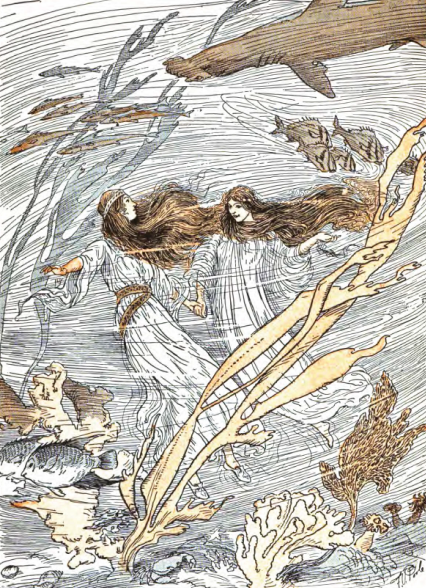
Hear now a legend of the days of old—
The days when there were goodly marvels yet,
When man to man gave willing faith, and loved
A tale the better that ’twas wild and strange.
Beside a pleasant dwelling ran a brook
Scudding along a narrow channel, paved
With green and yellow pebbles; yet full clear
Its waters were, and colorless and cool,
As fresh from granite rocks. A maiden oft
Stood at the open window, leaning out,
And listening to the sound the water made,
A sweet, eternal murmur, still the same,
And not the same; and oft, as spring came on,
She gathered violets from its fresh moist bank,
To place within her bower, and when the herbs
Of summer drooped beneath the mid-day sun,
She sat within the shade of a great rock,
Dreamily listening to the streamlet’s song.
Ripe were the maiden’s years; her stature showed
Womanly beauty, and her clear, calm eye
Was bright with venturous spirit, yet her face
Was passionless, like those by sculptor graved
For niches in a temple. Lovers oft
Had wooed her, but she only laughed at love,
And wondered at the silly things they said.
‘Twas her delight to wander where wild vines
O’erhang the river’s brim, to climb the path
Of woodland streamlet to its mountain springs,
To sit by gleaming wells and mark below
The image of the rushes on its edge,
And, deep beyond, the trailing clouds that slid
Across the fair blue space. No little fount
Stole forth from hanging rock, or in the side
Of hollow dell, or under roots of oak,
No rill came trickling, with a stripe of green,
Down the bare hill, that to this maiden’s eyes
Was not familiar. Often did the banks
Of river or of sylvan lakelet hear
The dip of oars with which the maiden rowed
Her shallop, pushing ever from the prow
A crowd of long, light ripples toward the shore.
Two brothers had the maiden, and she thought,
Within herself: “I would I were like them;
For then I might go forth alone, to trace
The mighty rivers downward to the sea,
And upward to the brooks that, through the year,
Prattle to the cool valleys. I would know
What races drink their waters; how their chiefs
Bear rule, and how men worship there, and how
They build, and to what quaint device they frame,
Where sea and river meet, their stately ships;
What flowers are in their gardens, and what trees
Bear fruit within their orchards; in what garb
Their bowmen meet on holidays: and how
Their maidens bind the waist and braid the hair.
Here, on these hills, my father’s house o’erlooks
Broad pastures grazed by flocks and herds, but there
I hear they sprinkle the great plains with corn
And watch its springing up, and when the green
Is changed to gold, they cut the stems and bring
The harvest in, and give the nations bread.
And there they hew the quarry into shafts,
And pile up glorious temples from the rock,
And chisel the rude stones to shapes of men.
All this I pine to see, and would have seen,
But that I am a woman, long ago.”
Thus in her wanderings did the maiden dream,
Until, at length, one morn in early spring,
When all the glistening fields lay white with frost,
She came half breathless where her mother sat:
“See, Mother dear,” said she, “what I have found,
Upon our rivulet’s bank; two slippers, white
As the mid-winter snow, and spangled o’er
With twinkling points, like stars, and on the edge
My name is wrought in silver; read, I pray,
Sella, the name thy mother, now in heaven,
Gave at my birth; and sure, they fit my feet!”
“A dainty pair,” the prudent matron said,
“But thine they are not. We must lay them by
For those whose careless hands have left them here;
Or haply they were placed beside the brook
To be a snare. I cannot see thy name
Upon the border,—only characters
Of mystic look and dim are there, like signs
Of some strange art; nay, daughter, wear them not.”
Then Sella hung the slippers in the porch
Of that broad rustic lodge, and all who passed
Admired their fair contexture, but none knew
Who left them by the brook. And now, at length,
May, with her flowers and singing birds, had gone,
And on bright streams and into deep wells shone
The high, mid-summer sun. One day, at noon,
Sella was missed from the accustomed meal.
They sought her in her favorite haunts, they looked
By the great rock, and far along the stream,
And shouted in the sounding woods her name.
Night came, and forth the sorrowing household went
With torches over the wide pasture-grounds
To pool and thicket, marsh and briery dell,
And solitary valley far away.
The morning came, and Sella was not found.
The sun climbed high; they sought her still; the noon,
The hot and silent noon, heard Sella’s name,
Uttered with a despairing cry, to wastes
O’er which the eagle hovered. As the sun
Stooped toward the amber west to bring the close
Of that sad second day, and, with red eyes,
The mother sat within her home alone,
Sella was at her side. A shriek of joy
Broke the sad silence; glad, warm tears were shed,
And words of gladness uttered. “Oh, forgive,”
The maiden said, “that I could e’er forget
Thy wishes for a moment. I just tried
The slippers on, amazed to see them shaped
So fairly to my feet, when, all at once,
I felt my steps upborne and hurried on
Almost as if with wings. A strange delight,
Blent with a thrill of fear, o’ermastered me,
And, ere I knew, my plashing steps were set
Within the rivulet’s pebbly bed, and I
Was rushing down the current. By my side
Tripped one as beautiful as ever looked
From white clouds in a dream; and, as we ran,
She talked with musical voice and sweetly laughed.
Gayly we leaped the crag and swam the pool,
And swept with dimpling eddies round the rock,
And glided between shady meadow banks.
The streamlet, broadening as we went, became
A swelling river, and we shot along
By stately towns, and under leaning masts
Of gallant barks, nor lingered by the shore
Of blooming gardens; onward, onward still,
The same strong impulse bore me till, at last,
We entered the great deep, and passed below
His billows, into boundless spaces, lit
With a green sunshine. Here were mighty groves
Far down the ocean valleys, and between
Lay what might seem fair meadows, softly tinged
With orange and with crimson. Here arose
Tall stems, that, rooted in the depths below,
Swung idly with the motions of the sea;
And here were shrubberies in whose mazy screen
The creatures of the deep made haunt. My friend
Named the strange growths, the pretty coralline,
The dulse with crimson leaves, and streaming far,
Sea-thong and sea-lace. Here the tangle spread
Its broad, thick fronds, with pleasant bowers beneath;
And oft we trod a waste of pearly sands,
Spotted with rosy shells, and thence looked in
At caverns of the sea whose rock-roofed halls
Lay in blue twilight. As we moved along,
The dwellers of the deep, in mighty herds,
Passed by us, reverently they passed us by,
Long trains of dolphins rolling through the brine,
Huge whales, that drew the waters after them,
A torrent stream, and hideous hammer-sharks,
Chasing their prey. I shuddered as they came;
Gently they turned aside and gave us room.”
Hereat broke in the mother, “Sella, dear,
This is a dream, the idlest, vainest dream.”
“Nay, Mother, nay; behold this sea-green scarf,
Woven of such threads as never human hand
Twined from the distaff. She who led my way
Through the great waters bade me wear it home,
A token that my tale is true. ‘And keep,’
She said, ‘the slippers thou hast found, for thou,
When shod with them, shalt be like one of us,
With power to walk at will the ocean-floor,
Among its monstrous creatures, unafraid,
And feel no longing for the air of heaven
To fill thy lungs, and send the warm, red blood
Along thy veins. But thou shalt pass the hours
In dances with the sea-nymphs, or go forth,
To look into the mysteries of the abyss
Where never plummet reached. And thou shalt sleep
Thy weariness away on downy banks
Of sea-moss, where the pulses of the tide
Shall gently lift thy hair, or thou shalt float
On the soft currents that go forth and wind
From isle to isle, and wander through the sea.’”
“So spake my fellow-voyager, her words
Sounding like wavelets on a summer shore,
And then we stopped beside a hanging rock
With a smooth beach of white sands at its foot,
Where three fair creatures like herself were set
At their sea-banquet, crisp and juicy stalks,
Culled from the ocean’s meadows, and the sweet
Midrib of pleasant leaves, and golden fruits,
Dropped from the trees that edge the southern isles,
And gathered on the waves. Kindly they prayed
That I would share their meal, and I partook
With eager appetite, for long had been
My journey, and I left the spot refreshed.
“And then we wandered off amid the groves
Of coral loftier than the growths of earth;
The mightiest cedar lifts no trunk like theirs,
So huge, so high, toward heaven, nor overhangs
Alleys and bowers so dim. We moved between
Pinnacles of black rock, which, from beneath,
Molten by inner fires, so said my guide,
Gushed long ago into the hissing brine,
That quenched and hardened them, and now they stand
Motionless in the currents of the sea
That part and flow around them. As we went,
We looked into the hollows of the abyss,
To which the never-resting waters sweep
The skeletons of sharks, the long white spines
Of narwhale and of dolphin, bones of men
Shipwrecked, and mighty ribs of foundered barks.
Down the blue pits we looked, and hastened on.
“But beautiful the fountains of the sea
Sprang upward from its bed; the silvery jets
Shot branching far into the azure brine,
And where they mingled with it, the great deep
Quivered and shook, as shakes the glimmering air
Above a furnace. So we wandered through
The mighty world of waters, till at length
I wearied of its wonders, and my heart
Began to yearn for my dear mountain home.
I prayed my gentle guide to lead me back
To the upper air. “A glorious realm,” I said,
“Is this thou openest to me; but I stray
Bewildered in its vastness; these strange sights
And this strange light oppress me. I must see
The faces that I love, or I shall die.”
She took my hand, and, darting through the waves,
Brought me to where the stream, by which we came,
Rushed into the main ocean. Then began
A slower journey upward. Wearily
We breasted the strong current, climbing through
The rapids tossing high their foam. The night
Came down, and, in the clear depth of a pool,
Edged with o’erhanging rock, we took our rest
Till morning; and I slept, and dreamed of home
And thee. A pleasant sight the morning showed;
The green fields of this upper world, the herds
That grazed the bank, the light on the red clouds,
The trees, with all their host of trembling leaves,
Lifting and lowering to the restless wind
Their branches. As I awoke I saw them all
From the clear stream; yet strangely was my heart
Parted between the watery world and this,
And as we journeyed upward, oft I thought
Of marvels I had seen, and stopped and turned,
And lingered, till I thought of thee again;
And then again I turned and clambered up
The rivulet’s murmuring path, until we came
Beside this cottage door. There tenderly
My fair conductor kissed me, and I saw
Her face no more. I took the slippers off.
Oh! with what deep delight my lungs drew in
The air of heaven again, and with what joy
I felt my blood bound with its former glow;
And now I never leave thy side again.”
So spoke the maiden Sella, with large tears
Standing in her mild eyes, and in the porch
Replaced the slippers.
To be continued in Part 2…
Notes
Coraline (kor’-a-li’.n ): a sea plant having a coral-red color.
Dulse ( dills): a coarse red seaweed.
Questions for Study
- Choose for reading the passages descriptive of the most beautiful details that Sella enjoyed. Which of these details have you seen? What have you seen that help you to understand the others?
- What do you like best about Sella? about her adventure?
- In this unrhymed verse, called ” blank verse, ” you can get very beautiful effects by letting the voice pause in the proper places. Practice reading aloud the passage that you like best.
Return to Elementary Literature 7
The lessons published on this site are freely available to read. If you wish to move from reading to formal study — with graded assessments, academic records, and the support of the Academy — you may enroll at any time. Enrollment is open year round, to students of all ages.
← Previous: Lesson 06. A Child’s Dream of a Star, by Charles Dickens | Contents | Next: Lesson 07. Sella, Part II, by William Cullen Bryant →