
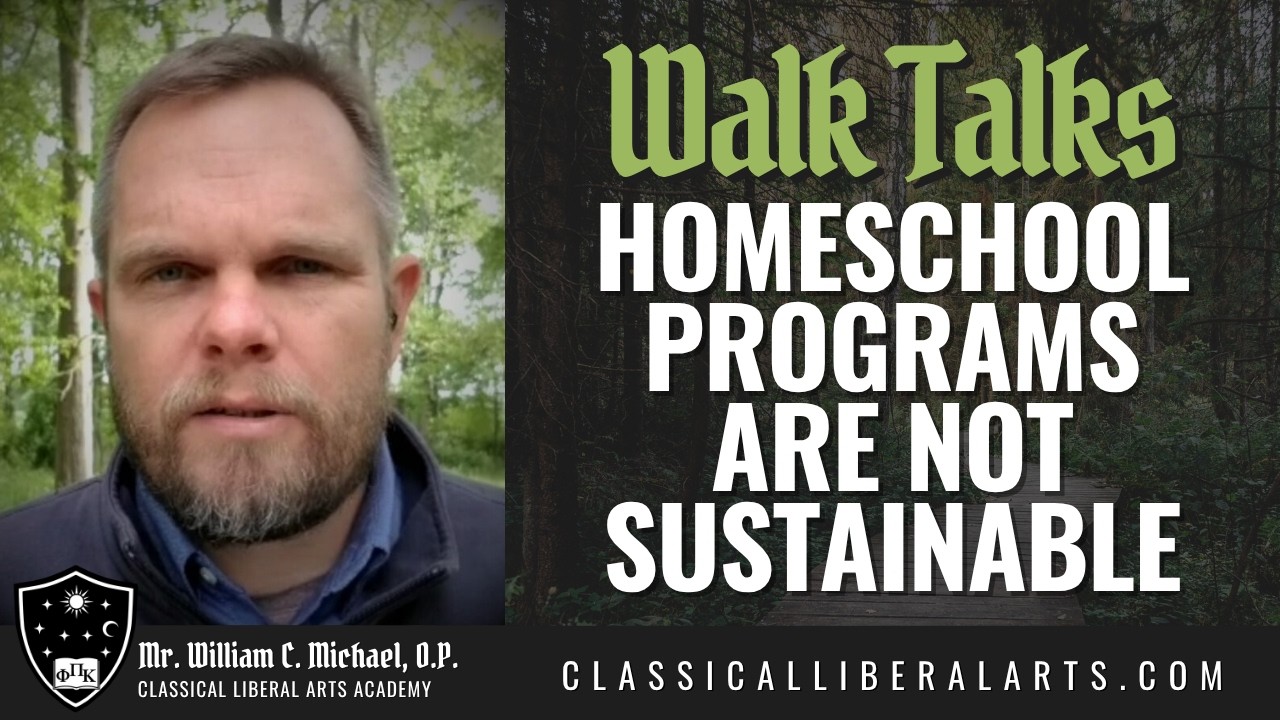
Today is Monday, October 5th, 2026, and I’m William Michael of the Classical Liberal Arts Academy. Yesterday I published a talk titled “How to Choose a Homeschool Curriculum,” and I received a couple of comments—a little bit of feedback on that video—asking me if I would talk about it a little bit more, especially as it relates to the last point that I made, about asking whether a certain homeschool program, plan, or curriculum is actually sustainable. So in this talk I’d like to expand on that a little bit, and talk about what it means for a homeschool program to be sustainable, and why this is a problem with modern homeschool programs—especially Catholic homeschool programs.
What “sustainable” means
Now, the term sustainable, just to make sure this is clear, means that the plan that’s proposed can actually be carried out. It’s realistic. It’s practical. It takes into consideration all of the circumstances, all of the challenges, and presents a method that can actually work. Now, that doesn’t mean it can work if Einstein is homeschooling his children. It means that it’s possible for the families to whom it’s being recommended and sold.
So if there’s a homeschool program that’s selling to the homeschool market—and that includes a wide variety of parents—and they’re pushing their program and their materials at homeschool conferences and through catalogs and online and so on, they have to consider whether the people they’re selling things to can reasonably be expected to carry out the plan. That’s what it means to be sustainable. And if they’re not, and if they take no consideration of that, then they’re really not doing what I call Golden Rule business—business in which you do unto your customers as you would have a company do unto you.
And I would argue very, very confidently that the homeschool industry—the homeschool market—does not practice Golden Rule business. In fact, I would argue that there are a couple of serious problems in the homeschool industry. And I think that homeschool parents experience these problems and know exactly what I’m talking about.
How we came to homeschooling
Now, let me provide a little bit of background before I get into this topic, because this is going to be pretty serious. My wife and I got into homeschooling unintentionally, as far as I’m concerned. I was teaching and already working in administration in private schools when my wife and I began having children. And my wife was an elementary teacher herself. She had studied classics, had studied elementary education, and worked in teaching for a couple of years before our first child was born. She had expressed an interest in homeschooling. I was planning to have my children attend the schools where I was working, because they were very high-quality private schools. But when my wife expressed an interest in homeschooling, I wasn’t against the idea.
But I had a talk with her where I made it very clear that I was not interested in what I knew of homeschool culture. In my work in private schooling, there were a number of times when I was forced to interact with homeschooling families. And remember, this was back around 2000, so we’re talking twenty-five years ago. I saw a lot of problems in homeschool culture. We often had students brought to our schools who had been homeschooled and were terribly behind in their academic work, and people like me were asked how to fix these problems. We’d have a seventh- or eighth-grade student who’d been homeschooled, who could barely write, who could barely read, who had completed almost no academic work and was years behind where his or her peers were—in schools that weren’t even very good. And so we did a lot of emergency repair work, trying to get homeschool students into a plan that would allow them to catch up and get on track without repeating more than was necessary, to be as efficient as possible. So I saw the results, and I knew that things weren’t very good from the little bit that I had seen.
And I want to be fair, because I teach logic. When I say “from the little bit that I had seen,” I don’t want to say that I can generalize about all homeschoolers. But what I saw were not simply some bad examples. I saw flawed principles—more than just some bad examples. I saw ideas that were being promoted by the homeschool industry. And so I understood not just that I had met a couple of bad examples of homeschooling, but that the concepts being promoted by homeschool conferences and homeschool publishers were irresponsible. They urged parents to undertake the work of homeschooling. They made all kinds of unrealistic promises, gave all kinds of unrealistic confidence, and then when things went bad, they just disappeared. They had no solutions. They offered no help. And the homeschooling families were just treated as customers, as if all sales are final, and that’s it: “If you don’t like it, go someplace else.”
So I saw how the homeschool industry, as I call it, was exploiting many, many families. And I had the opportunity to work with a sample of those families, and I could see the effects, and I could see where those effects were coming from. These were not bad families. In fact, one of the families that I have in mind was one of the best Christian families that I knew. The father was actually a schoolteacher. The mother was a homeschooling mother, and they had a bunch of children, and the kids were just chronically behind. And they got to the point where they just didn’t know what to do about it anymore, and they finally gave in under the pressure—which was now starting to negatively affect their family, even their marriage—and asked for help. So I’m not talking about irresponsible, ignorant people trying to homeschool. I’m talking about decent, good Christian families that found themselves moving deeper and deeper into a hole that they started to think they might not be able to get themselves out of.
So I saw that in my private school work, and I knew a number of homeschool families through our churches, and I saw the kinds of things that they did, and I had some reservations about homeschool culture. And so when my wife mentioned that she had an interest in homeschooling, I made it very clear: “We’re not doing that nonsense. We’re not going to have this goofy, conspiracy-theory homeschool culture. We’re not going to say that anything we do is good. There’s not going to be any of this unschooling nonsense. If we’re going to homeschool, it’s going to be to accomplish greater things and serve nobler ends than local schools already make possible.” And my wife agreed. I knew that she was interested in the same thing I was. I trusted my wife. I didn’t think that she wanted to be some homeschool crazy, and I knew that she wasn’t going to be duped by any homeschool marketing program.
The first problem: low quality
So we started talking about what we should do. Remember, I was still working in private schooling, with plans to continue in private school teaching and administration for the rest of my life. This was about my wife homeschooling our children. So I started to research, really for the first time. This was around 2007 or 2008. I started to look into homeschool programs—and we were Catholic by this time; we had converted in 2005—and I started gathering information from all the different homeschool programs, and I could immediately start to recognize some problems.
Number one, I found it very strange that they didn’t compete against each other. There was little to no competition. They didn’t point out their strengths. They didn’t identify weaknesses in other programs. They all seemed to be working as a team. Homeschool conferences would be advertised, and I would notice that all of the homeschool industry players would be there: all the publishers, all the homeschool programs, all the usual conference speakers, all the same messages, all the same products, present at every conference. And I said, “That’s strange. It’s strange that these programs all seem to be working side by side, and that there’s no competition in this market.”
And I know that when we talk about Christian culture, we’ll get this false-charity message about how we shouldn’t compete against each other, we shouldn’t criticize each other, we should all work together. But the problem is, we live in a capitalistic society, and the way this society is designed, the market is supposed to control things. Quality is left to the market. And if there’s no competition, then there’s no improvement. The status quo can be established, and it’s never challenged. All the players just agree to make room for each other and not cross each other’s lines, and they hold an industry hostage. And that’s what appeared to have developed in homeschool circles—especially in the Catholic homeschool market.
The standards were very low. Again, I was teaching in a private school where students were receiving three to four million dollars per year in scholarships. And I was teaching SAT prep courses, helping with college counseling and planning, teaching juniors and seniors. And I saw the quality of the work that the kids were doing, and I knew the quality I was pushing them to do. And I saw these Catholic homeschool programs advertising that their SAT scores were higher than public school averages. And I thought to myself, “What a terrible standard to compare yourself with.” The public schools take any kids who are dropped off outside their doors. They have no control over who their students are. Their kids may not even have parents. They may barely be housed and clothed. The schools give them whatever they can, and they often have no support at all from parents. And we’re comparing the SAT scores of homeschool students—students whose parents are directly committed to their education—and saying that if you spend thousands of dollars and commit all the time and energy required for homeschooling, your kids will score 50 points higher than public school kids on their SATs? That’s terrible.
Just as a comparison: I taught for the Princeton Review, and when we offered SAT prep courses, which would just last a couple of months, we guaranteed that every student who took our classes would raise his score by at least 100 points. That was the guarantee from the Princeton Review. So rather than sending a kid to the Princeton Review to take an SAT prep class that lasted a couple of months and would raise his score at least 100 points, guaranteed, we had Catholic homeschool programs boasting that after years and years of work with their programs, their students’ scores were 50 points higher than public school scores. And I said, “Something just doesn’t seem right. Something’s not right here. I’m certainly not going to spend thousands and thousands of dollars and have my wife working day and night as a homeschooling mother with the hope that my kids will get 50 points higher on the SAT.”
And so my wife and I started to order some of these products—samples of these programs. And I started reading through them, looking through them, and I just saw that it was complete junk. Nothing like this would ever be used in the private schools that I was teaching in. It was junk. And the justification for this junk would be that it’s Catholic. And by “Catholic,” that meant there were Catholic pictures on the covers. They had some sort of silly Catholic references throughout the book. Maybe they put “JMJ” at the top of the papers. But there was nothing about these products, nothing about these programs, that was in any way historically or intellectually Catholic. It was absolute junk: boxes and boxes of workbooks, paperback, disposable grade-level books. The box would come, and we’d open it up, and there would be all this stuff in there, and it was just a bunch of junk. Hundreds and hundreds of dollars for junk.
Then you would ask, “Okay, so we have all of this stuff. What do you actually do with it?” And we would find that there might be some so-called lesson plans included, or you could buy them separately. And the lesson plans tell the mother what to do with all of this stuff—day one, week one, through the year, all of these instructions and activities. And it was all just busywork. Just junk. Busywork to fill a school year. And everything had to be done by the mother. The homeschool program was really just selling boxes of resources, and all the work of teaching, support, assessment, evaluation, scheduling, discipline—everything—was just left to the parent.
Now, at the time—remember, around 2006—we already had five children. So I’m looking at my wife, home with five children, and I’m looking at these so-called homeschool curricula, these programs which are really just glorified book packages. And I’m asking my wife, “If this so-called lesson plan leaves everything for you to organize and execute with the child, how do you manage child number two and three and four? How would this plan work for four children being schooled at the same time?” And we ended up having ten children. If the grade-level plan serves one child, and all of the activities, planning, assessment, record keeping—all of that—needs to be done by the parent, how would this work for the second child or the fourth child?
So we’ve got this pro-family Catholic political message, where Catholics are being urged to have children and have large families, but the educational method is completely antithetical to that. No one is doing any of the work that’s necessary to actually develop a curriculum of any kind of quality worthy of being called Catholic, in light of Catholic educational history. And the practical plan for how this program is to be carried out is just not realistic at all. It’s like no one’s even thinking about what this would look like in real family circumstances.
And I told my wife, “You would have to work day and night to have all of this prepared and organized. Then you’d have to oversee all of it, manage all of it, manage all the assessment, manage all the records. It would be your whole life. And that wouldn’t be a bad thing if the quality was decent. But the quality is not even worth doing.” So you’ve got a crummy study program made up of this patchwork quilt of study materials, and this so-called lesson plan, which is really just a script for 180 days of busywork. And if you work really hard and sacrifice your whole life, turn the whole house upside down to do this, you may end up with kids who score 50 points higher on the SAT. And I just said, “There’s no way. There’s no way we’re doing this. This is the dumbest thing I’ve ever seen in education, and I can see now why homeschooling is criticized as it is. I can’t even believe that this is serious.”
So the first problem that I raised with my wife was just how low the quality of this stuff was, and how little the programs were actually doing in the name of helping parents. It was really very lazy and irresponsible.
The second problem: the grade-level school brought home
The second problem I raised with my wife—again, as a private school teacher working in curriculum development—was this. I said, “In our school, we’ve got grades K through 12. Tuition is $16,000 or $17,000 a year per student. We’ve got professional, high-quality teachers working at every grade level with the students at that grade level. We’ve got kindergarten teachers who are some of the best women I know. We’ve got high school teachers that I’m friends with—myself included—who are totally devoted, serious students themselves, and teachers. And we work hard to teach all of these grade levels and all of these subjects to these kids. This homeschooling idea suggests that you can do at home what this whole faculty of professional teachers is doing in a school where kids are paying $16,000 or $17,000 a year in tuition and have professional teachers and counselors and tutors helping them every day on every side. Why would anyone think that that model would work in homeschooling?”
Why would anyone suggest setting up school according to a modern grade-level system for a woman teaching her own children, who are at different grade levels? The whole thing makes no sense. Your situation at home is nothing like a modern school. Why in the world would your homeschool program be organized like a modern school? It makes no sense. It’s just—again—lazy and irresponsible.
They’re just selling you all of these grade-level products because it’s really a great marketing scheme. They can put all these packages together—whole boxes of books: first grade this, second grade that, fourth grade this, fifth grade that—boxes and boxes and boxes of books. And you can sit there in modern consumer culture and just swipe your credit card and order your four boxes of books for all your different grade levels, and you can go online and chat with all the other ladies who are buying all their boxes of books. And you’re getting all of this grade-level stuff shipped to your house.
The fallacy of composition
And it just gets even worse when you consider these crazies who collect materials from twenty different sources—the so-called eclectic homeschooler—just collecting materials from all over the place, materials that aren’t even designed to work together or support each other. It’s just the craziest, most mindless idea of education. And they think that buying this stuff is somehow going to produce a result.
And what’s ridiculous about it is that the whole idea is based on a logical fallacy, called the fallacy of composition. The fallacy of composition says that if we want to make the best whole, we need to have the best parts: if we have the best parts and put them together, that will make the best whole. That’s a logical fallacy. And it drives the whole homeschool market—especially this eclectic homeschool market, where you collect curriculum materials from a hundred different sources. And the women talk about this like it’s some kind of great achievement, and it’s actually humiliating to even read, because it’s so irrational. “What do you guys use for spelling?” “Oh, I use this.” “We use this.” “What do you use for writing?” “Oh, the best writing program is this.” Mix all these in a pot, and you’ll have the best education. That’s literally a logical fallacy.
It’s like saying that if we take all of our favorite foods and mix them up into one dish, that’ll be the best dish, the most delicious dish. I love ketchup, I love chocolate ice cream, I love peanut butter, I love steak—mix it all up in a dish, and that will be the most delicious meal. It’s just stupid. And yet that’s what we find driving the whole homeschool culture. And you’ve got all of these crazy, aggressive, loudmouthed homeschool parents on all these forums, dominating all of these chat rooms—no brain cells, just feelings and opinions, trying to get attention. Craziness.
So I explained to my wife that this grade-level education, combined with this eclectic homeschooling culture, was just total madness. And standing behind it, urging it all on, are these homeschool publishers that don’t care what anyone does as long as they keep buying books. And I just said, “There’s no way you’re doing this. There’s no way you’re getting into this mess. There’s no way you’re taking the grade-level system that was invented for large, highly funded modern schools with large faculties of teachers, buying supplies for it, having them all shipped into the house, and then managing our children’s education like that. It doesn’t make any sense at all.”
Materials designed for the home
So we had to deal with that whole problem. And as my wife and I continued talking things through—and the whole time I’m shaking my head, saying, “There’s no way we’re going to do this. There’s no way our children are going to be subjected to this homeschool craziness”—finally I said to my wife, “Let’s try something. I’m a Latin teacher. I teach Greek. I teach SAT prep. I teach composition. I teach history. Let me give you some lessons to use with our kids. I’ll show you the kind of stuff that they need. You need materials that are actually designed for your situation.”
“So you’re going to be sitting, let’s say, at the table, and you’re going to have a seven-year-old and a five-year-old and a four-year-old sitting together. They all need to be taught to read. They all need to be taught arithmetic. They all need to be taught to write and spell—all these basic skills. You need lessons that you as a mother can use to manage all of them at the same time. The materials have to be written for your situation. You can’t act like a kindergarten teacher, and then ten minutes later put on a different sweater and pretend you’re a preschool teacher, and then an hour later get dressed again and say, ‘Okay, now I’m a second-grade teacher.’ No, you can’t do that. The situation that you have, where there is one teacher and multiple children at different levels, requires study materials and teaching methods designed for that situation.”
And I said, “Let me give you an example. I’ll give you a few lessons to work on with the kids, and you’ll see what I mean.” And so I started to give my wife these grammar lessons—these preschool-level lessons—that showed how multiple levels could be handled with the same materials. And it became realistic to give these kids not just any education at all, but actually a good education, with good teaching, quality content, and so on.
The schoolhouse model rediscovered
And then, as I was doing that and thinking about it, I just sort of whacked myself in the head and said, “What am I thinking? Why am I being so stupid?” Before the 1850s, when the public schools were invented, this is how all schools worked. This is how all education worked. All of this big-school, K-to-12, grade-level education was invented in the 1800s, when the public school movement started. If we just go back before the public school era—back to when students were normally educated at home, when tutors privately taught children, when tutors would go from house to house teaching children—we would find study materials that were designed for that context, for those circumstances. So what homeschool families actually need—what we actually need—are the study materials that were used in places and times where tutors taught mixed groups of students. They would have had a whole system worked out for how to do that.
And what was so ridiculous, as I thought about that, was that that’s what I had already been studying and collecting my entire career. I was working with textbooks from the 1600s and 1700s. I had the Jesuit Ratio Studiorum from 1599. And it was like scales fell from my eyes, and I just realized, “What in the world am I even doing? Every one of these old textbooks that I have—all of these classical study materials—they’re all designed for this very purpose. This is how schools always worked.”
They were always set up in this schoolhouse model. And please don’t bring Little House into this. Little House was a TV show. I’m talking about real schoolhouses, where a whole community of children would come together under one roof and be taught at all their various levels by a single teacher. That was how schools always worked. So I realized not only that I already had the materials, but that I had just never thought about their application to the homeschool environment.
And as soon as I thought about that, the whole plan came into view. And I told my wife, “This is really stupid, but all of these materials that I’ve been working with”—and I had been collecting them since college, Latin and Greek textbooks from past centuries—”the reason why they’re set up the way they are is that they were designed for this context. This is how homeschooling should be done.”
And I went back to those books, and all of a sudden I could just see it all—how clear it all was. These books laid out the content of all of the necessary subjects in the classical liberal arts and Catholic studies in a way that allowed children to work through them independently. So a child could work one article at a time under the guidance of a teacher and could pursue mastery at his own pace, article by article by article, through the textbook. And a teacher could have twenty-five students at all different levels, and all of the children would just be working through the books one article at a time, and the teacher would be helping them as best she could. And when students were working at or near the same place, those students would be grouped together, and that would be a class. So a class was something that was natural—or I should say logical—based on the students’ actual place in the curriculum or in a certain subject. It wasn’t artificial. It wasn’t based on when the students were born. And the schools developed in a community organically, just like that.
So if there were ten kids who were all around the same level, working on the same stuff in grammar, that would be treated as a class in grammar. And students working outside of those classes, at their own pace or their own level, would be managed individually. And when all the children were together, the teachers would conduct activities that were beneficial to the whole group. For example, maybe the teacher would work with the older, advanced students in the presence of the younger students, so all the younger students could see what was ahead of them in their studies. They could see the work of the older students and look forward to it. They would see the good examples of their schoolmates, as well as the bad examples. And so when you had a bad student who wouldn’t pay attention and wouldn’t do his work, and the younger students saw that student get whipped for it, all of the students got their whipping, because they saw that they had to take their studies seriously. So the school was a system that educated that whole group, but they all worked independently. And that’s how the schools functioned.
Now, a wealthy family that wouldn’t send their children to the local school would simply have tutors come in and teach those children, or they would send those children to tutors. A good example of this: if you ever watch the movie A Man for All Seasons, you’ll see that Thomas More has a daughter who is fluent in Latin. His daughter Meg was given a classical education, and she actually says to the king in the movie that she’s being taught Latin by a man named John Colet, who was an expert classical tutor at the time and the founder of St. Paul’s School in London. So even men like Thomas More—wealthy, influential, highly educated men—would bring tutors in to teach their children, and they would be taught, again, individually, because all education is individual.
This whole idea of the modern grade-level system is an artificial experiment that was invented in the nineteenth century, and we’ve seen that it’s good for the strong kids and terrible for everybody else. But here are the homeschool families bringing the modern method home, which just makes no sense.
How the Classical Liberal Arts Academy began
So anyway, that’s when things clicked for me with respect to homeschooling, and at that point the writing was on the wall. Not only could I put together materials for my wife to use with our children, but I already had the materials. I had folders and folders of digital documents that did exactly what we needed. And my wife began to use some of them.
Our kids were still little, but I started to talk to other Catholics in the area who were homeschooling and having all the same frustrations, all the same problems. And I said, “Look, if you’re willing to try something different, I’d like to work with your kids. I’ll come to your house.” And I literally went to their houses, sat at their dining room tables, and taught their kids: classical grammar, the Baltimore Catechism, world chronology, and so on.
I contacted the bishop of the Diocese of Charlotte—it was Bishop Jugis at the time—and said, “This is a vision that I have for education. I’d like to share it with you, just so I know that I have your permission to do this in the parish.” He arranged several meetings for me with the vicar for education in the diocese, and I was encouraged not only to go forward with it, but to consider starting an independent school. So I had the encouragement and blessing of the diocese to go ahead and do this.
I was already beginning to tutor Catholic children in the area, and it started to grow quickly. The next thing I knew, families started to tell their friends and relatives. I had contacts coming in from other states—Florida, Michigan, New York. And that’s how the Classical Liberal Arts Academy started.
But what started it was recognizing the false foundation on which the entire homeschool industry had been built. They were selling public-school-era, grade-level school materials to families, which just makes no sense—a completely unsustainable approach to private education.
How the industry gets away with it
But there was still a problem, though. How could so many people get duped by this? To this day, they still do it. Literally millions—at the least, hundreds of thousands—of Christian families are using these homeschool programs, which produce little to no success, don’t serve anything that could be considered a historical Catholic standard of learning, use the modern grade-level public-school-era model, and put all of the weight on the shoulders of the parents—usually, by the way, the mothers.
And as I think about this, I ask: How does the homeschool industry get away with this? How have they been able to pull this off? Why do people fall for this?
And I don’t want to treat the parents as if they’re innocent. Many parents are extremely arrogant. I talked about the eclectic homeschool crazies before—just wildly arrogant people who don’t have a drop of knowledge of the history of education, of educational philosophy, of Scholastic education through history; no knowledge at all. And they’ve appointed themselves curriculum masters. They publish YouTube videos and guides to curriculum management, and Christian parents, Catholic parents, just mindlessly follow them. It’s crazy. But those parents get what they deserve, because there’s just no explanation for that behavior. How can you do that when you’ve got 2,000 years of saints and Doctors of the Church who worked in education? It just makes no sense. It’s just thoughtless.
“Primary educators” taken out of context
But as I thought about how the homeschool industry pulls this off, I realized the trick, and it’s pretty dark. The trick is this. In recent Church history, political systems like Communism have risen up which have challenged traditional teaching on family life, parental authority, and so on. These systems, when they gain power in different countries, in different societies, begin setting the state as the ultimate end of life. They’re usually atheistic, and they set the prosperity, the strength, the success of the state as the chief end of man. And not only do they do that, but they view citizens as the products of the state. So children born into these states are considered to be the property of the state. That’s Communism, socialism—where there’s no private property; everything belongs to the state, and that extends to the people themselves.
And so in modern history there have been attempts by states driven by these systems to take control of children and raise them for the state. And the Church had to step in and say, “Wait a minute. This is totally unnatural. The state does not produce children. Parents produce children—they produce their own children. And as the bearers of children, parents alone have the right to determine how their children are educated.” And then this key phrase came into use: Parents are the primary educators of their children.
In context, what that meant is that parents have the primary authority over the education of their children. Parents are the main authority. So “primary,” in that context, has the idea of “main,” and it’s referring to authority. The state does not have authority to direct the education of children; parents have that authority. Parents are the primary educators of their children: they make the decisions about how their children will be educated. So that phrase was used in the context of the Church opposing Communistic ideas of government—atheistic ideas, unnatural systems of government that sought to take control of children as possessions of the state. That’s the context in which the phrase “primary educators” was used.
Well, the homeschool industry got hold of that phrase, and they committed another logical fallacy, which is equivocation, because they changed the meaning of the phrase. In homeschool marketing, in homeschool culture, the phrase “primary educator” was changed to mean, “You are the one who provides your children with the best instruction. You are the best educator of your children. No one knows better than Mom what the children need. Mom is the best teacher. The parents are the best educators. No one can teach the children like the parents can.” And that message was pumped into Christian society by both Protestants and Catholics. It was this do-it-yourself message on education—this totally arrogant, unrealistic message that Mom and Dad know best. Not that they are the primary authority, not that they have the right to make the decisions about education so that their children can be educated according to their religious convictions, and so on—but that they should actually be the ones who execute the education, and that when they do so, it will be the best. That message is a complete farce. It has nothing to do with the meaning of the term “primary educator.”
“Primary educator,” in context, can reasonably mean two things. It can mean that parents are the main authority in decisions relating to the education of their children. They have the right and authority to choose to give their children, for example, a Catholic education. They don’t have to submit to a secular, state-directed education. And secondly, the phrase could be used to mean that the parents are chronologically the first teachers of their children. A mother is teaching a child in her arms. The discipline and order, the schedule, the routine, the culture of the home, the relationships between the parents and the children—all of that is a source of education. And in that way, parents are the primary, or first, educators of their children. Before the children even go to school, they’re already being educated by their parents, raised in a Christian home. So in those two senses, the phrase “parents are the primary educators of their children” can be used with reason.
But the homeschool industry clipped that phrase out of its original context and used it to promote this do-it-yourself message of parent-managed, parent-executed education. And that was a complete farce.
The invented history of homeschooling
And if that isn’t bad enough, the homeschool industry also invented a history of education. They began telling modern Christian parents that all through history, the most famous men and women—the most highly educated men and women—were all homeschooled, just like our children, just like we do it in the homeschool industry. And they would start naming George Washington, Abraham Lincoln, Thomas Jefferson, Benjamin Franklin, Aristotle—all of these great scholars, great political figures, heroes, legendary historical characters. “Back in the old days, everybody was homeschooled.” And again, people just accepted it as if it was true—just mindless drinking-in of this fantasy history of education. When no such thing is true at all.
When we talk about people being “homeschooled” throughout history, what that means is that they were simply educated at home. But it doesn’t mean that Mommy and Daddy—with the same educational background, intellectual tools, and financial circumstances as average homeschooling families today—were the ones teaching these famous minds. Most of them were taught by extraordinary scholars and tutors. And most of their time studying at home was brief and temporary, before they were sent off to schools.
So this whole history of the homeschooling world before modern culture arrived—it’s just so crazy. My brain hurts to even think about it, because they’re complaining about modern education, promoting homeschooling as a remedy for modern education, and then using the system of modern education for homeschooling.
Can I just speak directly, if you’re listening to this? How in the world can you fall for this? They’re criticizing modern education, setting themselves up as the saviors of families from modern education, and then selling you modern education in their own covers and boxes—and you’re mindlessly buying it up like crazy people. No one asks these people for any evidence to support their histories. No one asks for proof. No one asks for any demonstration of results in history. They just sit there and nod: “Oh, everybody was homeschooled? Okay, cool. I’ll take two boxes.” It’s just nuts.
And if you really ask, “Why are you doing this, in the name of Christian education?” they’ll say, “Because everybody’s doing it.” Everybody’s doing it. And I don’t mean to be silly, but that’s literally what people will say: “That’s what everybody does. How can it be wrong?” I don’t know what to say.
But anyway, this phrase—that parents are the primary educators of their children—was removed from its context and fed into this marketing machine, which began pumping up Christian parents with the idea that they’re the best teachers. “It doesn’t matter if you’ve never studied Latin. You’re the best Latin teacher. It doesn’t matter if you never studied algebra, or the history of the ancient world, or Homer’s Iliad. It doesn’t matter if you studied it. You’re the best teacher. You’re the primary educator of your children.”
And if you think I’m making this up, just pay attention. Just look around in homeschool circles, and you’ll see what I’m talking about. This whole fake classical education movement—just total insanity. K-to-12 Catholic homeschooling, Seton homeschooling, selling all of these modern books—first-grade math, third-grade science—with pictures of saints on the cover, pictures of Mary and angels on the cover. There was never a Catholic saint raised with books anything like these. Why would you put a picture of Thomas Aquinas on the cover of a book that rejects everything that Thomas Aquinas taught about education? It makes no sense.
The burden placed on mothers
Now, I could go on complaining about this forever, but that’s useless. Here’s the point. What the homeschool industry has done is successfully convince Catholic parents that they are responsible to actually carry out the education of their children. And homeschool mothers, who are usually the agents of the homeschool, are told that they are responsible to carry the load of instructing their children, of executing the homeschool plans. They’re told that this is how it has always been done, that parents are the best teachers, and that this is what will lead to success in education. And none of that is grounded in any truth or reality.
The parents, as I said, do it for two reasons. Number one: that’s what everybody’s doing. That’s the main reason. And number two: because they live in consumer culture, and if you can turn a problem into a solution that can be purchased, you’ve got a deal. Because consumers can only think of shopping, buying, having stuff delivered. They can’t think outside of the box—no pun intended. And that’s what homeschool culture is: a mindless, irrational, historically false marketing gimmick that sells modern education to families who imagine that they are fixing modern education.
No part of that plan can actually be carried out effectively. It’s not appropriate for homeschool circumstances. The pressure put on the homeschooling mother is totally ridiculous and unrealistic. And the worst thing about all of it is that when the mothers feel this—when the mothers realize this, when they begin to think, “This is impossible. There’s no way that this can work”—people look at them like they’re crazy. The homeschool publishers tell them they’re wrong: they just don’t have enough services, or they don’t have the right products, or they don’t have the right collection of resources. Other homeschool parents pretend to be having success. And so the homeschool mother who’s honest feels like she must be a total loser. Because she’s looking at what the kids are doing. She’s looking at these boxes of books and these relatively useless lesson plans. She’s not seeing any kind of progress. She doesn’t know how any of this has anything to do with any saints or with the history of education. She has this feeling in her soul that this is not the education these kids need. And when she thinks those thoughts, she’s made to feel like she’s just lazy, she’s too dumb, she’s too disorganized—and it just leads her back into the homeschool industry for the next wave of products and services. Tell me I’m wrong, if you’ve been in it.
What sustainable looks like
I wouldn’t let my wife get into that—because I love my wife, and I’m too selfish. I want to have a nice life with my wife. I want to go out to dinner. I want to come home to a happy, beautiful woman who doesn’t look like she was run over by a bus. I want to come home to a quiet, orderly home, where the kids are actually learning the things that they need as part of their Catholic education. I want to use our family’s financial resources for things the kids actually need, not for boxes and whole roomfuls of useless books. I’m too selfish to fall for that nonsense. And I’m too critical—you know, “uncharitable”—to just get in line, buy my box, and go home.
That’s where the Classical Liberal Arts Academy came from. It was simply the result of my desire to give my wife a program of study for our kids that was sustainable—that she could actually handle, that asked her to do things that she could actually do.
And so now, in 2026, this is what the Classical Liberal Arts Academy has been designed to be: a system that serves homeschool families. First of all, it does all the work of breaking courses down into lessons and tasks, and it provides the assessments. I’m the educator. I can do that stuff. I know how to develop curriculum. I know how to teach. I have all the resources. I have the technical skill to use computers to make these things accessible to students directly. And all I ask parents is to be parents. As Mom, you’ve got to do the work that only a mom can do. And that’s sustainable. You can do it. It’s within your power. You’re not going to be up at two o’clock in the morning trying to organize lesson plans or grade student work. You can go to bed and get some rest, and you can pick up in the morning where you left off.
So when I say that education is sustainable in the Classical Liberal Arts Academy, this is what I mean. It’s designed to actually be used by parents, for success in real-life circumstances.
So I know this has run long, and I want to wrap it up. I hope this is helpful. I’m glad someone asked for more information on the topic of sustainability. If you’d like to keep this discussion going, please let me know, and we’ll dig deeper. God bless.
Mr. William C. Michael, OP
Headmaster
Classical Liberal Arts Academy