
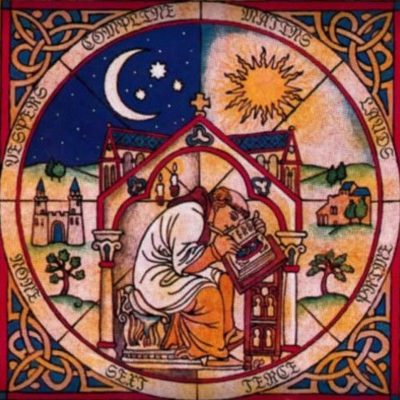
In the Catholic Church, the “Liturgy of the Hours” is a collection of “psalms, hymns and spiritual canticles”, along with prayers and and readings, that are recited in the Church at specific “liturgical hours” of each day.
Some may wonder, “What are the liturgical hours?” and “Where did the liturgical hours come from?”
First, the liturgical hours are found in Sacred Scripture, the Bible. It was common for God’s people in the Old Testament to pray at set hours of the day. We read King David saying
“Seven times a day I praise you because your judgments are righteous.”
Psalm 119:164 (NABRE)
Following David’s example, men prayed seven times a day. The day was divided into approximately 3 hour periods so that the prayers could be spaced out evenly through the day, starting at sunrise.
Morning Prayer
The first liturgical hour of the day is at waking, which is normally associated with the time of the sunrise. Before electricity, this was considered the first hour of the day, called “Prime”.
Midmorning Prayer
The second liturgical hour of the day is at mid-morning, which is half-way between sunrise and midday. Historically, this was the third hour of the day, and called “Terce”.
Midday Prayer
The third liturgical hour of the day is midday or noon, which is when the sun is directly overhead. Historically, this was the sixth hour of the day, and called “Sext”.
Midafternoon Prayer
The fourth liturgical hour of the day is midafternoon, which is when the sun is halfway between midday and sunset. Historically, this was the ninth hour of the day, and called “None”.
Evening Prayer
The fifth liturgical hour of the day is evening, which is when the sun is setting. Historically, this was called “Vespers”, from the Latin word for evening.
Night Prayer
The sixth liturgical hour of the day is at the last hour of the day, which is when we go to bed. Historically, this was the final hour of the day, and called “Compline”.
Office of Readings
The seventh liturgical hour of the day is in the night, divind the long period between bedtime and waking. Historically, this was at midnight or around the time when the roosters crowed before sunrise, and was called “Matins”.
We can see references made to the liturgical hours throughour Scripture.
“From the rising of the sun unto the going down of the same, the name of the Lord is worthy of praise.”
Psalms 112:3
“Peter went up to the higher parts of the house to pray, about the sixth hour.”
Acts of Apostles 10:9
“Now Peter and John went up into the temple at the ninth hour of prayer.”
Acts of Apostles 3:1
“And [Jacob] was gone forth to meditate in the field, the day being now well spent.”
Genesis 24:63
Thus, the liturgcal hours celebrated in the Catholic Church today are simply traditional hours of prayer that have been known since ancient times.
Mr. William C. Michael, O.P.
Headmaster
Classical Liberal Arts Academy
Enjoy this article? Take a moment and share it with friends.
