
In this essay, I wish to compare the curriculum offered by Saint Francis Classical Catholic Academy in Bally, PA (SFCCA) and the Classical Liberal Arts Academy (CLAA), both of which claim to be “classical Catholic” programs. While SFCCA is a small local school, it is representative of many other Catholic schools which are advertising themselves as classical. The points of comparison are likely applicable to other programs. This comparison is meant to offer an honest assessment of the school’s public statements as compared with those of the CLAA. It is not meant to disparage the work of those at this particular school, rather, to show how a typical “classical” Catholic school differs significantly from the CLAA. I wish to focus on five particular points and relate them to our knowledge of what constitutes, historically, an actual “classical Catholic” curriculum.
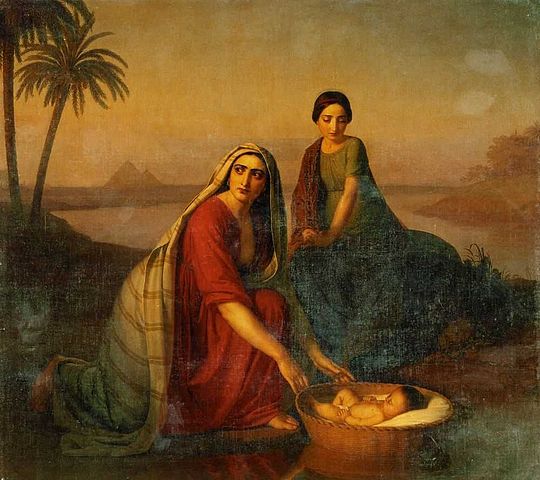

Moses would be educated in the classical liberal arts, as they were known among the Egyptians.
“Stages of Learning” Are Not Classical
The first point of comparison is the organization of the curriculum into what SFCCA calls “stages”. According to SFCCA, the first stage is the “Introductory Grammar Stage”, the second “the Advanced Grammar and Logic Stage”, and lastly a movement to a Rhetoric stage, in which SFCCA claims “students combine facts and reasoning together to make effective and truthful arguments.” These stages correspond to advancement through grade levels as children age. The CLAA for its part does not suggest any such organization of the classical Catholic curriculum into these stages. So, where does this language of stages come from?
The CLAA has researched this question in its work Understanding Classical Catholic Education. In response to the modern public educational movements of the early 1900s which were abandoning traditional education for secular modern education, an English woman named Dorothy Sayers wrote The Lost Tools of Learning in which she claimed to “turn back the wheel of progress” to the end of the Middle Ages where classical education prevailed. To do so however, she conceptually combined modern educational psychology to the names of the traditional classical liberal arts.
Rather than recovering these particular classical arts as subjects to be studied in themselves, she suggested that we divide childhood educational development into three periods, and she used the names of the old arts themselves as the names of the stages. Thus, she took the name “Grammar”, which historically in the classical Catholic curriculum is an art, and applied it to the first “stage” – the Grammar Stage. SFCCA adopts this and suggests this to be “classical” and “Catholic”, but this concept is not found anywhere in historical classical education nor in any Catholic curriculum prior to the 20th century. It is Sayer’s innovation.
The CLAA avoids this error, and maintains that “Grammar” is an art to be mastered, rather than some arbitrary stage of child development. The same follows for the other stages, where Sayers’ novelty orders the curriculum of the SFCCA further into the Logic Stage and the Rhetoric Stage. Rather, in the CLAA, Logic is offered as an art, more formally called Reasoning, of which there are several source texts to be studied by students wishing to begin a classical education. This art, the CLAA argues, is known historically to have been systematized and organized by Aristotle, who wrote the master texts on this subject in his Organon. These texts are actually studied in the CLAA, but are nowhere found in the SFCCA curriculum. This certainly makes the CLAA classical in reality, according to what is historically true, and SFCCA and all programs which follow Sayers, classical in name only.
Where Are the Classical Source Texts In “Classical” Programs?
The second point follows upon the first. In history, the classical liberal arts are seven, which both the CLAA and SFCCA admit. The CLAA argues that the arts are studied and mastered in their source texts and comprise the irreplaceable course of progression for a student in the classical curriculum. The Doctors and educated Saints of the Catholic Church testify to this truth.
In the early Church, St. Augustine stands out as an example of a man educated in classical liberal arts who was able to apply his knowledge of the arts to the study of Sacred Scripture and Divine Revelation, establishing the foundation of true classical Catholic schools, which would never be without these arts! St. Albert the Great in the high Middle Ages is famous for quoting the Scripture “Wisdom hath built herself a house, she hath hewn her out seven pillars” (Proverbs 9:1) as referring to the Blessed Virgin Mary (the house) and the seven liberal arts (the pillars). He and the other great educational Saints of the age (Aquinas, Dominic, Bonaventure) receive the arts as they come to them historically, not as stages, but as formal studies whose master texts are necessary.
We find Aquinas writing entire commentaries on the works of Aristotle as he prays and lives the life of a Dominican friar. In fact, combining sanctity and the study of the arts is what constitutes a “classical Catholic” education for these men. In the CLAA there are no stages, rather there is clearly defined coursework using the same source texts that Aquinas had in his library, combined with an encouragement of sanctity through living the sacramental life of the Church.
On the other hand in the SFCCA, no such clear connection exists between the historical seven liberal arts and the actual content of their curriculum. Where in its program are the texts studied in the CLAA such as the Organon of Aristotle, the Art of Rhetoric by the same, or the masterpieces of Cicero, the Introduction to Arithmetic of Nicomachus, Elements of Geometry of Euclid, the De Musica of Boethius, etc?
The Socratic Method Is Not Essential
A third point of difference is based upon the statement of SFCCA: “A defining characteristic of any classical education is a reliance on the Socratic method.” This reference to the Socratic method is popular in the modern classical educational movement. I would put it to these schools which make such a claim: Where do we find Saints, Doctors or wise men of the Catholic Tradition stating the same? In reality, this superficial reference to the Socratic method is wrong in two ways. First, it is poorly defined. Second, it is false.
As to the first error, the SFCCA defines the Socratic Method as follows: “This rapid-fire give-and-take learning style emphasizes retention, discussion, memorization, and mastery, as well as the capacity to relate timeless truths to the present controversies of our age.” I hate to be crude in my assessment here, but this definition is cringe-worthy and reveals a lack of classical education in its author. Socrates’ method is Dialectic, and is a methodic (not “rapid-fire”) interrogation of contradiction, as defined by Aristotle, who says, “But a demonstrative differs from a dialectic proposition in this; that the demonstrative proposition is an assumption of one part of contradiction; (for he who demonstrates does not interrogate, but assumes) but the dialectic is an interrogation of contradiction.”1 Without a study of Aristotle’s art of Reasoning, one might reduce, as these so-called classical schools do, Socrates’ method to a question/answer group discussion. But it is nothing like this and is a distortion of the actual method of Socrates.
The second error of this reference to the Socratic method as being a defining characteristic of classical education is that it is simply not true. Plato, who provides us with the content of Socrates’ interrogations, is studied by the early Church Fathers who do not have full access to the systematized organization of the Organon of Aristotle. But when Aristotle’s works and the fuller classical liberal arts tradition make their way into the Christian West, Plato is set aside as the superiority of Aristotle is apparent to men like St. Albert the Great and St. Thomas Aquinas.
This method of interrogation is fine in its own right, but is not, nor ever really was, “a defining characteristic” of classical Catholic education as is claimed. In reality, modern schools have group question/answer discussions and call this the Socratic method, giving the impression that this is what ancient wise men were doing. These schools neither study Plato’s works, nor understand the shift to Aristotelian philosophy which fortifies classical Catholic education in the Scholastic era.
The Origin of Liberal Arts
Fourth, it should be noted that there is an overarching difference between these two programs as to the origins of classical education. SFCCA makes the claim: “To a large extent, true Catholic education has always been classical, in the sense that the Liberal Arts Tradition was born in the monasteries of the Catholic Church, and later refined by the first universities the Church established.” This is partly false.
The Liberal Arts Tradition predates the Catholic Church. The Catholic Church receives this liberal education, it is not its origin. Divine Revelation itself testifies to this when we see in the Bible that men like Moses were educated in “all the wisdom of the Egyptians” (Acts 7:22) who had great knowledge of classical Mathematics and Astronomy. His education enabled him to write great treatises on varying topics, as we see in these first books of the Bible. Further, men like King David, who had knowledge of the art of Music, and King Solomon, who was advanced in philosophy and Wisdom, demonstrate again that the knowledge and organization of the arts began long before the Christian era. It is true that the monasteries of Christendom preserved this tradition, but the arts were not born there.
The Great Books Are Not Real Study
Fifth, and finally, we must address the idea that the “Great Books” of western civilization are constitutive of a classical Catholic education. SFCCA makes the claim: “our graduates are already familiar with perennial questions of good and evil, right and wrong, and justice and injustice” from having spent eight years reading the “Great Books”. First, a student does not master the nuances of the questions of good, evil, right, justice, etc. by reading fictional books. St. John Cardinal Newman taught this well: “It is common in an age where books abound to think that the gratification of the love of reading is real study.”2
This warning of one of the greatest Catholic minds of the last century should serve to discredit anyone suggesting that we ought to resort to the reading of books, as great as they may be, as the basis of a classical Catholic education. Rather, the study of the classical liberal arts, and as we have repeated several times now, their actual master source texts, are what is necessary for true study. If a student actually begins to read and study these texts, he soon finds he has very little time for fictional works. Such fictional reading is for those who have already mastered the arts. Yet, we find them offered by “classical” schools as a substitute for actual classical study.
Besides, the list of Great Books differs depending on the school. For SFCCA it even includes the works of Mark Twain, who ironically himself stated that he was “educated to enmity toward everything that is Catholic.”3 While Twain’s attitude toward the Church may be balanced overall, this quote helps us recall that the early American educational system was anti-Catholic in nature. Many of these Great Books authors were educated as Twain was. Are we sure we are educating our children in a “classical Catholic” curriculum?
Conformity with Historical Classical Education
In conclusion, the public statements of SFCCA, and other schools like it, need to be judged according to the actual historical evidence of what comprised a classical Catholic curriculum. Compared to the CLAA, which demonstrates the continuity of its curriculum with this evidence, the differences are so great that I am not sure referring to these schools as classical is warranted.