
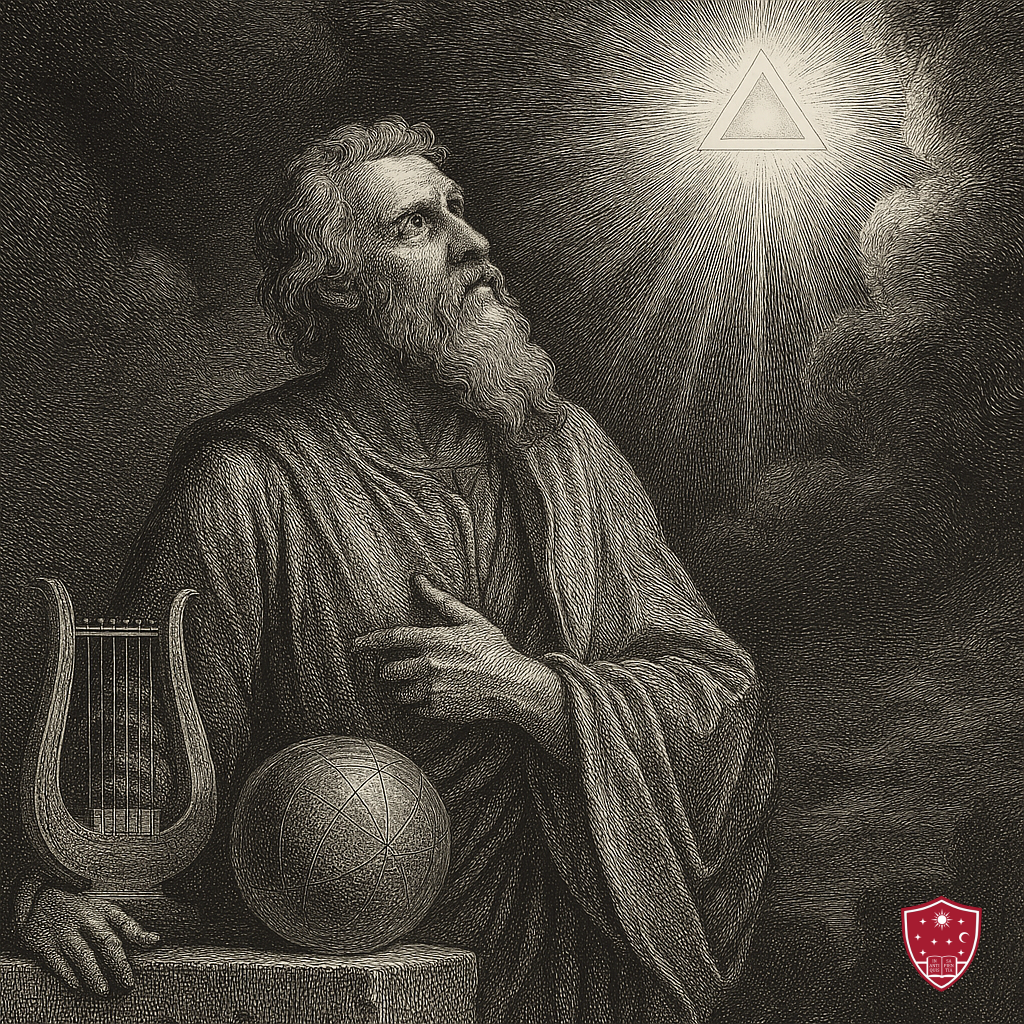
A Catholic Reflection on Nicomachus’ Arithmetic, Book I, Chapter 5
At the heart of creation is not chaos, but order—not randomness, but reason. In the fifth chapter of his Arithmetic, Nicomachus of Gerasa continues his exaltation of number, showing how it lies at the foundation of the sciences and the structure of the universe. For him, number is not merely a tool of measurement—it is the very principle by which the soul rises to contemplate truth. It is, he says, the “mother and nurse” of the other sciences.
For Catholic readers, this view resonates deeply. In the Christian tradition, order reflects the mind of God, who “has arranged all things by measure and number and weight” (Wisdom 11:20). By exploring this ancient chapter, we do not merely recover a piece of mathematical history—we are invited to rediscover the sacred origin of science and the divine harmony that upholds creation.
Why the Absolute Precedes the Relative
Nicomachus begins by observing a logical truth: the absolute comes before the relative. That which simply is must exist before we can compare it to anything else.
For example:
“Great” must exist before “greater.”
“Man” comes before “father,” since fatherhood is a relationship.
“Rich” is prior to “richer,” which implies comparison.
This principle applies not only to logic but to ontology, the study of being. That which is absolute exists in itself. That which is relative exists in relation to another.
St. Thomas Aquinas affirms this in the Summa Theologica: what exists in itself is more real than what exists only in reference. The good, for example, is absolute. To say one thing is better than another presupposes the good.
So too in mathematics, number in itself is absolute. Ratios—fractions, proportions, harmonies—are relative. They describe how numbers relate to each other, but cannot exist unless the numbers themselves first exist.
Thus, Nicomachus begins with arithmetic because it is the study of absolute quantity, the foundation on which all relationships rest.
Harmony in Music: Number Made Audible
This truth becomes especially clear, Nicomachus says, in the science of music. He draws attention to three classical harmonies:
The diatessaron (or fourth), represented by the ratio 4:3.
The diapente (or fifth), represented by 3:2.
The diapason (or octave), represented by 2:1.
Each of these intervals—well known in ancient Greek music theory—represents a harmonious relationship between two tones. The di-diapason, the double octave, is even more perfect, represented by 4:1.
What is striking is this: music is governed entirely by number. Harmony, though heard by the ear, is produced by ratio—by arithmetic relationships between frequencies.
This insight, known to Pythagoras and deeply revered by Nicomachus, reminds us of something profound: beauty is mathematical. Order in sound is not subjective or emotional. It is objective and quantifiable. As such, it reveals a higher law—a divine proportion built into creation.
St. Augustine understood this well. In his treatise On Music, he describes how musical harmony reflects the spiritual harmony of the soul. The mind that grasps order in sound is disposed to seek order in life, and ultimately to contemplate the One in whom all things find their measure—God.
The Stars and Their Movements: Number in the Heavens
If number governs harmony in music, Nicomachus says, it governs astronomy even more clearly.
He observes that astronomy depends on arithmetic not merely because it came later in history (motion follows rest), or because the heavens are musical (which they are), but because the movements of the stars themselves are governed by number.
He lists several celestial phenomena:
Rising and setting
Progression and retrogression
Phases and cycles
All of these are measured by numerical patterns. Ancient astronomers—long before telescopes—discovered that the heavens operate in precise, recurring intervals. The moon follows a 29.5-day cycle. The sun traces a path through the zodiac in one year. The planets move in complex yet knowable orbits.
This is not mere pattern—it is providence. As the Psalmist declares, “The heavens declare the glory of God; the firmament proclaims the work of his hands” (Psalm 19:1). That declaration is made through mathematical precision.
The Church Fathers often saw the stars as signs of God’s eternal order. In the Catholic tradition, this understanding matured into a theology of natural law, which teaches that the universe is not a cosmic accident but a well-ordered whole governed by reason.
Why Arithmetic Comes First
Having shown that both music and astronomy depend on number, Nicomachus concludes: it is right and proper to begin with arithmetic.
He calls arithmetic:
“More venerable”
“More honorable”
“Naturally prior”
And even the “mother and nurse” of the other sciences.
Why? Because arithmetic does not depend on the senses. It begins with pure thought. As St. Thomas says, number is the most abstract and intelligible of all things. Unlike geometry, which relies on figures, or astronomy, which relies on observation, arithmetic begins in the soul’s interior act of counting.
This priority of arithmetic is not about prestige—it is about origin. Without the absolutes of number, there can be no ratios, no harmonies, no cycles, and no comparisons. Arithmetic is the beginning of intellectual order, and thus the natural starting point for philosophy and theology.
From Number to Wisdom
Nicomachus’ insight goes even deeper. He suggests that arithmetic is not just prior to the other sciences—it is the path into them. It leads to music, which in turn tunes the soul. It leads to astronomy, which turns the gaze upward. It leads to geometry, which reveals order in form.
These are not separate disciplines. They are steps on a ladder, each one drawing the soul from sensory experience to spiritual insight.
In Plato’s Republic, Socrates calls arithmetic and geometry “purifiers of the soul.” They train the intellect, freeing it from distraction and preparing it to see eternal truths. As Nicomachus writes elsewhere, these disciplines lead from what is seen to what is understood—from matter to spirit, from sense to intellect, and ultimately from the world to God.
This is precisely what Catholic education once aimed to do: to use the quadrivium—arithmetic, music, geometry, and astronomy—as a preparation for theology, the queen of the sciences. For just as Christ is the Word made flesh, so the order of creation is the word made visible.
Conclusion: The Most Venerable Science
To Nicomachus, arithmetic is not a mere academic discipline—it is a sacred foundation. It reveals the principles of music and the movement of the stars. It orders the mind and prepares the soul for contemplation. It is, in short, the first science, and the most venerable.
For us as Catholics, this should renew our vision of learning. We do not study number for its own sake, nor do we treat it as a servant of commerce or convenience. We study it because truth is beautiful, and number reveals that beauty.
As the Catechism says, “God created the world according to his wisdom. It is not the product of any necessity whatever” (CCC 295). That wisdom is made visible in the harmony of the cosmos and the symmetry of truth.
Let us then return to arithmetic—not only to count, but to contemplate. For through number, we begin to hear the music of creation and glimpse the mind of God.
Mr. William C. Michael, O.P.
Headmaster
Classical Liberal Arts Academy
References
Aristotle. Nicomachean Ethics. Translated by W. D. Ross. https://www.perseus.tufts.edu/hopper/text?doc=Aristot.+Nic.+Eth.
Catechism of the Catholic Church. 2nd ed. Libreria Editrice Vaticana, 1997. https://www.vatican.va/archive/ENG0015/_INDEX.HTM
Holy Bible. New American Bible, Revised Edition (NABRE). United States Conference of Catholic Bishops, 2011. https://bible.usccb.org/
Nicomachus of Gerasa. Introduction to Arithmetic. Translated by Martin L. D’Ooge. https://archive.org/details/NicomachusIntroToArithmetic
Plato. Republic and Timaeus. Translated by Benjamin Jowett. https://www.perseus.tufts.edu/hopper/text?doc=Plat.+Rep.
St. Augustine. De Musica. https://www.newadvent.org/fathers/
St. Thomas Aquinas. Summa Theologica. https://www.newadvent.org/summa/
Wisdom 11:20. New American Bible. https://bible.usccb.org/