
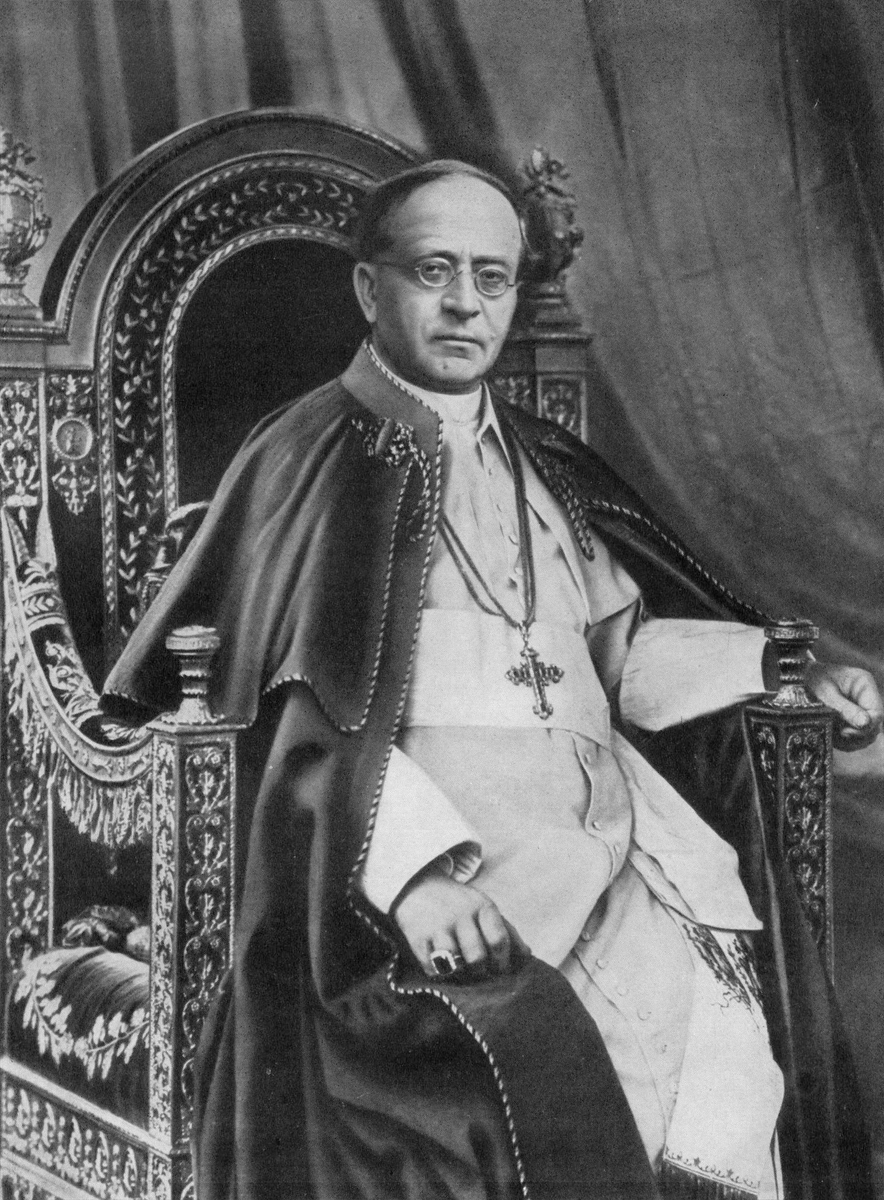
In 1929, Pope Pius XI gave the Church her fullest teaching on education in the encyclical Divini Illius Magistri, “On Christian Education.” Any work that offers classical Catholic education ought to be willing to measure itself against that teaching. I have done so with the Classical Liberal Arts Academy, and I am glad to testify that our work satisfies it.
What follows is not a claim to perfection. It is an account, point by point, of how the Academy was founded, how it is ordered, and why I believe it answers what the Holy Father asked of Catholic educators.
The Prior Right of the Family
Pius XI teaches that parents receive “directly from the Creator the mission and hence the right to educate their offspring,” a right “anterior to any right whatever of civil society” (¶32). He calls the school “subsidiary and complementary” to the family and the Church (¶77), and he laments children being “sent away from home even in their tenderest years” (¶73).
The Academy was built on this principle. It began in 2008 when I was tutoring homeschooled students and parents in other states asked for help. It exists to serve parents who are teaching their own children at home, not to take that work from them.
Our courses are open year-round and self-paced, so each family orders its children’s studies according to its own circumstances. The Academy supplies the curriculum, assessment, records and accreditation. The parents remain the first teachers.
Under the Church
The encyclical places Catholic education “under the direction and maternal supervision of the Church” (¶80). Before I began the Academy in 2008, I asked my Bishop for permission. He arranged two meetings between me and his Vicar of Education, and I was encouraged to go forward. The Academy was submitted to the Church before it ever enrolled a student.
The Academy is run by my wife and me, both perpetually professed Lay Dominicans of the Order of Preachers. We work under a Rule and within the Church, in an Order whose charism is the study and teaching of sacred truth.
We also chose our name deliberately. The Church reserves the name “Catholic” for undertakings her authority approves. For that reason the school is called the Classical Liberal Arts Academy, named for what it teaches. Its Catholic character is found where Pius XI looked for it, in the content and spirit of the teaching itself.
Religion as Foundation and Crown
Pius XI requires that religion be “the foundation and crown of the youth’s entire training,” and that “every other subject taught, be permeated with Christian piety” (¶80). He adds that philosophy must be brought “into full conformity with the Catholic faith,” because it determines “the right orientation of the other branches of knowledge” (¶87).
The Academy’s curriculum is ordered by exactly this principle:
- The Trivium: Grammar, Logic and Rhetoric
- The Quadrivium: Arithmetic, Geometry, Music and Astronomy
- Philosophy: Ethics, Physics and Metaphysics, studied in the Aristotelian and Scholastic tradition
- Theology: Sacred Scripture and Sacred Tradition
The arts prepare the mind, philosophy orders the sciences, and theology crowns the whole.
Families must also meet modern credential requirements, and we provide for them. We recommend efficient programs for modern subjects so that students can satisfy those requirements without letting them consume the time owed to Catholic studies. Popes have long warned that religious learning is crowded out in modern schools. Our approach reverses that order: the modern subjects serve, and the classical Catholic studies lead.
Sane Humanism and the Latin Tongue
Pius XI warns against “the unreasonable rejection of methods so successfully used by that sane humanism,” and he urges that the study of Latin be kept (¶87). He commends St. Basil’s counsel that the Christian teacher should “imitate the bee, which takes the choicest part of the flower and leaves the rest.”
The Academy’s mission since its founding has been “to research, restore, publish and teach the classical liberal arts.” Our Latin program follows the grammar of Emmanuel Alvarez, the textbook of the Jesuit colleges. Our Greek program follows Jacob Gretser. Our Logic program follows Porphyry’s Isagoge and Aristotle’s Organon, and our Geometry course follows Euclid.
We read the pagan classics as the Church always has, taking what is true and good and judging the rest by the light of faith.
Good Teachers and a Good System
Pius XI writes that “perfect schools are the result not so much of good methods as of good teachers,” teachers “thoroughly prepared and well-grounded in the matter they have to teach,” with “a pure and holy love for the youths” because “they love Jesus Christ and His Church” (¶88). Everyone agrees that saintly teachers give the ideal education. The real question is how to educate when such teachers are not available.
When the Holy Father wrote, religious orders and immigrant Catholic communities were supplying teachers in great numbers. That is not our situation. Many Catholic schools today do not even require their teachers to be Catholic.
The Church has answered this problem before. The Jesuit colleges staffed many classrooms with young teachers still in formation, and the Ratio Studiorum gave them an order of studies that carried their work. Francis Bacon, no friend of the Society, advised: “Consult the schools of the Jesuits.” Robert Schwickerath, S.J., in Jesuit Education: Its History and Principles (1903), argued that the Jesuit schools outperformed Protestant schools that had better schoolmasters, and he attributed their success to the superiority of their system.
The Academy’s self-paced program was built for the same purpose. It does not replace good teachers. It is a sustainable, affordable order of studies that the few faithful teachers available to us can operate, and that carries students where no master is at hand. If the Church supplied an army of qualified Catholic teachers, I would gladly put them to work within it.
Against Naturalism
Pius XI condemns “every form of pedagogic naturalism” that weakens supernatural formation, and he rejects systems built on “self-government and unrestrained freedom” that diminish the teacher’s authority (¶60). He reminds us that original sin leaves “weakness of will and disorderly inclinations” in every child (¶58).
The Academy takes this seriously. Unlimited freedom is a real problem for many students, who need order and accountability to direct their attention. Our self-paced courses are therefore joined to regular assessment, recorded progress and tutorial support. Our Semester Courses add fixed terms, weekly deadlines, live instruction and grades that carry consequences on the transcript.
The End of Education
Pius XI sets out the end of all Christian education: “to cooperate with divine grace in forming the true and perfect Christian, that is, to form Christ Himself in those regenerated by Baptism” (¶94). The Christian so formed “thinks, judges and acts constantly and consistently in accordance with right reason illumined by the supernatural light” (¶96).
This is the end the Classical Liberal Arts Academy serves. We support the family’s prior right. Our founding was submitted to the Church, and the Academy is run by professed Dominicans. We keep Latin and the sane humanism the Holy Father defended. We order every study under philosophy and theology, and we use a well-ordered system to multiply the work of faithful teachers.
For these reasons, I testify that the Classical Liberal Arts Academy satisfies the teaching of Divini Illius Magistri. I invite every Catholic family to read the encyclical for themselves and judge our work by it.
God bless,
Mr. William C. Michael, O.P.
Headmaster
Classical Liberal Arts Academy
Sources
- Pius XI, Divini Illius Magistri (December 31, 1929)
- Robert Schwickerath, S.J., Jesuit Education: Its History and Principles (1903)