
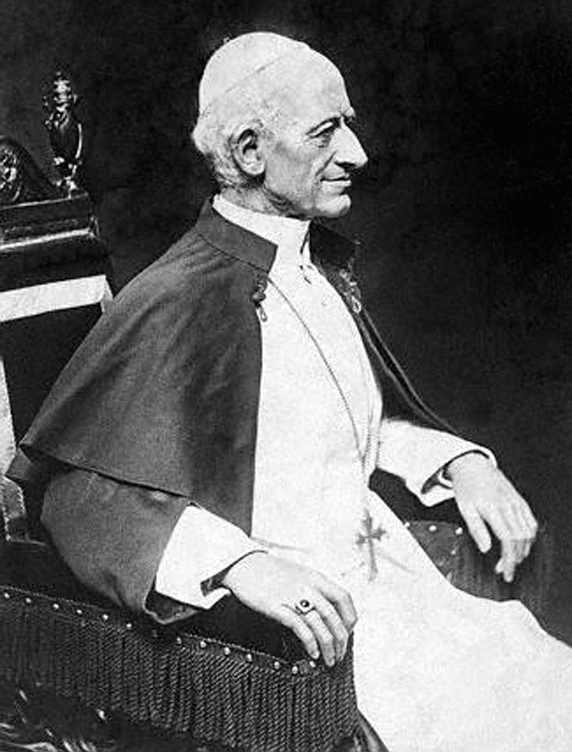
In 1879 Pope Leo XIII issued Aeterni Patris, “On the Restoration of Christian Philosophy.” In it he called on the Church’s teachers to “restore the golden wisdom of St. Thomas, and to spread it far and wide” (¶31). Few documents bear more directly on the work of the Classical Liberal Arts Academy.
I have measured the Academy against this encyclical, and I am glad to testify that our work answers its call. The account below follows Leo XIII’s own argument.
Philosophy Rightly Used
Leo XIII teaches that “philosophy, if rightly made use of by the wise, in a certain way tends to smooth and fortify the road to true faith” (¶4). Rightly ordered, it will “esteem it the highest honor to be allowed to wait upon heavenly doctrines like a handmaid and attendant” (¶8).
The Academy’s curriculum is built on this order. Students first learn the arts of the Trivium and Quadrivium, which train the mind to read, reason and demonstrate. They then study philosophy: Ethics, Physics and Metaphysics. Theology, the study of Sacred Scripture and Sacred Tradition, crowns the whole.
In this order, philosophy is neither neglected nor set up against the faith. It is studied for its own truth and placed at the service of sacred doctrine, just as Leo XIII asked.
St. Thomas, Master of All
Leo XIII traces Christian wisdom from the Fathers to “the doctors of the middle ages, who are called Scholastics,” who gathered “the rich and fertile harvests of Christian learning” (¶14). Among them, “the chief and master of all towers Thomas Aquinas” (¶17). “Philosophy has no part which he did not touch finely at once and thoroughly” (¶17).
The Academy teaches in this school. Our Logic program begins with Porphyry’s Isagoge and Aristotle’s Organon, the instruments St. Thomas himself used. Our philosophy follows Aristotle as St. Thomas read and corrected him, and our theology is taught in the Scholastic tradition.
My wife and I, who run the Academy, are perpetually professed Lay Dominicans. St. Thomas is a son of our Order. Teaching his wisdom is part of our vocation, not merely our curriculum.
Drawn from His Own Fountains
Leo XIII asks that “the doctrine of Thomas be drawn from his own fountains, or at least from those rivulets which… have thus far flowed… pure and clear” (¶31). He wanted students led to the sources, not to secondhand summaries.
The Academy’s lessons are built the same way. Each begins with the master text itself. A detailed written exposition follows, and then a video lecture that explains selected points and applies them. We teach students that careful study of the text is the surest way to master a lesson.
Where a text needs a guide, we use the authoritative manuals of the Catholic tradition, such as Alvarez in Latin grammar and Gretser in Greek. These are the “pure and clear” streams that carried the Church’s learning to generations of students.
For the Young, for Society, and for the Sciences
Leo XIII expected the restored philosophy to bear fruit in three places.
- For the young, he wished to “furnish to studious youth a generous and copious supply of those purest streams of wisdom flowing inexhaustibly from the precious fountainhead” (¶26). The Academy brings that wisdom within reach of homeschooling families everywhere, at an affordable cost, with no books to purchase.
- For society, he taught that “domestic and civil society… would certainly enjoy a far more peaceful and secure existence if a more wholesome doctrine were taught” (¶28). We begin philosophy with Ethics, because moral science forms the person who will one day order a household and serve the common good.
- For the sciences, he held that the ancient philosophy would bring them “force and light and aid” (¶29). Our students study the Quadrivium and natural philosophy, so that modern scientific study rests on a sound understanding of nature and its causes.
Conclusion
Since its founding in 2008, the Classical Liberal Arts Academy’s mission has been “to research, restore, publish and teach the classical liberal arts.” That mission is an answer to Leo XIII’s call. We order the arts to philosophy and philosophy to theology. We follow St. Thomas as the master of all, teach from the sources themselves, and offer this wisdom to families who could not otherwise reach it.
For these reasons, I testify that the Classical Liberal Arts Academy satisfies the teaching of Aeterni Patris. I invite every Catholic family to read the encyclical and judge our work by it.
God bless,
Mr. William C. Michael, O.P.
Headmaster
Classical Liberal Arts Academy
Sources
- Leo XIII, Aeterni Patris (August 4, 1879)