
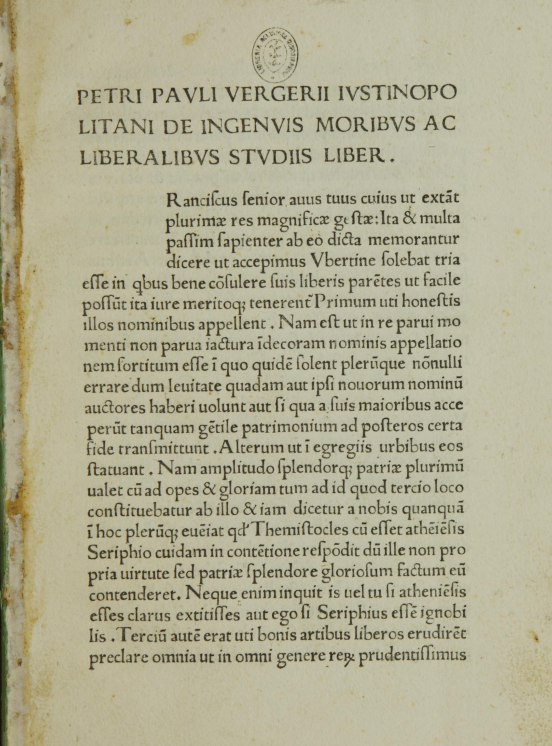
Pier Paolo Vergerio (1370–1444) of Capodistria was a canon lawyer, secretary to Popes Innocent VII and Gregory XII, a participant in the Council of Constance, and afterward secretary to the Emperor Sigismund. He studied at Padua, Florence and Bologna, and taught logic at Padua for sixteen years. About the year 1402 he wrote De ingenuis moribus et liberalibus studiis for Ubertino, son of the prince of Padua. It is the first of the Renaissance treatises on education and the most influential ever written, passing through more than forty editions before 1600, and its principles govern Catholic schooling to this day. We publish it here so that it may be studied as the source of a collapse.
No writing can be judged apart from its historical moment, and this one must be read in the year it was written. In 1402 the scholastic order of learning was not a neglected inheritance awaiting enrichment. It was the living structure of Christian education: the seven arts as the roads by which a mind is led into philosophy, philosophy ordered to sacred theology, and the whole held together by demonstration. Vergerio knew that order from the inside, having taught its foundational art in its foremost university. What he proposed was not an addition to it. It was a different center.
The evidence is in the treatise itself. He names as the chief studies of a free man history, moral philosophy, and eloquence — and gives his reason: eloquence is a part of civil science, philosophy enables us to think rightly, and history assists in both. The measure throughout is usefulness in public life. No study in the book is justified by its place in the order of the sciences. Divine science receives a single sentence, set after medicine and law, in what is a catalogue of subjects and not an order of learning. He then declares that the disciplines need not all be mastered, and that each student should embrace above all that for which he is best fitted — which is not a modification of the scholastic ordo disciplinae but a denial that any fixed order exists. He quotes Aristotle against lingering too long in the liberal sciences, on the ground that the speculative man is of little use to the city — a conclusion the Philosopher himself denies, having taught in the tenth book of the Ethics that contemplation is the highest and happiest activity of man.
The treatment of rhetoric is the clearest proof of what is intended. Vergerio complains that oratory has been driven from the courts, where men now contend by turns in the manner of the dialecticians. He is naming scholastic disputation as the thing that displaced eloquence, and he treats that displacement as a loss to be repaired. He does not ask that logic be abandoned. He praises it, ranks it second among the arts, calls it the science of learning and the discipline of knowing — and asks that eloquence be restored to the place logic has taken. That is the method by which logic was lost, and it has never required anything more. It has only ever been necessary to call the art preliminary, to declare that not everything must be mastered, and to let the usefulness of other studies do the rest.
The reader will find scholastic language throughout these pages — the speculative and practical intellect, metaphysics as divine science, the division of the rational and real sciences. Let him mark it well, for it is the pattern of every substitution that has followed. The vocabulary survives; the meaning does not. Logic is the only art that judges, and no education built to produce eloquent and useful men has ever had use for a student able to take an argument apart. What follows upon its loss is not error merely, but the incapacity to detect error — and a Catholic learning that can no longer demonstrate is left holding its doctrines upon authority alone, defenseless before the first man who denies them. Six centuries of consequences are contained in these few pages. They were not written by an enemy of the Church, but an insider. Read them closely.
PIER PAOLO VERGERIO OF JUSTINOPOLIS: A BOOK ON THE CHARACTER BEFITTING A FREEBORN YOUTH, AND ON LIBERAL STUDIES.
Translated with comments by William C. Michael, OP
Francesco the Elder, your grandfather — of whom, as many magnificent deeds survive, so also many wise sayings are everywhere remembered — used to say, Ubertino, as we have heard, that there are three things in which parents, just as they easily can, so also are they in right and justice bound to provide well for their children. The first is that they should give them honourable names. For it is, in a matter of small moment, no small loss to have been allotted an unbecoming form of name; and here a good many are apt to go wrong, when out of a certain frivolity they either wish to be reckoned themselves the authors of new names, or else hand on to their descendants, with unwavering fidelity and as though it were a family inheritance, whatever names they have received from their forebears. The second is that they should establish them in distinguished cities. For the greatness and splendour of one’s native city avail much, both toward wealth and glory and toward that third thing which he used to put last, and which I shall state in a moment — although in this matter what Themistocles, being an Athenian, replied to a certain man of Seriphos in an argument generally holds good, when the other contended that he had become famous not by his own merit but by the splendour of his native city. “For neither,” said he, “would you have risen to distinction if you were an Athenian, nor I have remained obscure if I were a Seriphian.” The third was that they should have their children educated in the good arts — admirably said in every respect, as by one who both was, and was held to be, the most prudent man of his time in every kind of affair.
But that last point he put most aptly of all. For parents can provide their sons with no sturdier riches, nor surer defences of life, than to present them furnished with honourable arts and liberal disciplines; for men endowed with these have commonly raised up and made illustrious both the obscure names of their family and their humble native places. For the laws allow anyone to change his name, provided it be done without fraud, and no one is forbidden to move his residence whenever he pleases. But unless a man has been trained in the good arts from youth, or if he has become infected with corrupt ones, let him not lightly hope of himself that at a riper age he will be able either to throw off the one or to acquire the other on the instant. The foundations of living well must therefore be laid at this age, and the mind must be shaped toward virtue while it is still tender and ready to take any impression whatever — an impression which, such as it is now, will be kept so through all the rest of life.
But while it befits all men — parents first of all — to be such as take pains to educate their children rightly, and children in turn such as may appear worthy of good parents, it is nevertheless especially becoming in those who stand in a loftier station, and none of whose words or deeds can lie hidden, to be so equipped with the principal arts that they may be held worthy both of their fortune and of the rank of dignity they hold. For it is only fair that those who wish all the highest things to be owed to them should on their own part be bound to render all the highest things. Nor is there any surer or steadier principle of rule than that those who hold sovereignty should be judged by all the worthiest of all to rule.
Wherefore, Ubertino, since in the first place you have been allotted a name long famous in your family and lately made illustrious by him who, sixth in descent, held the principate of your line; and since, next, you were born in this most ancient royal city, which both flourishes in the pursuit of all the good arts and abounds in a plenty of all things for men’s use — born of a line of princes, and of a father who is himself the prince, under whose leadership both the happy state of the city and the most illustrious name of your family grow greater by the day — I rejoice greatly, as my own loyalty and the goodwill you and yours bear me require, that I see you carried with every effort toward the good arts and noble studies, partly through your father’s care, but most of all by your own judgement. For although those three things I have mentioned seem to be looked for chiefly from parents — and in each of them I am not the man to deny that parents can do a great deal — still, it is chiefly parents who impose names upon their children, while it is chance, and never choice, that gives a man his native land. But the good arts, and virtue itself, each man procures for himself. And virtue is to be longed for above everything that men can seek by their own effort. For wealth, glory and pleasures are fleeting and perishable things, whereas the possession and fruit of the virtues stands entire and remains for ever.
If, then, I were to urge you to pursue this diligently — though I gladly perform that office — I see nonetheless that it is unnecessary. For what else can I advise you to do than what you always do? Or whom else can I commend to you as a model of virtue than yourself? For since you appear so established by nature herself in the endowments both of mind and of body that one may hope every great thing of you, and since you in fact render everything greater still, so that you outstrip not only the hopes but even the prayers of all — what is there by which you could be more forcibly urged on by anyone’s exhortation, or more kindled by the imitation of others?
It is in your name, then, that I have undertaken this brief work and have set about writing to you about the liberal studies and the character of youth — that is, in what pursuits freeborn young men should be exercised and what they should beware of. My aim is not to admonish you yourself, but through you to admonish others of that age; and that, while I lay down for others what ought to be done, you may recognize in yourself what you already do of your own accord.
Since man is composed of soul and body, those seem to me to have obtained a great thing from nature to whom it has been granted to be strong both in bodily powers and in mind. For when we see so many to whom it has fallen at birth, through no fault of their own, to be both slow of wit and feeble of body, how great the thanks we ought to render to nature if in both respects we are sound and vigorous! But worthy thanks will be rendered her only if we do not neglect her gifts, but take care to cultivate them with right studies and good arts. At the outset, then, each must examine his own talent for himself; or, if our years do not yet allow us to weigh it, our parents and the others who have charge of us must observe it. Our studies should be directed chiefly toward those things for which we are by nature inclined and apt, and in these we should be wholly engaged. Above all, those who have received a liberal nature must not be allowed either to grow torpid in idle leisure or to be entangled in illiberal occupations.
Now the first proof of a liberal nature is to be stirred by the desire of praise and kindled with the love of glory;* from which springs a certain noble jealousy, and a rivalry in praise and honesty that carries no hatred with it. The next is to obey elders willingly and not to be defiant toward those who advise us well. For as those horses are held better for battle which are easily governed by the hand and which prick up their ears and exult at the blare of the trumpet, so those among the young who listen well to their monitors, and are roused toward the good by praise, seem to hold out the promise of an abundant harvest. For since men inexperienced in affairs cannot grasp by reason the good itself, the very face of virtue and honour — which, if it could be seen with the eyes, would awaken a wondrous love of wisdom, as Plato says** and Cicero recalls of himself — the step nearest to this is that from the desire of glory and praise they should be willing to strive after what is best.
* Here we see the point of departure of counterfeit liberal education. Vergerio establishes what Aristotle identified as the political life as the end of the “liberal” man. This contradicts the teaching of Aristotle and the Church, which identified the contemplative life as the proper and highest end of man. -WCM
** Plato held that the young cannot yet see the good by reason — and his remedy was the ordered ascent through the mathematical arts to dialectic, by which the soul is turned toward it. Vergerio keeps the difficulty but replaces Plato’s remedy, putting the desire of praise in its place. We see here the habit of quoting words for an appearance of authority while changing the interpretation without context.
Further, those who are prompt in action, who shun idleness and always love to be doing something rightly, seem well disposed by nature. For — to keep to comparisons of the same kind — just as those racehorses are held the better which spring forward the instant the signal is given and do not stand waiting for the prick of the spur or the stroke of the lash, so those young men are to be reckoned excellently framed for the works of virtue who come back briskly and without a monitor, at the appointed hours, to their accustomed studies and to exercises briefly laid aside. It is well, too, if they fear threats and blows, but better still if they fear disgrace and dishonour, from which springs modesty — the best of all signs at that age. It stands well, then, if when rebuked they blush, if when chastised they grow better, and if they love their teachers; for that is evidence that discipline itself is loved. Nor is there less hope of every kind of goodness to be had of those who are by nature kindly and easily appeased.
For there is something in the mind like what is in the body. As in the body it is a mark of a good constitution that the stomach recoils from no food but readily receives whatever is put into it and works it up into nourishment for the limbs, so also to hate or despise no one, but to take whatever is said or done in the better part, is a sign of a mind well established by nature herself. Many proofs of this kind can be drawn from character. As for bodily constitution, Aristotle wrote that those who are soft of flesh are apt in mind; for the rest, one must consult those who profess that each man’s talent and native character can be detected by physiognomy — a whole science which I here pass over. But for the most part, as I have said, it can be discerned from our disposition while we are still young what sort of men we shall turn out to be. For from the very beginning of life nature puts forth in some a token of the goodness to come, like little blossoms; and so we call those youths of good disposition who, by the very cast of their face, by their bearing and their other acts, seem to promise well of themselves. And as it is shameful in these to disappoint men’s expectation, so praise is granted to those who, without any such sign, have nevertheless turned out well — resembling that kind of fruit which keeps a sweet savour beneath a rough and unsightly rind.
* Here Vergerio (a Catholic author) accounts for a boy’s goodness with Stoic teaching, not Christian. Aristotle is again cited to give an appearance of authority to a teaching Aristotle expressly denies, having held that the virtues arise in us neither by nature nor against nature. In the same passage we find the principle behind the sorting of children and their placement into “tracks”: that a boy’s nature can be read early enough to assign him his future. This is not Catholic teaching.
Hence Socrates gave the good precept that young men should look often at their own image in a mirror, on this principle: that those who had dignity of appearance should not dishonour it by their vices, while those who seemed of less comely form should take care to make themselves beautiful by their virtues. But perhaps they will attain this same end better if they look not so much at their own appearance as at the character of some approved man — a living mirror. For Publius Scipio and Quintus Fabius used to say that they were greatly stirred by gazing upon the likenesses of illustrious men, as happens to almost every noble mind; and this same thing fired Julius Caesar too, when he saw a likeness of Alexander the Great, to aim at the summit of affairs. What then may we expect to happen when one may look upon the living likeness itself, an example still breathing? — although the likenesses of ancestors perhaps rouse the mind more to the emulation of glory, for this reason: that a man’s presence commonly diminishes his glory, and envy is wont to attend the living. Yet for a sure example of virtue and conduct, and for all instruction, the character of a living man avails more, just as the living voice does.
The studious youth, then, whom the desire of virtue and true glory stirs, ought to choose one man, or several, as many as seems good, of the most approved sort, whose life and manners he may imitate so far as his years allow. And while those men, and others older in years, should observe a rule of gravity and modesty at all times, it must be kept most carefully of all in the presence of their juniors. For the age of youth is prone to go wrong, and unless it is held in check by the example and authority of its elders it easily slips ever into the worse.
But since there belong to the young, from their very age, certain characteristics of their own — as happens to the other ages of life as well — those of them that are good must be strengthened and helped by practice and precept, while those that are bad and blameworthy must be corrected. Of these traits some follow merely from nature, some from want of experience, and others from the two together. In the first place, then, the young are by nature open-handed and generous, because they have had no experience of want and their wealth has not been won by their own labour; for it does not usually happen that a man squanders recklessly what he has gathered by toil. At the same time heat and blood abound in them, not only for the body’s nourishment but for its growth as well — the contrary of which happens in the old, the opposite cause producing it. What sort of old man, then, are we to expect him to become who is tight-fisted and grasping in his youth? Not that lavish giving is to be permitted the young, since they do not know how to practise it with discrimination as to the number of the persons and their deserts; but because meanness is the mark of a corrupt nature and an illiberal disposition. Such young men are suited to the money-making arts, to manual work or trade, and above all to the management of household property; and even when they have sometimes attained the nobler arts they still always reduce these, like everything else, to base gain — a thing utterly alien to freeborn minds.*
* Vergerio uses “base gain” not for greed but for the necessity of earning — a social judgment, not a moral one. Here he abandons the Benedictine model of work and prayer, where the same men labor and read, and sorts boys instead into students and workers. In the early 1900s, child labor and compulsory education laws brought all children into the public schools — which then sorted them again, into vocational and college tracks, by the same principle.
Next, they are of good hope, and readily promise themselves many great things, and above all a long life, since their natural heat is in excess, as though it would suffice for every task and for all time. For this very reason they are high-spirited and lofty of heart, since it is the property of heat to carry upward; whence it comes about that they are arrogant and, as Flaccus has it, harsh to their monitors, and insolent to others, exalting themselves. For they long to excel, and therefore, wishing to seem to know much, they are quick to disclose what should be kept close, and in their boasting are commonly found liars. At the same time, because they are inexperienced, they are deceived in very many things while supposing that they speak the truth.
From this idle habit of lying they must be deterred above all. First, because those who grow used to lying in youth keep the habit when they are men, and nothing is baser than that. Secondly, because scarcely anything gives their elders equal offence as the lies of the young, who, born but yesterday, set about circumventing old men with their tricks. It will help, too, if they are advised to speak little and rarely to say anything unless bidden. For in much talk there is always something that can be found fault with; and if one must go wrong on one side or the other, it is far safer to be silent than to speak. For he who is silent at the wrong moment errs in this one thing only, that he is silent, whereas in speaking one may go wrong in many. Care must also be taken that they do not grow used to foul and dishonourable talk. For as the Greek poet said and the apostle Paul repeated: evil conversations corrupt good manners.
By the principle stated above, since they are eager for distinction they are also modest, because they fear dishonour and remember the recent chastisement of parents and master; and at the same time, being inexperienced, they think they can easily be refuted. They are likewise too credulous; for from want of experience of affairs they believe whatever they hear to be true. They also change their opinions readily, since their humours are in motion on account of the body’s growth, and heat abounds, which chiefly produces such movements; and the soul follows the body’s temper. And so, as they easily desire what they lack, so when they have got it they are soon sated. They pursue their passions most keenly and do everything vehemently, since their desires are sharp and heat inflames them, and they are not strong in reason and prudence, which […] For my own part, following the Sosia of Terence*, I think it not unreasonable that this above all is useful in life: that everything be done fitly, and nothing to excess. They are compassionate too, and not of a malicious disposition, since they are near to their birth and have kindly blood; and they judge others by themselves, and because they have themselves done few wrongs they believe that others suffer unjustly. Most of all they delight in friendships and love good fellowship — which they commonly both form and break off on the same day.
* Note Vergerio’s habit of citing profane sources almost exclusively, and a wide variety of them: Aristotle, Plato, Socrates, Cicero, Terence. This is not the teaching of St. Thomas Aquinas. Sacred Scripture appears once, and then as repeating a Greek poet; no Father, no Doctor of the Church, no saint, and Christ is never named. We have moved from the doctrine of wise men to the memorable sayings from literary sources.
In accordance with these observations, then, teaching must be applied: the good traits are to be taken up, while the bad must either be lessened or rooted out altogether. As for the care of the young, although very much is left to domestic discipline, some things are nevertheless commonly settled by law — though everything ought to be, I should almost say. For it is a public concern that the youth in our cities be of good character; and if young men are trained on a rational plan, that will be useful to the cities and good for the young themselves. But to speak more particularly: they must above all be kept from those faults into which nature easily leads them at that very age. For the ages of life have each their own peculiar vices. Youth burns with lust, middle age is tossed by ambition, old age is eaten up with covetousness and greed — not that all men are so, but that by their age men are more prone to these vices.
Care must therefore be taken that the young be kept unspoiled as long as possible, for untimely love unnerves the powers both of mind and of body. This will be secured if they are kept from dances and other amusements of the kind, and likewise from all frequent company of women, and if they neither speak nor hear anything of such matters. For since of themselves they are swept toward love by the heat of their years, no hope will be left if a companion of evil counsel is added besides. It will help most of all if they are never let go idle, but are always kept at some honourable labour of body or mind. For idleness makes men prone to lust and to every kind of intemperance; and so young men suffering from too much well-being will fitly be cured by plenty of hard work.
Nor is idleness their only enemy: solitude too is bitterly hostile, since it soothes a weak mind with continual brooding upon such things and does not let it turn elsewhere. For just as those who are gripped by despair are least of all to be trusted to solitude, so also are those whose minds are bound fast by pleasure. They must therefore be kept from all filthiness and abominable baseness, watched with great care, and entrusted to none but those whose character and whole life are thoroughly known, and by whose example they will not be led into sin but rather held back by their authority. For just as men bind stakes to the tender shoots of trees so that they cannot be bent aside either by their own weakness or by any force of the winds, so companions must be provided for the young, by whose warnings they may learn, by whose watchfulness they may be checked, and by whose imitation they may make progress.
They must also be restrained from growing immoderate in the other things that belong to daily life. For too much food and drink and too much sleep come rather from habit — not that I would deny that more or less of these is owed to the various constitutions of bodies, but because in all men nature is content with few supports if we look to necessity, whereas if we look to pleasure nothing can ever seem enough for it. From wine they must be kept back most of all at that age, since excessive use of it is an enemy to good health and greatly disturbs the exercise of right reason. In this matter the practice of the Lacedaemonians seems to me by no means to be condemned, who took care to have drunken slaves brought into their banquets — not that they might be entertained by their foolish talk or foul behaviour, for it is an inhuman pleasure to take delight in another man’s harm or vice, but that they might show their young men by example how base a thing it is to be seen drunk. Boys, then, should be given drink in such a way that from their tender years they grow accustomed to having their water flavoured with wine rather than their wine watered, and so soberly and so seldom that the drink may seem given rather to soften the food than to quench thirst. For it is unbecoming — and belongs neither to virtue nor even to good health — to measure food and drink by the belly, or to make one’s sleep as long as the winter nights, or to set the limit of pleasure at satiety. Rather we should govern everything by reason and so train ourselves that we can easily bridle the impulses of youth, and judge that not everything which power or opportunity permits us to do is therefore fitting for us to do.
Before all things it becomes a well-trained youth not to neglect the care and reverence of religion, and to be steeped in that conviction from his earliest years. For what will be sacred among men to him who despises the divine? Yet he should not be carried as far as an old wife’s superstition, which at that age is usually much condemned and left open to ridicule, but should keep a fixed measure — though what measure can be applied in a matter where all that we can do falls short of the measure? But especially, since it is abominable at every age, they must be warned not to blaspheme holy things, nor to hold sacred names up to mockery, nor lightly to swear of their own accord; for those who swear rashly grow used to perjuring themselves often.
Next, the greatest reverence should be shown to the old and to those greater in years, and they should be reckoned almost in the place of parents. In this the Roman youth was admirably trained by ancient custom: on the day the senate met they escorted the senators — whom they called Fathers — into the senate house, waited constantly there before the doors, and when the senate rose attended them home in numbers. These were surely the first exercises of that steadfastness and endurance which they were to show at a riper age. Those young men, then, who gladly keep close to the old and do not readily leave those from whom they may profit, seem with good reason to wish to outrun their years by their virtue. They must besides be taught how properly to receive those who come and to take leave of those who go; how they should greet their elders respectfully, welcome their juniors kindly, and meet friends and well-wishers on familiar terms. And while these things sit becomingly on all men, in princes and their children they appear especially graceful and are especially noticed; for in such men affability is commonly loved and gravity praised. In both, however, one must beware that gravity does not pass into boorish harshness, nor affability into buffoonish frivolity.
These things they will be able to attain if each readily allows himself to be corrected and advised — a practice wholesome at every age and in every case and condition. For as we learn the blemishes of our face by holding a mirror before it, so by the reproofs of friends we weigh the errors of our mind; and that is the step nearest to amendment. But those lie most open to deception who can hear nothing that gives them pain. It is the mark of a weak stomach to be able to bear nothing but delicacies; and so it is fitting to be able to endure those who speak ill of us and to listen to those who rebuke us. For he who will not suffer himself to be corrected to his face is not commonly defended behind his back.
But it becomes those most of all who are of loftier fortune, and in whose hands lies the law of cities and peoples, to hear those who advise them well not merely with patience but even gladly; inasmuch as they themselves, through their great licence, are the more prone to go wrong, and their faults usually harm the greater number. And this must be attended to all the more because few dare to tell them what is true and fitting, and fewer still are willing to hear it — for the man who wishes to hear the truth easily finds someone from whom to hear it. And so it may well seem a wonder if any man is good or wise who has been born to power and great fortune and has never known an adverse turn; and if there be any such, I hold that he should be loved and honoured as a kind of earthly god. For amid an abundance of everything that ministers to every pleasure, and the power of obtaining whatever they desire, and a vast supply of flatterers — who commonly turn fools into madmen — there is scarcely anywhere room left for reason and sound judgement. Plato saw this finely and put it aptly in a few words, a passage which I here render word for word from the Gorgias: “It is difficult,” he says, “and most worthy of praise, to have lived justly amid a great licence of doing wrong.”
But excessive indulgence on the part of parents also commonly softens and unnerves the young, as is generally plain in those who have been reared in indulgence under widowed mothers. I approve, therefore, the custom found among certain peoples, of having their children brought up either outside the city or at least outside their own house, among kinsmen or friends. And even though they often find these more indulgent, the very knowledge that they are living in another’s house* takes from them the looser sort of licence and makes them more attentive to those better studies which we call liberal — of which it is now time for me to speak.
* It’s worth noting that, contrary to the messaging of the modern homeschooling community, education for this political life is not well-suited to home education.
We call those studies liberal, then, which are worthy of a free man: those by which virtue and wisdom are either practised or sought, and by which body or mind is disposed toward all that is best.* From these men commonly seek honour and glory, which are the first rewards set before a wise man after virtue itself. For as gain and pleasure are set up as the end for illiberal natures, so are virtue and glory for the freeborn.** We ought therefore to bend ourselves to these from earliest childhood and to strive after wisdom with every effort. For if there is not one of the private arts — even among those that demand less sharpness of wit — which a man can master excellently unless he has applied himself to it from his tender years, what shall we judge of wisdom, which is made up of so many and such great matters, and in which art are contained the precepts and principles of a whole life? We shall assuredly not be — since we all wish both to be thought wise and to be so — we shall not, I say, be wise in old age unless as young men we have first begun to be wise. Nor should we accept what almost everyone takes for granted, namely that those who as young men are wise beyond their years commonly lose their wits in time when they grow older — although in some men this does not conflict with philosophical reasoning, since their faculties are vigorous while they are still boys and afterwards wither as their age advances. In this connection a certain old man was neatly answered by a youth; the names of both are unknown. For when the young man was held to be prudent and upright beyond his years, and they were pointing him out to the old man as a marvel, “He will be a fool in his old age, then,” said he, “who is so wise in his youth” — and that with his voice raised, so that the young man should hear. But the youth, forgetting nothing of his native sharpness, turned on him at once. “You, then,” he said, “were splendidly wise in your youth” — and, as the saying goes, ran him through with his own weapons.***
* The first clause is true, but watch what “all that is best” comes to mean. Within two lines the end is honour and glory, and Aristotle rejects honour as the human good precisely because it lies with those who bestow it rather than with the man himself. Vergerio does not report this as an error; rather, he builds on it, making the desire of praise the first proof of a liberal nature.
** Aristotle names three lives: pleasure, honour, and contemplation. Vergerio names the first two and drops the third (the one Aristotle ranks highest) and presents the remaining two as the whole field. A false dilemma, and not an accidental one: the man who wrote this had taught logic for sixteen years at Padua and cites the Ethics elsewhere in the same treatise. We see the aversion to contemplative life which would later become a foundation of the Protestant schism.
*** Having just urged reverence toward elders, Vergerio offers this as a model of wit: the boy’s retort admired for its sharpness, the old man run through with his own weapons. The anecdote teaches what he had just warned against, and what it holds up for imitation is not the virtue but the victory.
And indeed there is by nature in very many young men such quickness of mind in understanding, and such keenness in inquiry, that even without much learning they can speak on the greatest matters and deliver the weightiest judgements; and if their inborn power is strengthened by learning and helped by discipline, the result is commonly the making of the greatest men. But as these are to be carefully tended, so those of middling ability are not to be neglected — rather they are to be helped the more for this very reason, that the force of nature in them is the weaker. All alike, however, must be bound over from boyhood to studies and labours, “while the minds of the young are pliant, while their age is still mobile,” as Maro’s verse has it;* and we must press the harder then, in proportion as that age is fitter for teaching than the rest — although one must learn at every age, unless perhaps it is sometimes more shameful to be learning than not to know. Cato, the head of that Porcian family, showed the contrary: he learned Latin letters when nearly an old man, and Greek when he certainly was one, and did not believe it shameful for an old man to learn what it was noble for a man to know. Socrates too, so great a philosopher, took up the lyre when already advanced in years and handed over his fingers to a master to be trained — while our young men meanwhile, if it please God, are too soft to trouble themselves with learning, and, scarcely yet weaned, are ashamed to be under a master.
* “Maro” = Publius Vergilius Maro (i.e., Vergil). Again a poet rather than a moral authority; and the line is from the Georgics, where Virgil is describing when to break young livestock, while they are still pliant. That is the image offered for the formation of a boy’s soul.
Yet they must by no means be left to their own judgement, but must be drawn to good and right studies by various devices. Some are to be enticed by praise and the show of honour, others by little gifts and coaxing, others must be driven by threats and the lash. And all this must be duly weighed and governed by reason, so that teachers may use these methods by turns even upon the same nature; and care must be taken that they be neither too easy with them nor too severe. For as excessive licence dissolves a good disposition, so harsh and unremitting punishment unnerves the force of the mind and puts out the little fires of nature in boys, who, while they fear everything, can dare nothing; and so it comes about that they go wrong almost always, precisely because they are afraid of going wrong in each particular. Those especially in whom black bile abounds must be held with a looser rein: it is fitting that they be left very much to their own discretion and be cheered with liberty and with jesting. In this class of temperament are found — not all, as Aristotle would have it, but certainly very many — of the gifted.
But it happens that many endowed with a liberal nature, while they are striving to follow right studies, are either called back by a hand laid upon them, or forced to halt in mid course by barriers set in their way, or turned aside elsewhere. To very many, narrow family means have been the hindrance, which has forced a free mind, born for better things, to be a slave to gain* — although a noble nature commonly rises to the heights through the greatest difficulties, and lavish abundance is wont to harm good talents more than utter poverty does. Of such men it is often said, not without indignation: “How great a man this would have been, had he been born to smaller fortunes!” Others have been thwarted by their parents’ command and by a habit taken up from infancy. For what has been our habit when we were younger we readily keep to when we are grown, and boys willingly let themselves be given over to those pursuits of their parents in which they were born and bred. We also follow very much what is customary in our cities, as though whatever the rest approve and do were the best thing to do. This deliberation, then, is the hardest of all; for either it is not free, or we come to it only when already steeped in false opinions drawn from bad custom and from men’s perverse talk.
* Vergerio says a poor man who must work for a living is “a slave to gain.” He means simply that he has to earn money. Work itself is the slavery. St. Benedict’s monks worked with their hands and studied every day, and no one called them slaves. This is not a Catholic view of work. Vergerio seems interested in leading his reader to despise the poor and working class, which leads to a dilemma: the men actually teaching in the universities of his century were mendicants, owning nothing and living on alms. St. Thomas Aquinas was an example of such men.
Yet it has been granted to some, by God’s singular gift, that of themselves and without any guide they were able both to find the right road and to keep to it. Few indeed are these, and such as, in the poet’s words, “impartial Jupiter loved” — or even begot, if we may grant something to the fables as well. Such above all we have heard Hercules to have been, as the Greeks relate and the Latins after them record.* For when he saw two roads before him, the one of virtue and the other of pleasure, being then at that time of life when the deliberation about one’s whole life must be undertaken, he withdrew into solitude; and there, thinking long and much with himself — for that age is weak in judgement and counsel — he at last rejected pleasure and embraced virtue. Whence, through many and heavy labours, he built himself a road to heaven in the belief of men.
* Here Vergerio speaks of “God’s singular gift,” but then illustrates it with Jupiter’s favour, allows that Jupiter may have fathered such men, and offers Hercules as the example. A Christian writing on how a man is led to the right road without a guide had Scripture and the saints to draw from. He chose a pagan demigod. His authorities are not Christian ones, and this is not an isolated lapse but the habit of the whole treatise. Here is the Renaissance at its beginning: Christian men forming Christian boys on pagan exemplars, with the Christian sources left on the shelf.
So he did; but it goes well enough with us if we are led by precept and by the hand to be good, or if we are even driven to it by some force and necessity. For happy is the necessity that compels a man to the good. And I see that this too has in part befallen you, Ubertino. For whereas among men’s studies and arts there are two chief ones, most nearly allied both to the cultivating of virtue and to the winning of glory — namely the discipline of arms and that of letters* — and whereas your father’s indulgence would have allowed you to follow the military one alone, which is almost the peculiar property of your family, you have so tenaciously embraced both, with industry and zeal, that, having left your equals far behind, you can contend even with your elders in either kind of praise. You do rightly, then, in not neglecting the military discipline in which your ancestors always excelled, and in having attempted to add to this old family glory the new praise of letters besides.
* Vergerio says “men’s studies,” but names only what a prince needs: arms and letters. This is not a division of the sciences. It leaves out the contemplative life entirely. What if Ubertino decides to be a monk? Vergerio has nothing for him.
For you do not seek to imitate those men — and there is a huge crowd of them in our times — who shrink from the repute of learning as from a disgrace; nor do you approve the opinion of Licinius, once emperor of the Romans, who used to call letters a poison and a public plague. Far rather you approve what that other said: that commonwealths would be happy if either the students of wisdom governed them, or it fell to their governors to study wisdom.* And indeed, for this is the truth, the disciplines of letters take away neither folly nor malice. Nay rather, just as they greatly help those who are born for virtue and wisdom,** so very often they are either the means by which folly is exposed or the instruments of more destructive wrongdoing. For — not to depart from the Roman emperors — we have heard that Claudius was certainly learned, and it is agreed that Nero, his stepson and successor in the principate, was highly educated; yet the former was of notable folly and the latter was stained with cruelty and every kind of outrage. And Nero once said, under the pretence of clemency, that he wished he did not know how to write — a thing he might indeed have wished for himself, if only there had been no other way for him to be merciful than by being ignorant of letters. But I suppose that if he had been quite free to cast out letters as well, which lodged ill in him, he would have done it as promptly and as gladly as he threw off that clemency he had feigned for a season, so that no room might be left in him for any of the virtues or the good arts.
* Vergerio cites Plato’s saying that cities are happy when philosophers govern or governors study wisdom. But Plato’s philosopher has completed the ascent to the good and must be compelled to rule, since he would rather contemplate. Vergerio’s governor is not advised to study the Platonic curriculum, and is warned not to linger in the liberal sciences, but to seek glory. Plato’s words are quoted but “philosophy” now means something different. By now the method is plain: he quotes the authority correctly, then draws a conclusion the author denied.
** Virtue and wisdom have no correlation to birth or social status. These are acquired by habit and given by grace, which is why the Church opened her schools to whoever wished to study. An example of such is St. John Bosco, who was a peasant’s son who excelled in studies and taught poor boys to pray, work and study. This worldview being taught by Vergerio is not Catholic.
Jacopo da Carrara, your great-grandfather, was the contrary: a prudent man and a great-souled prince, who, though not himself greatly learned, honoured learned men to a wonderful degree, thereby showing that this one thing had been wanting to his fortune, that he was not so educated as a modest man might wish to be. And in old age a man may indeed wish for learning, but he will not easily attain it, unless from the beginning of life we have procured it for ourselves by study and toil.* We must therefore lay up in youth those comforts that may gladden an honourable old age. For the studies that are laborious to youth will be the pleasant leisure of old age. And they are truly great defences in this matter, whether we are seeking a remedy against listless torpor or a solace amid anxious occupations.
* This is a false threat. Learning is difficult at any age and children learn through years of schooling, direction from teachers, etc. The adult often has the advantage: he has chosen to study, he knows why, and he has the experience the material rests on. St. Ignatius took up grammar at thirty-three and went on to Paris.
For there are two kinds of the liberal life: one wholly given to leisure and contemplation, the other consisting in action and business.* In the former, how necessary the knowledge and use of writings is must be supposed hidden from no one. In the latter, how useful it is may easily be seen from this. Those who apply their minds to affairs — I say nothing of how much more prudent they may become both by the precepts of those who have written and by the examples of those about whom men write — but whether they administer the commonwealth, or are engaged abroad in wars or at home in their own and their friends’ business, they have nothing else in which, when weary, they can more pleasantly find rest. And there fall out times and hours when one must be free of such matters. For we are often kept from public affairs against our will; wars are not always being waged; and every day and night has some part of it in which a man must keep at home and be by himself. For this time, then, when leisure lets us do nothing abroad, reading and books will come to our aid — unless we choose to give ourselves wholly to sleep, or to waste away in idle leisure, or to copy the habit of the emperor Domitian, who every day at fixed hours shut himself away from everyone and hunted flies with an iron stylus.
* Here Vergerio takes the names of two forms of religious life and redefines them to serve his purposes. The “active” and “contemplative” lives, in Catholic usage, are the life of preaching and teaching and the life of cloistered prayer and adoration. Vergerio applies the terms instead to two aspects of secular life: leisured study and public business.
He was the son of Vespasian and the younger brother of Titus, far inferior to both — nay rather, as much the foulest of all men as Titus was held the most upright of all, whom the histories have called the darling of the human race. And so the memory of the one is as honoured as that of the other is accursed. For posterity uses a free judgement about men’s affairs and lives, and neither fears to censure the wicked nor grudges praise to the deserving. In this matter, as we see, princes have a great privilege — nay, I should almost say, a necessity laid upon them of acting well, if they wish to have any regard for men’s judgement and for the eternity of their fame among those who come after. For in other and humbler men great force and virtue is needed if they are to come into the light, and their faults are covered by the obscurity of their station; whereas in princes and great men uprightness — whether because it is rare amid great fortune and is therefore the more admired, or because it is made more conspicuous by the splendour of their fortune — is reckoned brilliant and remarkable even when it is but moderate, while their misdeeds can neither lie hidden, however secret, nor, once known, be long kept quiet. For those very men who are either the ministers of their pleasures or the partners of their crimes and privy to their doings publish them abroad and are the first to condemn them.
Of this kind, one of Domitian’s own chamberlains marked that emperor’s madness with a witty stroke. Being asked once whether anyone was inside with Domitian, he answered, “Not even a fly” — as though the emperor had made away with them all by his own diligence. Perhaps pardon might be granted to this unseemly occupation of his, if only it were established what he used to do alone in the winter, or if he had not made himself deserving of greater hatred for his hideous crimes than of mockery for this foul fly-catching.
As for what Scipio used to say of himself — that he was never less alone or less at leisure than when he seemed at leisure or alone — that cannot easily fall to any man’s lot, but only to great minds endowed with outstanding virtue; although he seems to me in no way the lesser man who can do the opposite and keep solitude in a crowd and quiet amid business. This is written of Cato, who, while the senate was gathering, would often sit reading books in the senate house; and from that, no doubt, he dictated counsels most wholesome for his country, both for the matter in hand and for all time to come.
And if no other fruit besides were had from the study of letters — though in fact they are very many and very great — this alone ought to seem abundantly weighty: that while we are reading attentively we are called away from a great many things which we could not think of without shame nor remember without distress.* For if there is anything either in ourselves or in our fortune that galls us, we are easily relieved of it by reason.** Besides which, the study of the disciplines*** begets wondrous pleasures in men’s minds and brings the richest fruits in season, whenever such seed has fallen upon a good mind fit for that cultivation. Therefore, when we are alone, free of all company and of other cares, what better can we do than resort to books,**** where everything is to be found that is most delightful to learn or most effectual for living well and holily? For while they avail much for other ends, the records of literature are most necessary of all for preserving the memory of antiquity, wherein are contained the deeds of men, the turns of fortune, the unlooked-for and unusual works of nature, and above all these the reckoning of the ages. For the memory of men, and whatever is handed on from hand to hand, gradually slips away and scarcely outlasts the lifetime of a single man; but what has been well committed to books abides for ever. Painting, perhaps, or the carving of marble or the casting of metal may achieve something of the same sort; but these neither mark dates nor readily show the variety of what has happened, they express only the outward appearance, and they can easily be destroyed. What is handed down in letters, on the other hand, not only does all that has been said, but records speeches as well and portrays men’s very thoughts; and once it has been published in many copies it cannot easily perish — provided only that dignity be added to the style. For what is written without dignity neither wins credit nor can it long survive.
* Vergerio never says what he means by “the study of letters”. The word is used many times in this treatise, but is never defined. Here he reduces liberal education to reading, and reading to a pastime.
** Again, there is no definition of “reason.” If he means the faculty itself, this comfort would be experienced by all men, naturally. If he means some art, he does not say which, or how it is attained. As in modern writing on “classical education,” the terms are used constantly and never defined.
*** Again, a vague reference to “disciplines” that are neither named nor defined. One might say, “He is referring to what were understood to be the disciplines of learning: the classical liberal arts.”, but we will see that this is not at all what he is referring to. The vagueness lets the reader assume the old sense while Vergerio, in fact, introduces a new one.
**** As in modern writing on “classical education”, we find ourselves reading a celebration of “books” with language that all but contradicts the testimony of wise men and saints on the subject. Is “book reading” a virtue in itself? Where does this message come from?
What life, then, can be more delightful, or at any rate more profitable, than always to be reading or writing — to learn, though we are new-comers ourselves, the things of antiquity, and, though we are of the present, to speak with those who shall come after, and so to make all time our own, both past and future? O splendid furnishing, I mean of books! and O delightful household, as Cicero rightly calls it, and thrifty too, and well-behaved! For it does not clamour, does not shout, is not grasping, not greedy, not defiant. Bidden, they speak; bidden, they are silent; and they are always at hand for every command; and from them you will never hear anything but what you wish, and as much of it as you wish. Since, then, our own memory is not capacious enough for everything, retains but few things, and scarcely suffices for particulars, I judge that books should be kept and preserved in the place of a second memory. For letters and books are the sure memory of things and the common storehouse of everything that can be known.*
* I don’t think much needs to be said to highlight the absurdity of this idea. If our memory is weak and books can serve as a second memory, why not let books serve as our entire memory? This is the exact opposite of what Plato has Socrates teach in the Phaedrus, where he warns that writing would weaken memory and lead men to think they possess knowledge which they do not. Vergerio’s teaching here has no place in real classical learning, but it is common today, where a collection of books is taken as a sign of knowledge.
And we ought to take care that the books we have received from our predecessors — if it happens that we can produce nothing of our own — we hand on whole and uncorrupted to posterity; and in this way we shall both provide usefully for those who are to come after us and repay to those who are gone this one reward at least for their labours. In this matter we may perhaps justly accuse a certain age, and the periods just before our own, of having allowed so many splendid works of illustrious authors to perish — though we may be indignant and accomplish nothing. Of some, only their names have come down to us, adorned with the highest praises; of others, part of their vigils and certain fragments of their works. Whence it comes about that in the one case we long for their works because of the splendour of their fame and name, and in the other we are indignant that the rest of their labours have perished, because of the excellence and worth of what still survives — although even these we have received, in very many of their parts, so faultily emended, and some of them so cut about and mutilated, that it would almost have been better if none of them had reached us at all.
But in this loss, which is very great, it ought not to seem the smallest part that very many of our own affairs, and Italian deeds most worthy to be known, are for the most part hidden from us, the knowledge of them having perished together with the books and records that held it.* And so, while we know the deeds of barbarians, we are ignorant of most of our own, through this mishap of books. It has come to this, that we must seek both the knowledge and the warrant of Latin history from Greek authors. For very many such matters, which among us are either scantily recorded or wholly unknown, are found set out at large among them — although that very Greek tongue, once household and familiar to our own ancestors, has almost died out among its own people and is utterly extinct among us, unless the few men who in this age have applied themselves to it are now calling it back from the tomb into the light.
* A few lines after calling books the sure memory of things, he notes that Italian deeds worth knowing are lost, the knowledge having perished with the books that held it. A storehouse that can burn is not a sure memory. This is Thamus’s warning in fact rather than in prospect. Bizarre self-contradiction.
But I return to history, whose loss is the more grievous in proportion as the knowledge of it is both more useful and more delightful. For to liberal natures, and to those who must move in public affairs and in the society of men, the knowledge of history and the study of moral philosophy are the most fitting of all. The other arts* are called liberal because they befit free men, but philosophy is liberal for this reason, that the study of it makes men free. In the one of these, then, we shall find precepts as to what we ought to follow and what to shun; in the other, examples. For in the former are set out the duties of all men and what befits each; in the latter, what has been done or said, and in what times. To these must be added, if I am not mistaken, a third, namely eloquence,* which is a part of civil science. By philosophy we are able to think rightly, which is the first thing in every matter; by eloquence to speak with weight and grace, by which one thing above all the minds of a multitude are won; and by history we are helped toward both.
* For the first time, Vergerio names specific studies: history and moral philosophy. He speaks of “the other arts” without naming them, so we cannot be sure whether he is referring to the seven classical liberal arts or something else. After all, he seems to refer to history and moral philosophy as arts here, which makes no sense.
** A settled tradition of seven liberal arts was known and discussed by Augustine, Boethius, Cassiodorus, Isidore, Hugh of St Victor, and the arts faculty in which Vergerio himself had taught for sixteen years. Vergerio lists three “arts” (?) — history, moral philosophy and eloquence. These were not recognized as core subjects of study in 1400, so he is clearly presenting a new course of study to his reader. The end of this education is entirely practical: they serve the political life. He is obviously working to redirect what was spoken of as “liberal education” away from contemplative life to political life.
For if we judge old men wiser, and listen to them gladly, because through a long life they have gone through much themselves and have seen and heard much in others, what are we to judge of those who hold in memory the affairs of many centuries that are worth knowing, and can produce some illustrious example for every emergency? From which follows that which belongs to the greatest man and to a wholly excellent nature: that he is able to speak in the best way and strives to act in the best way.
Now there were four things the Greeks used to teach their boys: letters, wrestling, music, and drawing,* which they also call delineation. Of wrestling and music I shall speak later. Drawing is not now in use as a liberal art, except perhaps so far as it concerns writing; for writing too is itself a kind of drawing and delineating, while as for the rest of it, it has stayed in the hands of painters. Among the Greeks, however, this occupation was not only useful but honourable as well, as Aristotle says. For in the buying of vases and panels and statues, in which Greece took the greatest delight, it helped them not to be easily cheated in the price; and it contributed very much toward discerning the beauty and grace of things that exist by nature or by art — matters about which it belongs to great men both to converse among themselves and to be able to judge. But the fruit of letters is always great, for every walk of life and for every kind of man, and especially for those who study them: as much for receiving instruction as for confirming the habit of it and for calling back to mind what has slipped away.
* This list is from Aristotle, and it describes what Greek boys were taught as children in elementary schooling, not liberal studies. Vergerio has already named his own three studies. Neither list is the seven liberal arts, and he does not say how they are related. The purpose of this paragraph is hard to understand. It has nothing to do with the liberal arts.
Before all things, then, if we wish to make any progress in the disciplines, regard must be had to correct speech, and care must be taken that, while we pursue the greater matters, we do not appear to stumble shamefully in the lesser. Next to this the art of disputation* must be applied, by which in each several matter we readily seek out by argument what is true and what false; and since this is the science of learning and the discipline of knowing, it opens the way easily to every kind of teaching.
* Here Vergerio seems to state the traditional order correctly: Grammar first (“correct speaking”), then dialectic (“the art of dispuatation”), which he rightly calls the science of learning that opens the way to all teaching. This shows he knew the tradition. But he has already named his own three studies — history, moral philosophy and eloquence — and will warn against lingering in the “liberal sciences”. Note how little he says. A clause for grammar, a clause for dialectic, etc. Hugh of St Victor, writing two hundred and fifty years earlier, defines each art, states its subject and its parts, and says in what order they are learned. Vergerio names them and moves on. A boy reading this could not say what any one of these arts contains. This reads like modern classical school or homeschool information.
Rhetoric is the third of the rational disciplines, through which artful eloquence is sought — the same which I placed third among the chief parts of civil life. But although it was once commonly cultivated in the studies of noble men, it has now almost wholly fallen out of use.* It has been cast clean out of the courts, where men contend no longer in continuous speech but by turns, in the manner of dialectic, with the laws brought to bear upon the case — though in that kind many young Romans once won great glory, either by prosecuting the guilty or by defending the innocent. In the deliberative kind it now has no place with princes and lords of affairs, since they want an opinion despatched in few words and bare reasons brought into council; while among the people those are held distinguished who can speak copiously even without art. There remains the demonstrative kind, which, though nowhere abolished in practice, is scarcely anywhere found practised by rule; for in composing speeches nearly everyone uses the very devices that are contrary to the art of speaking well. Since this is so, the man whom we would have well trained must nonetheless labour at it,** so that in every kind of case he may be able to speak with ornament and fullness according to the art. Next to this is poetry, the study of which, though it can contribute much both to life and to speech, seems nevertheless better suited to delight.
* In this strange paragraph, Vergerio complains that Aristotelean reasoning has taken over Christian society and there is no longer any place for long, ornamental speeches by glory-seeking orators. He complains that courts simply dispute the laws, with no opportunities for Ciceronian displays of eloquence. He complains that rulers don’t want to listen to speeches but want “few words and bare reasons” for deliberation. He is complaining about an efficient, logical society that provides for no fancy speech-making.
** Vergerio argues here that he would have students study and practice Roman speech-making even though there is no place for such in society. It is clear that there is a culture he wants to replace the one he lives in and the education he recommends is the means by which that society may be developed.
The art of music — for that too delights the hearer — was once held in great honour among the Greeks, and no one was thought liberally educated who had no skill in singing and the lyre.* For which reason Socrates, who learned it himself in old age, ordered that freeborn youths be trained in it: not indeed as an incitement to wantonness, but so as to govern the motions of the soul under rule and reason. For as not every sound but only that which chords well makes the melody of music, so too not all the motions of the soul but those that agree with reason belong to the harmony of a rightly ordered life. And while the practice of music avails much for the relaxing of the mind and the calming of the passions, the knowledge of that discipline is also worthy of a liberal nature: by it we examine the various natures and powers of sounds, and by what mutual proportions concords and discords come to be produced.
* In yet another strange paragraph, Vergerio describes the practice of “the art of Music” before the study of the science thereof, which is disordered. Music is one of the four mathematical arts — the science of proportion in sound — and Boethius taught that the man who knows it is more truly a musician than the man who plays. Vergerio praises eloquence and music for their ability to “delight the hearer,” which is not the true end of either. Remember that in 1400, the nature and purpose of these arts were clearly known. Boethius’s treatise on music was the standard text in the arts faculties, including the one at Padua where Vergerio taught.
So likewise the science of numbers, which is called Arithmetic, and that of magnitudes, which is called Geometry, in which, according to the various relations of even and odd and likewise of lines, surfaces and solids, the various kinds of numbers and magnitudes are established, and many properties are demonstrated to belong to them. This knowledge is most delightful and contains in itself a special certainty. Most beautiful too is the science that treats of the motions, magnitudes and distances of the stars. For it calls us away from this darkness and thick air and leads our eyes and mind up into that higher and most shining house, picked out with so many lights. As one gazes into it, it is delightful both to make out the figures of the fixed stars and to mark the wandering ones by their places and names, and to foresee and foretell long beforehand their conjunctions and the eclipses of sun and moon.*
* Here Vergerio mentions the remaining three arts of the Quadrivium: Arithmetic, Geometry and Astronomy. Note that he gives no account of their proper end. He praises them as delightful and beautiful — the same word he used of music and eloquence. Plato taught in the Republic that these studies draw the mind from sensible things toward what does not change, and warned against treating astronomy as the gazing at visible lights. That is precisely what Vergerio praises.
But most of all, the science of nature is consonant and conformable to the human understanding: by it we come to know the principles and properties of natural things, animate and inanimate, and the causes and effects of the motions and changes of all that is contained in the heavens and the world; and we can give the reasons for many things that commonly seem marvels to the crowd. And while it is delightful to understand all these, it is most delightful of all* to be busied about those phenomena that occur in the air and about the earth. Equally, the branches of knowledge attached to these have most beautiful inquiries of their own, such as optics and the science handed down concerning weights.
* Vergerio states the true end of natural science in the first half: knowledge of principles, properties, causes and effects. Then he tells us what it is for (to give reasons for what the crowd takes as marvels) and what part of it he prefers: whatever is most delightful. The science is real; the reason he gives for pursuing it is the same one he has given for everything else.
And since I have gone thus far in speaking, I shall touch on the remaining disciplines* as well. Medicine is most beautiful to know and most serviceable for the health of the body, but its practice is not at all a liberal one. Knowledge of the laws is useful both publicly and privately and is everywhere held in great honour; and it too is derived from moral philosophy, just as medicine is from natural philosophy. And as it is honourable to expound the law to those who listen, or to open a point of law to men disputing at law, so it is unbecoming, in conducting cases, to sell one’s services for a price and by bargain. Divine science treats of the highest causes and of things far removed from our senses, which we reach by the understanding alone.
* The three higher faculties of the university were Medicine, Law, and Sacred Theology. Vergerio, however, puts Metaphysics there instead and calls it “Divine Science”: the highest causes, reached by the understanding alone. He does not give a shallow account of theology, but the wrong faculty altogether. This is a plan for educating a Christian prince’s son, written in 1400, in which religion has no part. Christ is never named. Scripture appears once. There is no mention of prayer, the sacraments, the catechism, or the Church. In that century there was no neutral ground to write from — every school in Christendom was the Church’s. To leave all this out was a choice. This was a plan for secularized education — completely unknown in that generation.
I have now counted up nearly all the principal disciplines — not that every one of them must necessarily be mastered by each man if he is at last to be learned or to be held so. For each single one of them can claim a whole man for itself;* and it is a work of virtue in both directions, to be able to bear a modest fortune and likewise a moderate learning. Rather, each should embrace above all that for which he is best fitted — although all the disciplines are so bound together that no one of them can be excellently mastered while the others are entirely unknown.**
* In the late 1800s, men proposed ideas of “concentration” in education, where students focused on certain studies or themes according to their interests and needs. We can see something of this idea here in Vergerio’s educational plan. This has nothing to do with Christian education or classical liberal arts education. Most importantly, the classical curriculum was ordered with respect to both learning and dignity. All of the “disciplines” were not of equal value for students to choose from at will. Grammar and Logic were the first of all studies because the knowledge of all subsequent arts depended on them. Theology was considered the queen of the sciences, because all served this most excellent study. This order is completely denied by Vergerio who subjects everything to the natural ability and practical interests of a student.
** As he has done elsewhere, Vergerio grants that all of the sciences form one coherent system of learning, yet gives advice that contradicts it.
But there are different kinds of mind.* Some readily find, in any matter whatever, the argument and the means by which to bring in their own proposition; others are slow at invention but solid in judgement. The former are the fitter for objecting, the latter for answering; and the former are suited to poetry and to the rational sciences, the latter to the real ones. There are others again quick in mind but slower in tongue and speech, and these seem strong in composed discourse and in rhetorical oration; while those who are ready in both do excellently at dialectical disputation. But those whose speech is quicker than their mind — ready of tongue, that is, but slow of wit — are good at neither kind of speaking. Further, in some the power of memory is strong, and these are suited to the knowledge of history and to the mastering of the ample volumes of the law. Here we ought to know that memory without intelligence avails little, but intelligence without memory almost nothing — so far, at least, as the disciplines are concerned; in practical affairs it is the other way about, since what has been done and what is to be done can be committed to writing in place of memory. But in the disciplines we do not seem to know what we do not know by heart or cannot easily call to mind.**
* After suggesting that students may choose whatever disciplines delight them, Vergerio describes a mechanism for sorting students by natural strengths. Rather than seeing the arts as skills gained by all students through study and practice, he treats them as specialized studies proper to different natures — so that dialectic, the art on which every other depends, becomes the portion of one kind of mind among five.
** This contradicts what Vergerio said earlier when he praised books for serving as a “second memory.” Here he confines that to “practical affairs” and denies it of “the disciplines.” He states, rightly, that “in the disciplines we do not seem to know what we do not know by heart or cannot easily call to mind” — which destroys the earlier claim. If the knowledge of “the disciplines” must be present for use, while the knowledge of practical affairs may be served well from books, should students not devote their study to the knowledge of the disciplines rather than to history, law, etc.?
There are besides those whose mental power is drawn away from sensible and material things and is fitter for grasping what is separate and universal; and others, on the contrary, more inclined to range and busy themselves about particulars. The latter are suited to prudence and to natural science, the former to the mathematical sciences and to that divine science which is called Metaphysics. Besides this, since the intellect is twofold, speculative and practical, each man ought to follow the studies that suit whichever of the two he is the stronger in. There are moreover certain minds that are limited and, as the lawyers say, bound to the soil, which, though feeble in all else, are yet outstandingly strong in one subject or two; and to these should be allowed* only those subjects in which alone they are judged capable of most. Aristotle, however, held that one should not indulge too far in the liberal sciences nor linger over them, having regard to men’s perfection and to the active life. For he who is wholly given over to speculation and to the allurements of letters is perhaps dear to himself, but certainly of little use to the city, whether he be prince or private man.**
* Vergerio continues with his desire to sort students by natural strengths, but goes even further here saying that students should only be allowed to study those subjects for which they are suited by natural strength.
** The appeal to Aristotle on contemplation and the common good will not hold. Aristotle wrote in the fourth century before Christ, of a philosopher in a Greek city, judged by his usefulness to that city. This is not the contemplative life of Christian religious communities, which serve the Church and the world by study, prayer and sacrifice — active in that they serve the common good, cloistered in that they do so hidden. Vergerio leaves no room for this vocation, which continues to point to a general disregard for religion.
So much, then, for the disciplines and for talents and the kinds of both. And in these matters this must be observed before all else: that not only those greater precepts which are handed on to the more advanced, but the first elements of the arts as well, ought to be received from the best teachers; and that among the authors of books one should not dwell on any and all indiscriminately, but on the best. On this principle Philip, king of the Macedonians, wished Alexander to learn his first letters from Aristotle, and the ancient Romans, when they gave their children over to school, took care that they should first be trained on Virgil — both with excellent reason. For what is planted in tender minds sends its roots deep and cannot afterwards easily be torn out by any force. If therefore at the outset they have grown used to the better authors, they will hold these chief and will always use them as their guides; whereas if they have drunk in any errors they will need twice the time, first to shake off the errors and then to learn the true precepts. For which reason Timotheus, a musician famous in his own day — who was ordered into exile from Sparta for multiplying the strings of the lyre and inventing new modes — used to bargain for a fixed fee from those pupils who had made no progress under others, but demanded double from those who had already learned something elsewhere.
In learning, however, that is usually a hindrance to most people which ought to have been a great help: namely a great eagerness to learn, whereby it comes about that while they wish to embrace everything at once they can hold nothing. For as superfluous food does not nourish but rather turns the stomach with loathing and burdens and weakens the rest of the body, so a great mass of matter crammed into the memory all at once both slips away readily at the moment and leaves its power weaker for the future. Let students of the disciplines therefore always read much, but let them pick out a few things each day which their memory can digest, and so set aside three or four things, or more, as each man’s capacity or leisure allows, as the chief gain of that day. By reading the rest they will achieve this: that what they have already learned they keep safe by reflection, and what they have not yet learned they make more familiar to themselves by daily reading.
But joined to this excessive eagerness to know and to learn there is commonly a certain disorderly curiosity of inquiry. For while they are eager to take in many things about every subject, they apply themselves to various disciplines at one and the same time and are carried now this way, now that; or at one moment they embrace a single one with all their might, and then, laying it aside after a little, take up another and another. This is not merely useless but exceedingly harmful. For as the fact is, and as the proverb has it, wines turn sour that are decanted too often. It is fitting therefore to dwell upon one thing and pursue it with all zeal, and to take up and attempt the disciplines in the order in which their own authors have handed them down. For those who read books out of order — now making the end their beginning, now picking out the middle, and taking last what ought to have come first — gain nothing by their random reading except the appearance of having neglected everything. As for books belonging to the same discipline, it is fitting to handle a great many, yet so that we always hold the better ones chief.
Nor should equal labour be undertaken by all, but by each according to the measure and character of his own mind. For in some, so to speak, the edge of the mind is of lead, in others of iron. Those whose edge is of lead, being blunt as well, are of little use for the disciplines. Those whose mental edge is sharp but soft, and can easily be turned, need frequent breaks while they study; for unless they pierce at the first onset to the point they aim at, the harder they press on afterwards the blunter they grow. But those who have been allotted an iron intellect, and a sharp one besides, have no bar set against them, unless they choose to force their way where everything must needs break; and if their iron wit is blunt, they still overcome every difficulty by unremitting study. And so, if they have not understood something, let them not reject it at once, which is the mark of the proud, nor despair, as happens with petty minds, but rather persevere in their effort.
This too is very generally true, that the sharper in mind are the weaker in memory, and that those who grasp quickly retain less. For preserving and strengthening the memory, then, that practice of Cato’s is especially apt which he said he followed: in the evening he would call to mind whatever he had done or seen or read in the day, as though exacting from himself an account of the day’s business — and he wished an account rendered not of business only but of leisure too. So we also shall take care to recall everything if we can; and if not, we shall at least hold the more firmly to those chief things we have picked out for ourselves. It will also be profitable to confer often with our companions about our common studies. For disputation sharpens the mind, trains the tongue and strengthens the memory; and not only do we learn many things by disputing, but what we learn in this way we know better, express more aptly and remember more firmly. And by teaching others what we have learned we shall help ourselves not a little as well, for the best way of making progress is to teach what you have learned.
But it happens with almost all learners that if they have made good progress at the start they immediately suppose they have attained great things in the disciplines, and now dispute as though they were learned and stubbornly defend their own opinions — which does them very great harm. For the first step toward the disciplines is to be able to doubt, and nothing is so hostile to learners as to presume too much on their own learning or to trust in their own cleverness: of which the one takes away all care for learning and the other lessens it. Thus they deceive themselves in a matter where there is no need at all. But no one is easier to deceive than oneself, and no one do we deceive at greater cost. This happens because the inexperienced have not yet been able to weigh the by-paths and windings and precipices that lie hidden in the sciences. Whence it comes about that they either wrongly emend many passages in books which they cannot properly understand of themselves, or, blaming the writers’ ignorance or carelessness, deliberately pass over much that they have failed to understand. But study and perseverance will shake off such notions.
Everything will go well if our time is duly apportioned: if each day we give set hours to letters and are drawn off by no business from reading something daily. For if Alexander used to read a great deal in camp, if Caesar wrote books even while setting out with his army, and if Augustus, engaged in so great an affair as the war of Mutina, still made a practice of reading or writing in camp and of declaiming every day, what can happen in the leisure of the city that should call us away from the study of letters for any length of time? It is useful to count the loss of even the smallest portion of time as a great loss, and to keep as strict an account of our time as of our life and health, so that nothing perishes for us to no purpose — as when we give those idle hours which with other men are spent in doing nothing either to lighter studies or to pleasant reading. For it is the mark of good management to gather up those goods as well which the rest are wont to neglect: as when a man reads after supper and waits for sleep among his books, or at any rate drives it off by means of them — although the physicians maintain that this harms the sight and the eyes, which is true if only it be done beyond measure, either with excessive concentration or upon a very full stomach. This too will be of no small profit: to set up within our libraries, before us and in full view, those instruments by which men measure the hours and seasons, so that we may see time itself, as it were, flowing and slipping away; and to use those very rooms for nothing but the purpose for which they were established, admitting there no outside occupation or thought.
Let those pursue what I have said with the greater care and zeal whose minds are fitter for the disciplines than their bodies for war. But those in whom both the mind is vigorous and the body strong ought to take care of both: to form the mind so that it may discern truly and be willing to govern by reason, and the body so that it may bear hardship bravely and readily obey. And in short we should so prepare our whole selves that we are always ready, not to inflict violence, but to ward off wrong; or, if we are permitted to use force as well, to contend not for the sake of plunder or of greed, but for dominion and glory.
It befits princes above all to be trained in military discipline. For they ought to abound in the arts both of peace and of war, to be able to lead out armies, and, when need arises, to fight in their own persons. That this should be so Alexander, surnamed the Great, showed always by his deeds and often by his words. For whenever a dispute arose among his friends, as such disputes will, about the verses of Homer — of whom he was a most devoted student — as to which of them was the more elegant, he always gave a special preference to that one which is written of Agamemnon: […] as though it becomes the same man who is a good king to be a brave fighter also.
The body must therefore be exercised for warfare from infancy itself, and the mind shaped to endurance. As men lead horses by the hand, so the boy must be led out onto the running-ground, that through dust and sweat he may grow used to bearing sun and toil easily. For as we very often see slender little branches on trees carry through to its full size a great weight of fruit born of themselves from the first blossoms, and though bent right down by that burden yet not broken — whereas if it had not grown upon them by degrees the weight hung there would overthrow even the stronger boughs — so men too, unless from boyhood first and then through all the ages of life they accustom mind and body alike to the endurance of toil, are broken at once if any hardship afterwards threatens, and cannot bear the force of adversity.
This very thing the authority of those great lawgivers whom antiquity celebrates, Minos and Lycurgus, teaches us. For the laws of the Cretans and the Lacedaemonians trained their youth by toil, not only to endurance of body but to self-control of mind. They ordered that the young be brought up out of doors and exercised in hunting, and thereby made to run, to leap, to go hungry and thirsty, to bear cold and heat, so that, being thus trained, they might easily be put to military service. For soft living dissolves men’s minds and bodies, whereas toil strengthens and hardens them; and so none can endure in labours but those who have been hardened by labours. Those who grow accustomed in this way will use both mind and body readily, when need arises, to face every danger and difficulty.
In this kind I can set before you no more illustrious example, whether from the ancients or from our own day, than your father. For gladly, as you see, do I set the likenesses of your ancestors before you and take pains to recall them often to your memory, since there is in them what you may nobly follow, and men are commonly stirred more by examples from their own household. For as it is glorious to surpass one’s own family in well-doing, so it is commonly judged shameful to fall away in life and character from those whose virtue we count an honour to ourselves. But I return to your father: to whom, though countless praises might be assigned, yet he himself is wont to glory in nothing about himself more than in his endurance of toil. For he is, as we see, so tireless in labours and in dangers so bold, that he seems neither to feel that he carries any bulk of body nor to think that he was born a mortal. For from the contempt of toil there is born a contempt of death as well, and boldness grows; and by it he attacks every difficulty so undauntedly that he must be thought to fear nothing — except perhaps this one thing, that it should fall to him to die an old man. In which he seems to me to judge on the best of reasoning. For virtue must always be kept in view, and the mind bent upon noble deeds, and no great anxiety felt about life. Whoever weighs the things of this world at their due value will readily see both that the fruits of living long are too small for a long life to be earnestly sought, and that its mischances are too great for even a short one to be hoped for. It becomes a man, then, living honourably in peace and acting bravely in war, to bear all else with an even mind and to receive death calmly whenever it comes — nay, often, when occasion or necessity demands, to go out to meet it. For we ought not to fear that we may perhaps have lived too little, but that in the very living we may seem to have lived to little purpose.
For every age has it in it to produce something magnificent. Scipio, who was afterwards the first to be called Africanus, while scarcely yet of age and serving under his father for his country against the Carthaginians, when Hannibal had routed the Romans at the Ticinus, rescued from danger his own father, the consul and commander of the war, who had taken a grievous wound and was surrounded by the enemy. And so, out of a battle from which even the veterans scarcely contrived to escape, Scipio at that age saved a consul, a commander, a citizen and a father, acting no less dutifully than bravely, and won heaped-up praise by a service at once public and private. Aemilius Lepidus too, a mere boy brought into battle, in one and the same engagement both killed an enemy and saved a citizen; in memory of which a statue with an inscription set upon it was placed to him on the Capitol by decree of the senate, both that others might be fired by the example and that due honour might be paid to the author of so splendid a deed at that age. And you too — unless we grudge you your own praises — younger in years than either of them, lately at Brescia, when you were in the army of the Germans, dared to advance armed against the enemy further than any other of the soldiers ventured to expose himself; by which deed I know not whether you were more a wonder to the enemy or a reproach to your friends.
So then boys must be trained from their earliest years both to dare great things and to endure hard ones. For consider that story of the Lacedaemonian boys, who among the ancients are most highly commended for the care of their upbringing. What spirit must that custom have bred in them, who were used, in contests with their equals, to show such endurance that when thrown down by force or fallen by mischance in wrestling they would sooner let themselves be killed and give up the ghost than be willing to confess themselves beaten! And what wonder? For at the altar they used to take such a flogging that blood always flowed freely from the body, and very often they breathed their last; yet no one ever cried out, or gave more than the barest sign of pain. Youth thus formed at home went on to perform those feats of war with which all ancient record is filled. For what was it fitting that they should hear from their commander or from their fathers, when, as they set out against the enemy, they were coaxingly charged by their mothers either to bring back their arms alive or to be brought back dead upon them? — since they counted it worse than death to hand their arms to the enemy or to fling them away in flight.
They tended and guarded their arms, therefore, as parts of their own body; and no wonder that they often showed themselves in arms while they lived, who believed that these would be an honour to them even when dead. And the habit and practice of bearing arms brings this about, that men use them as they use their limbs or their clothes, and no burden seems added to the body by them. For unless the Roman legions had been trained in this way by long and unremitting exercise — since it is from exercising that an army takes its name — how could they have marched on foot in column, and often at the double, carrying first their arms, then a stake besides, and whatever else they needed for daily use, and on top of all this often fifteen days’ provisions or more, a load hard even for a pack animal?
Those, then, who are to be given to the pursuits either of arms or of letters — since these are the most liberal of the arts and the most princely, for this reason too, that they best become princes — ought to grow used to arms as soon as their years allow them the use of their limbs, and must be handed over to learn their first letters as soon as they can shape words. And from that point they ought to taste, as it were, the first-fruits of those matters and studies which they are to practise all their lives, and to be exercised in such rudiments. They will easily be able to carry on both together by turns, keeping fixed hours for the exercise of the body and assigning fixed hours likewise to the school of letters. And it becomes not boys only but grown men to do this, as they say the emperor Theodosius was accustomed to do: by day he either trained in arms or gave judgement upon his subjects’ affairs in the administering of justice, while by night he bent over his books by lamplight.
Of the studies of letters I have said above as much as seemed enough; let me now pursue the rest. Those exercises are to be undertaken which preserve good health and make the limbs more robust; and here each man’s natural constitution must be carefully attended to. Those whose bodily habit is soft and moist must be dried and hardened by more strenuous exercises, the rest more lightly; and those whose blood is easily inflamed should be kept from exertion in the burning sun. Regard must also be had to age, so that until the time of puberty they are put to lighter burdens, lest the sinew of that age be broken or the body’s growth hindered; but after puberty they must be tamed with heavier labours. Those below puberty it is fitting to train rather toward understanding, and these older ones toward character; and to look after the former for discipline, the latter rather for strength and bodily health.
How great the importance is of exercising the young, and what care must be applied, let Marius be the example: who, as Plutarch reports, though he was an old man, heavy with a great bulk of body, and a man of such glory in war, nevertheless in time of peace came daily to the Campus with the young men and exercised along with them, in order to train his son in military duties and practice. For through these shadow contests men come to real battles the bolder and the better instructed. For unless this discipline of fighting, which is sought in peace and at leisure, were useful, P. Rutilius the consul would not with good reason have been the first to wish his soldiers to receive instruction in the handling of arms; for he summoned trainers of gladiators from the city and ordered this practice of avoiding and delivering a blow to make its way into the camp, so that the soldier might be strong not only in force and daring, on which alone he had formerly relied, but in skill and application as well.
Young men must therefore be taught what belongs to this practice: to strike the enemy with the sword in the right hand while covering themselves with a small buckler in the left; to handle sword and spit and club and lance with either hand; now to fling themselves out at full stretch, now to draw back again under the shield, and to strike with point and edge without difficulty. It is fitting also to be exercised in running and leaping, in wrestling and in boxing; to hurl the javelin as far as one can, to shoot straight, to brandish stakes, to whirl stones, to break horses and to urge them with the spur now to a gallop or a leap, and again, with the reins drawn round, to wheel them in mid course; and so to prepare oneself for both that each may fight easily on horseback and on foot. The charges of horsemen too, as they make at one another with levelled weapons, are wont to make them both bolder and better schooled for battle, when they have learned both to plant their spear-point where they aim it and to face with unflinching eyes the line that comes against them. The fashion of arms, like that of clothes, changes with daily use; and this change we ought to follow in such a way that we try each novelty but always keep to the better.
In like manner the customs of fighting are also apt to vary. For in the days of the heroes of old commanders were used to fight from chariots; afterwards, among the Romans especially, there were few cavalry, or at any rate not many, and almost the whole strength of an army lay in the infantry. Now no one fights from a chariot, and nearly all make war on horseback. What is in current use, provided it be the better, ought to be kept to and constantly practised in exercises on the field; and in short a man should come to each kind of combat already trained for it. For one must act one way in a chance skirmish, another when the whole line is engaged, another when companies clash, another when the fight is single combat. Many have been seen to fight most bravely in the line who, when challenged to single combat, grew numb in courage and in strength.
Yet this kind of training which is sought in leisure is far inferior to that which is learned amid the tumult of war, through the want of everything and through real terrors. And so Flaccus gave his warning: let the boy, made strong by hard soldiering, learn to bear pinching poverty as a friend; as a horseman formidable with the spear let him harry the fierce Parthians, and pass his life under the open sky amid alarms. For thus men come to those greater matters which future commanders of wars must master both by practice and by theory: by what arts an army is to be led, in what places a camp is to be pitched, in what order the lines are to be drawn up, by what method one may forestall the enemy’s plans, lay ambushes for them as war allows and guard against those they lay, draw off the soldiers of a hostile army while holding one’s own together by fear and by goodwill, and never let military discipline slacken.
For as the valour of soldiers commonly wins praise for their commanders, so their failure is generally set down to the commander’s fault; yet glory does not spring from good deeds as readily as disgrace from failures. He himself ought to carry out with forethought everything that the occasion holds, and not to be thrown into confusion as though the matter were new or sudden; for the spirits of soldiers cannot stand firm when the commander’s judgement wavers. The soldiers themselves ought to be brave by nature and trained in the arts of war, to have much spirit, arms enough, and of provisions no more than necessity requires. What, then, are the parts of a commander and of a soldier, and what the duty of a horseman or of a foot-soldier, use and experience will teach — which report these things at large out of the facts themselves, so that they may be better learned so than they can be taken in by word of mouth or handed down in any writing — although there exist books on military affairs published by great men, which you certainly ought not to neglect. A commander ought also to know the power and use of engines; and in this you see that your own father is most skilful, nor do I know whether anyone has pursued it with greater zeal or has provided more of that kind.
Lastly, as not foreign to these matters, skill in swimming should also be given to the young. In this Augustus Caesar took such pains to have his grandsons trained — for he had no sons of his own — that he generally taught them himself. For it commonly delivers men from great dangers and makes them bolder for sea-fights and for the crossing of rivers.
And in this whole class of things that belong to military exercises you have men to imitate in your own elder brothers, Francesco and Jacopo, great-souled men, widely known in arms and distinguished by every kind of prudence and moderation; whom it becomes you always, as you do, to honour with all loyalty and affection, and so worthily to imitate that you may be to those younger than yourself both an example of virtue and a defence in misfortune. For the society of mankind will stand best if the rights of blood are held sacred, and if reverence toward superiors, kindness toward inferiors, and moderation and good humour toward equals are preserved.
But since we cannot always be at work, and some relaxation must now and then be allowed, let me now prescribe the measure and method for this very thing. The first precept, and the chief, is that no base or harmful game be taken up, and none except so far as it either sharpens application or exercises the body’s strength. For as to Scipio and Laelius, and sometimes the augur Scaevola, who was Laelius’ son-in-law, being accustomed, when they were free for the mind’s relaxation, to gather pebbles and shells on the seashore or in the beds of rivers — with them this was done under a kind of necessity, for they came to such amusements only when they had discharged great labours, or when they were already well on in years. But in this kind perhaps that same Scaevola is the more praiseworthy, who is said to have played ball excellently; for, wearied by business in the forum and by the labour of expounding the law to his fellow citizens, he betook himself chiefly to this recreation for the restoring of his strength and the strengthening of his frame. Of the same kind is the pursuit of hunting and fowling and fishing, pursuits which fill the mind with the greatest delight and strengthen the power of the limbs by movement and toil — “lightly austere,” as Horace says, “beguiling the labour with zeal.” For unless these were seasoned with so much pleasure, who would willingly undergo so much toil, or be able to endure it under any compulsion? — although under the laws of Lycurgus this very thing was a serious pursuit for young men and not a pastime. But if these should seem too heavy to relieve men wearied with study, one may either rest outright, or ride gently, or take a walk; and it will be pleasant too to exchange jests and modest witticisms, which was the Lacedaemonians’ custom in their leisure, and what benefit that brings has been set out in the Life of Lycurgus.
Nor will it be unseemly to relax the mind with singing and the lyre, of which I made mention above. For this was the custom of the Pythagoreans, and it was once famous among the heroes of old, as Homer brings in Achilles, returning from battle, accustomed to find his rest in it — singing not love songs, but the praises of brave men. So then in our leisure we shall be able either to perform ourselves or to judge of others’ performing, and to embrace those modes that shall seem most suited to the occasion and to ourselves. For the Sicilian modes tend rather to the relaxation and quiet of the mind, the Gallic on the contrary to excitement and motion, while the Italian hold a middle place between them. And likewise the melody made by the plucked string or by singing is the more seemly, whereas that produced by the breath and the mouth seems less becoming to the freeborn.
But dancing to music and leading women’s dances may well seem pleasures unworthy of a man, although there is some profit in them, since they exercise the body and add much dexterity to the limbs — if only they did not make young men wanton and corrupt their good character by excessive frivolity. Not so the game of the board, since it presents the image of a battle and of hostile contest; which Palamedes, as the most ancient authors relate, invented in the Trojan war, that by this occupation at least he might keep the soldiers busy and turn an idle army away from the outbreak of mutiny. But the game of dice involves either a greed by no means liberal or a softness unbecoming in a man. For those who play it for gain would do better to carry on more profitable business, while those who hunt pleasure in it are rather dull, in that they can find nothing else in which to take a more honourable delight.
We ought therefore to take delight in those games that have something of skill in them — as much as may be — and as little as possible of chance; unless perhaps someone should think that those things are not without art about which a system has been handed down in writing, or, moved by the eminence of the author, should think it not unbecoming to do what that author had thought it becoming to write about. For Claudius Caesar published a book on the game of dice: a pursuit in which those take delight who are diligent in this one thing, that they neglect their whole substance, or at any rate throw away the entire span of their life. But for those whose delight is in the study of letters, variety of reading will bring solace, and new reading will take away the tedium of the old. Yet sometimes it is needful, as it seems, to do nothing whatever and to be wholly free of work, so that in the end we may be equal to work and labour.
For a sinew that is always strained to the utmost is apt to snap unless it is sometimes slackened — although no time is more laborious to a wise man than that in which he does nothing, if indeed a wise man can do nothing. We have heard that some were accustomed to divide their time in this fashion: of the day and night they allowed a third part to sleep, a third to meals and rest, and gave the remainder to liberal studies. Their plan I neither quite dare to condemn nor can wholly approve. But this I can and dare affirm: that the more of our time we make over to good studies, the less of our life slips away from us, and the longer we live.
Let me now touch, last of all, upon the care of the body: that it be seemly, neither too elaborate nor altogether neglected, but suited to the matter, the place and the time, and above all to the person. For it is not fitting to sit in a school of letters garlanded or with one’s gown hitched up, nor to come forward to a trial of arms in a flowing toga or with long sleeves; nor yet for a prince’s son to wear a cheap and dirty tunic like a commoner, or to show himself in a threadbare cloak. But excessive care for dress and elegance marks a womanish mind and is proof of much vanity. Some things, however, must be allowed to the young, nor should all their faults be punished with severe correction; for unless a man has in some measure had his fill of youth, the vices of that age will be carried over into his old age.
These things I have written to you, Ubertino, as I promised at the outset — not so much to remind you what you ought to do as to show you to yourself; for if you follow nature as your guide you have no need of a monitor to attain the highest virtue. Unless you fail yourself, your natural disposition seems to promise every splendid thing of you. And if I have seemed to bestow any praises upon you, I would have you take them from me in such a way as to reckon them rather a spur to well-doing than a reward for good deeds done. With all your strength summoned to your aid, then, it becomes you to show yourself such a man as may worthily answer to these so noble beginnings of your youth: lest either you should seem to have used nature’s gifts ill, or that so excellent disposition in you should seem to have lied; and lest I, if you are at all moved for my sake, should prove either a false prophet concerning you or an empty herald. If therefore you bear yourself well, you will have present praise from all men, and from me you shall be commended to posterity in writing besides, if I have any such power. And if not, I shall be one who dares to say plainly, and to confess it openly, that nothing seemed wanting to you but yourself.
HERE ENDS THE BOOK OF PIER PAOLO VERGERIO OF JUSTINOPOLIS ON NOBLE AND LIBERAL STUDIES.
Mr. William C. Michael, O.P.
Headmaster
Classical Liberal Arts Academy