
In Union County, North Carolina (where I live), there are ZERO Catholic schools. There are thousands of Catholic families, and ZERO Catholic schools.
To find a Catholic high school, one would need to drive 50 minutes to Charlotte Catholic High School. There, we find that tuition is nearly $22,000, while Catholics are offered a discounted rate of almost $17,000.
That’s $17,000 for a grade-level, day school education for one child. Moreover, the school only serves 300 students at each grade level.
This is not a reasonable situation.
The Problem
First, we have to ask whether Catholic education is necessary, even important. In the late 19th century, the Catholic bishops of the United States argued that Catholic schools were “the bulwark for the preservation of the Faith among future generations of Catholics” (see Gleeson, below). the Council mandated that all Catholic churches offer Catholic education to all Catholic children, and that they be free if necessary. Catholic education was not negotiable in American society.
Today, this message seems to be ignored. How can an entire county have no Catholic school in 2024? How can a major American city (Charlotte) with a million residents have ONE high school that serves 1,200 students? Has American society become more friendly to Catholicism, allowing children to no longer need Catholic schooling? The Church certainly isn’t teaching that. Catholic schooling is simply not a priority. Bishops and priests are aware that the children in their churches are being educated by non-Catholics, and are perfectly comfortable with that.
Second, where there are schools, the cost of them seems to contradict all Catholic teaching on social justice. How can it be “just” that (a) Catholic education is important, but (b) only for children who can afford $17,000 in tuition? How can the Church complain about care for the poor and then design a school that will cost $17,000 to attend? How can the Church promote marriage and reproduction and then provide schools that the Catholic parents can’t afford? (Psst! — This is why American couples don’t want to have children.)
Third, Catholic leaders may say that the construction, maintenance and staffing is so expensive that there’s simply no way to lower tuition or build more schools. That might seem reasonable, but if a model for a project does not satisfy the goal of the project, isn’t that normally cause for rejecting the model? If a modern Catholic school does not serve the goal of Catholic schooling–which is to provide Catholic education to all Catholic children–isn’t the modern Catholic school a failure?
In our diocese (which I think is a good one), there are 75 parishes and 20 schools. How can that make sense? Why would parishes need separate churches, fellowship halls, parking lots, etc., but not schools?
Again, in our diocese, there are over 18,000 children in parish religious education programs and less than 8,000 in diocesan schools (not necessarily Catholic children). So, we know that at least 10,000 parish children (i.e., the majority) are not in Catholic schools–nor can they be.
Is Catholic education important, or not?
If it’s not, why would families be asked to pay $17,000/year for it?
If it is, then why isn’t there a plan that allows all Catholic children the opportunity to have it?
The situation doesn’t make sense.
The Solution
The model for Catholic schooling is not capable of serving the goal of Catholic education. Sure, those involved in the schools are having a good time. It’s fun to walk through the halls, look into the classrooms, attend sporting events, and so on. Everything looks great–for a fraction of the children in the diocese.
What about the other Catholic children?
They’re ignored.
The K-12 school model, which was invented to serve a tax-funded public school system is not appropriate for the goals of Catholic education. The Catholic parochial school system was able to pretend that it could run alongside the public school system in the late 1800s and early 1900s because of the artificial supply of religious brothers and sisters immigrating from Europe, but this was not sustainable. When immigration slowed, Catholic education died in America. Left behind was an unsustainable school model incapable of serving the Catholic population.
The need for Catholic education was not unique in the late 19th century. In fact, many of us would be glad for the opportunity to live in a society where the danger our children faced was the teaching of Protestants. What our children face in America today is far, far worse, and the protection we supply them is far, far less.
No plan for Catholic education should be tolerated that does not provide for all Catholic children. To be a realistic Catholic school, a school must serve all local Catholic students. The large K-12 school model is unsustainable for Catholic education and must be abandoned. Simpler, local Catholic schools must be arranged at the parish level, whereby the people of the parish collaborate in the education of the parish’s children. After all, “To instruct the ignorant.” is one of the spiritual works of mercy and should be practiced by every parish.
Catholic schools should follow a historical schoolhouse model where children of differing ages and abilities are gathered together and provided with study materials, instruction, assessment and supervision. This has been done throughout history and must be restored today. Moreover, modern technology allows individualized, local education to be more convenient today than ever before.
Conclusion
Catholic schools are failing to serve their mission in 2024. While existing schools are incapable of serving students in Catholic parishes, the unsustainable model employed by Catholic schools is causing existing schools to close, leaving more and more Catholic children without Catholic education.
Everyone has someone or something to blame for this failure, but none of these excuses help any Catholic children.
Only by making prudent use of modern technology in small, local school arrangements can Catholic education be provided to Catholic children. The continued neglect of a known problem is inexcusable.
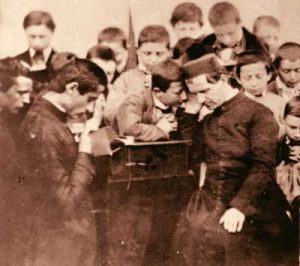
St. John Bosco, a poor priest, could educate 150 poor children by himself in 1856–while also providing them with room and board. Today, the Catholic Church is offering day school attendance for less than half the year for $17,000 a head. We should be looking to Catholic educators like John Bosco for solutions to the Catholic education (and vocations) crisis.
Mr. William C. Michael, O.P.
Headmaster
Classical Liberal Arts Academy
Enjoy this article? Take a moment and share it with friends.
