
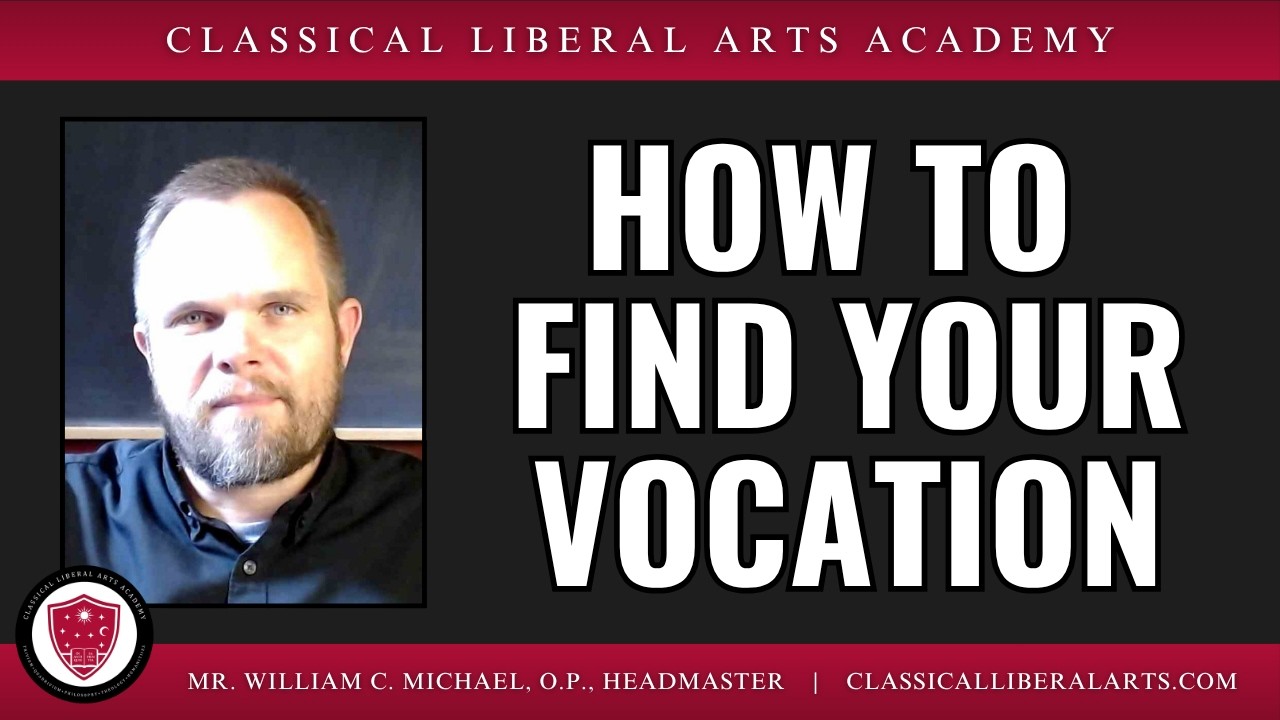
I have been working in education, and as a father, with older students for almost thirty years, and in that time I have had to work through many difficult deliberations with young people as they try to figure out what they are going to do with their lives. It is really the most important question we have to answer. What am I going to do when I grow up? What am I going to do when I finish my college studies? Now that I am a young adult, independent and able to make my own choices, what should I do?
This is a very difficult set of decisions, and it is a decision that has to be made again and again throughout life. I want to talk about it because I think it is oversimplified in modern society. Rather than helping people, this oversimplification actually makes things more confusing, because the student is told one thing but feels and experiences something else. He is told, for example, “You can do whatever you want. Just choose what you love.” He is told that this is simple. But he feels that it is not simple, and that causes even more confusion, because he starts to think something is wrong with him. What other people tell him is simple, he finds complicated and very difficult to resolve.
I would like to address this question with respect to its real complexity and to the confusion that surrounds it today, because we need to stop oversimplifying things and give teenagers and young adults realistic, helpful advice.
Why This Is on My Mind
Within the last twenty-four hours, I have had to think about this topic three times.
First, a former student of mine who has been working through the formation process for the Catholic priesthood is scheduled to be ordained a deacon in November. I have been working with him and following his progress since he was seventeen years old. He struggled with this question of discernment and future plans as a high school student, and he chose to pursue the priesthood, which was a very courageous decision for him. He had many problems as a younger student, both social and academic, but he chose to trust in God and go forward with what was truly his life’s desire, to serve the Church as a priest. He pursued that goal in spite of many obstacles, and I have watched him over the years move through seminary to the point where he is now about to be ordained into the clergy. I was following up with him yesterday, which had me thinking about his background.
Second, I received an email yesterday from a young man asking for advice on developing a career in classical Catholic education. What I do seems like it would be a difficult career to establish, and it is. I did not want to answer him with a quick email, so I decided to give the question more thought and a more detailed treatment here.
Third, last night my second son, who is a senior in college studying business, came home for a night. He talked about his studies and his interests, and about how he is not sure exactly what he wants to do when he graduates, though he is finding certain things in business that interest him. He wanted to talk with me because I deal with these things every day and can speak about them practically, as I actually do them in business, rather than in the more theoretical way some of his classes do.
There is no easy way to answer these questions, because they are the greatest questions of our lives. They are complicated. We have to make sure that we have good principles, that we gather all the necessary information, and that we make these decisions in truth. There are also questions of virtue to consider.
Two Paths: Religious and Secular
When we speak of vocations, we normally recognize two paths: one can choose a religious vocation, or one can choose a secular vocation. This first decision is a very great one, and it usually needs to be made while a person is fairly young, because the religious life normally requires celibacy for the sake of the service of the kingdom of God. As a young person moves through his teenage years, he begins to ask: Am I going to look for a partner? Am I going to get married? Should I be paying attention to the other sex and developing relationships? Or should I zero in on a religious vocation, on prayer and study and the life of the Church?
Why So Few Are Disposed to Religious Life
It is commonly said that there is a vocations crisis in the Catholic Church and that very few young people seem interested in religious vocations. I would argue that there is both a practical reason and a spiritual reason for this.
The most glaring practical reason is that Catholic students are not receiving an education that disposes them to religious life. They are receiving a modern secular education in modern Catholic schools, and even in homeschools, focused on math and science and college admission. They talk about how they will use this or that subject when they grow up and pursue their professions. They are being raised with a secular mindset and a secular curriculum, an education designed to serve a secular vocation. So they are put at a disadvantage from the start. Even though the door to religious life is technically open to them, it is closed intellectually, because they are simply not educated in a way that properly disposes them to it as they enter adulthood.
That is one of the things I seek to remedy in the Classical Liberal Arts Academy as we restore classical Catholic education. I am not talking about fake classical education, “great books” education, and so on. I mean real classical liberal arts education, the kind enjoyed, recommended, and perfected by saints and Doctors of the Church such as St. Augustine and St. Thomas Aquinas. This education introduces Catholic students to the studies and disciplines that dispose them to religious vocations, and that make contemplation interesting and desirable to them.
Many parents love the idea of their children growing up to choose religious vocations. They pray for it, and they talk about hoping to raise saints and to see their children become monks, nuns, or priests. But the education and formation they give their children does not support that hope, and so they come to see a religious vocation as some sort of spiritual mystery that simply happens to a person.
The Problem of Over-Spiritualizing Religious Vocations
In this way, religious vocation becomes overly spiritualized. We often hear men and women who have chosen religious life describe their vocation in very spiritual, almost mystical terms. That is not really appropriate, and it is not what religious vocation is about. You do not need to be a mystic to choose a religious vocation. If we look through Church history, we see that religious were not necessarily the holiest, most spiritual, or most intellectual people. They were simply people who devoted their lives to the service of the Catholic faith, and they did so for many different reasons, among them a desire for material simplicity and intellectual tranquility.
Today we often hear what I call the “EWTN” religious-life message: “I was at Eucharistic adoration one day, and I was just lost in love with Jesus, and I said, ‘Why would I ever want to be anywhere else but here, where I can just be with Jesus?'” Very few people feel that, and throughout history very few people chose religious life because of that kind of experience.
It is comparable to the Protestant language of being born again. People describe living in the world, and then suddenly one day having an experience in which they felt God speaking to them, and that mystical experience becomes the reason they became Christians. I think modern Catholic talk about religious vocations shares much of that language, and it produces a great deal of confusion. I know it produces confusion among Protestants, who can struggle their whole lives when they do not have such an experience. Children born into Christian families, for example, do not have a road-to-Damascus story about being arrested by the Holy Spirit and having their lives changed in the blink of an eye. So they struggle, wondering whether they are truly born again, and a whole false teaching of experiential religion develops.
That false idea of spirituality creeps into Catholicism because children are not receiving a classical liberal arts education, a philosophical and theological education that is rational and simple. Without it, the justification for a religious vocation has to be some mystical experience, some sort of Eucharistic miracle. Very few people will ever have such experiences, and very few are willing to pretend to have them. So they conclude, “If that is what a religious vocation looks and feels like, I don’t have it,” and they look elsewhere.
There are many reasons for the lack of interest in religious vocations today, but I would argue that the primary reason is that Catholic children are not being educated so as to be properly disposed to them. They have an unrealistic view of religious life, and that leads to a kind of self-disqualification.
I do not mean to be negative, but consider the truth about the priesthood. When we think of a priest as a sacramental minister, the Church teaches that the power of the sacrament does not come from the minister. It comes from Christ himself, working through the minister. We would even say (and I am not saying this is a good thing, only that it is true) that a priest can be a relatively unholy man and still be an effective minister of the sacraments. So the requirement for a religious vocation is not the profound mystical spirituality we so often hear about. Throughout history, most priests and religious did not choose their vocations because they had a profound mystical life they wanted to continue. They had other, simpler, more natural and human reasons, and that is good.
What Christ and St. Paul Actually Teach
You do not have to be a Catholic mystic to be called to a religious vocation. In fact, Our Lord makes the call universal: “Whoever can receive it, let him receive it.” The question is whether one has the strength to live that life.
St. Paul speaks about this very frankly and practically in his letters to the Corinthians. He himself lived a celibate life devoted to the kingdom of God as an evangelist and apostle, and he says, in effect, “I would prefer that all men live as I live,” that is, unmarried and devoted to religious service. But if you cannot, because you do not have the strength, the self-control, the temperance, the continence to live that life, then you should marry, because it is better to be married than to end up in sin while attempting a religious vocation. St. Paul sees marriage as a means of grace God provides for those who do not have the strength to live as Christ lived, as St. John the Evangelist lived, as St. Paul himself lived, and as many of the saints have lived. He presents marriage as a concession for the perfection and sanctification of those unable to choose religious life.
Notice how practical this is. It is not mystical or experiential. It is simple. St. Paul wishes that all men would live as he does, and Christ says, “Whoever can accept it, let him accept it.” It is a general, universal call. That gives young people much more freedom to consider a religious vocation without tormenting themselves with the sort of “Great Awakening” questions Protestants ask: Am I called? Am I born again? Am I like Padre Pio or St. Catherine of Siena? That is not a requirement for religious life, and we have to get past a great deal of misinformation and over-spiritualizing of religious vocations.
To summarize: first, the education Catholic children receive does not rightly dispose them to the contemplative and religious life. Second, religious life is misrepresented when we take the few people who choose it today, in a generation that is not disposed to it, and make their personal experiences the standard by which others discern whether they are called. In both ways we are effectively restricting religious vocations, by the education we give Catholic children and by the message we present to them.
If a child is given a classical liberal arts education, introduced to the seven liberal arts and to Scholastic philosophy, and to the study of logic, rhetoric, moral philosophy, physics, and metaphysics in an Aristotelian and Scholastic framework, he will come to see how desirable those studies are. Many students who advance in them will never want to turn their attention away, and that becomes the natural motivation for a contemplative or religious vocation. They will simply not want to leave studies they love.
When we look through history, we often find that men in religious life were more like philosophers. They were great intellectuals. They were interested in contemplation: not only contemplative prayer, but contemplative thought, study, and meditation. They wrote and taught, and they carried out active apostolic works beyond their priestly ministry: works of education, apologetics, mercy, writing, and research. It was a Catholic intellectual life, free from worldly distractions and pursued within the context of religion. If children receive an education that properly disposes them to religious vocations, that door will be much more realistically open to them as they approach adulthood.
Celibacy or Marriage? The Wrong Question
Many young people will say, “I’m not interested in a religious vocation,” especially in modern society, which has been secularized and sexualized. There is so much erotic and sensual media, and many children are not only exposed to it but immersed in it. They will not see a celibate life lived for the kingdom of God as a real possibility. That is the weakness St. Paul spoke of, and it is real. It is not necessarily a bad thing; choosing marriage may be the responsible thing. So they turn to a secular vocation instead.
We then see teenagers anxious about relationships, finding a partner, making money, and looking good, because they are concerned about the challenge of meeting someone. For them, choosing a secular vocation is almost entirely a choice to get married. They say, “I’m not interested in religious life. I’d like to get married.” They think of the decision as one between celibacy and marriage, and they are not even thinking about what they will actually do in their secular vocation.
I would argue that this is a very immature and uninformed way to approach the question. In fact, if a person sees the decision as one between celibacy and marriage, he is probably not going to pursue a religious vocation, because he does not really understand the beauty and quality of religious life. He sees it as a sacrifice, as going without something, rather than as gaining something greater.
Teenagers begin talking about wanting to get married. Young women talk about marrying and having children; young men talk about having a family. They rarely talk about wanting to do business, and this is where I pull young men aside and say: “Listen. Getting married is not what it means to be an adult. When you marry, you become the head of a household. You are responsible for providing for that household, and you will have many duties as a husband and father. What you should be thinking about and talking about is not your girlfriend, or getting married, or finding a partner. What you should be devoting your attention to is your actual work, what you are going to do as a man living a secular life.”
When we get past that first question of religious or secular vocation, we need to get past the oversimplified version of it too: Do I want to be celibate, or do I want to get married and have a family? That oversimplification, which I think is irresponsible, already misrepresents the decision. It signals a person who will choose a secular vocation because he sees religious life as having less, as something difficult and sacrificial rather than something desirable and better.
The Council of Trent taught that if anyone says the married state is equal to or better than celibacy for the sake of the kingdom of God, let him be anathema. The Church officially teaches that the religious life of celibacy for the sake of the kingdom of heaven is objectively and intrinsically the superior life. It is the life Our Lord himself lived, and the life almost all the canonized saints have lived. The Church recommends it to us as the more excellent of the two. They are not equal choices. So if Catholic young adults see the married state or secular life as superior to religious life, something is wrong in the way they think about these two paths.
I have seen this myself. I once took a group of boys to Clear Creek Abbey in Oklahoma to visit the Benedictines, and we spent a week living with the monks, following their whole routine of daily prayer and work. It was interesting to hear the boys’ comments, because they were disappointed and unimpressed. One of them asked me, “What do they actually do? It doesn’t seem like they do anything.” He was talking about men who pray the entire Divine Office, celebrate the Mass, and maintain an independent community through their own manual labor, and he was saying they did nothing. His disposition did not recognize or respect prayer, study, worship, simplicity of life, and manual labor, the very things that characterize the lives of most of the saints. To the modern young man, such a life looks idle. The disposition is wrong. And it is funny for me to say this, because that boy is now a priest. But at the time, he saw the life of those contemplative Benedictines as idle and boring, and he wanted something more. That is the danger in how we perceive religious life when we are not properly disposed to it.
We look at religious life as an inferior state. We look down on religious as men who could not get married or women who could not find a husband. That is not only an unfortunate way to see things; it contradicts the Church’s teaching on religious and secular vocations.
The Challenges of the Secular Life
Now let us turn to secular vocations. Religious vocations are relatively simple. When someone has received a proper education and has the right disposition, and he looks at the options available (monk, nun, brother, sister, priest), it is not very difficult, with the help of a vocations director, to identify the best path within religious life.
The secular life raises many more difficult questions, especially for modern Catholics, whose education is not preparing them for the challenges they will face. They are raised in an artificial school environment in which the future is presented in an unrealistic, optimistic, modern way. They are puffed up with all kinds of ideas about what they are going to be and do, almost none of which materialize, and then they are left choosing from whatever options happen to be available, because they were never prepared for the real ones. It is an unrealistic and irresponsible preparation, and it leaves them to struggle.
I want to speak more honestly than that, as one who lives this life. I am the father of ten children and have been married for almost thirty years. I am a self-employed business owner who started a business and has developed and managed it for many years while providing for a large family. I know the challenges of secular life. I am also an idealistic person and a devout Catholic, very zealous for the faith, and I have had to figure out how to live this life as a secular man. I cannot simply get a job and ignore my spiritual life, ignore moral and social questions, and say, “This is just what I do for a paycheck,” as if the end justified the means. That undermines the whole Catholic life.
The Mission of the Laity
When we establish ourselves first as Catholics, with Catholic faith and morals to live by, and then enter the secular world, we have a responsibility as Catholic laymen. It is not simply to find a job that pays the bills so that we can play at home with our families on weekends and vacations. The Catechism teaches that the laity are to engage in temporal affairs and direct them according to God’s will. That is the mission of the laity, and that is what it means to choose a secular vocation.
Laymen are not free simply to go and play, to make money, and to eat, drink, and be merry because they did not choose the sacrificial religious life. The laity are still part of the Church Militant and have a mission to fulfill, and that mission is to direct temporal affairs according to God’s will. Whatever is in your control as a layman, you are responsible for directing according to God’s will.
This is a much more noble vocation than it is often given credit for being. If we choose a secular vocation, we must understand the serious mission we are called to serve, for which we will be accountable to God. A man who chooses secular life does not simply get to enjoy his wife and roll around on the floor with his children and say, “I’m a layman. I believe in family life. We have children. I love my wife.” That is not the mission of the laity. Yet in many men’s lives, that becomes their whole idea of what it means to be a layman, and you can see why so few would choose religious life if that were all the lay life was. It is not. The mission is to direct temporal affairs according to God’s will. I would argue that this teaching of the Church is really the key to helping young people make vocational decisions.
Interest and Ability
Consider my son. He comes home as a senior in college and says, “Dad, I’m really interested in this. I like business analytics. I’m interested in the psychology of business and management.” He is taking business calculus and analytics and tells me about the data mining and programming he is doing. He is obviously interested. But then he admits, “I have no idea what I’m going to do with it. I just find it really interesting.”
That is something good. He has an interest, and interest is part of discerning a vocation. There are two marks we should look for in a vocation: interest and ability. My son is finding an interest in a certain kind of work, having decided on a secular vocation, and he has a wonderful girlfriend whom he could very well marry. The pieces are coming together for a responsible secular life. But he does not yet see the details of what to do with his interest, and this is where many young men find themselves. They have an interest, and probably an ability, since we are usually interested in what we are good at, but they do not see how to apply that interest and ability in the real world. That is the dilemma: What will I do outside of college? How will I earn a living doing what I am interested in and good at, since I will have to do it every day?
Solomon wrote in Ecclesiastes, “Whatever your hand finds to do, do it with all your might.” We are supposed to devote ourselves to something and work at it. We are supposed to specialize and become expert in something that we then use to benefit others, and that is how we make an honest living. We do good to our neighbors, and we are paid for that good. I like to call it Golden Rule business: we do to others what we would have them do to us. There is a mutual exchange of benefits that leaves both sides better off, and that is how adult life is supposed to work.
So we have interest, we have ability, and we see things coming together providentially for a responsible secular life, but we do not see the practical details. There are real reasons for this confusion, and there is nothing wrong with it. In fact, it is a good sign. It shows that the young person does not have an unrealistic, arrogant, or silly view of adult life. He likely sees it realistically, and so he says, “This is confusing. I don’t know what I should do or how this applies to real life,” because real life is complicated.
A Constantly Changing World
When we choose a secular life, we choose to live in a constantly changing context. The secular world is not a monastery or a convent. It is not even the Church, which, though it changes, is relatively stable. The market can move all over the place from year to year. Technology transforms entire industries, and it is doing so more and more rapidly. We see emerging technologies like artificial intelligence and robotics, and we hear that they will put everyone out of work, that occupations people have held for generations will be eliminated by computers, machines, and robots. This constant chaos of change does not allow us the tranquil, simple, regular life of a monastery, or even of a parish priest. Priests are very busy, but there is still a daily and weekly regularity to their lives; whatever chaos there is, it is within constraints.
In secular life we have little control over what will happen. Think of all the factors that can affect our work, starting with the weather. Imagine being a farmer or a construction worker whose work is governed by what is happening outside. Then think of technology, where new discoveries and breakthroughs change whole industries. How can we plan a secular life when there is so much change?
One of the key virtues for sustained success in a secular vocation is adaptability: resourcefulness, flexibility. You have to be a person who not only has an interest and an ability, but also a masterful grasp of a field, so that you can live by principles. Those principles are what allow you to be adaptable and resourceful in your work, because you never know what the practical details of your life will look like. You must live according to principles, but you must always be able to adapt and change what you are doing, in many cases constantly reinventing your work.
I can give examples from my own work in the Classical Liberal Arts Academy. When I was a Classics student in college, I worked in the basement of the Rutgers library with old books and texts, from textbooks of the fifteenth through the eighteenth centuries to digital copies of ancient documents, and I imagined myself working in that setting for the rest of my life. But the internet and email were developing, and some of my courses were moving online. Things were changing. I was not going to work with old books; I was going to work almost exclusively with digital texts, and that digital library was going to explode as Google Books, the Internet Archive, and other online collections developed. Within ten years, I was working almost entirely on computers. At the same time, wireless devices were multiplying, the iPad appeared, and high-speed internet came into the home. Suddenly, the whole life of a classicist, the life I had intended to lead, was being transformed. I was forced to hold on to my principles while constantly adapting to new circumstances.
I never intended to make the Classical Liberal Arts Academy an online school. I was teaching children in person in the Charlotte area when demand for my study materials and tutoring began to come in from all over the country. I responded by moving my teaching materials online, and within a year there were a thousand students enrolled in my online classes. I never planned that, and I was completely unprepared for it, but I had to adapt to a market that technology had changed. That has continued nonstop to this day. Now artificial intelligence is changing everything and causing me to rethink everything, and again I must keep my principles in hand while adapting to the practical details of the market, of technology, and of the world outside my little bubble.
So we need more than an interest and a general ability. We need a pursuit of mastery and a knowledge of principles, because the details of our work will constantly change. What allows us to handle that is expertise in our field, which is really a knowledge of its principles, because principles can be applied to new circumstances and so allow the mission to move forward. We cannot choose an occupation by looking at its circumstances. We have to think about principles.
The Real Question: What Problem Will You Solve?
That brings me to my real recommendation for young men as they consider their future. I think they need to be told this: You should not be asking what kind of work you want to do. You should not be looking at the jobs people have today and saying, “I like that. I like what he does and how he lives. I visited this office, I interned with this company, and I like the environment and the work they do.” You cannot choose a career by its circumstances, because every circumstance can change. You have to look at a field of work and form a deeper, principled judgment about it.
So rather than looking at the circumstances of jobs, or at the lifestyles of people they know who hold certain jobs, young people should ask a different question. This is the heart of what I want to say:
What problem do I see in the world that I would like to devote my life to solving?
Remember the words of Solomon: whatever your hand finds to do, do it with all your might. What problem do I see in the world that is worthy of all my might? That is your vocation. And this also answers the question, “How am I going to serve God with my life?” I am going to serve Him by working to solve this problem.
It should be an ambitious problem. We have to be careful not to reach too high, but we also have to be careful not to aim too low. Many people are bored because their ambition is not as great as it should be. They are living with too little ambition, and the problem they are working to solve, if they are working on any problem at all, is too small. We see people who are simply idle, sitting around watching television and sports or scrolling on social media, bored. They do not have much to do, and they end up getting into trouble.
Idleness and Too Little Ambition
A Dominican priest, Fr. Gregory Pine, recently gave a talk on gossip. When I think about my own life, I don’t think I have ever confessed gossip to a priest, because I simply do not have time for it. I am not interested in idle talk. I am always busy, always at work, moving to the next task or project. Idleness is the cause of most of the sins people struggle with and confess.
People are idle because they have no problem they are working to solve. They have no challenge worthy of all their might, attention, and time. They think they have no such mission, when in fact they do. Remember, the mission of the laity is to direct temporal affairs according to God’s will: to look out at the world and say, “This needs to be fixed. This needs to be directed according to God’s will, and that is what I am going to do. I am going to glorify God through my secular vocation by working to fix this problem.” And it needs to be a great problem, worthy of all our energy.
If we aim too low, we leave ourselves in idleness, and then we find ourselves dealing with all the petty sins modern men struggle with. How often do we hear men talk about their problems with pornography, gossip, overeating, drinking, watching too much television, or scrolling online too much? There is really only one problem there, and it is idleness. Ask these men, “What is your mission in life? What problem are you working to solve?” They have no answer. Ask them about their work, and they will tell you about the place where they have a job, where they do something for a paycheck. They talk about that paycheck as if it were an assigned financial circumstance they simply have to live with. They treat their occupation as a destiny they have received, rather than something they have chosen.
My grandfather, for example, had three jobs when I was young, and they had nothing to do with one another. He repaired electric motors in his spare time, his side business, as it were. He was a manager in a toy warehouse (I believe it was Mattel), and he worked for another company doing mechanical work. He was always working. You could see that his real interest and mission were mechanical work, repairing and building motors. He loved it, and he loved helping people with his knowledge of machinery. On garbage days he would go out and collect things people had thrown away, like broken fans and air conditioners, because he could fix them all. Then he would repair them and give them to people who needed them. He saw his work as a mission. He could use his skill to help people, do good, and make a living, and he did. He was always working, and I had his example as a boy.
When I look at men today who fuss over what they are eating for dinner, or over sports, or who struggle with pornography, I see idleness. They are not working. Often their wives are working to help pay the bills, because the men treat their jobs as an assignment they received, as their destiny. “It is what it is.” That is completely false.
So I would challenge young men with this: You have interests and abilities, but there is a bigger question to answer. What problem are you going to devote your life to solving? That is what you should be asking yourself.
The Example of St. Paul
An example I like to use, though not a secular one, is the Apostle Paul. St. Paul was a miracle-working apostle and evangelist whom Christ visited directly in a vision, one of the most amazing men in the history of the Church. His mission in life was to preach the Gospel. The problem he wanted to solve was that men were lost in sin, and he wanted to change that. He wanted to found churches, establish and order them, appoint leaders, teach, preach the Gospel, and lead men to salvation. That was his problem, and he devoted his whole life to it.
When we look at his life, we find him teaching that “godliness with contentment is great gain,” and that we should be content with food and clothing. Why? Because our mission is not to indulge our pleasures, but to solve the problem we have been given. It is a mission-oriented life.
We also learn that St. Paul’s mission had operating costs. It was not free. He had to travel, find places to stay, and provide his own food and clothing, and he needed to make sure the men who traveled with him were provided for. He had material needs, and he worked with his own hands to cover the costs of his famous apostolic ministry. He was a tentmaker. He made tents to earn the money to fund his life’s mission.
St. Paul was a celibate man living a life devoted to the service of the kingdom of God, a religious vocation. But in his life we see a model that should hold true for every Christian man: a life devoted to solving a great problem, a problem that consumes him and takes all his strength, all his intellectual power, all his study, time, and energy; a mission he considers his service to God; and a willingness to accept all the costs and circumstances of that mission as his own business, to be met by honest means.
St. Paul is an example of a responsible Catholic adult life. Obviously we cannot imitate him in his unique historical ministry. He was a miracle-working apostle visited by Christ himself, and his was an exceptional mission. But we see in him the principles of the Catholic life: a mission-oriented life that accepts all the costs and offers itself, as St. Paul teaches us, as a living sacrifice in the service of God.
It does not matter whether you are a priest, a monk, a nun, or a man working in temporal affairs. Your duty is to direct temporal affairs according to God’s will, to solve a problem or many problems, and that is what you should be thinking about, because that is where your principles and your general mission come from. You take that mission and its principles into the secular world, where things are constantly changing, and you adapt to those circumstances, because they are all accidental to your life. None of them is essential. You cling to your principles, focus on your mission, and adapt to the changing circumstances.
Mission First, Then Marriage
That is what I would advise young men to think about. Do not start by thinking about a wife, because you will need to choose a wife who will share in your mission. Do not worry about the details of your life: what your house will be like, where you will live, what food you will eat, what clothes you will wear, what car you will drive. None of those things is significant. You should have something nobler in mind. You should have a problem you are going to work to solve, a mission for your life, and principles by which and for which you will undertake that mission.
As you focus on that mission, if it leads you to celibacy, you can see how that becomes the right motive for a religious vocation, or for a secular vocation lived unmarried, in which you give yourself entirely to your mission. And if you are going to marry, the purpose is to find a woman who will enter into that life with you as a partner and a helper.
Consider my wife, for example. I live a very radical, mission-oriented life. There are not many people who would want to live with me, because I am always focused on my work: always thinking about it, talking about it, and working on it. Every decision I make is based on my work in education. It takes a very special woman to be my wife, and my wife is the perfect woman for me. She complements me in every way and participates in my mission in every way. Together, as a couple, we are better at everything than either of us would be alone. I would argue that this is the highest purpose of marriage: to strengthen husband and wife in a shared mission that allows them to accomplish more than they ever could by themselves.
What I advise my own children and my students about finding a spouse is this. You do not even know whether you need a partner, or whether the Lord will provide one, and you certainly should not choose a partner first, without regard to your life’s mission. Focus on your mission, on what you are going to pursue and try to achieve, and pray that you will find someone along the path of that mission who shares your interests and your passion for solving a certain problem, and who wants to partner with you not only as a person, but also as a layman whose life is directed by that same mission. The best place to find someone to marry is on the path of your mission, when you meet someone who is interested in the same things, wants to do the same work, and is willing to go where you go and live as you live for the sake of that mission. That is the ideal partner.
You can see how focusing on the mission orders everything else. I enjoy a marriage like that. I do not know whether there is another woman on the planet who could be my wife and live the life I live, but God provided me with the perfect partner, and the two of us work together every day. We have been together since we were seventeen. She is involved in everything I do. We are both Lay Dominicans, we are both classicists, and we work together in the classical liberal arts. Every part of our life is truly shared between us. I would like young people to enjoy a marriage like that. When circumstances change, it has no effect on us, because we are in this together. We share the same principles and the same mission, and we understand that things are always changing. That gives stability to our marriage and to every part of our life, emotional and physical. Our life is at peace because we share a common mission and pursue it together.
So when we think about Catholic marriage, we should think of it as something much more profound than simply reproducing or starting a family. Matrimony is a sacrament, and there are graces proper to Christian marriage. We have to ask: What are those graces for? Are they for making dinner, planning birthday parties, and organizing vacations? Or is something more, something supernatural, expected of married couples? I would argue that the graces of the sacrament enable two people to come together as one and accomplish incredible things together in the service of God.
If you are a young person considering a secular life and thinking about marriage, you have to put the horse in front of the cart. Establish your mission first. That will help you not only to live the best life and serve God as well as possible, but also to discern whether someone special you meet would make a good spouse. They have to know the terms up front. Otherwise you end up fighting and distracted, perhaps even divorced, because the marriage had no purpose. It was not a mission-oriented marriage.
Consider how Christ called His apostles. He looked at people and called them to follow Him, and He said, “Go, sell what you have, and give to the poor, and come, follow me.” He said that whoever will not take up his cross cannot be His disciple, and that whoever will not leave father and mother, brothers and sisters, even children, and even his own life for His sake, is not worthy of Him. He stated the terms up front when He called people into relationship with Himself. The relationship between Christ and His Church is that of bridegroom and bride, yet look at how He established His own mission and His own way of life, and called people to join Him on fixed terms that served that mission. In Christ we see the model of how to live. He shows us a mission-oriented, principled Christian life that subjects everything to the service of God, because loving God is our first priority. Love of neighbor flows from the love of God; it is not an alternative to it.
Conclusion
To wrap this up: we do not need to begin by deciding whether to pursue a religious or a secular vocation. That decision is actually a consequence of the real question we have to answer. The real question is this: What problem do I want to work to solve with my life? If I am going to offer myself as a living sacrifice, what problem am I going to work to solve? What is my life’s mission? That will determine whether I should be a religious, whether I should remain single in the world, whether I should marry, and whom I should marry. The mission will answer all of those questions, and that is why I need to make it my priority. I believe that when we do make it our priority, we can answer it. We can see a problem and focus our entire life on attacking that problem, solving it, destroying that enemy, as it were. I think we can make that decision quite easily.
Let me close with my own story. When I was a senior in college, I had many options, one of which was a graduate fellowship to continue my classical studies. But the problem I had identified, the one I wanted to work against, was that K–12 education was not giving students the learning and studies they needed early enough. I saw further college work in graduate school as useless for that purpose, because the problem was that K–12 education was not equipping children by age eighteen to make the decisions they need to make as Christians. I made that my problem, and I set my mission to bring real classical Catholic education back down to younger students, where it once was. You can see how my work to solve that problem has taken shape in the Classical Liberal Arts Academy throughout my life.
I identified that problem when I was twenty-two or twenty-three years old, and my girlfriend at the time shared that mission and wanted to pursue it too. So we married in that mission, and we have lived our whole life focused on it, working together as husband and wife in its service. Our work in the Classical Liberal Arts Academy has only been possible because she was willing to go wherever I needed to go to serve that mission. There were times with no money and times with plenty, times when we lived comfortably and times when life was very hard, but we were able to navigate all of it because our attention was always fixed on persevering in our mission.
So the questions we should ask are these: What problem am I going to solve? What principles will guide me in solving it? How can I define the mission of my life? Once we have answered those questions, we can allow the answer to settle all the others. I think you will find a peaceful, satisfying, even exhilarating life, serving a mission you truly believe in and working to solve a problem you truly want to see solved. That becomes the motivation for virtuous living, a motivation that very few people have today.
I hope this is helpful. If you are a young person who would like to work through the details of your own situation, I am happy to help. I am not going to go back and forth in long emails about these things, but if you would like to talk about circumstances in your life or decisions you need to make, you will find my phone number on the Academy website. Please give me a call. I hope this inspires new questions and better answers. God bless you all.
Mr. William C. Michael, OP
Headmaster
Classical Liberal Arts Academy