
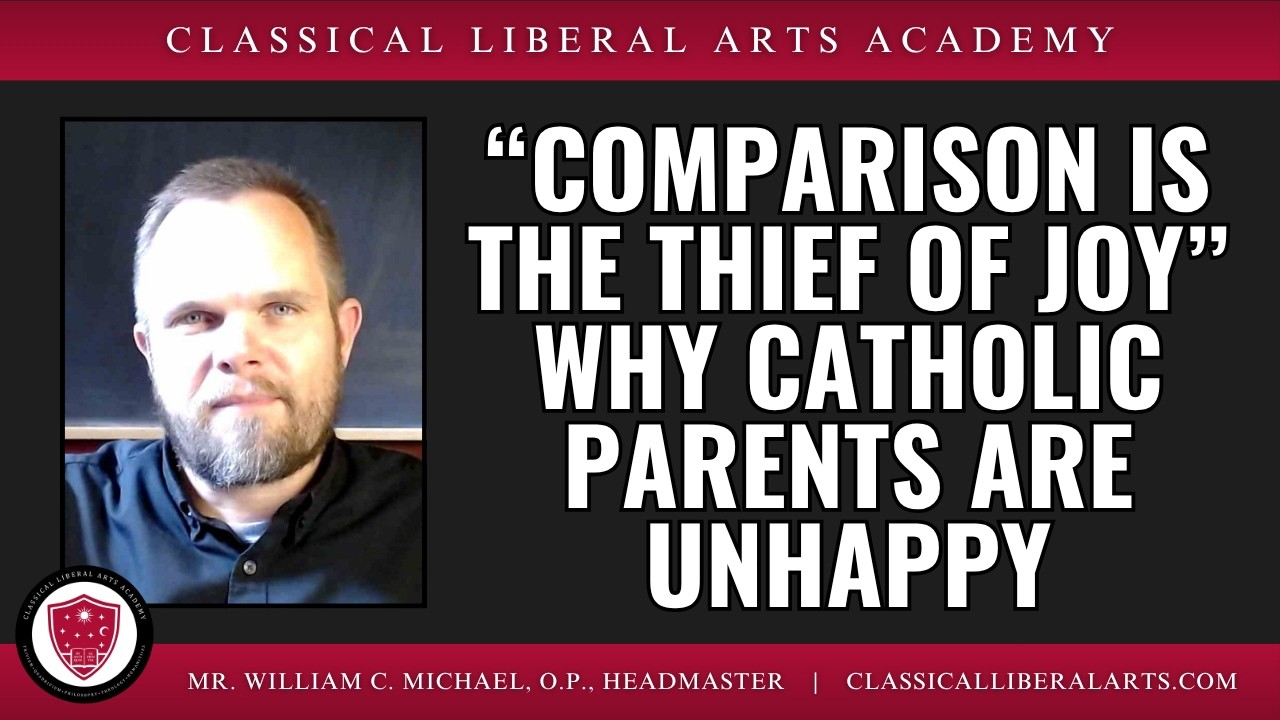
Comparison Is the Thief of Joy
I have been working in education full time for twenty-six years now. In the Classical Liberal Arts Academy my wife provides daily support for homeschooling families and spends a great deal of time on the telephone with homeschooling mothers. Through the years we have worked with hundreds, if not thousands, of Catholic families trying to give their children a great education. We have seen some fine examples and real successes. We have also seen failures and tragedies, far more numerous.
My wife often has conversations that begin as simple academic consultations and develop into deep and personal discussions about problems in family life. I tell her, as she talks with these women, that she has an advantage over many of them: I have been arguing with her and teaching her for almost thirty years. We have been together since we were seventeen years old, and I have been philosophical about life and focused on my goals as a Catholic man for many years. As I have studied philosophy, and especially moral philosophy, I have always shared what I was learning with my wife, and we have built our family life and our work out of the writings of history’s wisest and best men.
That does not mean we always practice what we know to be right, or that we know the answer to every question as it first arises. We often learn partly by study and partly by trial and error. But my wife and I have had an unusual experience as a married couple, because we both studied classics, we are both devout Christians, and we both respect the wisdom of the ancients. Usually, if I can show her that Scripture says this, or the Fathers of the Church said this, or a respected philosopher like Cicero or Seneca or Aristotle said this, then even if she does not like it she will get in line. That allows us to live in alignment, which allows us to do a great many things, and we enjoy a very happy relationship because of it.
I explain to my wife that the situation we live in is rare. With the Catholic parents who contact her — almost always mothers and wives — that same background cannot be assumed. We cannot assume they know a certain concept, or have read the Bible, or know what the Church teaches, or are familiar with the writings of the ancient philosophers. So we have to spend a great deal of time laying that foundation and helping them become aware of these ideas. And then we have to be very patient, because the ideas of wise men are countercultural and unpopular, and they are displeasing to people who are trying to live for pleasure or honor or wealth.
Patience
Patience becomes a very great virtue in working with Christian families in education, because we are nowhere near where we need to be. The foundations have been destroyed — foundations in family life, in morality, in religion, in the general knowledge of philosophical concepts. There is a great plague of ignorance and disorder and indiscipline. So even when we know the right answers, putting them into practice, and getting other people to put them into practice, is a slow and painful process. I have learned that over the years.
I think patience has been one of the virtues God has given me that has allowed me to succeed in my work, and as a husband and father: learning not to expect quick results, but knowing that a foundation has to be laid, that habits have to be developed, and that everyone needs time to get on board. Often, when people are confronted with a teaching or a piece of advice, the initial reaction is negative — and normally that initial reaction needs to be ignored. They need to be allowed time to go and chew on it, to think about it, to ruminate on it. And eventually I find out that they took the advice, that they listened to the old philosopher or the passage of Scripture or the teaching of the Church, and that to some degree they put it into practice.
So I have learned to be patient — not that I am virtuous in that respect, but I have learned that patience is a necessary part of helping people. The results do not come quickly. They take years and years. When we counsel one another, we have to respect the fact that change is difficult. The Church models this for us very well. Many criticize her for what looks like complacency or indifference, but it is really a fatherly, even a motherly, patience; it is the patience with which God deals with us. And we should always be imitators of God, especially in patience.
An independent spirit
So we spend a great deal of time talking with parents. We hear many stories, many reports, and we see many results. And there is a great deal of tragedy, sorrow and failure in families. I believe I can explain what the cause of that failure usually is.
It is something my own personality has spared me from — and I do not necessarily say that is always a good thing, because it has also gotten me into a lot of trouble in my life. I have always been something of an independent spirit. I have always been confident, always competitive, always wanting to win, always wanting to separate myself from the crowd. I have never been afraid of working on my own or taking a route on my own. In many areas of life that is a strength. In others it has been a fault I have had to watch carefully. There are times when we should not isolate ourselves, and I have had to learn when those times are.
But generally speaking, the readiness to say that if I want something done right I need to do it myself — or that if I want to accomplish a goal I need to focus on the end, develop a strategy for achieving it, and stick to that strategy until it is achieved, without worrying what other people are doing or saying, focusing entirely on my own circumstances and my own goals — that disposition has served me well. The development of the Classical Liberal Arts Academy is a good example of it.
I have been known in my family and among friends for that personality, and at times I do not realize how many troubles it saves me from. When I talk with other Catholics and hear about their problems and their concerns, and watch what they are doing, I can see what the cause of the problem is, or at least one of the causes, and I realize that I do not struggle with it as many others do. I am not bragging; it is really just a matter of personality, and, as I said, the same trait that has been a virtue in some circumstances has been a vice in others. It is like anger. Anger can be a great benefit when it makes us ready to fight against evil, but the same anger is easily provoked where it is not appropriate, so it always has to be governed by reason.
But this idea of independence is important, because in order to serve God well in our lives we have to be willing to live and work independently. I will qualify this as I go, and speak about the good aspects of independence and the bad. But I would like to challenge Catholic parents and students to think about this characteristic, and to see why it matters so much in the Christian life — and how its absence causes so much unhappiness and failure, and even tragic ends: suicide, divorce, and worse.
These are families people see at church, families that appear joyful and fruitful on social media, and later we find out they have ended in tragedy. I have seen suicides. I have seen divorces. I have seen parents end by abusing or even killing their children — and I am not speaking of the Classical Liberal Arts Academy in particular, but of Christian circles generally. If we look at these situations and ask how a man can go from wanting to be a Christian, to marry, to start a family, to raise children — from all of those good and beautiful and virtuous ends — to some terrible result, I think the way families fall into it is not as bizarre or mysterious as it seems. I think we all feel this problem in our own lives, and deal with it in different ways and with differing degrees of success.
Comparison is the thief of joy
I would like to focus on a saying. It is sometimes attributed to C. S. Lewis and sometimes to Theodore Roosevelt, though the author does not seem to be known with any certainty. The saying is that comparison is the thief of joy.
I would ask you to think about that with me, and to think about your own life. Think about your Christian life as an individual. Think about your life as a husband or a wife, as a father or a mother. Think about it with respect to the education of your children, the culture of your family, your home life — every aspect of your life. Think about the idea that comparison is the thief of joy, because I believe this is the actual cause of the trouble in many Christian families.
When I counsel people on academic matters, they are almost always enslaved to comparisons. I try to talk with them about goals, about setting realistic goals, about making objectives and developing tasks — which is what it means to strategize. And often the strategy that would allow them to achieve their goal demands that they separate from others, or live differently, or do different things. They are not willing to do it, because they would rather be like other people than accomplish the goal. So eventually they abandon the goal, because they are so concerned with comparing themselves, with being like others, being accepted by others, being approved by others, that they will sacrifice their goals for that acceptance.
The trouble is that this acceptance is not in their control, and they often fail to obtain it. And when they feel themselves failing to obtain that approval, they go to pieces, because they feel their life is out of their control and that they are failing — without ever asking what it is that they are failing at.
Aristotle on happiness
This relates to Aristotle’s moral philosophy, and here is where I am protected from these errors, because I know what the ancient wise men taught. When I am thinking something or feeling something, I am not left to myself. I can ask what Scripture teaches about it, what the Fathers of the Church said about it, what the ancient philosophers said about it. And when I see that the difficulty I am struggling with was a difficulty they struggled with too, I realize that I am probably struggling with it because I am on the right track — I just do not yet know how to deal with it. I have the benefit of being able to go back to the winners, to the wise men and saints: men who dealt with these things successfully in real life. I can go back and see what they said and taught and counselled.
In Aristotle’s moral philosophy — the book is the Nicomachean Ethics — he asks what human happiness is. He ultimately says that happiness is the enjoyment of a virtuous life: the enjoyment of virtue, the enjoyment of simply being good. That satisfaction which comes from being good is what makes the human soul happy. Goodness is happiness.
Along the way he examines a number of popular but false ideas of happiness. The first is pleasure. Pleasure certainly seems to be a source of happiness — whether the pleasure of eating and drinking, or physical comfort, or the extreme pleasures such as sexual pleasure. These seem like things it would be miserable to live without, and like things that would make a life happy.
But Aristotle points out how short-sighted that view is. If physical pleasure were equivalent to happiness, then we would have to admit that our happiness is no better than that of irrational animals — of cattle and dogs and the beasts of the field. They enjoy physical pleasures too. In fact they are led about by the pursuit of those pleasures as their natural irrational instinct. So we cannot possibly accept that mere pleasure is what men are made for. There must be something more noble than that, inasmuch as men are more noble than animals.
So he proposes a second option: honor, respect, fame. There are men more noble than the pleasure-seekers, men who are willing to sacrifice pleasure, willing to live without it, even willing to live with positive pain, for the sake of something else — and what they seek is honor. Aristotle calls this the political life, because it pursues ends beyond individual pleasure or individual satisfaction.
The most obvious example is the life of a soldier: a man willing to leave his wife, to leave the comforts of his home and his family, to go out and risk his life to defeat an enemy or defend his country and promote justice in the world. He is willing to lose limbs, willing to lose his life, willing to spend the rest of his life in pain and suffering, for the sake of a cause considered greater than his own physical pleasure. He is concerned with the community rather than with himself.
Aristotle presents this as a second candidate for human happiness — and says no, this is not acceptable either, because honor comes from other people. The man who goes and serves his country may accomplish his mission and achieve his objective, and yet not receive the honor he sought, or expected, or deserved. Look at the soldiers who fought in the Vietnam War. They came home to protests. They were cursed and accused of injustice and imperialism and every other evil. What began as a life of public service and self-sacrifice did not bring them the honor they sought, but the opposite: dishonor. We have watched veterans of that war struggle for the rest of their lives after returning to America, because the system did not work for them and their expectation was not fulfilled.
That is why Aristotle says honor is not an appropriate end for human life. It is not a source of happiness. He concludes finally that happiness is an activity of the soul experienced in the practice of virtue. In other words, being good — and knowing that we are being good — is what it means to be happy. Goodness is happiness.
Parents who live for pleasure
The reason this matters so much is that most people are not living such a life. Most are living either for pleasure or for honor.
We see the first in a man who wants to marry because he thinks how pleasant it will be to have a comfortable home, a woman who prepares him good meals and provides him with sexual pleasure. He is thinking entirely of his own pleasure as he enters into family life. We look at that and say it is a miserable, selfish way to live — and we see many men and women living exactly that way, treating marriage and family as the means to a selfish, carnal end.
We see families in which this is normal. They say things like, “That ice cream is for Dad. The sodas in the refrigerator are for Dad. Don’t you children touch those. Turn the air conditioning down. What do you think this is?” There is a fight between parents who are seeking their own pleasure and children who are treated as robbers of that pleasure rather than as its source. This is usually where we find hypocrisy in parenting: parents making strict rules for the children because they do not want electricity wasted or money spent, while they squander money everywhere on their own self-indulgence. The reason they do not want money spent is that they want to be the ones who spend it, and they want all of it to serve their own pleasure, because that is the end of their life. It is extremely selfish, and it is very common.
Parents who live for honor
But we also see parents who are concerned with honor, and I think this is even more dangerous.
It shows itself in the way they look at society, friends, so-called fellowship and community as the means by which they can obtain honor. The church becomes something like a beauty pageant, where a family competes with other families. “Your family is so beautiful. All your children are so beautiful.” There is a desire for others to recognize our excellence as a family, our excellence as parents. We are not like those bad parents over there whose children scream during the service and climb over the pews. Look at our children: they sit like little angels, hands folded, cleanly dressed, beautiful. We are a good family, not a bad family, and we expect the community to honor us as such.
We see the same thing in a private school. Parents hover over their children, managing their every move — not because they are concerned about the child’s actual intellectual development, but because they are interested in honors and awards within the school community. They worry about perfect attendance. They worry about the honor roll. They worry about whether their children are in the honors class, whether they are getting all the documentation and awards and respect available. They are competing for honor.
We see it in sports. Instead of sport being a means of physical development and the training of character, it becomes an honors contest. Who gets the trophy? Who is most valuable player? Do we get jackets if we win? Who are the starters? Who are the stars? It is more about honor and status than about the development of the children playing.
We see it in the neighborhood, in the phrase “keeping up with the Joneses.” I was guilty of this as a boy. Across the street from me lived another teenager, a few years older, named Brian, and every Christmas we had a contest. It was never agreed upon or discussed, but it existed: who could decorate his house most audaciously. I would work all through the Christmas season to get my parents to buy as many strings of lights and as many decorations as I could, and I would risk my life to decorate my house better than Brian’s. I had a giant two-story house — giant by New Jersey suburb standards — and Brian had only a single-story home, so I had an advantage; I had more space. But I would be thirteen or fourteen years old, up an extension ladder at the top of the house, hanging lights on the gutter, and the whole motivation was that I wanted the best-decorated house on the block.
I can laugh at it now, but it is an example of how the desire for honor makes us do stupid things. That is a childish example. Adults do the same in far more serious ways: buying expensive houses, choosing the model with all the options in the new development, landscaping, putting in swimming pools. It is the pursuit of honor in the neighborhood by comparing what we have with what others have, with a constant one-upmanship to obtain the next visible token. The Joneses have all new shrubs and landscaping in front of their house, so we will need that. The man across the street has a new pool — look at the fun those children are having; look at us over here in our boring house with nothing but a sprinkler. And now we have homeowners’ associations, which codify all this and make it crazier still.
What honor does to the Church, and to education
The trouble is that none of this honor is an essential part of life in any of these circles. It is all man-made trouble.
The Church is not designed to be a contest over who has the best-behaved children, or the prettiest daughters, or the most respectable sons. That is not what the Church is for. The Church is where sinners come to be reconciled to God and to worship Him. When we lose sight of that, we destroy the Church; we turn her into something she was never meant to be.
We see this among many modern Catholic families who want the Church to be a kind of social club — an elite country-club environment where all the best families in town gather, and their children become friends with the children of the other best families, and everyone else is kept out. It would be ideal, for many of these families, if there were two parishes: the honorable parish, and the parish for everyone else. That is how they think the Church should work, and I think this is exactly what the bishops have been pushing back against. The Church is not a social club. If you want a social club, start one or join one; they exist. There is already a country club in your area, and if you want to fraternize with the wealthier families you can pay the dues and have what you want there. But the Church is not that place. Many want her to be a museum full of beautiful artwork, or a concert hall where they can hear the world’s most beautiful music. Those are not the essential attributes of the Church. That is not the end for which she exists. And so the Church becomes corrupted by the desire for honor among her own members.
But what I want to focus on is that the same thing happens in education and in home education. This desire for honor, this comparing and contrasting and competing among families, corrupts education and destroys Catholic learning. The children suffer most, because instead of having parents concerned with their happiness and their development, they have parents seeking their own honor and their own glory at the children’s expense. The children become props. They become the means to their parents’ end, while the parents miserably seek honor by comparing themselves with others.
Why the comparison is foolish
The reason that pursuit is foolish is that the playing field is not equal among men. It is never equal. And what happens in these honor-seeking cultures is that the differences between people and between families are ignored, as though they did not exist. That leads to all sorts of troublesome problems, and that is what I would like to focus on.
Let me say this first: I do not think anyone ever says, “I want honor.” No one says, “I am competing against my neighbors.” No one will admit to it. But it does not matter whether they admit it or not. They are doing it, and they know they are, because if you ask them why they are doing this, or why they bought that, or why they want that, they can give you some baloney answer — but the real answer is that they want to impress others, or gain status, or move into a different category within the crowd. So we have to be careful, because no one is going to admit this unless he is confessing his sins; and yet it is what drives the behavior.
Because I work in education, I can see this quickly in a consultation with parents. When we talk about the proper goals of Catholic education and the means necessary to pursue them, I can see the resistance rise the moment they realize that what they need to do will not bring them honor. I can see exactly where the resistance begins when I mention something that needs to be done, or share what a philosopher or a saint said about education. And I understand why they are resisting. I tell them that one purpose of these talks is to break down those barriers. But that is the challenge. The strategy that would achieve the proper ends of our lives is very often blocked by these alternative, inferior ends that we desire.
God judges us relatively
Scripture speaks about this, because it is a hindrance to human happiness — and the whole purpose of true religion, of the Church, of divine revelation, is to lead men to the happiness God created us for. The Catechism teaches that God made us to know Him, to love Him and to serve Him in this life, and to be happy with Him forever. That is the end for which we were created. Our salvation is the entrance into that happiness. It can begin here, if we are wise and obedient; it is what the Scriptures call eternal life. We can enjoy it here to a degree, but it is to be experienced in full in the life to come. And remember — happiness is simply being good, and being good with God forever.
The most important passage I would like to look at is in the twelfth chapter of Saint Luke. It is a teaching of our Lord, who modelled this independent, holy and happy life more than anyone in human history. But He teaches a truth that I think most Christians would object to if I stated it without introduction.
Imagine if I said that God does not judge us all equally, but judges us relatively — that He does not judge us all by the same standard, but by relative standards. I think most people would be startled and try to object. They would think I was saying something wicked. But our Lord tells us this explicitly in the Gospel, and it is important that we understand it and nail it down as a pillar of our moral lives.
What He says is that to whom much is given, much will be required; to whom more is given, more will be required; and to whom less is given, less will be required. God’s judgment of us is not based on what we do in an absolute sense. It is not comparative. God judges us according to what we do relative to what we have been given. What we do with what we have been given — that is how we are judged.
LeBron James could dunk a basketball when he was fourteen years old. I could never dunk a basketball, and no one would ever judge me as a basketball player on whether I could. Think of how we watch professional sports. We watch the best basketball players and the best soccer players in the world, the greatest athletes alive, and how do we judge them? “He stinks. What a bum. What a bust.” We criticize professional athletes as spectators — and why? Because we do not judge them in comparison with ourselves. We judge them relative to their capabilities, relative to their gifts, relative to what they have been given. We look at a man and say: he is seven feet tall, muscular, athletic, can jump out of the gym — and he is not motivated. What a waste. We judge him relative to his gifts and his potential. And that is exactly how God says He will judge us.
Now here is why this matters. When we walk into the church, there is no competition among equals. When we walk into a school, there is no competition among equals. When we walk into a homeschool group, or into the neighborhood, there is no competition among equals. That is why comparison is so foolish. We are not comparing like with like. We are comparing people in wholly different circumstances.
Some of the people we see have been given very little and have overachieved with what they were given. Others are, in an absolute sense, more successful, but relatively they are underachievers. They have wasted opportunities, wasted gifts, wasted connections and resources — and yet, measured by absolute achievement or quality of life, they stand above others. Relative to what they were given, they are the losers.
It is very difficult for us to think this way, because we assume all things are equal and we try to compare and compete. Some of us may sit near the bottom of the comparison chart and yet have overachieved, doing virtuous and extraordinary things with what we were given. If we are not sober, if we are not wise about the different circumstances and gifts and privileges of different men, we will spend our lives comparing ourselves to others and end up depressed and miserable, feeling that we are failing when in fact we are overachieving and cannot see it.
And others at the opposite end of the spectrum will be arrogant and boastful, acting as though they know everything and have all the answers, because in a measurable and absolute sense they have more success — while their advice is actually terrible advice, which only works if you have piles of resources and gifts and opportunities to waste. It is a very inefficient way that does not really work and is a net negative when all the circumstances are considered. Yet most people will go for advice to those who appear successful, rather than to those who have worked out how to succeed in circumstances like their own. And there we get into all sorts of trouble, because the people giving the advice and the people being asked for it are the wrong people. They do not actually know how to succeed.
Here is an example. I struggle with a good deal of nerve pain in my neck and back and shoulders and arms, from accumulated injuries over the years. I often look for advice or relief from physical therapists who post videos, recommending stretches or movements that might relieve some of the pain. I try to avoid medicines, and I am certainly going to avoid surgery. And I can tell the difference between a physical therapist who has actually felt nerve pain and one who enjoys perfect health and is giving advice about circumstances he has never experienced. The second man, with his fine natural health, is pretending that he knows how to obtain and maintain health in any circumstances, when in fact he has never had to deal with any other. It is easy to see which therapists know exactly what this pain feels like, what these movements feel like, what will feel good and what will feel terrible — and who would never recommend something they know would flatten a man with a certain condition. Whereas the others recommend stretches and movements and the people watching think: are you joking? I cannot move my arm like that. I cannot bend my back like that. My neck will not rotate like that.
So those who enjoy the best circumstances do not necessarily know how to accomplish anything for people who do not share them.
Goals set with no regard for circumstances
Where is this going? When we come to education, we very often set objective goals with no regard for circumstances at all. It is the familiar question: what do you want to be when you grow up? And the children say: a doctor, a lawyer, an astronaut, a farmer. And we act as though it were a fine thing for children to sit around setting goals with no awareness of their circumstances — because children have no idea.
When I think back to the neighborhood I grew up in, and the schools I attended, and the other children I knew, I think of their parents, and I can tell you I had no idea what any of them did for a living unless it was something extraordinary. One of my friends had a father who was a police officer; that was a big deal. But for ninety per cent of the adults I met, the parents of my friends and neighbours, I had no idea what they did. I had no idea of anyone’s financial circumstances. I could not have told you who had more money or less, more education or less. To children all of that is invisible. And yet we ask these children to make declarations about what they want to be when they grow up, when they have no knowledge of the path they would have to take to get there, and often no knowledge that the goal, given the way things work, is completely inaccessible to them.
I want to be an astronaut. I want to be a doctor. Well, that is going to cost hundreds of thousands of dollars, or you will have to be so extraordinary a student that you can win scholarships; and if you do not have a great deal of money and you do not win scholarships, you probably will not be able to do it. So again: if that is your goal, then in your circumstances this is the strategy — and the moment you choose not to follow the strategy, you are finished. When we take no account of circumstances, we end up in this strange world of talking about what we want to be and how we want to live, and it is simply irrational.
Christians do this as much as anyone. It is not a problem peculiar to sinners; it is common among Christians. Two people marry and begin thinking about their family life, and they imagine themselves living at Pemberley in a Jane Austen novel. They are going to have a gentleman’s life, with daughters riding horseback in flowing dresses, and servants, and high culture — and they have none of the family connections, none of the wealth, none of the virtues that make such a life possible. But they read of it in a book and approved of it, and so they suppose that is how they will live. They are out of their minds. They may be earning thirty thousand dollars a year and living in a one-bedroom apartment as newly-weds, and the wife will be talking about curtains and decorations, trying to live out her fancy.
Or a husband and wife marry, have a child, and immediately announce that they are going to raise this child to be the next Thomas Aquinas — with no knowledge of how Thomas Aquinas became Thomas Aquinas, of what privileges and benefits and circumstances he lived in, or of whether it is even possible to raise another. There is no regard for circumstances; only this ignorant, childish talk about what I am going to be when I grow up. And this is what threatens Christian families and Christian individuals: a comparison culture that takes no thought of circumstances, and that ultimately does not think about our lives the way God does.
God’s way is better
God’s way is so much better. God looks at the ignorant, uneducated, poorly cultured twenty-five-year-old wife who barely has an education, who went to public school, and He says: you have been given little, and less is expected of you. A successful life for you will be accomplished by setting realistic goals that are humble and within your reach — and perhaps, with God’s grace, you may overachieve and do things greater than were naturally possible for you. But less is expected, and success for you means doing the best you could.
Doing the best you could is the definition of success. But you would not allow that to be the definition, because your pride and your desire for honor were irrational. And so you ended up frustrated with your children, because they did not turn out to be the little models you hoped for. Your daughter’s hair is not what you wanted. Your son does not look like a model or a professional athlete; it turns out he is not built for sport, that he has poor eyesight and needs glasses, that he has a bad leg and walks with a limp, that he is handicapped. So all your ambitions are thwarted, because you set goals that were completely irrational and took no thought of circumstances. And God never asked you to do any of the things you set your attention on.
God gives us our circumstances. Scripture calls it our lot. He gives us our circumstances, and all He asks is that we do the best we can within them. By His grace we can sometimes overachieve — but He asks us to do the best we can.
When we see a couple who will not accept the reality of their circumstances, but set their ambitions on things too high for them, we see strife and unhappiness, because they are seeking an honor they will never have and blaming the people around them for the frustration. A woman blames her husband because she married a plumber and has since decided that she wants to belong to a family of artists and philosophers — and this “bum,” all he does is work, and he is dirty, and he does not study, and he has no interest in going to the museum. It is not realistic. This woman is married to a plumber who works to provide for his family, and those are her real circumstances; but she is living in a fantasy, imagining herself a medieval princess. This is how marriages are destroyed.
As I was saying, parents form a vision of what they want to be as parents and what their children are going to be, and then they have children who are not equipped for any of it — because God is not really interested in your selfish ambition and your desire for honor. He creates children with His own wisdom and His own purpose for each of them as individuals, whom you are supposed to direct and nurture. Instead you see them as props and instruments of your honor, and they become a source of vexation to you. You are disappointed in them. You are embarrassed by them, because you are irrational and have set your ambition on something completely outside your control and never in God’s will for you. And now you see the people you are supposed to be serving and loving as problems in your life. You are angry with them. You actually hate them. You cannot even get along with your husband any more, because he will not play the role you assigned him. You are trying to be a member of the homeschool co-op where the other women’s husbands are lawyers and doctors and bankers, and your husband, who works with his hands, cannot give you what they have. You think yourself worthy of what those women have and blame the man you married for not providing it. And so, out of a selfish desire for honor, you now live contrary to the teaching of Scripture, which tells you to love and respect your husband.
And men do the same things.
Our own circumstances
I have told this story many times. My wife and I are often looked at as the model Catholic family — and we come from about the most adverse circumstances possible.
I was raised in an unbelieving family given over to carnal pleasure. I was a public school child, the class clown in my high school, played sports, ate like a pig, and had no religion. That is the life I was raised in. My wife was raised in an anti-Catholic evangelical family with all its strange beliefs, and she was sent to public school and had no Christian education. So the two of us married, and we were serious about life. We were both given great graces, and we made our way out of false Protestant teaching, and by the time we were thirty we entered the Catholic Church. We already had children before we were Catholics. We had to learn everything as we went, and we are still learning.
We have had to raise ten children, and we have raised them, and we have done the best we could. There are times when we sit back and feel frustrated ourselves — we wish we had done this, or had not done that; why did we make that foolish decision; why did our child do this? And then we stop ourselves and say: enough of this “what if” talk, because it is all false. Everything we did was done in circumstances that were real. If I go back and look even at decisions that turned out badly, at the time and in the circumstances that existed the decision seemed right.
If our children make decisions we wish they had not made, we can stop and say: look at their lives. Yes, they had a zealous mother and father, devoted to learning, educated, very zealous in the Catholic faith by the time they were forty. But they did not have Catholic grandparents. They do not have Catholic uncles and aunts. They do not have many Catholic friends. Our neighbours are not Catholics. They really do not have the circumstances in which we should expect a great Catholic culture to develop. So let us be careful to evaluate our children in the light of their real circumstances — because we were given less, and less should be expected; and our children were given less, and less should be expected.
We should not look for the virtues of Thomas Aquinas in an American child. We should not look for the virtues of John Bosco in an American boy. Very rarely will the strong Catholic circumstances be present in a child’s life that would justify expecting more, or justify comparisons with the saints. American culture is not medieval European culture. We should not expect the same fruits. That does not mean our children are bad. Our children may be doing very well in the light of what they have been given, and we need to learn to respect that.
It has been one of the great challenges of my life as a father: to look at my children and always check my judgment — when I am becoming angry or frustrated, to stop and ask whether I am judging this boy or this girl fairly, in relation to his circumstances and to what he has been given.
Perfection, and patience again
And so, as I said at the beginning, the key becomes patience — because the one thing we all have in common is that our Lord told us to be perfect as our heavenly Father is perfect. That is the goal, and by God’s grace it is possible for any of us. We can look back at saints who had no business being saints, like Saint Joseph of Cupertino, who was picked on and clumsy and dull his whole life and turned out to be a man God highly favoured and poured graces upon. So we cannot say that anything is impossible, and our Lord calls us all to perfection.
But the path to perfection, especially when we have been given less, is a longer, slower and more patient one. Most Catholics do not want to hear that today. They want to watch films about the saints. They want to go to the homeschool group and compare themselves to the saints and to the other families, taking no account of circumstances, and then sit with a miserable face and folded arms, complaining to God that they do not have all the benefits they want. Their desires are simply irrational, contrary to all reality.
In Stoic philosophy, happiness is said to be contentment with what has been given to you. That is a wise thing for a merely human philosophy. And the source of unhappiness in Stoicism is setting your desires on things not in your control. That is what it means to be vexed or perturbed — and that is exactly what Christian parents do.
We can joke about this. We can tell silly and embarrassing examples. But when it is not addressed, when it is not taught, when we do not see it and it is allowed to continue, it leads to the horror stories we hear.
When you hear that a woman has killed her children and ask what could possibly motivate such a thing, I can tell you: a vexed desire for honor will make a woman hate her children and be willing to kill them. What causes a Christian couple who chose to marry to divorce? How can two people who once freely decided to give their whole lives to each other reach a point where they cannot live together at all? I can tell you where it comes from: from an irrational desire for pleasure, or an irrational desire for honor. It is not a mystery. It is only that these things are allowed to fester and develop into habits over years and years, until, like a volcano, they finally erupt. What leads a man to take his own life? A feeling of despair — that there is no hope of accomplishing what he set as his own goal, and that he sees he will never have it. I am never going to be respected the way I decided I want to be respected. I am never going to have the honor I want. I am never going to have the pleasure I want. And therefore, rather than adjust my desires, which is what a reasonable man would do, I would rather die.
It is not difficult to understand. And that is why this habit, which is common in our society and present in all of us to some degree, can evolve into something horrific. It is not a funny little fault. It is a fault that, if it is not rooted out, can lead us to do things we cannot even imagine, because it simply builds and builds.
Do not think of yourself more highly than you ought
An important remedy for this in Scripture is given by Saint Paul in the twelfth chapter of Romans, where he tells us not to think more highly of ourselves than we ought. That is a sober warning to examine ourselves carefully, and it means what I have been describing. It means asking: are my expectations realistic, considering my circumstances, considering what I have been given and what I can do by natural means? I cannot presume upon God’s grace. I cannot assume that miracles will come along whenever I call for them. Looking at my circumstances, am I setting my self-evaluation in a realistic place, or am I thinking of myself too highly? Am I exalting myself into a position for which I have no qualifications at all, but where I simply think I belong — because that will be a source of vexation to me, and will make me miserable, and will make me sin.
Do I think I ought to be among the elite Catholic families of the community? Why would I think that? Do my circumstances suggest it? If not, why am I trying to rub elbows with the most influential people, whose circumstances are not mine? I need to look at my real circumstances and think of myself humbly and realistically. I need to think about what God would consider success for me, and focus on that.
And that always draws us back to God’s commandments, because His commandments are — usually, if not always — unconditional, in the sense that they apply to everyone. You do not have to be rich to tell the truth. You do not have to be born into a prestigious family to tell the truth. The people who steal are not necessarily the poor; there are rich men who steal. The moral commandments are not respecters of persons. And God’s judgment is no respecter of persons either, because He will not judge us according to what we look like or what we have accomplished, but according to what we are relative to what He made us. We will be judged by what we do with what we have been given.
It is important for us, as Americans living in the twenty-first century with so many impediments to virtue and wisdom, to have a realistic estimate of our potential — because many of us are already overachieving. Many of us are already doing wonderful things and living excellent lives, and are judging ourselves by unrealistic, irrational and ungodly standards, comparing ourselves to others without any regard for circumstances. We do not even know whether the people who look impressive to us truly are impressive, or whether they appear so because they are doing something dishonest, or going deeply into debt to maintain the appearance of a condition they do not have. We do not know the details of anyone’s circumstances, so we should never be comparing or judging. We do know our own circumstances — and we judge ourselves unjustly.
Much of the complaining and sorrow and regret that Christian parents feel is simply false. It is in their own heads: the failure to meet expectations they set irrationally for themselves, and then sat around tormenting themselves over. If they would look at their circumstances and think rightly, they would see a successful and happy life that they ought to be proud of.
The duties of Catholic parents
As I said, my wife and I did not become Catholics until we were thirty, and we were working out Catholic doctrine and Catholic life with children already growing up. One thing I did — and I hammer this into the heads of Catholic parents every day — was to go to the Catechism and draw out from it what the duties of Catholic parents actually are. Not what I want, not what I think, not what other people are doing or saying. What does the Church tell me my duties are as a parent? I made a list of them. There are twenty-seven duties listed in the Catechism, and I have put this into an article and a printable document on the Academy website.
I focus on that constantly, and I constantly point my wife to it and ask: which of those duties are we not doing? None. We are doing all of them. All of those things are within our control. They are within our power, and we are doing them.
You can say, “Our children are not saintly. Our children do not want to be religious. They do not want to be priests.” Listen: we made promises at their baptism to raise them in the faith. That baptismal promise was fulfilled when they were confirmed by the Catholic Church. Their confirmation confirmed our faithful fulfilment of the promises we made when we had them baptized. And of our ten children, every one is confirmed.
I have to point my wife to these things and say: consider our circumstances, where we came from, what we were given. You can look at it without any attention to circumstances and think, I wish we could have, I wish we would have. That is all nonsense. And if you keep thinking that way, it is not harmless — it is not merely being too hard on yourself. That thinking will actually cause you to do bad things. You have to stop yourself and ask: what have I done in my circumstances? Because that is what God is concerned with.
What are the duties of parents? Have I fulfilled them? Yes — objectively and measurably, I have fulfilled the duties of a parent. Have I kept the promise I made at my children’s baptism to teach them the faith? Yes. How do I know? Because they received the sacrament of confirmation. These things are objective and measurable, and they can be obtained in our own circumstances, whatever they are. There will be different paths to these ends for different people. If we are unwilling to take those different paths because we are comparing ourselves and trying to look like other people, we will be the cause of our own troubles.
But if we have the independent spirit I spoke of at the beginning, and we say, “This is the goal; these are my circumstances; I want to know how I can reach this goal in my circumstances,” then we can develop a strategy, and if we follow that strategy to the end we can reach the goal. We may find the strategy very difficult. We may fall at times and have to get back on track. But we can persevere. It may take longer than we hoped. Instead of being finished at eighteen, our child may not get there until he is twenty-one. That is what our different circumstances require of us: to pursue virtuous ends by our own strategies. We cannot look like other people. We cannot do things the way other people do them. And we have to have the courage to step out of the line and say, “I have to do this differently if I am going to accomplish the goal” — rather than trying to look like everyone else in order to save face. If we step out of the line, follow our strategy and persevere in it, we will succeed.
Conclusion
So when it comes to education, this is my message to parents. If you want to give your children an elite education, you can — but you have to get rid of every idea in your head about what that is going to look like. You need to look at the actual goals of true Catholic education. You need to understand the path that has to be taken in your circumstances. And then you choose either to take it or not. I watch parents every week decide not to pursue what they know to be true Catholic education, because they want to look a certain way, or want their life to feel a certain way. That is the difference.
So I would urge parents to take some time and examine themselves. Am I beating myself up as a parent irrationally? Am I expecting of myself things God does not expect of me? Am I expecting things of my husband, or of my children, that I should not expect? Do I dislike my husband because he is not something I decided he ought to be, when he never was that to begin with? Do I actually resent my children because they do not serve as little props to bring me honor in the circle where I want to be honored?
If we learn to focus on these things, we will free ourselves, first, from false guilt as Catholic parents; and second, we will actually be able to set the goals we ought to be setting, evaluate our circumstances honestly, and then form realistic, achievable strategies for reaching them. And we are going to have to take independent paths to get there.
So do not let this habit of comparison rob you of your joy. Know that this is Scripture and not my opinion: to whom much is given, much will be required; to whom less is given, less will be required. We are judged, and we are always judged relatively, by God, who knows our circumstances.
And we should judge ourselves the same way. Then, practising the golden rule, we should judge others by that same measure. When you judge your husband or your wife, consider their circumstances. What were they given? Were they given much, which would justify lofty expectations — or were they given little? Might they already be overachieving?
We need to live at peace with our circumstances. We can set virtuous goals, but we have to make realistic, strategic plans to achieve them, and then stick to those plans even when it requires us to be different from everyone else. Perhaps it means taking a path or a method we would find embarrassing. So be it; it is what our circumstances require. And if you do not have the courage for that, admit it.
That, I would say, is the greatest problem among Catholic families in American society — and it is the reason we hear these horror stories in Christian circles. We do not talk about it enough, and we do not talk about it honestly. As soon as we do address it, I find that the darkness is dispelled and we can be happy, because God’s judgment gives us reason to be happy: He will judge us according to what we were given, and not according to the circumstances of others.
We should never think of ourselves more highly than we ought, but be humble and take the low seat at the table, as our Lord said. We will find that there is peace in doing so — and not only peace, but a freedom that allows us to accomplish more in reality. It is the means to our real success.
I hope that is helpful. God bless.